

Native Groundcovers for Santa Cruz Gardens
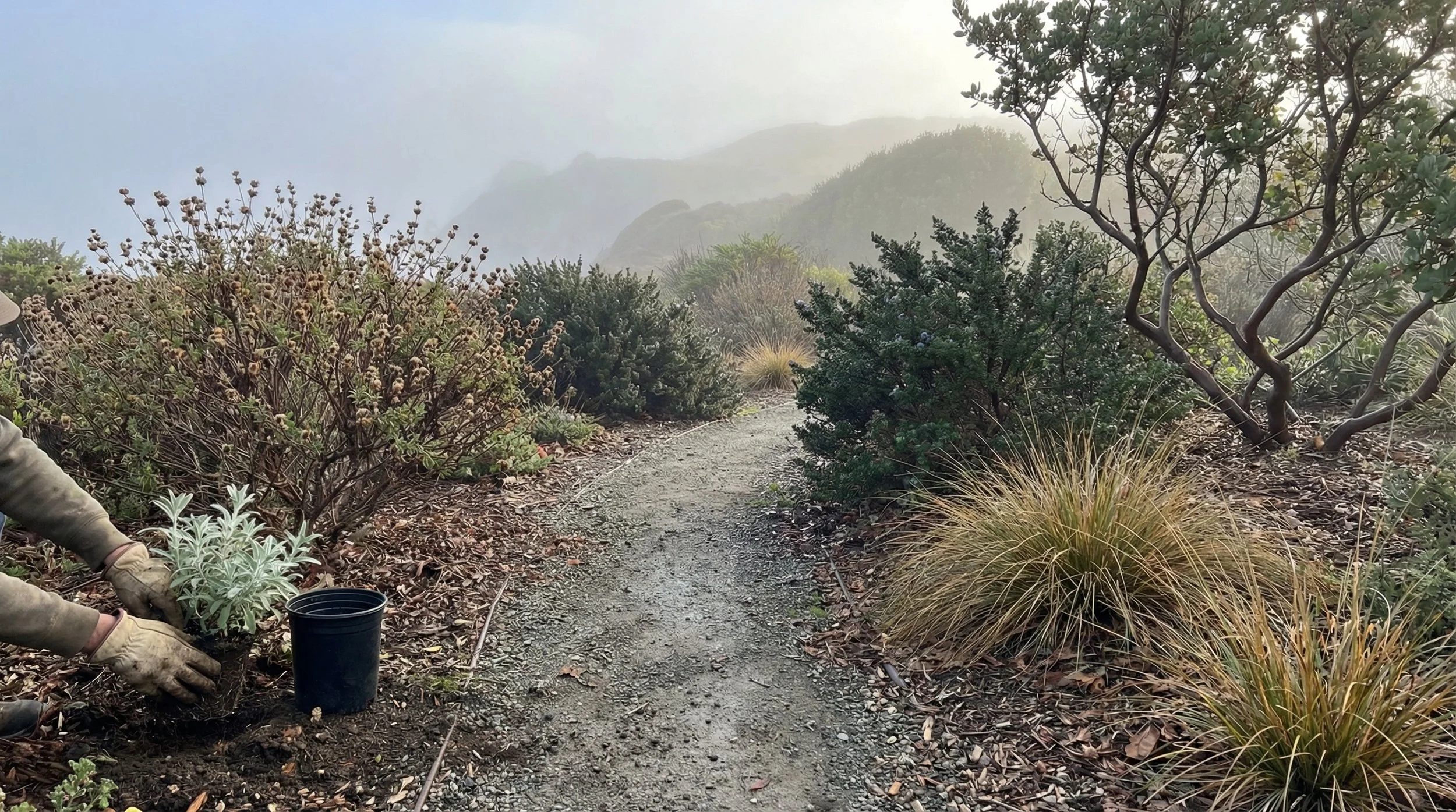
Lawns are thirsty, high-maintenance, and offer little value to local wildlife. Yet many Santa Cruz gardeners hesitate to remove them because they're not sure what to use instead. The answer, for much of our region, is native groundcovers.
California native groundcovers solve multiple problems at once. They require little to no supplemental water once established, need minimal mowing or maintenance, stay green year-round (many of them, anyway), control erosion on slopes, and provide food and habitat for pollinators and wildlife. Best of all, they look beautiful and create gardens that feel like they belong here.
This guide covers the best native groundcovers for Santa Cruz County, organized by growing conditions and use.
Why Native Groundcovers Work Better Than Lawns
Traditional lawns made sense in rainy England but make little sense in California's Mediterranean climate. We receive virtually no rain from May through October, exactly when lawns need the most water. According to UC ANR, turf grass can require 50 inches or more of water annually, most of it during our dry season.
Native groundcovers flip this equation. They evolved in our dry-summer, wet-winter climate and actually prefer to go dormant or at least slow down during summer. Most established native groundcovers need no supplemental irrigation at all.
Beyond water savings, native groundcovers offer ecological benefits lawns can't match. They provide nectar and pollen for native bees, seeds for birds, host plants for butterfly caterpillars, and shelter for beneficial insects. A lawn is essentially a green desert; a native groundcover planting is a living ecosystem.
How Should You Choose the Right Groundcover for Your Site?
The key to success with native groundcovers is matching the plant to your conditions. Consider these factors:
Sun exposure: Full sun (6+ hours direct), part shade (3-6 hours), or full shade (less than 3 hours)
Soil drainage: Fast-draining sandy or gravelly soil, average loam, or heavy clay that stays wet
Foot traffic: Will people walk on it regularly, occasionally, or never?
Slope: Flat, gentle slope, or steep hillside needing erosion control
Aesthetic preference: Tidy and lawn-like, meadow-style, or a loose, naturalistic look
Native Groundcovers for Sunny Sites
Sunny, well-drained locations offer the most options for native groundcovers. These plants thrive in the conditions that stress traditional lawns.
Creeping Sage (Salvia sonomensis)
This spreading sage forms dense mats of aromatic gray-green foliage 6-12 inches tall. Spikes of lavender-blue flowers appear in spring, attracting bees and hummingbirds.
Best for: Sunny slopes, pathway borders, areas where you want a tidy, low appearance Spacing: 18-24 inches apart Water needs: None once established Foot traffic: Light occasional traffic only Notes: Excellent on slopes for erosion control. The aromatic foliage is deer resistant.
California Fuchsia (Epilobium canum) - Spreading Forms
While often grown as a perennial, low-spreading varieties like 'Everett's Choice' work as groundcovers. Gray-green foliage is topped with tubular red-orange flowers in late summer and fall.
Best for: Sunny banks, dry areas, late-season color Spacing: 24-36 inches apart Water needs: None once established Foot traffic: None Notes: Spreads by underground runners and can be aggressive. Best combined with other tough plants that can compete.
Coyote Brush 'Pigeon Point' (Baccharis pilularis 'Pigeon Point')
A flat-growing selection of this native shrub, reaching only 12-18 inches tall but spreading 6 feet or more. Evergreen foliage creates a dense, weed-suppressing mat.
Best for: Large areas, slopes, fire-wise landscaping, erosion control Spacing: 3-4 feet apart Water needs: None once established Foot traffic: Occasional light traffic Notes: Very tough and drought-tolerant. CAL FIRE lists it as fire-resistant due to its low fuel load and dense growth. One of the best choices for large-scale lawn replacement.
Woolly Yarrow (Achillea tomentosa)
Gray-green, finely divided foliage forms a mat 3-6 inches tall. Clusters of yellow flowers appear in late spring and summer.
Best for: Rock gardens, pathway edges, between stepping stones Spacing: 12-15 inches apart Water needs: Minimal, tolerates some summer water Foot traffic: Moderate Notes: More tolerant of foot traffic than most native groundcovers. Works well in mixed plantings with other low-growing plants.
What Should You Know About Native Groundcovers for Part Shade?
Areas receiving morning sun and afternoon shade, or dappled light throughout the day, support a different palette of groundcovers.
Yerba Buena (Clinopodium douglasii)
The plant that gave San Francisco its original name. This trailing groundcover has small, rounded aromatic leaves and tiny white flowers. Forms a loose, spreading mat 2-4 inches tall.
Best for: Part shade, woodland edges, between shrubs Spacing: 12-18 inches apart Water needs: Occasional summer water in hot areas Foot traffic: Very light only Notes: Traditional medicinal and tea plant. Spreads slowly by rooting stems. Pleasant minty fragrance when brushed.
Hummingbird Sage (Salvia spathacea) - as Groundcover
While often grown as a perennial, this spreading sage makes an excellent groundcover in part shade. Large, aromatic leaves form clumps that spread by underground rhizomes. Magenta flower spikes appear in spring.
Best for: Part shade under trees, woodland gardens, hummingbird habitat Spacing: 18-24 inches apart Water needs: Tolerates summer drought but looks better with occasional water Foot traffic: None Notes: One of the few hummingbird plants for shade. Can become aggressive in ideal conditions, which is perfect for groundcover use.
Beach Strawberry (Fragaria chiloensis)
Glossy, dark green leaves form a dense evergreen mat 4-6 inches tall, spreading by runners like garden strawberries. White flowers in spring are followed by small, edible (if bland) red fruits.
Best for: Part shade to part sun, coastal gardens, erosion control Spacing: 12-18 inches apart Water needs: Best with occasional summer water, especially away from coast Foot traffic: Light traffic Notes: Parent species of modern garden strawberries. Works well in coastal fog belt gardens. Adapts to more shade than most groundcovers.
Douglas Iris (Iris douglasiana)
Strap-like evergreen leaves form graceful fans 12-18 inches tall. Blue, purple, or white flowers appear in spring. Spreads slowly to form expanding clumps.
Best for: Part shade to full sun, slopes, mixed plantings Spacing: 12-18 inches apart Water needs: Drought-tolerant once established, but tolerates summer water Foot traffic: None Notes: One of the most versatile native groundcovers, adapting to conditions from coastal fog to inland heat. Hybridizes freely, so seedlings may vary in color.
Native Groundcovers for Full Shade
Deep shade, especially under redwoods, challenges most groundcovers. These species evolved in exactly those conditions.
Redwood Sorrel (Oxalis oregana)
The signature plant of the redwood forest floor. Clover-like leaves fold down at night and in bright sun. Pink-streaked white flowers appear in spring. Forms a dense carpet 4-8 inches tall.
Best for: Full shade, under redwoods, moist north-facing areas Spacing: 12 inches apart Water needs: Prefers consistent moisture; may go summer-dormant if dry Foot traffic: Very light only Notes: Goes dormant in dry conditions, re-emerging with fall rains. Native to our local redwood forests and perfectly adapted to the acidic soil and deep shade.
Wild Ginger (Asarum caudatum)
Heart-shaped evergreen leaves on trailing stems create a lush groundcover 6-10 inches tall. Unusual brown flowers hide beneath the foliage in spring.
Best for: Full to part shade, rich moist soil, under trees Spacing: 12-15 inches apart Water needs: Prefers consistent moisture Foot traffic: None Notes: Spreads slowly by rhizomes. The leaves have a ginger fragrance when crushed but are not related to culinary ginger. Makes a beautiful companion to ferns.
Inside-Out Flower (Vancouveria planipetala)
Delicate, rounded leaflets create an airy groundcover 8-12 inches tall. Sprays of tiny white flowers in spring. Deciduous in colder areas but often evergreen in mild coastal gardens.
Best for: Full to part shade, under oaks and conifers Spacing: 12-18 inches apart Water needs: Tolerates summer drought; goes dormant if very dry Foot traffic: None Notes: Related to Epimedium. The "inside-out" flowers have reflexed petals. Native to our local forests.
Native Groundcovers for Special Situations
For Steep Slopes (Erosion Control)
Slopes present special challenges: water runs off before soaking in, soil erodes, and maintenance is difficult. These groundcovers grip steep hillsides and stabilize soil.
Best choices:
Coyote Brush 'Pigeon Point' (sunny slopes)
Creeping Sage (sunny slopes, deer resistant)
Coffeeberry 'Little Sur' (part shade tolerant)
California Fuchsia (sunny, dry slopes)
For severely eroded slopes, consider installing jute netting during establishment to hold soil while groundcovers root.
For Pathways and Stepping Stones
Some native groundcovers tolerate foot traffic between stones or along pathway edges.
Best choices:
Woolly Yarrow (most traffic-tolerant)
Creeping Thyme (technically native to Mediterranean but naturalizes here)
Lippia (Phyla nodiflora, native to Southwest, very traffic-tolerant)
Beach Strawberry (light traffic)
For Coastal Salt Air
Near-beach gardens face salt spray and constant wind. These groundcovers handle it.
Best choices:
Beach Strawberry (evolved on coastal dunes)
Seaside Daisy (Erigeron glaucus, tolerates salt well)
Coyote Brush (coastal ecotypes especially)
Coast Buckwheat (actually prefers coastal conditions)
For Fire-Wise Landscaping
In fire-prone areas, groundcovers within Zone 0-1 (immediately around structures) should be low-growing, low-fuel, and high-moisture. CAL FIRE recommends maintaining groundcovers with irrigation during fire season in the highest-risk zones.
Best choices:
Coyote Brush 'Pigeon Point' (low fuel load)
Creeping Sage (aromatic oils are not highly flammable despite myth)
Beach Strawberry (high moisture content)
Woolly Yarrow (low growing)
Avoid California Fuchsia directly adjacent to structures, as the dry stems can carry fire.
For complete fire-wise landscaping guidance, see our Fire-Wise Gardening 101 guide.
How to Establish Native Groundcovers
Proper planting and establishment are crucial for success. Native groundcovers are tough once settled in but need care during the transition period.
Timing
Best: Fall (October through December) planting allows roots to establish during rainy season Acceptable: Early spring (February-March) planting works but requires more summer irrigation Avoid: Summer planting puts stress on new plants during their most vulnerable period
Site Preparation
For lawn replacement:
Remove existing turf by solarization (summer), sheet mulching (any season), or physical removal
Rough up soil surface to improve root contact
Add 2-3 inches of compost if soil is poor (most natives prefer lean soil, so don't overdo amendments)
Shape soil for proper drainage; native groundcovers resent standing water
Planting
Space plants according to species recommendations. Closer spacing gives faster coverage but costs more. Most groundcovers fill in within 2-3 years at recommended spacing.
Plant at the same depth as nursery container. Create a slight basin around each plant to direct water to roots. Water deeply at planting.
Mulching
Apply 2-3 inches of bark mulch or wood chips between plants, keeping mulch away from plant stems. Mulch:
Suppresses weeds during establishment
Retains soil moisture
Moderates soil temperature
Breaks down to improve soil over time
First-Year Care
Watering: Deep soak weekly for the first summer (more often during heat waves). The goal is to encourage deep roots, not keep soil constantly moist.
Weeding: Remove weeds promptly while groundcovers fill in. Competition during establishment is the biggest threat to success.
Fertilizing: Usually unnecessary. Most natives prefer lean soil. Excess fertility promotes weak, floppy growth.
Second Year and Beyond
Reduce watering to every 2-3 weeks, then eliminate summer water entirely by year 3 for most species. Some groundcovers (Redwood Sorrel, Wild Ginger) always appreciate occasional summer moisture in inland areas.
Designing with Native Groundcovers
Mixing Species
A single species can look monotonous over large areas. Consider mixing compatible groundcovers for more visual interest:
Beach Strawberry + Seaside Daisy (coastal gardens)
Creeping Sage + Woolly Yarrow (sunny areas)
Redwood Sorrel + Wild Ginger + Ferns (shade gardens)
CoyoteBrush + California Fuchsia (large sunny areas)
When mixing, choose species with similar water and light needs. Plant in drifts rather than a random mix for the most natural appearance.
Adding Vertical Interest
Groundcovers work best as part of a layered landscape. Consider adding:
Bunch grasses like Deer Grass or Blue Grama for vertical accents
Flowering perennials like California Poppy or Lupine for seasonal color
Low shrubs like Coffeeberry 'Little Sur' or dwarf Manzanita for structure
Transition Zones
Where groundcover meets lawn, path, or patio, create clean edges with:
Buried steel or aluminum edging
Stacked stone or brick borders
Mowing strips of decomposed granite or flagstone
Without defined edges, spreading groundcovers can invade adjacent areas, and lawn grasses will creep into groundcover plantings.
Most Common Mistakes to Avoid
Planting in summer: Even drought-tolerant natives struggle to establish during hot, dry months. Wait for fall rains or be prepared for intensive summer irrigation.
Overwatering established plants: This is the most common killer of native groundcovers. Once established (usually after two summers), most need no supplemental water. Overwatering causes root rot and fungal problems.
Expecting instant coverage: Native groundcovers take 2-3 years to fill in completely. Be patient, keep weeds at bay, and the wait is worth it.
Choosing the wrong plant for your conditions: A shade-loving groundcover in full sun, or a drought-adapted species in soggy soil, will fail regardless of care. Match the plant to the site.
Planting too close to irrigation: If you have existing irrigation for other plants, native groundcovers planted nearby may receive too much water. Either remove irrigation in groundcover areas or choose species tolerant of summer water.
Ignoring deer pressure: In high-deer areas, even "deer-resistant" groundcovers may be browsed during establishment or drought. Protect new plantings with temporary fencing until established.
Groundcovers by Microclimate
Coastal Fog Belt (Zone 1)
Best choices: Beach Strawberry, Seaside Daisy, Coast Buckwheat, Coyote Brush 'Pigeon Point', Yerba Buena
These species tolerate salt air, cool temperatures, and summer fog. Beach Strawberry is especially well-adapted, having evolved on our coastal dunes.
Sunny Inland Areas (Zones 2, 4, 5)
Best choices: Creeping Sage, California Fuchsia, Coyote Brush, Woolly Yarrow, Lippia
Heat-tolerant species that thrive with minimal water. Lippia (Phyla nodiflora) is particularly good for lawn replacement in warm areas, tolerating foot traffic and staying green with minimal water.
Under Redwoods (Zone 3)
Best choices: Redwood Sorrel, Wild Ginger, Inside-Out Flower, Sword Fern (not a groundcover but fills the role)
These species evolved in exactly these conditions: deep shade, acidic soil, and the presence of allelopathic compounds from redwood duff. Don't fight the environment; embrace it with appropriate plants.
For more on matching plants to your specific location, see our guide to Native Plants by Microclimate.
Where to Find Native Groundcovers
Sierra Azul Nursery in Watsonville specializes in California natives and carries most species mentioned here. The staff can help you choose the right groundcovers for your specific conditions.
Dig Gardens in Santa Cruz offers a curated selection of natives including groundcovers.
California Native Plant Society Santa Cruz Chapter holds plant sales featuring locally-propagated natives, often including groundcovers that may be hard to find elsewhere.
UCSC Arboretum plant sales occasionally include native groundcovers, and visiting the gardens provides inspiration for how to use them.
Frequently Asked Questions
Can native groundcovers completely replace my lawn?
Yes, for most purposes. If you need a surface for active play (soccer, running children), groundcovers won't work. But for visual green space, walking paths, and general use, native groundcovers are excellent lawn alternatives. Many homeowners replace most of their lawn while keeping a small turf area for specific activities.
How long does it take for native groundcovers to fill in?
Most species fill in within 2-3 years when planted at recommended spacing. You can speed coverage by planting closer together, but this increases cost. During the establishment period, mulch between plants to suppress weeds and conserve moisture.
Will native groundcovers attract snakes?
Dense groundcovers can provide habitat for small wildlife, including occasional garter snakes. This is generally beneficial (garter snakes eat slugs and other pests). If snake habitat is a concern, keep groundcovers trimmed back from doorways and high-traffic areas, and maintain clear pathways.
Do I need to mow native groundcovers?
Most native groundcovers need no mowing. Some gardeners cut back California Fuchsia or Coyote Brush annually to maintain compact growth, but this is optional. One of the main benefits of native groundcovers is eliminating the weekly mowing cycle.
How do I remove weeds from established groundcovers?
Hand-pull weeds while small, before they set seed. Dense groundcover plantings naturally suppress weeds once established. Avoid herbicides, which can damage groundcovers. A thick mulch layer during establishment greatly reduces weed pressure.
Can I walk on native groundcovers?
Some tolerate light foot traffic (Woolly Yarrow, Lippia, Beach Strawberry), while others do not (Redwood Sorrel, Wild Ginger, California Fuchsia). Install stepping stones or defined pathways through groundcover areas to concentrate foot traffic and protect plants.
Will deer eat native groundcovers?
Deer resistance varies by species and local deer pressure. Generally resistant: Creeping Sage, California Fuchsia, Coyote Brush, Yarrow. Sometimes browsed: Beach Strawberry, Redwood Sorrel. In high-deer areas, protect new plantings until established.
How do I convert lawn to native groundcover?
The basic process: Remove existing lawn (solarization, sheet mulching, or physical removal), prepare soil, plant groundcovers in fall, mulch between plants, water through first two summers, then reduce to no supplemental irrigation. Our Water-Wise Gardening guide covers lawn conversion in detail.
Free Resources
Know Your Microclimate Worksheet: Identify your specific growing conditions to choose the right groundcovers.
Water-Wise Gardening Guide: Complete guidance on reducing water use, including lawn alternatives.
Fire-Wise Gardening Guide: Learn which groundcovers work for defensible space landscaping.
Related Articles
Native Garden Design in Santa Cruz County
Native Plants by Microclimate: What to Grow Where
