

Growing Avocados in Santa Cruz County | What Actually Works
A few of the product links in this guide are affiliate links. If you buy through one, Ambitious Harvest may earn a small commission at no extra cost to you, which helps keep these guides free. As an Amazon Associate, we earn from qualifying purchases. Read our full disclosure.
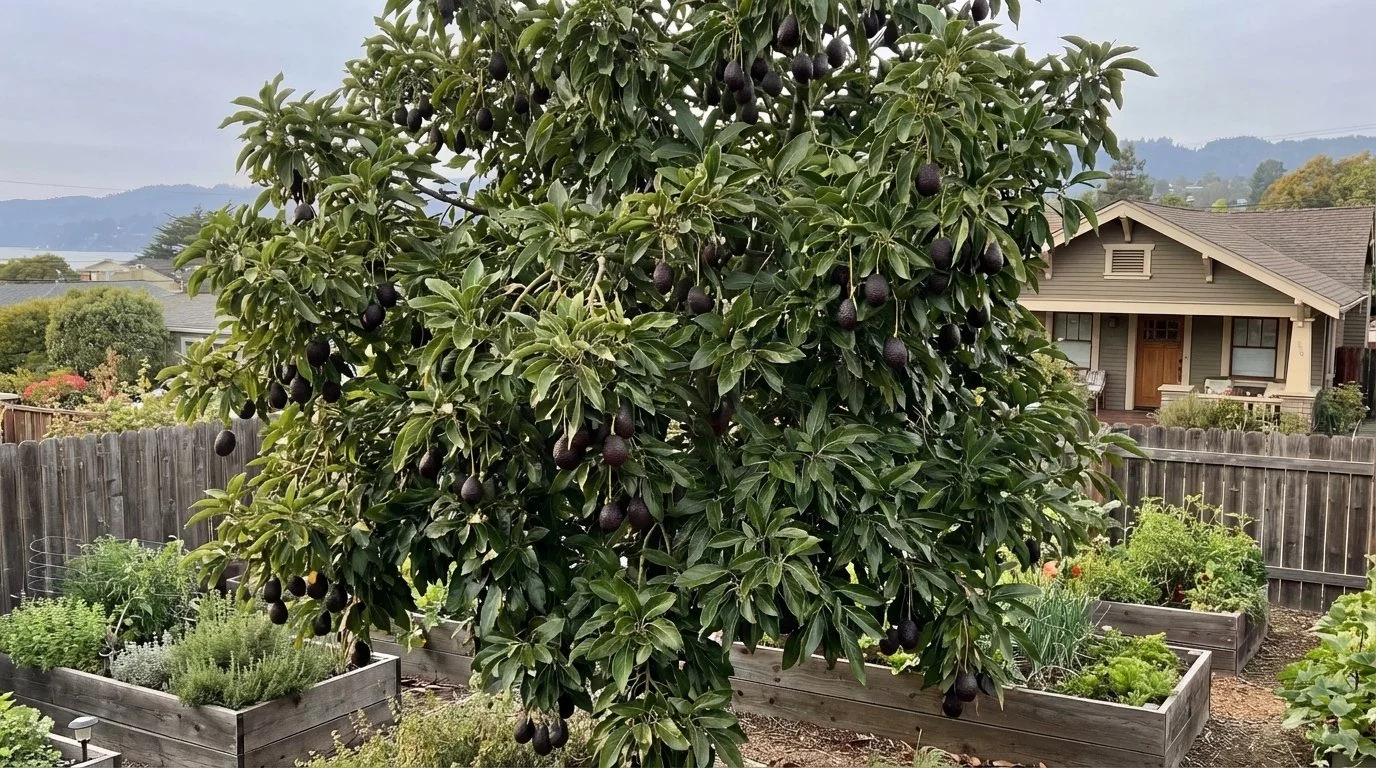
An avocado tree is a long-term commitment to one spot in the garden. In Santa Cruz County, decide whether that spot has enough warmth, drainage and frost protection before choosing a variety. UC Agriculture and Natural Resources explains why cold matters. A healthy tree in a sheltered garden is possible here; a dependable crop is a separate question.
Why Is Santa Cruz County Considered Marginal for Avocados?
Look for the warmest suitable part of your property rather than relying on the county's reputation. Coastal moderation can soften winter cold while summer fog slows growth and fruit development. Inland sites may gain daytime warmth but lose it quickly on clear winter nights.
Avocados grow best with growing-season temperatures around 60 to 85 degrees Fahrenheit, and most varieties are damaged when winter lows drop into the mid-20s or below. In Santa Cruz proper, winter lows regularly dip into the low 30s, and inland valleys like the San Lorenzo Valley can see temperatures in the mid-20s or lower during cold snaps.
Some local trees do well. Their success is a reason to investigate the site and variety, not a guarantee for the next yard. Think through three things together: winter lows, summer warmth and what you can realistically do during a cold spell.
What Microclimates in Santa Cruz County Work Best for Avocados?
A protected slope and a low hollow can behave differently even on the same property. Start with your own observations and the guide to Santa Cruz microclimates; nearby mature trees provide useful clues, but note their exposure and shelter too.
Sheltered Coastal Pockets
Slightly inland, sheltered sites around the coastal communities can offer warmth and maritime moderation. The banana-belt label is only a starting clue. Check the actual slope, cold-air drainage and winter lows rather than assuming a neighborhood is frost-free.
Watsonville and the Pajaro Valley
A sunny site around Watsonville or the Pajaro Valley may offer useful growing-season warmth. Compare the actual exposure and winter lows with nearby sheltered sites rather than treating the whole valley as one climate. The risk is that inland valleys can experience radiation frosts on clear winter nights, so low-lying areas should be avoided.
Protected Urban Sites
Within the city of Santa Cruz itself, south-facing walls, courtyards, and sites sheltered by buildings or mature trees can create microclimates warm enough for cold-hardy avocado varieties. Masonry can store daytime heat, but reflected warmth does not guarantee frost protection. Leave room for the mature tree and access.
Where Avocados Struggle
Cold valley bottoms, exposed coastal sites and heavily shaded slopes are difficult starting points. A warm ridge in the San Lorenzo Valley is different from a frost pocket below it. If your available space stays cold or shaded, another fruit crop may make better use of it.
What Are the Best Avocado Varieties for Santa Cruz?
UC avocado specialists compare cold tolerance, with tree age and duration of cold affecting damage. Use UC harvest guidance as a seasonal reference, then test fruit from your own tree.
Choose a variety with the site in mind, including the flavor and harvest season you want. Cold-hardier types deserve consideration in marginal locations, but no nursery temperature rating guarantees survival. The avocado variety guide compares choices in more detail.
Mexicola and Mexicola Grande
Mexicola and Mexicola Grande are often considered for colder sites because Mexican-race avocados are comparatively cold tolerant. Their smaller, thin-skinned fruit differs from supermarket Hass. Treat advertised minimum temperatures as approximate: duration of cold, tree age and condition can change the outcome.
Bacon
Bacon has green-skinned fruit and is comparatively cold tolerant. Its California picking season often falls in winter, but local maturity needs checking. It is an option for a suitable sheltered site, not a guaranteed local producer.
Fuerte
Fuerte produces pear-shaped, green-skinned fruit and is more cold tolerant than Hass. California harvest guidance gives a broad late-fall-to-spring season; weather and location affect when individual fruit are ready.
Stewart
Stewart is another comparatively cold-tolerant variety to investigate. Ask about a local record of flowering and harvest before treating it as the solution for a marginal site.
Hass
The familiar grocery-store avocado is more cold sensitive than Bacon, Fuerte or Stewart. Consider Hass only where winter protection and growing-season warmth are adequate; neither fruit size nor crop regularity can be predicted from a neighborhood name.
Reed
Reed has round, green-skinned fruit and a later California harvest season. It needs a warm, suitable site and deserves the same careful frost assessment as Hass.
How Does Rootstock Affect Avocado Success Here?
UC's avocado rootstock chapter describes selection for root-rot tolerance and the limits of that trait.
Ask the nursery what is below the graft as well as above it. Rootstocks differ in disease tolerance and adaptation to soil conditions. They can improve your starting point, but cannot make a poorly drained planting hole safe.
For Santa Cruz County, look for trees grafted onto these rootstocks:
Dusa is a commonly used rootstock selected in part for Phytophthora root-rot tolerance. Tolerance is not immunity, and good drainage remains essential.
Mexicola seedling rootstock is another nursery option. Do not assume it gives the fruiting variety above it a fixed increase in cold hardiness; ask about suitability for your soil and local conditions.
Duke 7 is another rootstock used for some tolerance to Phytophthora root rot. Ask how its performance compares with other available rootstocks for your soil; do not assume a rootstock supplies a fixed canopy frost rating.
Buy a healthy, grafted container tree from a nursery that can identify its variety and rootstock. Inspect the plant and ask how to handle the root ball at planting. This is more useful than choosing a large tree with an uncertain history.
How Do You Plant an Avocado Tree in Santa Cruz County?
Have the site ready before taking the tree out of its container. Avocado roots are easily damaged, and there is little benefit in rushing the planting into soil that stays wet.
Site Preparation
Choose a south-facing or southwest-facing location with full sun (at least 6 to 8 hours of direct sunlight daily). Protection from north and northwest winds is valuable. If considering a sheltered exposure near a structure, plan for the tree's mature canopy, root space and access rather than relying on a universal wall setback.
Soil and Drainage
According to UC ANR, good drainage and careful watering are essential for avocados. Assess whether a properly drained mound is suitable when the existing soil drains poorly. They are extremely sensitive to waterlogged soil, which promotes Phytophthora root rot. Santa Cruz County soils vary widely, from well-drained sandy loam near the coast to heavy clay in parts of Watsonville and the San Lorenzo Valley.
If water lingers in heavy soil, address drainage before planting. A broad mound or an appropriately designed raised bed may help, but must drain into a suitable surrounding area. A hole filled with loose amendments can still collect water.
Use native soil as backfill rather than adding compost or other amendments to the planting hole. Keep useful organic material as a surface mulch, clear of the trunk. The aim is for roots to move into the surrounding soil, not remain in a pocket of contrasting material.
Planting Steps
Dig a hole twice as wide as the root ball but no deeper. Avocados should be planted at the same depth they were in the nursery container, or even slightly high.
If drainage is questionable, resolve it before planting; a mound must drain into suitable surrounding ground.
Handle the root ball gently and keep it intact; ask the nursery about severely circling roots rather than routinely tearing or teasing fragile avocado roots.
Backfill with unamended native soil.
Water deeply and immediately.
Apply 4 to 6 inches of coarse mulch (wood chips work well) around the tree, keeping mulch 6 inches away from the trunk.
Do not put concentrated fertilizer against the roots at planting. Base later feeding on establishment, growth and the product instructions.
What About Watering Avocados in Our Climate?
Watering changes as roots spread beyond the nursery root ball. Check that original root ball as well as surrounding soil while the tree establishes. Later, widen the watered area with the canopy and watch how readily the soil drains.
Avocado trees have shallow, spreading root systems. According to UC Master Gardeners, they need consistent moisture but never saturated soil. In Santa Cruz County, here is a general framework:
Winter: Rain may supply enough moisture. Pause irrigation when the root zone is moist, and reassess during dry spells rather than waiting a fixed number of weeks.
Spring: Resume supplemental irrigation as rainfall tapers and the soil begins to dry. Check young trees closely because their roots still occupy a small area.
Summer: Monitor moisture through the dry season and heat waves. Tree size, soil, mulch and exposure determine the interval; watering every five or seven days is not reliable for every garden.
Fall (October through November): Gradually reduce watering as temperatures cool and rain returns.
Check soil moisture below the surface in several places within the watered root zone. For a new tree, check the nursery root ball too. A screwdriver's resistance alone cannot distinguish dry soil from compaction; feel a small soil sample or use a suitable probe, and avoid digging into major roots.
How Do You Protect Avocado Trees from Cold in Santa Cruz?
Plan cold protection while the tree is small enough to cover. Keep materials accessible and watch both the forecast and conditions in the garden. The companion article on avocado cold protection covers practical arrangements; a plan made in daylight is easier to use when a cold night arrives.
Keep frost cloth on hand and be ready to deploy it when temperatures are forecast below 32 degrees Fahrenheit. For young trees (under 3 years), consider building a simple frame around the tree that you can drape with frost cloth or even old bedsheets during cold snaps.
Avoid improvising electrical heat inside a wet tree cover. If using supplemental heat, choose equipment designed and rated for the location and follow its instructions, keeping it clear of fabric and foliage. Covers alone also have limits during a hard freeze. (UC Cooperative Extension frost protection guide)
If soil is dry before a predicted frost, bring it to appropriate moisture. Do not saturate an already wet root zone in an attempt to protect the canopy.
What Should You Realistically Expect?
Allow for years of establishment and uneven harvests. A grafted tree may bear sooner than a seedling, but site, variety and weather affect the wait. A tree that survives is not necessarily warm enough to set and mature much fruit.
Timeline to fruit: A grafted nursery tree can begin bearing within a few years, but establishment, cultivar and weather determine the wait. Do not plan a harvest around a fixed container-size timeline.
Yield: Expect variation rather than a promised fruit count. Weather during flowering and alternate bearing can produce a generous season followed by a sparse one.
Fruit quality: Flavor and usable harvest depend on the variety and whether fruit reaches maturity. Avocados soften after picking. Test a representative fruit before picking a large crop; immature fruit may shrivel or fail to soften properly.
Risk: Cold or poor drainage can damage or kill a tree. Start with a planting you can care for and a loss you could accept, especially if the site has no track record with avocados.
Home avocado growing in a marginal area is rewarding, as long as you accept that the conditions are not ideal. The gardeners who succeed are the ones who choose their site carefully, select cold-hardy varieties, stay vigilant about frost protection, and maintain realistic expectations.
How Do Avocados Pollinate, and Do You Need Two Trees?
Avocados have an unusual flowering system. According to UC Cooperative Extension, avocado varieties are classified as Type A or Type B based on when their flowers open as male versus female. Type A varieties (like Hass and Reed) open as female in the morning and male the next afternoon. Type B varieties (like Bacon and Fuerte) do the opposite.
In theory, planting one Type A and one Type B improves cross-pollination and fruit set. In practice, especially in cooler climates like Santa Cruz, cross-pollination can make a difference in yield. If you have space for two trees, plant one of each type. Bacon (Type B) and Mexicola Grande (Type A), or Fuerte (Type B) and Hass (Type A), illustrate complementary flower types. Choose both trees for the site and check overlapping bloom rather than assuming the pairing guarantees yield.
That said, a single tree can still set fruit. Other avocado trees nearby may also provide pollen for cross-pollination. Bees and other pollinators handle the work, and avocado flowers are surprisingly attractive to honeybees.
What Are the Most Common Problems for Avocados in Santa Cruz?
Several issues crop up regularly for avocado growers in our area:
Phytophthora root rot is the most serious threat, especially in heavy soils during our wet winters. Prevention through excellent drainage is far more effective than any treatment after infection. See our avocado troubleshooting guide for details.
Leaf-tip burn: Salts, water stress and damaged roots can produce similar-looking symptoms. Check irrigation and drainage, and consider water or soil testing before trying to leach salts. Adding water to a poorly drained root zone can worsen the problem.
Poor fruit set in cool, foggy years is frustrating but normal. When temperatures during bloom (typically February through May) stay consistently cool, pollination suffers and fewer fruit develop.
Sunburn on trunk and branches happens when trees are young or heavily pruned, exposing bark to direct sun. Whitewash the trunk and major branches with diluted interior white latex paint (50/50 with water) for protection.
Persea mite and avocado lace bug: Identify the pest and its damage before treating. Keep the tree appropriately watered and consult pest-specific recommendations. The UC IPM guidance addresses persea mite, not every avocado pest.
Is It Worth Growing Avocados in Santa Cruz?
It is worth trying when you have a suitable site and want the work that comes with it. Check drainage, choose the tree carefully and make a frost plan. If any of those are impractical, there is no need to force an avocado into the space.
A warm, protected exposure is the most promising starting point. In a colder site, a container is useful only if you can actually move or shelter it as the tree grows. Consider that practical limit before buying a large pot.
Start with one well-chosen tree and keep notes on winter lows, flowering and fruit set. Those observations make any later planting decision better informed.
For more California gardening resources tailored to our unique growing conditions, visit our free resource library at Your Garden Toolkit or sign up for our email newsletter to get seasonal growing tips delivered straight to your inbox.
Frequently Asked Questions
Can I grow a Hass avocado tree in Santa Cruz?
Hass is worth considering only after assessing the site's cold exposure and growing-season warmth. A protected location improves the prospects but does not guarantee a crop. Compare it with cold-hardier varieties before committing the space.
How long does it take for an avocado tree to produce fruit in Santa Cruz?
A grafted tree can bear within a few years, but a cool site or setbacks can extend the wait. Seedlings take longer and do not reliably reproduce the parent's fruit. A grafted tree gives you a known variety, not a guaranteed harvest date.
Do avocado trees need a lot of water in Santa Cruz?
Avocados need a moist, aerated root zone. Check soil and root-ball moisture, then adjust irrigation as the tree grows and weather changes. Winter rain may meet its needs, but neither a fixed summer interval nor a blanket winter shutoff suits every site.
What is the most cold-hardy avocado variety for Santa Cruz?
Mexicola and Mexicola Grande are comparatively cold-tolerant choices to investigate. A quoted minimum temperature is not a survival guarantee: tree age, duration of cold, wind and condition matter. Their thin-skinned fruit is different from Hass, so choose for eating quality as well as cold tolerance. (UC ANR)
Should I plant my avocado tree in the ground or in a container?
For the warmest microclimates in Santa Cruz County (banana belt, south-facing protected sites), planting in the ground gives trees the best chance at long-term growth and production. For marginal locations, container growing offers the advantage of moving the tree to shelter during cold snaps. A compact variety such as Wurtz (Little Cado) may be easier to manage, but the container still needs adequate root space, drainage and regular moisture checks. Plan how you will move the mature container before relying on it for frost protection. See our container growing guide for detailed instructions.
When is the best time to plant an avocado tree in Santa Cruz?
Plant when the ground has warmed and the main frost risk has passed, often in spring. Avoid cold, saturated soil and heat waves. If you must hold a nursery tree, keep its root ball appropriately moist and protected; do not leave it indefinitely in an outgrown pot.
