

Growing an Avocado from Seed | Fun Project, Will It Fruit?
A few of the product links in this guide are affiliate links. If you buy through one, Ambitious Harvest may earn a small commission at no extra cost to you, which helps keep these guides free. We only point to gear we would use in our own Santa Cruz garden. As an Amazon Associate, we earn from Read our full disclosure.
Growing an Avocado from Seed: Fun Project, But Will It Fruit in Santa Cruz?
Growing an avocado from a grocery store pit is one of the most popular kitchen gardening experiments in America, and it genuinely works as an educational project, but it will not give you a reliable fruit-producing tree on any reasonable timeline. According to UC Agriculture and Natural Resources, seed-grown avocado trees take 7 to 15 years to produce their first fruit (if they ever do), and the fruit will not be true to the parent variety, meaning your Hass pit will not grow into a Hass tree. That said, the process is fascinating, virtually free, and an excellent way to learn about plant biology.
Why Do People Grow Avocados from Pits?
Let's be clear about what pit-growing is and is not.
What it is: A fun, low-cost experiment that teaches seed germination, root development, and basic plant care. It is a fantastic project for kids, classrooms, and anyone curious about how plants work. Watching an avocado seed crack open and send out a root and shoot is genuinely delightful, even for experienced gardeners.
What it is not: A practical strategy for producing homegrown avocados. If your goal is edible fruit within a reasonable number of years, buy a grafted nursery tree instead.
Understanding this distinction upfront saves years of frustration. Grow a pit because the process is enjoyable and educational. If you also want avocados to eat, plant a grafted tree at the same time.
What Happens Genetically When You Plant an Avocado Seed?
This is the key fact that most pit-growing guides skip or bury in fine print: avocado seeds do not grow true to the parent tree.
Every avocado seed contains a unique genetic combination, the result of cross-pollination between two parent trees. UC Riverside's avocado program notes that each seed is the product of cross-pollination, so the tree it grows into will be very different from the parent, which makes any seedling a genetic gamble. The tree that grows from a Hass avocado pit might produce fruit that looks nothing like Hass: different size, different skin texture, different flavor, different ripening time.
This is exactly how new varieties are discovered (Hass itself was a chance seedling found by Rudolph Hass in his La Habra Heights yard in the 1920s), but the odds of a random seedling producing desirable fruit are low. Most seed-grown avocado trees produce fruit that is unremarkable at best and unpalatable at worst.
The commercial avocado industry solved this problem long ago through grafting. A branch (scion) from a proven, desirable variety is grafted onto a rootstock, creating a genetic clone of the parent tree. Every Hass avocado you buy at the store comes from a grafted tree that is genetically identical to the original Hass seedling from the 1920s. When you buy a grafted nursery tree, you know exactly what fruit you will get. See our guide to the best avocado varieties for Santa Cruz for help choosing.
How Do You Sprout an Avocado Pit? (Step by Step)
There are two main methods: the classic toothpick-in-water method and direct soil planting. Both work, but they have different advantages.
Method 1: The Toothpick and Water Glass (Classic)
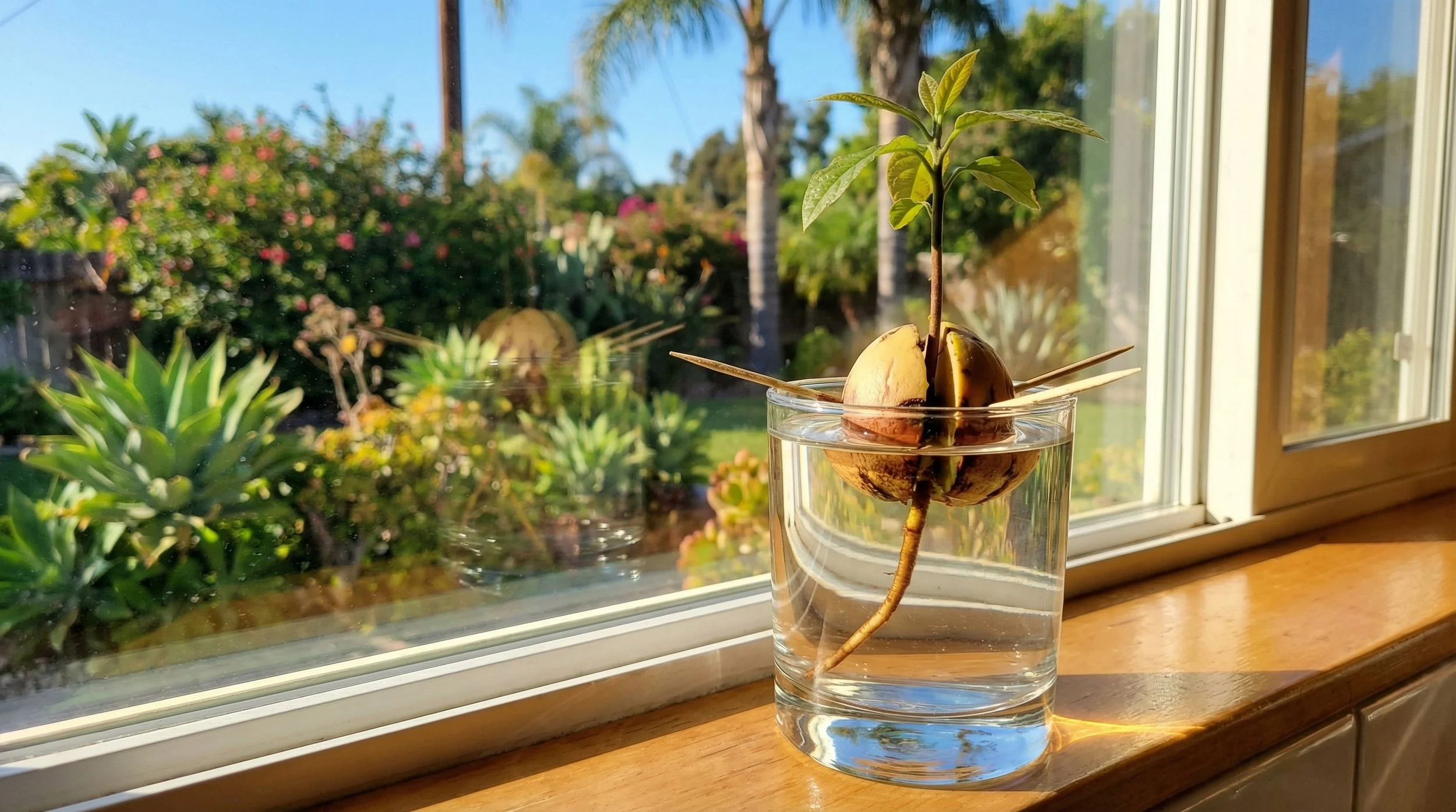
This is the method most people know, and its main advantage is that you can watch the entire germination process through the glass.
Step 1: Prepare the pit. Remove the pit from a ripe avocado, rinse off all the flesh, and let it dry for a day or two. Identify the top (slightly pointed) and bottom (slightly flatter, where the root will emerge).
Step 2: Insert toothpicks. Push 3 to 4 toothpicks into the middle of the pit at a slight downward angle, spacing them evenly around the circumference. The toothpicks act as a scaffold to suspend the pit over a glass of water.
Step 3: Set up the glass. Place the pit, bottom-down, over a glass or jar of water so the toothpicks rest on the rim and the bottom third of the pit is submerged. Use room-temperature water.
Step 4: Position and wait. Place the glass in a warm spot with indirect light (a kitchen windowsill is perfect). Change the water every 5 to 7 days to prevent bacterial growth and algae. Keep the water level consistent so the bottom of the pit stays submerged.
Step 5: Watch for germination. Within 2 to 6 weeks (sometimes longer; patience is required), the outer seed coat will dry and crack, a taproot will emerge from the bottom, and eventually a shoot will push up from the top. Some pits take 8 weeks or more. If the pit gets mushy or moldy, discard it and start with a fresh one.
Step 6: Let it grow. Once the stem is 6 to 8 inches tall and has a few leaves, it is ready to transplant to soil. Some guides recommend cutting the stem back to 3 inches when it reaches 6 inches to encourage branching, but this is optional.
Method 2: Direct Soil Planting
This method skips the water glass and is arguably better for the plant, since the roots develop in soil from the start and do not need to transition from water to soil.
Step 1: Prepare the pit. Same as above: clean, dry, identify top and bottom. Some growers carefully remove the brown seed coat to speed germination, but this is optional.
Step 2: Plant in a pot. Fill a 6-inch pot with well-draining potting mix. Plant the pit with the bottom half buried and the top half exposed above the soil surface.
Step 3: Water and wait. Water thoroughly and place in a warm spot with indirect light. Keep the soil consistently moist but not soggy. Germination takes 2 to 8 weeks, and you will know it is happening when the pit cracks and a shoot emerges from the top.
Step 4: Move to brighter light. Once the shoot has leaves, move the pot to a sunny location (6 or more hours of direct sunlight). An outdoor spot protected from wind is ideal in spring and summer.
The direct soil method has one disadvantage: you cannot see the root developing, which eliminates half the fun if this is a project with kids. For pure education and wonder, the water glass method wins.
Two Ways to Sprout an Avocado Pit
Both work. Choose based on your goals.
Water Glass Method (Classic)
Setup: 3-4 toothpicks suspend pit over glass, bottom third submerged
Location: Warm spot with indirect light (kitchen windowsill)
Maintenance: Change water every 5-7 days
Germination: 2-8 weeks
Transplant when: Stem is 6-8 inches with leaves
Best for: Kids, classrooms, watching the full process
Direct Soil Method
Setup: Plant bottom half in 6-inch pot, top half exposed
Location: Warm spot with indirect light initially
Maintenance: Keep soil moist but not soggy
Germination: 2-8 weeks
Move to sun when: Shoot has first leaves
Best for: Stronger root development, no transplant shock
Germination timeline: Pit cracks (week 2-4) > Root emerges from bottom > Shoot pushes up from top > First leaves unfold
How Do You Care for a Seed-Grown Avocado Seedling?
Once your pit has sprouted and is growing actively, treat it like any young avocado tree, with a few extra considerations. If you eventually want to move it to a larger container, our guide to growing avocados in containers covers pot sizing, soil mixes, and ongoing care in detail.
Light
Young avocado seedlings need bright, direct sunlight. Indoors, a south-facing window is the minimum. Outdoors (in spring and summer), a spot with 6 to 8 hours of direct sun is ideal. If the seedling is leggy (tall stem with widely spaced leaves), it needs more light.
Watering
Water when the top inch of soil feels dry. Avocado seedlings are sensitive to both overwatering (which causes root rot) and underwatering (which causes leaf curl and browning). Consistent, moderate moisture is the goal. Good drainage in the container is essential.
Fertilizing
Do not fertilize until the seedling is at least 6 months old and has multiple sets of leaves. Then use a diluted (half-strength) balanced liquid fertilizer once a month during the growing season (spring through early fall). According to UC ANR, young avocado trees are sensitive to fertilizer burn, so less is more in the first year.
Potting Up
As the seedling grows, move it to progressively larger containers. Start in a 6-inch pot, move to a 1-gallon by the time the plant is 12 to 18 inches tall, then to a 5-gallon pot by the time it is 2 to 3 feet tall. Use a well-draining mix (potting soil with added perlite or bark).
Pinching for Bushiness
Avocado seedlings tend to grow as a single tall stem without branching, which creates a leggy, top-heavy plant. When the stem reaches 12 inches, pinch off the growing tip (the top set of leaves). This encourages lateral branching and creates a bushier, more attractive plant. Repeat pinching on new branches as they elongate.
Outdoor Transition
If you plan to grow the seedling outdoors (or eventually plant it in the ground), harden it off gradually. Start with a few hours of outdoor shade per day, increasing sun exposure over 1 to 2 weeks. Avocado seedlings raised indoors under lower light can sunburn badly if moved directly into full sun.
Will a Seed-Grown Avocado Tree Ever Produce Fruit in Santa Cruz?
Here is the answer, broken into components.
Timeline
According to UC Cooperative Extension, seed-grown avocado trees typically begin flowering after 7 to 15 years, sometimes longer. Some never flower at all. In Santa Cruz County's cooler conditions, the timeline may extend further because growth is slower than in warmer regions.
Compare this to a grafted nursery tree, which can begin producing fruit in 3 to 5 years. If you planted a grafted tree on the same day you sprouted your pit, you could be eating fruit from the grafted tree for years before the seedling even considers blooming.
Fruit Quality
When (if) a seed-grown tree finally produces fruit, the quality is unpredictable. The avocados might be small, stringy, watery, or have an off-flavor. They might also be perfectly good. There is no way to know until the tree produces, which, as noted, takes at least 7 years.
UC Cooperative Extension in Ventura County notes that seedling avocados usually do not produce fruit true to the parent variety, which is why every commercial tree is grafted, so the odds of a random seedling matching a named variety are low. Commercial avocado breeders grow thousands of seedlings and select only the very best, which gives you a sense of the odds.
Cold Tolerance
A seedling grown from a grocery store Hass pit will have unknown cold tolerance. It might have slightly better or slightly worse cold hardiness than its Hass parent, depending on the pollen parent (which you have no way of knowing). In Santa Cruz's marginal climate, this uncertainty is a real liability. With a grafted tree, you know exactly what cold tolerance to expect.
The Recommendation
Grow the pit for fun. Enjoy the process. Let your kids watch a seed become a plant. Keep the seedling as a houseplant or patio ornamental for as long as it brings you joy. But do not count on it for avocados.
If you want to eat homegrown avocados within 5 years, buy a grafted Mexicola, Bacon, or Fuerte from a reputable nursery and plant it in the best microclimate you can find on your property. See our complete guide to growing avocados in Santa Cruz County for variety recommendations and planting instructions.
Can You Graft a Seed-Grown Avocado Seedling?
Yes. If your seedling grows into a healthy, vigorous young tree, you can use it as rootstock and graft a named variety onto it. This is actually how all grafted avocado trees are produced: a seedling rootstock (usually from a variety selected for root characteristics, like Dusa or Duke 7) receives a scion (budwood) from the desired fruiting variety.
However, grafting avocados is more difficult than grafting many other fruit trees. According to UC Cooperative Extension (Ventura County), avocado grafting requires specific technique (chip budding or cleft grafting), careful timing (spring, when the bark is slipping and the tree is actively growing), and practice. The seedling should be 24 to 30 inches tall before it is ready for budding or grafting. Success rates for beginners are often below 50 percent.
If you want to try grafting, here is a basic outline:
Grow the seedling until the trunk is pencil-thick (roughly 1/4 to 3/8 inch diameter), typically 1 to 2 years after sprouting.
Obtain budwood (small branch with buds) from a known, desirable variety. Some California agricultural programs and avocado societies make budwood available.
Perform a cleft graft or chip bud graft in spring, wrapping the graft union with grafting tape and sealing with grafting wax.
Protect the graft from direct sun and wind until it takes (typically 3 to 6 weeks for initial callus formation).
Once the graft is growing, gradually prune away the seedling growth above the graft to direct energy into the grafted scion.
This is an advanced project. If you are new to grafting, practice on citrus or stone fruit trees first, as they are more forgiving. But for the ambitious gardener who enjoys the challenge, grafting a favorite variety onto a homegrown seedling rootstock is deeply satisfying.
What Are the Best Educational Activities with Avocado Pits?
If you are growing avocado pits with kids or as a classroom project, here are ways to extend the learning. For more ideas on getting children excited about growing things, see our guide to 5 easy crops kids can grow in Santa Cruz.
Seed Anatomy
Before sprouting, cut an avocado pit in half vertically. Inside, you can see the embryonic plant: the tiny root (radicle) and shoot (epicotyl) nestled between the two halves of the cotyledon (the food storage tissue that fuels early growth). This is a textbook example of a dicot seed that you can examine without a microscope.
Germination Race
Start multiple pits at the same time (some in water, some in soil) and track which germinates first. Have kids measure root and shoot growth weekly and graph the results. This teaches the scientific method, data collection, and basic botany.
Growth Observation Journal
Have kids sketch or photograph their avocado seedling weekly, noting changes in leaf number, stem height, and root development (visible in the water glass method). This is an exercise in observation and patience, two skills that serve well in gardening and in life.
Variety Comparison
Sprout pits from different avocado varieties (Hass, Fuerte, and others available at farmers markets or specialty stores). Compare seed size, germination speed, and seedling characteristics. This illustrates genetic diversity in a tangible, hands-on way.
How Long Can You Keep a Seed-Grown Avocado as a Houseplant?
Seed-grown avocado trees can survive indoors for several years as foliage plants, but they rarely thrive long-term. Here is what to expect.
Year 1: The seedling grows vigorously, often reaching 2 to 3 feet. Leaves are large and attractive. This is the honeymoon period.
Years 2 to 3: Growth continues but may slow if light is insufficient. The plant may become leggy (long stems with few leaves). Pinching helps, but the fundamental issue is usually inadequate light.
Years 3 to 5: Many indoor avocado plants begin to decline. Lower leaves yellow and drop. The plant may develop a sparse, tree-like appearance that is less attractive than the lush seedling stage. Spider mites and scale insects sometimes become problems in the dry indoor environment.
Beyond 5 years: Some growers maintain indoor avocado plants for many years, but it requires excellent light (supplemental grow lights help), consistent humidity, regular fertilization, and periodic repotting. The plant will never fruit indoors.
If your seed-grown avocado has outgrown its welcome indoors, consider planting it outside in a protected spot as a landscape ornamental. Even if it never produces edible fruit, it can grow into an attractive shade tree in the right location. In the banana belt areas of Santa Cruz County, a mature seed-grown avocado can become a handsome tree that provides shade, wildlife habitat, and neighborhood character.
For the long view from sapling to harvest, see our avocado growth stages guide.
Frequently Asked Questions
How long does it take for an avocado pit to sprout?
Most avocado pits germinate within 2 to 6 weeks using either the water glass or direct soil method, though some take up to 8 weeks or longer. Warmer temperatures (70 to 80 degrees Fahrenheit) speed germination. Pits from ripe avocados germinate more reliably than those from underripe fruit. If your pit has not shown any signs of cracking or root emergence after 8 weeks and it is not mushy or moldy, give it another few weeks before discarding it.
Will an avocado grown from a Hass pit produce Hass avocados?
No. UC Riverside's avocado program explains that an avocado seed is the result of cross-pollination, so the tree it produces will be very different from the parent variety. A tree grown from a Hass pit will be a unique genetic individual with unpredictable fruit characteristics. The fruit might be small, large, stringy, watery, or occasionally decent, but it will not be Hass. For guaranteed variety-true fruit, you need a grafted nursery tree.
Can I plant my avocado seedling outside in Santa Cruz?
You can, but proceed with caution. A seed-grown avocado from a Hass pit has unknown cold tolerance (likely similar to Hass, which is marginal for Santa Cruz at about 28 to 30 degrees). Plant in the warmest microclimate you can find (south-facing, protected from wind, in the banana belt) and provide frost protection in winter. Treat it as an ornamental tree that might someday produce fruit, rather than a reliable food source.
Why did my avocado pit get moldy in the water glass?
Mold typically develops when water is not changed frequently enough, allowing bacterial and fungal growth. Change the water every 5 to 7 days (or whenever it looks cloudy). Make sure the pit was thoroughly cleaned of avocado flesh before starting, as residual flesh decomposes and promotes microbial growth. If the pit itself turns soft and mushy, it has rotted and should be discarded. Start over with a fresh pit.
How do I make my avocado seedling bushier instead of tall and leggy?
Pinch or cut the growing tip (the topmost set of leaves) when the stem reaches 12 inches tall. This removes the terminal bud's hormonal dominance and encourages lateral buds lower on the stem to grow, creating branches. Repeat this pinching on each new branch as it elongates. Additionally, ensure the plant is receiving maximum light. Leggy growth is almost always a response to insufficient light, as the plant stretches toward the brightest source. Moving the plant to a sunnier location or supplementing with a grow light reduces legginess.
Is it worth growing an avocado from seed if I also plant a grafted tree?
Absolutely. There is no conflict between the two approaches. The grafted tree is your practical investment for edible fruit within 3 to 5 years. The seed-grown plant is a fun, educational companion project. Some gardeners keep their seed-grown tree as an ornamental or eventually use it as rootstock for grafting practice. Doing both lets you enjoy the process of growing from seed while still having realistic fruit production from the grafted tree.
For more hands-on California gardening guidance and seasonal growing tips tailored to our unique coastal climate, visit our free resource library at Your Garden Toolkit or join our email list for practical advice delivered to your inbox.
