

Citrus Cold Protection in Santa Cruz County
A few of the product links in this guide are affiliate links. If you buy through one, Ambitious Harvest may earn a small commission at no extra cost to you, which helps keep these guides free. We only point to gear we would use in our own Santa Cruz garden. As an Amazon Associate, we earn from Read our full disclosure.
Santa Cruz County's mild winters fool many gardeners into thinking citrus needs no protection here. Then a hard frost sweeps through, and unprepared trees suffer damage that takes years to recover from, if they recover at all. Understanding when and how to protect your citrus can mean the difference between a brief setback and losing your tree entirely.
This guide covers the cold hardiness of different citrus types, how to predict frost risk in your specific microclimate, and proven protection methods for Santa Cruz County conditions.
What Is Citrus Cold Hardiness?
Not all citrus handles cold equally. Mandarins and kumquats are the most cold-hardy varieties, while limes and citrons are the most sensitive. Knowing your variety's limits helps you prepare appropriately.
Cold hardiness by citrus type (temperature at which wood damage begins after 4+ hours):
Kumquats: 20°F (most hardy)
Satsuma mandarins: 20°F
Meyer lemons: 22°F
Other mandarins: 24°F
Oranges: 24°F
Lisbon lemon: 24°F
Eureka lemon: 26°F
Grapefruit: 26°F
Bearss lime: 28°F
Key/Mexican lime: 32°F (most sensitive)
Citron/Buddha's Hand: 32°F
Important nuances:Leaves, green wood, and fruit are more frost sensitive than hard wood. A 28°F night might not kill your Meyer lemon tree, but it can damage leaves and ruin fruit. Fruit is slightly less cold-tolerant than leaves, and trees carrying fruit are less tolerant than trees without fruit.
Young trees are more vulnerable than established trees. A mature Meyer lemon can shrug off 24°F briefly, while a first-year tree of the same variety might suffer significant damage.
Container plants are more vulnerable than in-ground trees because roots are above ground and lack the insulating mass of soil.
What Is Frost Risk in Your Microclimate?
Santa Cruz County's varied topography creates dramatically different frost risks even within short distances.
Coastal areas (Westside Santa Cruz, Live Oak, Aptos): Frost is rare but not impossible. The ocean moderates temperatures, and coastal gardeners may go years between significant frost events. However, when frost does occur, gardeners are often caught unprepared.
San Lorenzo Valley (Boulder Creek, Ben Lomond): Higher frost risk from October through April. Cold air drains into valley floors and shaded canyons, while sunny ridges stay warmer. Know whether you're in a cold sink or an elevated, well-drained location.
Inland valleys (Scotts Valley, Soquel hills): Moderate frost risk with cold air pooling patterns similar to San Lorenzo Valley but generally less extreme.
Watsonville area: Frost occurs but is less severe than mountain areas. Still requires attention during cold weather events.
How cold air behaves: Cold air is dense and flows downhill like water, pooling in low spots, valley floors, and areas where it's trapped by barriers. Trees growing in open areas are more likely to suffer frost damage, while trees near walls or structures benefit from reflected and radiated heat.
Cultural Practices That Reduce Frost Damage
Good year-round care makes citrus more frost-resistant.
Proper timing of pruning and fertilizing:Pruning and fertilizing should occur in spring and early summer to give new vegetation time to mature and harden off before cold weather. Late-season pruning or fertilizing stimulates tender new growth that's highly vulnerable to frost.
Maintain healthy trees: Healthy, well-watered trees endure stress better than struggling trees. Keep up with regular fertilization and pest management throughout the year.
Water before frost:Drought-stressed trees are more susceptible to frost damage. Moist soil also retains heat better than dry soil, actually warming the air near the soil surface overnight.
Keep the ground bare around trees: In winter, avoid thick mulch directly under citrus canopy. Bare soil absorbs daytime heat and releases it at night. You can add mulch back in spring.
Maintain full canopy: The leafy canopy of a healthy tree helps shelter fruit. Avoid heavy pruning that opens up the interior before winter.
Active Frost Protection Methods
When frost is forecast, active protection can save your trees.
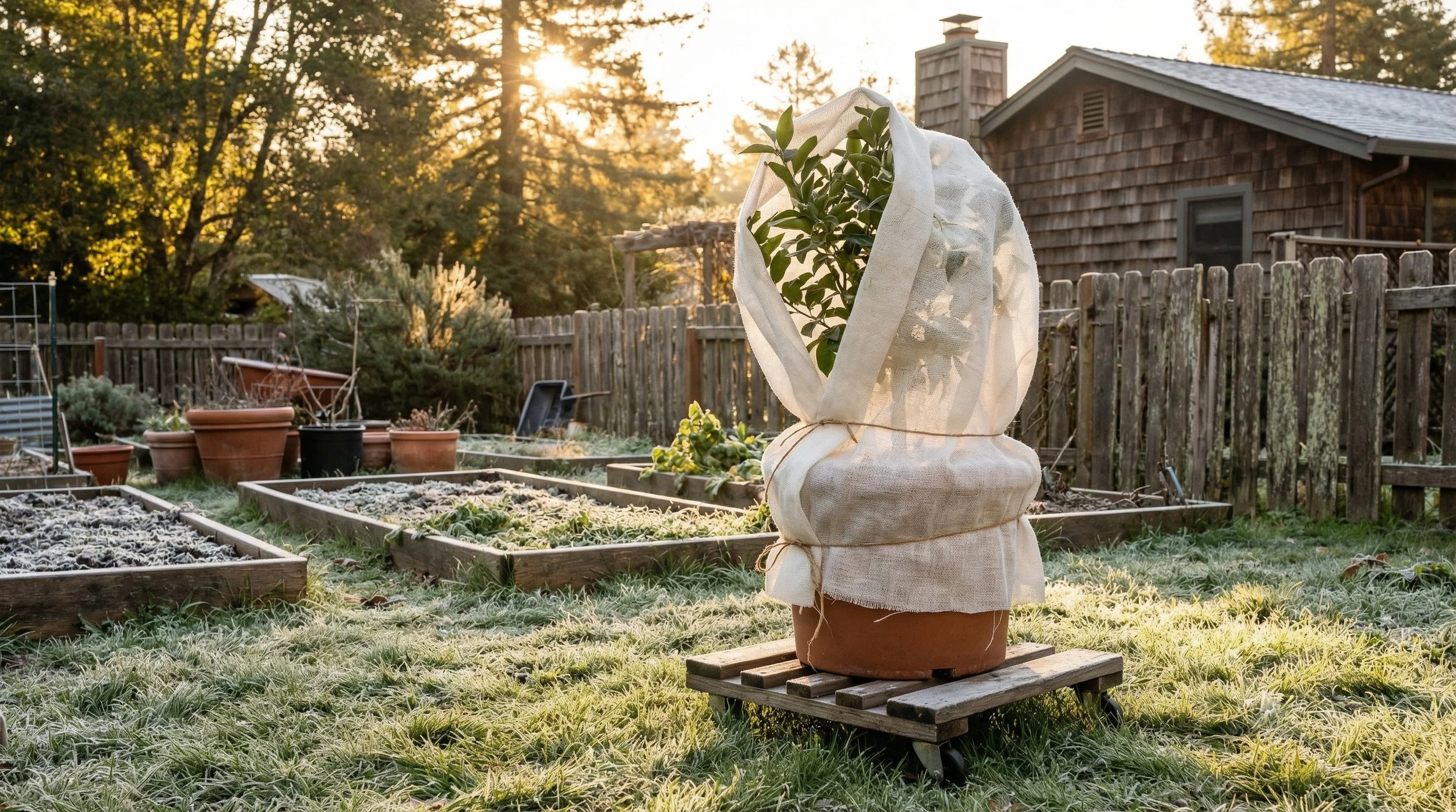
Covers and wraps: Frost cloth, burlap, old sheets, or blankets trap heat radiating from the ground and protect foliage from freezing air. For best results:
Cover the entire tree to the ground
Secure covers at ground level to trap warm air (don't leave gaps at the bottom)
Remove covers during the day to allow sun to warm the tree and soil
Avoid plastic directly touching foliage (it can conduct cold and cause burn)
Radiant heat sources: Incandescent lights strung through the canopy provide meaningful heat. A light bulb (100-watt, designed for outdoor use) or Christmas lights hung in the middle of a tree can provide frost protection if the lights are the old-fashioned incandescent type that actually release significant heat. LED lights don't produce heat and won't help.
Young tree protection:Frost-sensitive young trees can be protected by wrapping them with insulating material from the ground up to the main branches. Commercial tree wraps, burlap, or even cardboard tubes provide insulation for vulnerable trunks.
Harvest ripe fruit:Ripe fruit is more cold tolerant than green fruit because sugars in the juice act like antifreeze. However, picking ripe fruit before a predicted freeze not only saves the fruit but helps protect the entire tree.
Water overnight (use cautiously): Running sprinklers all night can protect trees from frost as the freezing water releases heat. However, this only works if water is applied continuously; if the water supply is interrupted, more damage may result than would have otherwise occurred. This method also uses significant water and isn't appropriate during drought conditions.
Dealing with Frost Damage
Despite your best efforts, frost damage sometimes occurs. Knowing how to respond helps trees recover.
Don't rush to prune: Frost-damaged leaves and branches look alarming, but wait until spring to assess the full extent of damage. Citrus leaves curl and turn brown or black within a few days of frost, but wood that looks dead in winter may leaf out in spring.
Wait for new growth: In spring, you'll see where the tree is putting out new growth. Prune back to living wood only after you can clearly identify what's dead and what's recovering.
Be patient with recovery: Badly frosted trees may take a full season or more to recover their shape and productivity. Continue normal care (watering, fertilizing) to support recovery.
When to give up: If the trunk is damaged below the graft union, the tree won't recover as the fruiting variety. Suckers growing from below the graft are rootstock, not your desired citrus. If no growth appears above the graft by midsummer, consider replacement.
Frost Protection for Container Citrus
Container citrus offers the ultimate frost protection: mobility.
Move to shelter: When frost threatens, move containers to protected locations:
Against south or west-facing house walls
Under eaves or covered patios
Into garages or unheated greenhouses
Away from open, exposed areas
If moving isn't possible: Cluster containers together (grouped plants protect each other), wrap with frost cloth or blankets, and add incandescent lights for heat.
Indoor option: Containers can be brought indoors temporarily during severe cold. Place in the brightest available location, reduce watering, and return outdoors as soon as weather permits.
Planning for Cold Protection
Know your microclimate: Track minimum temperatures in your garden over several winters. Place a min/max thermometer in your citrus area. You may find your garden is warmer or colder than weather reports for nearby locations.
Have supplies ready: Don't wait until frost is forecast to find your frost cloth. Keep covers, extension cords for lights, and stakes or supports ready before winter arrives.
Monitor forecasts: Pay attention to weather forecasts from late October through March. The NOAA National Weather Service provides frost advisories for our area.
Know when protection is needed: For most Santa Cruz citrus varieties, take action when temperatures below 28°F are forecast. For more sensitive varieties like limes, protect at 32°F.
Frequently Asked Questions
At what temperature do I need to protect my citrus?
It depends on the variety. Kumquats and Satsumas handle 20°F; Meyer lemons 22°F; most oranges 24°F; Bearss limes 28°F. Protect when forecast temperatures approach these limits. For mixed plantings, protect when the most sensitive tree needs it.
Will one frost kill my citrus tree?
Brief exposure to temperatures at or slightly below a tree's tolerance usually causes leaf and fruit damage but not tree death. Prolonged exposure (4+ hours) below tolerance, or temperatures significantly below tolerance, can cause serious damage or death, especially for young or stressed trees.
Should I cover my citrus every time it gets cold?
Not necessarily. You need protection when temperatures approach or exceed your variety's damage threshold. Light frost (33-36°F) rarely damages citrus. Focus on protecting during hard freeze events.
Do LED Christmas lights provide frost protection?
No. LED lights produce minimal heat. Only incandescent bulbs release enough heat for frost protection. If using Christmas lights, ensure they're the old-fashioned incandescent type.
How do I know if my citrus was damaged by frost?
Leaves curl and turn brown or black within days of frost damage. Fruit may show discoloration or soft spots. Wait until spring to assess wood damage, as branches that look dead may recover.
Can I save frost-damaged fruit?
Slightly damaged fruit can be used immediately (juice may be fine even if pulp is affected). Heavily damaged fruit with soft spots should be discarded. Frost-damaged fruit doesn't store well.
Should I water my citrus after a frost?
Don't overwater after frost, but maintain normal irrigation. Healthy watering practices support recovery. Avoid fertilizing until you see new spring growth.
My tree froze but has growth below the graft. Will it recover?
Growth from below the graft union is rootstock, not your fruiting variety. If all growth above the graft is dead by midsummer, the fruiting variety won't recover. You can keep the tree as rootstock and attempt grafting, or replace it.
Free Downloadable Resources
Related Articles
Growing Citrus in Santa Cruz County: What Actually Works
Best Citrus Varieties for Santa Cruz Microclimates
Growing Citrus in Containers: The Mobility Advantage
