

Growing Avocados in Containers in California | Realistic Guide
Growing Avocados in Containers in California: A Realistic Guide
A few of the product links in this guide are affiliate links. If you buy through one, Ambitious Harvest may earn a small commission at no extra cost to you, which helps keep these guides free. We only point to gear we would use in our own Santa Cruz garden. As an Amazon Associate, we earn from Read our full disclosure.
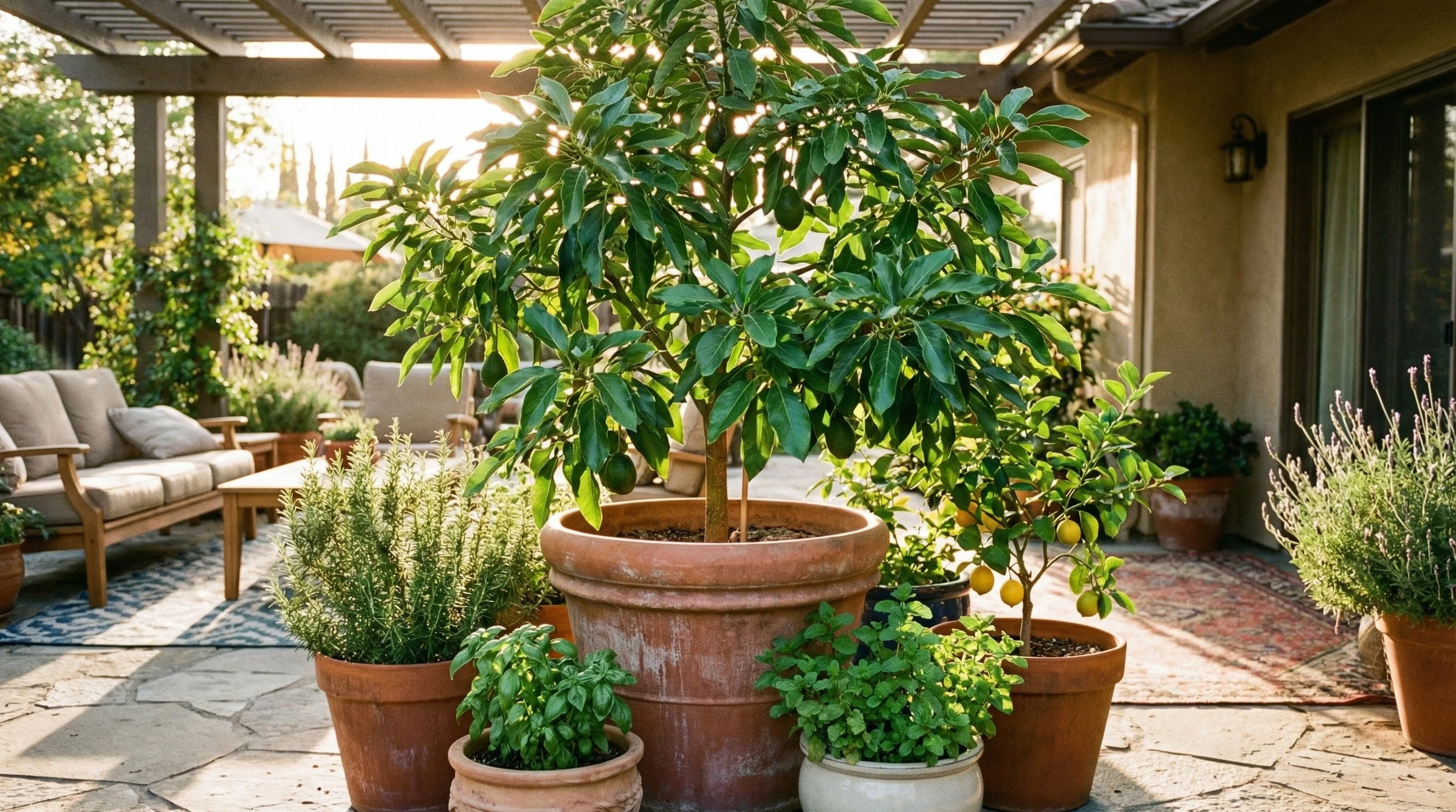
Growing avocados in containers is a practical strategy for California gardeners in marginal climates who want the flexibility to move trees to shelter during cold snaps. According to UC Agriculture and Natural Resources, container-grown avocado trees can produce fruit when given proper care, though yields are naturally smaller than in-ground trees because root space limits overall tree size. The tradeoff of reduced production for increased cold protection control is often worth it in coastal areas like Santa Cruz County.
Why Grow Avocados in Containers Instead of in the Ground?
There are several legitimate reasons to choose container growing, and one very common bad reason. Let's address each one plainly.
Good Reasons for Container Growing
Cold protection mobility. This is the number one reason for coastal California gardeners. A container avocado can be wheeled into a garage, covered patio, or greenhouse during freeze events. In Santa Cruz County, where temperatures occasionally dip below the damage threshold for even cold-hardy varieties, the ability to move the tree to a 40-degree garage for a few nights can save years of growth.
Poor native soil. If your property has heavy clay, compacted fill, or poorly draining soil, a container filled with the right mix gives your avocado the drainage it demands. According to UC IPM, Phytophthora root rot is the leading cause of avocado tree death, and it thrives in waterlogged soil. For more on diagnosing and treating common issues, see our guide to avocado problems in California. Containers give you complete control over the root environment.
Limited space. Apartments, condos, townhouses, and small yards may not have room for a full-sized avocado tree. A container-grown dwarf variety on a sunny patio or deck is a workable alternative. Our guide to container gardening covers more crops that thrive in pots.
Rental properties. If you might move in a few years, a container tree goes with you.
The Less-Good Reason
Impatience with an indoor avocado dream. Many people imagine growing a lush avocado tree in their living room year-round. This rarely works well. Avocados need intense sunlight (at least 6 hours of direct sun daily), and even the brightest indoor window in California does not compare to outdoor conditions. Indoor avocado trees typically become leggy, produce no fruit, and eventually decline. Grow your container avocado outdoors and only bring it inside for brief cold-protection stays. If you are curious about starting a tree from a grocery store pit, see our guide on growing avocado from seed.
What Are the Best Avocado Varieties for Containers?
Not every variety works well in a pot. You want varieties that stay relatively compact, tolerate root restriction, and (for most California locations) offer reasonable cold hardiness. For a full comparison of varieties suited to our climate, see best avocado varieties for Santa Cruz.
Wurtz (Little Cado / Littlecado)
Wurtz is the most popular container avocado variety for good reason. It is a natural semi-dwarf, reaching 8 to 12 feet in the ground and staying considerably smaller in a container (4 to 8 feet is typical with pruning). Wurtz is a Mexican-Guatemalan hybrid that is reportedly cold-hardy to around 25 degrees Fahrenheit, though authoritative data is limited. The fruit is medium-sized, pear-shaped, with dark green skin and creamy texture. Flavor is good, though not as rich as Hass.
Wurtz is a Type A variety, so it pairs well with a Type B container tree (like Bacon or Fuerte) for cross-pollination, or it can produce some fruit on its own.
UC ANR's home-garden avocado table calls Wurtz a small tree of 8 to 10 feet that suits small gardens or large containers, and notes it is also sold as Dwarf, Littlecado, or Minicado.
Holiday (Wertz)
Holiday is closely related to Wurtz (sometimes considered the same variety under a different name, sometimes classified as a distinct selection). Growth habit and cold tolerance are similar. If your nursery offers Holiday instead of Wurtz, it is a comparable choice.
Mexicola Grande
While not a dwarf variety, Mexicola Grande responds well to container culture and pruning, staying manageable at 6 to 8 feet in a large pot. Its exceptional cold hardiness (to about 18 to 20 degrees) makes it the most cold-tolerant option for container growing, and the fruit is flavorful with thin, edible skin. Mexicola Grande is a Type A variety. Because Wurtz is also Type A, pairing it with a Type B variety like Bacon or Fuerte provides more effective cross-pollination.
Lamb Hass
Lamb Hass offers a more compact growth habit than standard Hass, with similar fruit quality. Cold tolerance is comparable to Hass (marginal at 28 to 30 degrees). It is a reasonable container choice only if you have a reliably warm microclimate and can provide winter shelter.
Varieties to Avoid in Containers
Full-sized varieties like Fuerte, Bacon, Reed, and standard Hass are not ideal for containers. They are vigorous growers that become rootbound quickly, resulting in stress, poor production, and constant maintenance. You can technically keep any avocado in a container with aggressive pruning, but you will fight the tree's natural growth habit every year.
Best Avocado Varieties for Containers
Compact growers suited to pot culture in coastal California
Wurtz (Little Cado)
Container height: 4-8 ft with pruning
Cold tolerance: ~25F
Flower type: A
Fruit: Medium, dark green, creamy
Top pick for containers. Natural semi-dwarf.
Mexicola Grande
Container height: 6-8 ft with pruning
Cold tolerance: ~18-20F
Flower type: A
Fruit: Small-medium, thin edible skin
Most cold-hardy option. Outstanding flavor.
Lamb Hass
Container height: 6-8 ft with pruning
Cold tolerance: ~28-30F
Flower type: A
Fruit: Medium, Hass-like quality
Warmest sites only. Needs winter shelter.
Container size progression:
Year 1: 5-gallon (nursery pot) > Year 1-2: 15-gallon > Year 3+: 25-45 gallon or half wine barrel
Source: UC Cooperative Extension container fruit tree recommendations; UC ANR variety guides
What Size Container Do Avocado Trees Need?
Container size directly limits tree size and production. Here is a progression that balances tree health with practical manageability.
Starting Out
Purchase your grafted nursery tree in a 5-gallon container. Keep it in this pot for the first year while it establishes and acclimates to your conditions. This is also a good time to evaluate your site: is the tree getting enough sun? Can you move it to shelter when needed? Work out the logistics before committing to a larger (and heavier) container.
First Upgrade (Year 1 to 2)
Move to a 15-gallon container. This gives the roots room to grow and the tree enough stability to begin developing a proper canopy. At this size, the container is still manageable for one person to move on a plant dolly.
Long-Term Container (Year 3 and Beyond)
A 25-gallon container is the minimum for long-term avocado production. A tree this size can support fruit, maintain a healthy root system, and look attractive on a patio. Expect the tree to reach 4 to 6 feet in a 25-gallon pot with regular pruning.
For maximum production, a half wine barrel (roughly 25 to 30 gallons) or a 35- to 45-gallon container is ideal. At this size, the tree can reach 6 to 8 feet and produce a meaningful harvest. However, a 45-gallon container with wet soil weighs 200 to 300 pounds, so mobility requires a sturdy plant dolly with locking wheels.
Container Material
Fabric grow bags (25- to 45-gallon) are excellent for avocados. They provide natural air pruning of roots (preventing circling), superior drainage, and are lighter than ceramic or concrete pots. The main drawback is that they dry out faster than solid containers, requiring more frequent watering in summer.
Plastic pots are lightweight, inexpensive, and retain moisture well. Choose light-colored pots to reduce heat absorption in summer, as black plastic pots in direct California sun can cook roots.
Ceramic and terracotta look beautiful but are heavy and can crack in freezing temperatures (a real concern if you are leaving the pot outdoors during a mild freeze). Terracotta also wicks moisture from the soil, requiring more frequent watering.
Wood half-barrels are attractive and insulate roots well. Line the interior with plastic sheeting (with drainage holes) to extend the barrel's lifespan.
All containers must have drainage holes. No exceptions.
What Soil Mix Works Best for Container Avocados?
Standard potting soil from the garden center is not ideal for avocados. These mixes often retain too much moisture and lack the drainage avocados demand. According to UC ANR, the most important thing with an avocado is not to overwater, because overwatering is a major contributing factor for avocado root rot, and the small soil volume in a container makes overwatering easier.
Recommended Container Mix
A good avocado container mix consists of:
40 percent high-quality potting soil (peat-based or coir-based)
30 percent perlite or pumice (for drainage and aeration)
20 percent coarse bark (orchid bark or small pine bark chunks)
10 percent compost (for nutrients and microbial activity)
This mix drains quickly while retaining enough moisture for the shallow avocado root system. The bark and perlite create air pockets that keep roots oxygenated.
Avoiding Root Rot in Containers
Even with the right mix, root rot remains the top threat to container avocados. Follow these rules:
Never let the container sit in a saucer of standing water. If you use a saucer, empty it after watering.
Water thoroughly until water runs out the bottom, then do not water again until the top 2 inches of soil feel dry.
Elevate the container slightly on pot feet or a platform to ensure the drainage holes are never submerged.
Repot every 3 to 4 years with fresh mix to prevent soil compaction and salt buildup.
How Do You Water and Fertilize Container Avocados?
Watering
Container avocados need more frequent watering than in-ground trees because the limited soil volume dries out faster. However, the same principle applies: consistent moisture, never saturation.
Summer (June through September): Water every 2 to 3 days in Santa Cruz, more frequently during heat waves or if using fabric pots. In hotter inland California locations, daily watering may be necessary.
Winter (November through March): Reduce watering significantly. Check soil moisture before watering and allow the top 2 to 3 inches to dry between waterings. Overwatering in winter is the fastest way to kill a container avocado.
Spring and Fall: Transition periods. Water when the top 2 inches are dry, typically every 3 to 5 days.
Water quality matters. Avocados are sensitive to salts, chloride, and sodium. According to UC ANR research on avocado salinity, avocados have among the lowest salt tolerance of any fruit crop. If your municipal water is high in dissolved salts, consider using rainwater collection for your avocado or flushing the container thoroughly with excess water periodically to leach accumulated salts. Leaf tip burn (brown, crispy edges) is a classic sign of salt buildup.
Fertilizing
Container trees need regular fertilization because nutrients leach out with watering.
What to use: A slow-release citrus/avocado fertilizer (such as those with an NPK ratio around 6-4-6 or similar) applied three times per year (February, May, and August) is the simplest approach. Follow the package rate for the container size.
Alternatively, use a liquid organic fertilizer (fish emulsion, kelp extract, or a balanced organic liquid) every 2 to 4 weeks during the growing season (March through September). Do not fertilize from October through January.
Micronutrients matter. According to UC IPM fertilizing guidelines, avocados commonly show deficiencies in iron, zinc, and manganese, especially in alkaline soils. Container mixes tend to be slightly acidic, which helps, but watch for yellowing between leaf veins (interveinal chlorosis), which indicates iron or zinc deficiency. A chelated iron supplement or an avocado-specific micronutrient spray addresses this.
How Do You Prune Container Avocados?
Pruning is essential for container avocados, both to maintain manageable size and to shape the tree for production.
When to Prune
Prune in late spring (April to May) after the risk of frost has passed and new growth is visible. Avoid pruning in fall or winter, as this stimulates new growth that is vulnerable to cold damage.
How to Prune
For size control: Remove the top leader (the tallest, most vertical branch) to encourage lateral branching. This creates a bushier, more compact tree rather than a tall, spindly one. Repeat each spring as needed to maintain your desired height.
For shape: Remove any branches that cross, rub against each other, or grow inward toward the center of the canopy. Good air circulation through the canopy reduces disease risk.
For production: Avocados fruit on the outer portion of the canopy where sunlight penetrates. Moderate pruning that opens up the canopy to light improves fruit production. However, avoid heavy pruning that removes more than 20 to 25 percent of the canopy in a single year, as this reduces the following year's fruit.
Whitewash exposed bark. If pruning exposes previously shaded trunk or branch surfaces to direct sun, apply whitewash (1:1 interior white latex paint and water) to prevent sunburn.
How Do You Move Container Avocados for Cold Protection?
The primary advantage of container growing is mobility for cold protection. Here is how to make this practical rather than theoretical.
Equipment
A sturdy plant dolly with locking casters is essential for any container 15 gallons or larger. These are available at garden centers for $15 to $30 and save your back. For larger containers (25 gallons and up), choose a dolly rated for at least 300 pounds.
Shelter Options
Unheated garage: The most common option. A garage typically stays 10 to 20 degrees warmer than outdoor temperatures on cold nights. Move the tree in before sunset when a freeze is forecast and back outside once temperatures are above freezing. An unheated garage is fine for brief stays (1 to 3 nights). For longer cold spells, position the tree near a window if possible.
Covered patio or porch: Overhead cover reduces radiant heat loss and blocks frost from settling on leaves. Combined with frost cloth, a covered patio provides significant protection.
Greenhouse or cold frame: Ideal if available. Even an unheated greenhouse traps enough solar warmth to protect through most Santa Cruz County freeze events.
Indoor (last resort): You can bring a container avocado inside for a few nights during extreme cold, but do not keep it inside for weeks. The low light and warm, dry indoor air stresses the tree. Use this only for genuine emergencies.
Timing and Logistics
Monitor weather forecasts regularly from November through February. When overnight lows below 32 degrees are predicted, move the tree to shelter before sunset. Move it back outdoors the following morning once temperatures are above freezing. On most Santa Cruz County properties, this happens only 5 to 15 nights per year.
What Should You Realistically Expect from Container Avocados?
Here is the assessment:
Fruit production: A mature container avocado (4 to 5 years old in a 25- to 45-gallon container) may produce 10 to 30 avocados per year in a good year. Some years you will get fewer or none. This is not going to replace your grocery store purchases, but there is something deeply satisfying about eating an avocado you grew yourself.
Tree lifespan: With proper care, repotting, and root pruning, a container avocado can live and produce for 15 to 20 years or longer. Many growers eventually plant their container tree in the ground when they find the right property or the right spot.
Effort level: Container avocados require more attention than in-ground trees. Watering, fertilizing, repotting, and seasonal moving all take time. It is not a plant-it-and-forget-it situation. If you want low-maintenance fruit, consider figs or citrus instead.
The real reward: For many California gardeners, especially those in marginal avocado climates like Santa Cruz County, container growing is the most practical path to homegrown avocados. The mobility advantage alone justifies the extra work. You control the environment in a way that is impossible with an in-ground tree.
How Do You Repot a Container Avocado Tree?
Every 3 to 4 years, container avocados benefit from repotting. This refreshes the soil mix, addresses root circling, and prevents salt accumulation.
When to repot: Late spring (April to May) is ideal. Never repot in fall or winter.
How to repot:
Water the tree thoroughly the day before repotting to reduce transplant shock.
Gently remove the tree from its container. If roots are tightly circling, use a sharp knife to score the root ball vertically in 3 to 4 places, cutting about an inch deep. This encourages new roots to grow outward.
Trim any dead, mushy, or obviously unhealthy roots.
If staying in the same container size, remove about 20 percent of the root mass from the outside and bottom of the root ball. Replace with fresh soil mix.
If moving to a larger container, position the root ball in the new pot and fill around it with fresh mix. Do not bury the trunk any deeper than it was before.
Water deeply and place in partial shade for a week to reduce transplant stress before returning to full sun.
According to UC Master Gardener recommendations, root pruning during repotting is standard practice for long-term container fruit trees and helps maintain the balance between root mass and canopy size.
Container trees follow the same long arc; our avocado growth stages guide covers each phase.
Frequently Asked Questions
Can I keep an avocado tree indoors year-round in California?
Indoor avocado growing rarely works well for fruit production. Avocado trees need at least 6 hours of direct sunlight daily, which even the brightest window cannot match. Indoor trees typically become leggy, drop leaves, and never produce fruit. UC Riverside's avocado variety collection warns that a tree moved indoors needs bright light and dislikes the high, dry heat of a house, so keep indoor stints short and the container from drying out. Grow your container avocado on a sunny patio or deck for best results.
How big does a container need to be for an avocado tree to produce fruit?
A 25-gallon container is the minimum practical size for fruit production, though larger is better. A half wine barrel (roughly 25 to 30 gallons) or a 35- to 45-gallon container provides enough root space for a dwarf variety like Wurtz to produce 10 to 30 avocados per year once mature. Smaller containers (15 gallons) can support a young tree but typically do not allow enough root mass for meaningful fruit production.
What is the best dwarf avocado variety for containers in coastal California?
Wurtz (also sold as Little Cado or Littlecado) is the most widely recommended dwarf avocado for container growing. It naturally stays compact (4 to 8 feet in a container), tolerates root restriction, and produces medium-sized fruit with good flavor. For maximum cold hardiness, consider Mexicola Grande instead. While not a true dwarf, Mexicola Grande responds well to container culture and pruning, and its exceptional cold tolerance (to 18 to 20 degrees Fahrenheit) provides the most security in marginal climates like Santa Cruz.
How often should I water a container avocado tree?
In coastal California, water container avocados every 2 to 3 days during summer and every 5 to 7 days during winter, adjusting based on soil moisture. Check by inserting your finger 2 inches into the soil. If dry, water thoroughly until water drains from the bottom. If moist, wait another day. Fabric grow bags dry faster than plastic pots and may need daily summer watering. Overwatering in winter is the number one killer of container avocados, so always err on the dry side during the rainy season.
Can a container avocado tree survive a freeze without being moved?
Container avocados are actually more vulnerable to cold than in-ground trees because the root ball is exposed to air temperature on all sides. In-ground roots are insulated by surrounding soil. For container trees left outdoors during a freeze, wrap the container with blankets or bubble wrap to insulate roots, drape frost cloth over the canopy, and add heat sources. This provides moderate protection, but for hard freezes below 28 degrees, moving the tree to shelter is the safest option.
