

Why Are My Blueberry Leaves Turning Yellow?
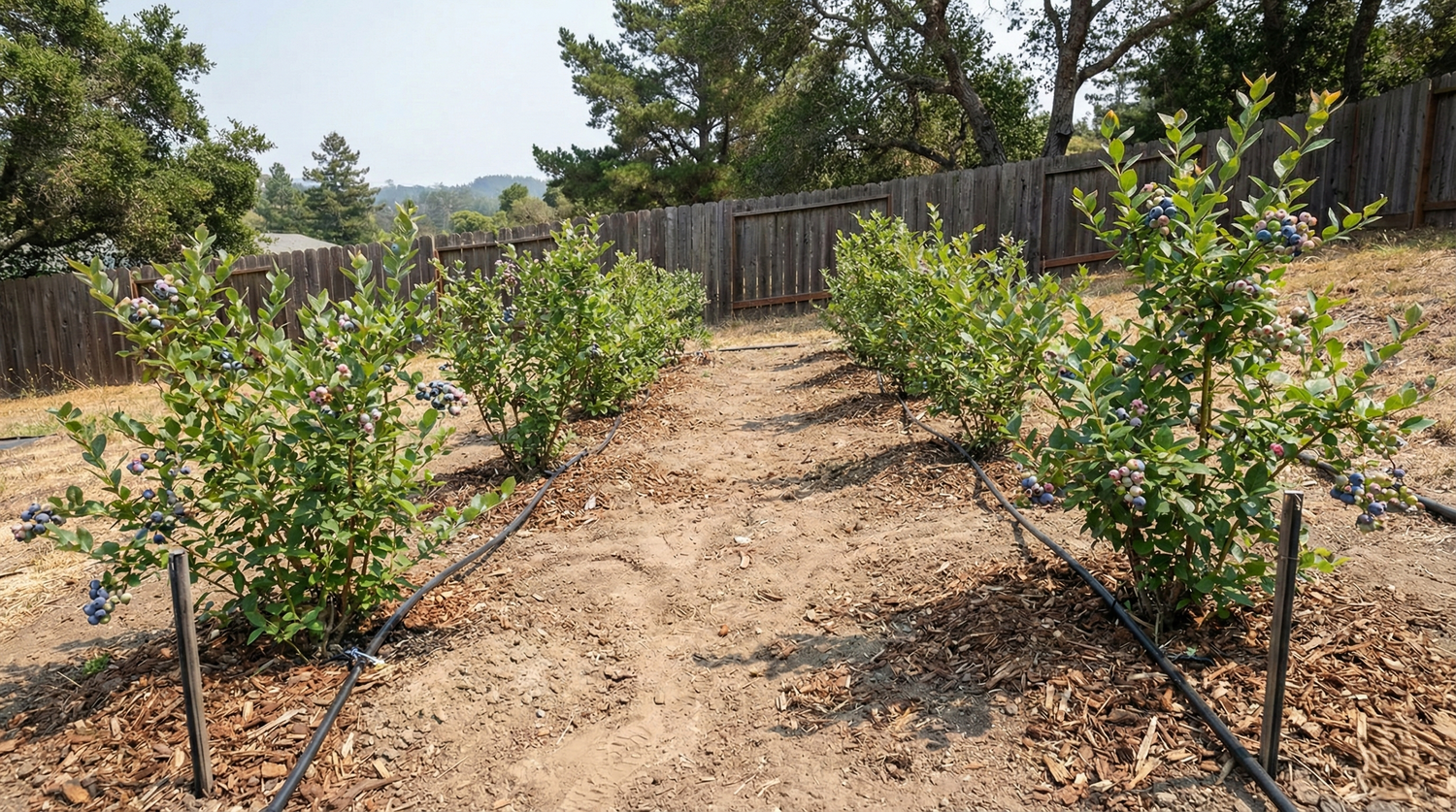
Blueberries growing in a garden. The leaf checks below help distinguish possible causes of yellowing.
Yellow blueberry leaves are a reason to pause before reaching for fertilizer. If the youngest leaves are yellow between green veins, soil pH is an important suspect: blueberries can struggle to take up iron when the root zone isn't acidic enough. But wet roots, poor drainage and other nutrient problems can also change leaf color.
Start with the pattern, then check the soil. That gives you a better chance of helping the plant than adding sulfur, iron and fertilizer all at once.
Read the leaves, then test the root zone
The UC Master Gardeners' blueberry growing guide recommends a soil pH of 4.5 to 5.5. Above that range, yellowing between the veins can signal an iron-availability problem. It doesn't necessarily mean the soil contains too little iron; the plant may be unable to obtain enough of what is there.
Don't assume a Santa Cruz address tells you the pH. Test the soil or container mix where the roots are growing. A garden bed, imported raised-bed soil and a pot of commercial mix can have very different conditions. A home pH kit can offer an estimate, but use a laboratory soil test to guide acidification. Oregon State Extension recommends laboratory testing because home-kit results may not be precise enough for that decision.
Also notice which leaves changed first. Iron chlorosis commonly appears on younger leaves with the veins staying greener. Nitrogen deficiency can begin as more uniform paling of older leaves. These are clues, not a diagnosis on their own: root stress can interfere with nutrient uptake, and more than one problem can be present.
Check drainage before adding nutrients
Blueberries have shallow roots and need steady moisture, but the roots also need air. Feel beneath the mulch and check whether a pot drains freely. A plant sitting in wet soil may need a drainage correction rather than more frequent watering or fertilizer. Oregon State Extension's blueberry guide explains how waterlogged soil can damage roots and increase root-rot risk.
That distinction matters during cool coastal weather, when a pot may stay wet longer than expected, and during warmer spells, when the same plant can dry more quickly. Adjust to the conditions at the roots. For an in-ground planting that stays wet, review the site as well as the soil; our guide to improving heavy clay soil discusses that broader problem.
Make a measured correction
If testing confirms that pH is too high, elemental sulfur can lower it gradually. The amount depends on the starting pH, soil texture and area being treated. Follow the product's directions for established plants and a soil-test recommendation; don't dig through shallow blueberry roots or repeat applications simply because the leaves haven't changed color yet. Substantial adjustments take time. Our guide to acidifying soil for blueberries can help you plan the process.
Pine needles and aged bark can be useful surface mulches for conserving moisture. They aren't a measured acidification treatment. University of New Hampshire Extension explains that pine-needle mulch does not appreciably lower soil pH.
If a nutrient deficiency is supported by the evidence, choose a fertilizer labeled for blueberries or suitable acid-loving plants and follow its rate. Blueberries are sensitive to overfertilizing. An acid-forming fertilizer also supplies nutrients, so don't use repeated feeding as a shortcut to lowering pH.
When a container makes sense
A container lets you start with a mix suited to blueberries when the garden soil needs major changes. Look for a well-draining potting mix intended for acid-loving plants, and check its stated pH rather than relying on the word “azalea” alone. The pot still needs drainage, moisture checks and ongoing care.
Our California guide to growing blueberries in containers covers that option. If you're choosing a new plant, blueberry varieties for Santa Cruz is a separate decision: the right variety won't compensate for unsuitable conditions around its roots.
Keep amendments specific to the crop. Our articles on strawberries and coffee grounds and blossom-end rot in tomatoes examine other situations where a familiar garden remedy can miss the underlying problem. If you're comparing berry crops for a container, see growing blackberries in a pot for that plant's different needs.
Frequently Asked Questions
Are yellow leaves with green veins always caused by high pH?
No. That pattern, especially on young leaves, makes iron chlorosis worth investigating. Confirm the root-zone pH and check moisture and drainage before treating it. If those checks don't explain the symptoms, get help identifying the problem rather than continuing to add amendments.
Will pine needles fix yellow blueberry leaves?
They can help conserve soil moisture as mulch, but won't reliably acidify the root zone enough to correct a pH problem. Use a test to decide whether acidification is needed, and keep checking moisture beneath the mulch.
Should I add more fertilizer if the whole plant looks pale?
Not automatically. Uniform paling may fit a nutrient problem, but damaged or waterlogged roots also limit uptake. Review drainage, watering and recent feeding first. Match any fertilizer to the identified need and label instructions instead of giving a stressed plant an extra-strong dose.
This week: Photograph the youngest and oldest leaves, check root-zone moisture and arrange a pH test. Keep those observations together so you can judge the next step and later growth. The free Garden Toolkit has more garden-planning and troubleshooting resources.
