

Succulent Container Gardens in California | Design, Soil & Care
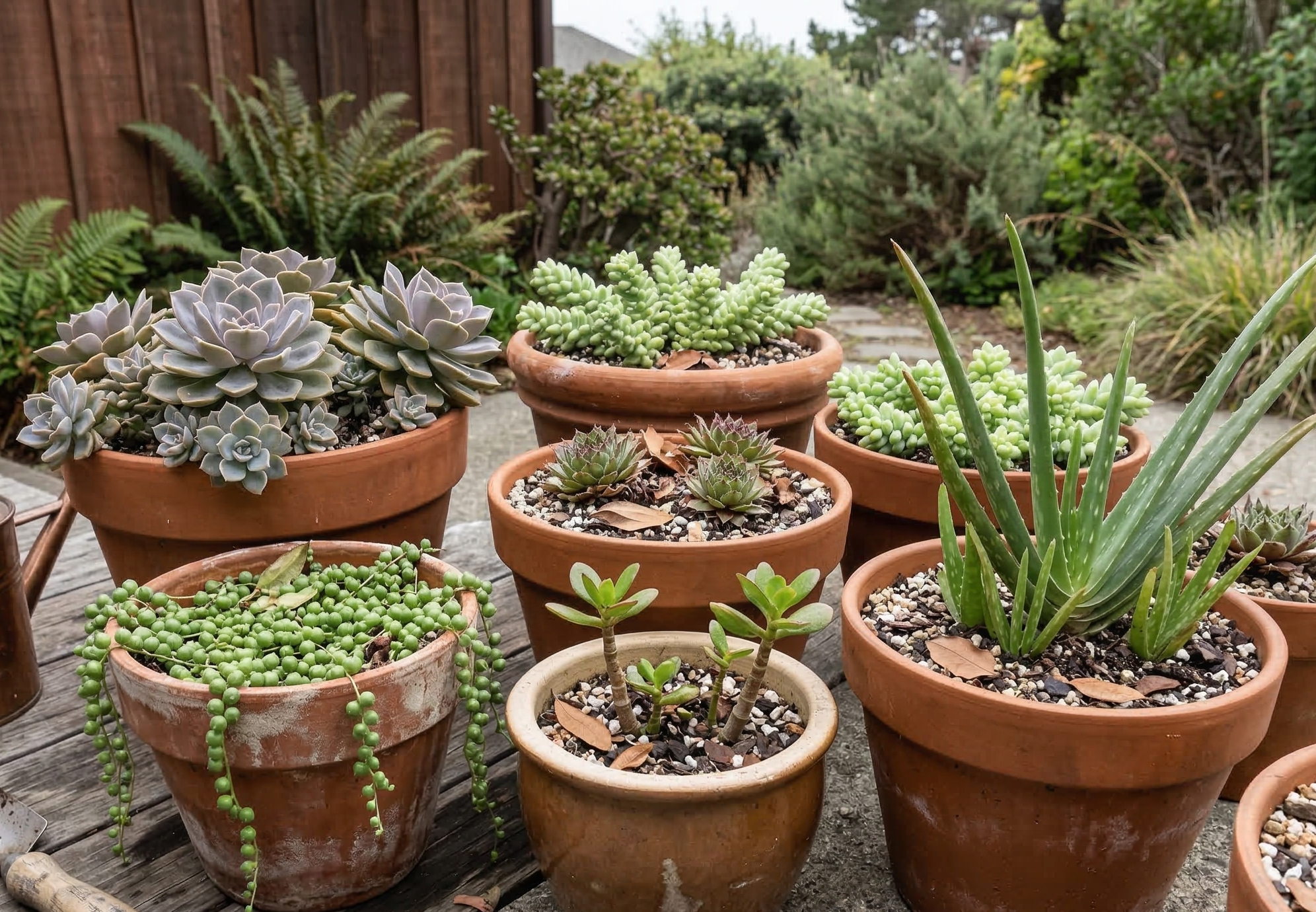
Succulent Container Gardens in California: Design, Soil, and Year-Round Care
A few of the product links in this guide are affiliate links. If you buy through one, Ambitious Harvest may earn a small commission at no extra cost to you, which helps keep these guides free. We only point to gear we would use in our own Santa Cruz garden. As an Amazon Associate, we earn from Read our full disclosure.
Container growing is the single most effective way to manage the biggest challenge of growing succulents on the California coast: too much moisture. UC Master Gardeners note that succulents rot in soggy soil and are best protected from heavy rain, which is the practical case for containers on the coast: you control the mix, the drainage, and how much winter rain reaches the roots. A well-designed succulent container can thrive outdoors year-round in Santa Cruz County with minimal fuss, as long as the fundamentals of soil, pot selection, and seasonal care are right.
Whether you are working with a single statement pot on a patio or designing a collection across a whole balcony, this guide covers everything you need to create and maintain beautiful succulent containers in California's coastal climate.
What Soil Mix Do Succulents Need in Containers?
This is the most important section in this guide. Get the soil right and almost everything else becomes easier. Get it wrong and no amount of careful watering will save your plants.
Standard potting soil, even the kind labeled "for cacti and succulents," retains too much moisture for most succulent containers on the California coast. The commercial cactus mixes sold at garden centers typically contain peat moss, which holds water like a sponge, exactly what we do not want in a humid, foggy climate.
The recommended container mix for coastal California:
UC Marin Master Gardeners suggest a simple succulent mix of one-third potting mix, one-third coarse sand, and one-third pumice, topped with crushed granite or pea gravel, which drains almost instantly. When you water, the liquid should flow through and out the drainage holes within seconds, not minutes. The soil should feel barely damp one to two days after watering, and dry within four to five days at most.
Why pumice is ideal for coastal California:
Pumice is a volcanic rock that is lightweight, porous, and available locally (it is mined in several Western states). Unlike perlite, which tends to float to the surface during watering, pumice stays mixed into the soil. It holds just enough moisture in its pores to keep roots from desiccating between waterings while allowing excess water to drain away immediately. UC Master Gardeners of Sonoma County note that drainage is fastest when coarse sand, perlite, pumice, or small lava rock is added to the potting mix.
What to avoid in your mix:
Fine peat moss (holds too much water, becomes hydrophobic when dry)
Vermiculite (excellent water retention, which is the opposite of what we need)
Heavy garden soil or clay (compacts in containers, blocks drainage)
Wood chips or bark chunks (decompose into water-holding mush over time)
Mixing your own vs. buying premade:
Mixing your own soil is more cost-effective for large collections. Buy pumice in bulk from landscape supply yards (it is significantly cheaper in bulk than in small bags from garden centers). For a few pots, a commercial cactus mix amended with extra perlite (roughly 50/50) is a reasonable shortcut.
How Do You Choose the Right Container?
The pot is not just decorative. It directly affects how long moisture stays in the soil, which means it directly affects whether your succulents live or die.
The one non-negotiable rule: drainage holes. Every container must have at least one drainage hole. No exceptions. No "gravel layer at the bottom instead." UC research has repeatedly demonstrated that a gravel layer beneath soil does not improve drainage in containers. It actually creates a perched water table that keeps the soil above it wetter for longer. Always use a pot with holes, and let water flow freely out the bottom.
Container material comparison:
Terra cotta (unglazed): The best all-around choice for succulent containers in coastal California. Terra cotta is porous, which means moisture wicks through the walls and evaporates from all sides, not just the top. This keeps soil drier and roots healthier. The downside: terra cotta dries out faster (an advantage on the coast) and is heavier. It can also crack if dropped.
Glazed ceramic: Attractive but retains moisture longer than terra cotta because the glaze seals the clay. Use glazed pots for succulents that tolerate slightly more moisture (Aeonium, Sedum) rather than extremely drought-adapted types. Ensure drainage holes are present and generously sized.
Concrete and hypertufa: Excellent for succulents. Porous like terra cotta, heavy (stable in wind), and develops an attractive patina over time. Hypertufa (a lightweight concrete alternative you can make at home from Portland cement, perlite, and peat) is popular for trough-style succulent gardens.
Plastic and resin: Lightweight and inexpensive but retains the most moisture. If you use plastic pots, increase the inorganic content of your soil mix (60 to 70 percent pumice/perlite) and water less frequently. Plastic works fine for temporary displays or for succulents awaiting transplant, but terra cotta or concrete is preferable for permanent plantings.
Metal: Heats up dramatically in direct sun, which can cook roots. Avoid metal containers in sunny locations unless they are very large (thermal mass helps buffer temperature swings) or shaded. If you love the look, use a metal planter as a cachepot with a smaller plastic pot inside that you can remove for watering.
Size considerations:
Succulents do not need large pots. Their root systems are generally shallow and modest. A pot that is 1 to 2 inches wider than the root ball is appropriate. Oversized pots hold more soil moisture than roots can absorb, increasing rot risk. Shallow, wide bowls and troughs are often better than deep, narrow pots because they dry out faster and suit the shallow root systems of most succulents.
How Do You Design a Beautiful Succulent Container?
Succulent containers are a design playground. The sheer variety of colors, textures, and forms available makes it possible to create arrangements that rival any flower garden, and they last far longer than annual plantings.
The Thriller/Filler/Spiller Framework for Succulents
This classic container design formula adapts beautifully to succulents:
Thriller (the focal point): A single architectural plant that draws the eye. Options include: - Aeonium 'Zwartkop' (tall, dramatic dark rosettes) - Agave attenuata (bold blue-green rosette) - Aloe striata (coral-edged flat rosette) - Echeveria 'Afterglow' (large lavender-pink rosette, for sunnier spots)
Filler (mounding plants that fill the middle ground): Plants that create body and color between the thriller and the pot edge: - Echeveria elegans (compact blue-white rosettes) - Graptoveria 'Fred Ives' (pink-purple rosettes) - Sedum adolphi (golden clusters) - Sempervivum varieties (tight rosettes in greens, reds, purples) - Aeonium haworthii (compact blue-green rosettes with red edges)
Spiller (trailing plants that cascade over the pot edge): The finishing touch that softens the container edge: - Sedum morganianum (burro's tail, long trailing stems of plump leaves) - Senecio rowleyanus (string of pearls, delicate trailing strands) - Sedum rupestre (blue-green trailing stonecrop) - Othonna capensis (trailing succulent with small purple-backed leaves) - Dischidia or Ceropegia (string of hearts, for partly shaded containers)
Design Principles
Contrast in form: Pair spiky plants with rounded ones, tall with low, rosettes with trailing stems. An Agave next to soft Sedum next to trailing burro's tail creates visual tension and interest.
Color harmony: Succulents offer a remarkable color palette: blue-gray, silver, deep purple, bright green, coral, pink, red, and nearly black. Choose a color scheme (cool blues and silvers, warm pinks and oranges, or high-contrast dark/light combinations) and stick with it for a cohesive look.
Odd numbers: Arrange plants in groups of three, five, or seven rather than even numbers. Odd groupings feel more natural and visually balanced.
Leave some breathing room: Do not pack succulents shoulder to shoulder. Leave a half-inch to an inch between plants for airflow and visual definition. Top-dress the exposed soil with crushed rock or fine gravel for a finished look and to keep stems dry.
Monoculture can be stunning: A single pot filled with one variety (a bowl of Sempervivum in varying colors, or a collection of Echeveria elegans) can be just as striking as a mixed planting. Simplicity has its own elegance.
How Do You Plant a Succulent Container?
Step 1: Prepare the container. If using a new terra cotta pot, soak it in water for 30 minutes before planting. Dry terra cotta wicks moisture away from the soil so aggressively that newly planted succulents can struggle. If the drainage hole is very large, place a piece of mesh screen (not a rock or pottery shard) over it to keep soil from washing out while allowing water to flow freely.
Step 2: Plan your layout. Before planting, arrange succulents (still in their nursery pots) on the soil surface to test your design. Move them around until you are satisfied. Take a photo so you remember the arrangement.
Step 3: Fill with soil mix. Add your fast-draining soil mix to the container, filling it to about 1 inch below the rim. Do not pack it down. Succulents prefer loose, airy soil.
Step 4: Plant. Remove each succulent from its nursery pot and gently loosen any circling roots. Set each plant at the same depth it was growing in its nursery pot, never deeper. The crown (where the stem meets the roots) should sit slightly above the soil surface. Fill around the roots with more soil mix, pressing gently to eliminate air pockets.
Step 5: Top-dress. Cover the exposed soil surface with a thin layer (about a half-inch) of crushed rock, fine gravel, or decomposed granite. This keeps the stem base dry, discourages fungal issues, and gives the arrangement a polished look.
Step 6: Wait to water. Do not water immediately after planting. Wait 3 to 5 days. This allows any roots damaged during transplanting to callus over, which is critical for preventing rot. Letting freshly cut or disturbed roots dry for a few days before the first watering is a common practice for cuttings and transplants; UC Marin Master Gardeners simply advise against watering succulents right after planting.
Step 7: First watering. When you do water, drench the soil thoroughly until water runs freely from the drainage holes. Then do not water again until the soil is completely dry, which may take a week or more depending on pot size, material, and weather.
How Do You Water Succulent Containers in Coastal California?
Overwatering kills more container succulents than every other problem combined. In our coastal climate, where humidity is high and fog adds moisture to the soil surface, the risk of overwatering is even higher than in drier inland areas.
The basic rule: Water thoroughly, then allow the soil to dry completely before watering again. Completely means the soil feels dry at least 1 to 2 inches below the surface. Stick your finger in to check, or use a wooden chopstick (insert it into the soil; if it comes out damp, wait longer).
Seasonal watering guidelines for coastal Santa Cruz County:
Summer (June through September): Water every 7 to 14 days, depending on pot size and sun exposure. Small pots in full sun may need water weekly. Large pots in part shade may go two weeks or more. Aeoniums are dormant and need very little water; once or twice a month at most.
Fall (October through November): Reduce watering frequency as humidity rises and temperatures cool. Every 10 to 21 days is typical. Stop watering once regular rain begins.
Winter (December through February): Stop watering containers that are exposed to rain. If containers are sheltered under eaves or a roof overhang where rain does not reach, water sparingly (once a month or less). Check the soil before watering; it dries very slowly in cool weather.
Spring (March through May): Gradually increase watering as days warm and rain tapers off. Every 10 to 14 days to start, moving toward weekly as summer approaches.
Watering technique matters: Always water the soil, not the leaves. A watering can with a narrow spout or a gentle hose nozzle directed at the soil surface is ideal. Water sitting in rosette centers promotes rot, especially in Echeveria and Aeonium during cool weather.
The saucer question: If you use saucers under pots to protect surfaces, always empty them after watering. Never let pots sit in standing water. Some growers skip saucers entirely for succulents, preferring to let excess water drain freely onto gravel or a permeable surface.
How Do You Fertilize Succulent Containers?
Succulents are not heavy feeders, and in containers, they need even less fertilizer than in-ground plants because their growth is naturally limited by pot size.
According to UC Master Gardener guidelines, a light feeding once or twice during the active growing season is sufficient:
Use a balanced liquid fertilizer (such as 10-10-10 or 8-8-8) diluted to one-quarter or one-half the label rate
Apply in spring (March or April) when most succulents are actively growing
A second application in early fall benefits winter-growing species like Aeonium
Never fertilize during dormancy or during the heat of summer
Never fertilize dry soil; water lightly first, then apply the dilute fertilizer solution
Overfertilizing succulents causes soft, leggy growth that is more susceptible to pests, disease, and cold damage. If in doubt, skip the fertilizer entirely. Succulents growing in reasonably fresh potting mix (repotted within the last year or two) have access to adequate nutrients without supplemental feeding.
How Do You Maintain Succulent Containers Through the Year?
Ongoing Maintenance
Remove dead leaves. Dried lower leaves trapped against the stem or sitting on the soil surface create damp pockets where mealybugs and fungal spores hide. Peel them away gently every few weeks.
Watch for pests. Mealybugs are the most common pest on container succulents in our area. They appear as small white, cottony clusters, usually in leaf axils or on the undersides of leaves. At the first sign, treat with 70 percent isopropyl alcohol applied directly with a cotton swab. For heavier infestations, UC IPM recommends insecticidal soap spray. Scale insects and aphids also appear occasionally.
Repot every 2 to 3 years. Succulent soil mixes break down over time as organic components decompose, reducing drainage. Repot into fresh mix every 2 to 3 years, or sooner if you notice the soil staying wet longer than it used to. Spring is the best time to repot, and it is also a good opportunity for propagating succulents from offsets or cuttings. You can often reuse the same pot; succulents do not mind being slightly root-bound.
Refresh top-dressing. The gravel or crushed rock topping gets displaced over time by watering and wind. Add more as needed to keep the soil surface covered.
Seasonal Adjustments
Moving pots: One of the great advantages of containers is mobility. In coastal Santa Cruz:
Move rain-sensitive species (Echeveria, tender cacti) under eaves or an overhang before the winter rain season
Shift shade-dwelling containers to sunnier spots during the gray days of June fog season
Move heat-sensitive species (Aeonium, Sempervivum) to afternoon shade during the occasional hot spell (90-plus degrees, rare but possible in September and October)
Winter protection: Most container succulents in Santa Cruz County do not need frost protection, but containers freeze faster than the ground. If a hard freeze (below 28 degrees) is forecast, move containers against a south-facing wall, cover them with frost cloth, or bring them into a garage or covered porch temporarily.
What Are the Best Succulents for Containers in Coastal California?
Some succulents are better suited to container life than others, and our guide to the best succulents for coastal California covers in-ground options as well. Here are the top choices organized by growth habit for containers specifically.
Compact rosette formers (stay small, perfect for bowls and troughs): Echeveria elegans, Echeveria 'Lola,' Sempervivum varieties, Graptoveria 'Debbie,' Pachyveria 'Blue Pearl'
Mounding/branching types (fill medium to large pots): Aeonium haworthii, Crassula ovata (jade plant), Sedum adolphi, Kalanchoe tomentosa (panda plant), Cotyledon orbiculata
Trailing types (for edges and hanging baskets): Sedum morganianum (burro's tail), Senecio rowleyanus (string of pearls), Othonna capensis, Sedum rupestre, Ceropegia woodii (string of hearts)
Solo statement plants (one plant, one pot): Agave attenuata, Aloe polyphylla, large Aeonium arboreum, Dudleya species (California natives), Euphorbia ammak (for a cactus-like look)
For shade or part shade: Haworthia (Haworthiopsis) varieties, Gasteria, Sansevieria (now classified as Dracaena), Aeonium canariense
Frequently Asked Questions
Can I leave succulent containers outdoors all winter in Santa Cruz?
Yes, for most species. Aeonium, Sedum, Sempervivum, Aloe arborescens, and Agave tolerate our typical winter temperatures in containers. The main concern is not cold but waterlogging from winter rain. Move containers under eaves or a porch overhang to prevent soil saturation, or tilt pots slightly so excess rain drains out more quickly. Only truly frost-tender species need to come indoors.
How often should I repot container succulents?
Every 2 to 3 years is a good general guideline. Repot sooner if you notice the soil staying wet much longer than it used to (a sign that the organic components have broken down and are holding excess moisture), if the plant has outgrown its pot, or if you see roots growing out of drainage holes. Spring is the ideal time. Use fresh, fast-draining soil mix and consider going up only one pot size.
Can I use rocks at the bottom of the pot instead of drainage holes?
No. This is one of the most persistent gardening myths. UC research has shown that a rock layer at the bottom of a container without drainage holes does not create drainage. Instead, it creates a perched water table that keeps the soil above it saturated longer. Always use pots with drainage holes. If you love a decorative pot that lacks holes, use it as a cachepot: place a slightly smaller pot with holes inside it, and lift it out to water and drain.
What is the best pot size for succulents?
Choose a pot 1 to 2 inches wider than the plant's root ball. Succulents prefer to be slightly snug rather than swimming in excess soil, because unused soil stays wet and promotes rot. Shallow, wide containers (sometimes called azalea pots or bulb bowls) work especially well because they dry out faster and match the naturally shallow root systems of most succulents.
Can I mix succulents and other plants in the same container?
You can, but choose companions carefully. The fast-draining, infrequently watered conditions that succulents need will stress most traditional annuals and perennials. Good companion choices include Mediterranean herbs (rosemary, thyme, lavender), ornamental grasses adapted to dry conditions, and other drought-tolerant plants. Avoid pairing succulents with anything that needs consistently moist soil.
How do I keep string of pearls alive in coastal California?
Senecio rowleyanus (string of pearls) is beautiful but temperamental on the coast. It rots easily in our humid conditions. The keys to success are: use an extremely fast-draining mix (60 to 70 percent pumice), plant in a hanging basket or elevated container where air circulates freely around the trailing stems, place in bright indirect light rather than hot direct sun, and water very sparingly. Bring it under cover in winter. Even with perfect care, string of pearls may be a short-lived plant in our climate.
Ready to dig deeper into water-wise, low-maintenance gardening? Visit our Garden Toolkit for free planting guides, soil recipes, and California-specific growing tips sent right to your inbox.
