

Growing Dudleya in Santa Cruz County | California Native Succulents
A few of the product links in this guide are affiliate links. If you buy through one, Ambitious Harvest may earn a small commission at no extra cost to you, which helps keep these guides free. We only point to gear we would use in our own Santa Cruz garden. As an Amazon Associate, we earn from Read our full disclosure.
Growing Dudleya in Santa Cruz County: California's Own Native Succulents
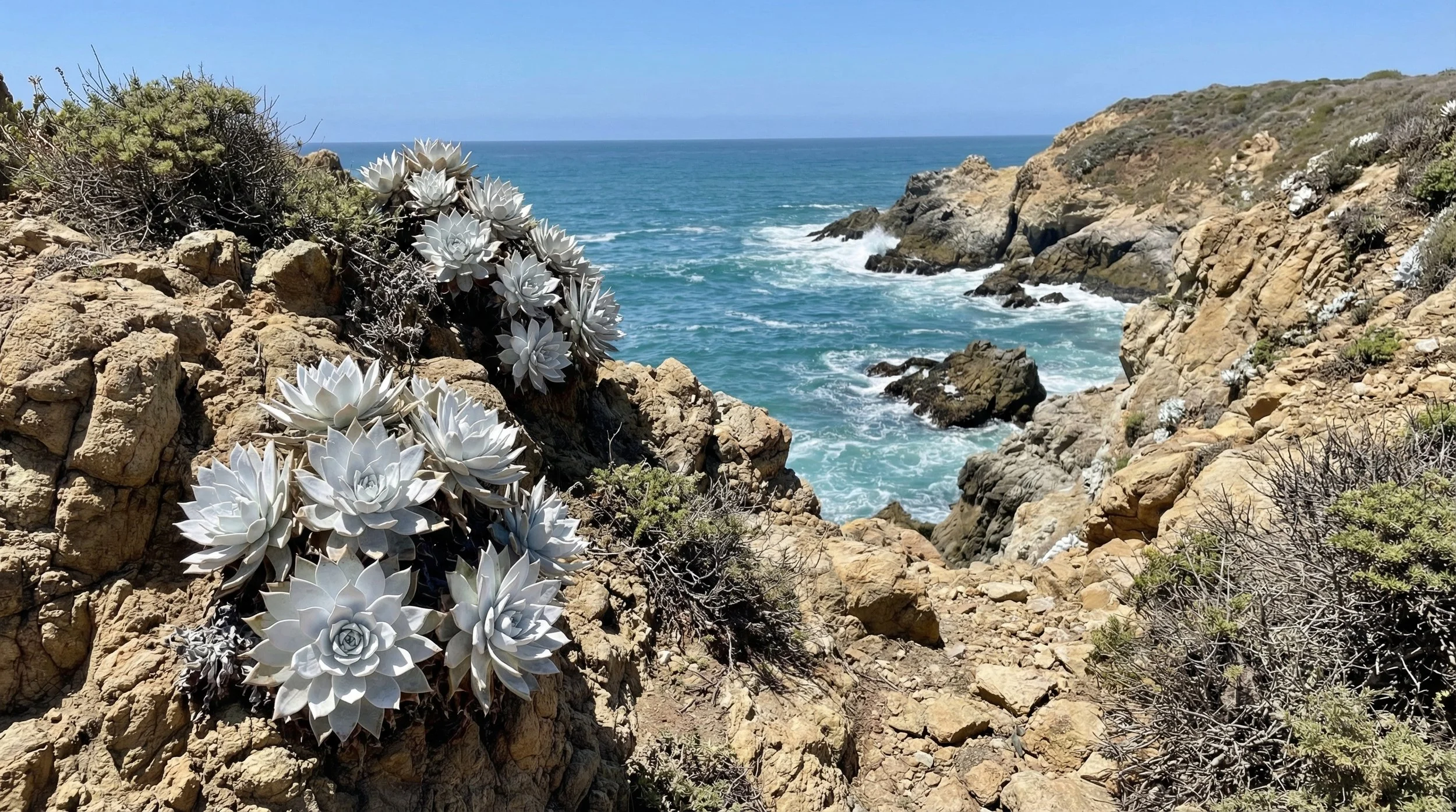
Dudleya are the only succulents truly native to the California coast, with several species growing wild on Santa Cruz County's sea cliffs and rocky bluffs. According to the California Native Plant Society, the genus includes 47 species and 21 subspecies, 26 of them native to California and growing along coastal cliffs, and more than half of California's dudleyas are ranked as rare. For local gardeners, Dudleya offer something no imported succulent can: a plant that evolved over millennia to thrive in exactly the conditions your garden provides. If you are newer to growing succulents in Santa Cruz, Dudleya are among the best places to start.
These chalky, silvery rosettes are not just beautiful. They are drought-proof, fire-resistant, salt-tolerant, and ecologically valuable as habitat for native pollinators. They also carry a conservation story that every California gardener should know: wild Dudleya populations face serious threats from poaching, habitat loss, and invasive species. Growing Dudleya ethically in your garden is one small way to support this remarkable genus.
What Makes Dudleya Different from Other Succulents?
Dudleya belong to the Crassulaceae family, which also includes Sedum, Echeveria, and Sempervivum. They were first described scientifically in the late 1800s and named after William Russell Dudley, the first head of Stanford University's botany department.
What sets Dudleya apart is their native range. While almost every other succulent in California gardens originated on another continent (South Africa, Mexico, the Canary Islands, Madagascar), Dudleya evolved right here. Their native habitat stretches from southern Oregon to Baja California, with the greatest species diversity in Southern California. They grow on coastal bluffs, rocky outcrops, canyon walls, and serpentine soils, typically in spots with excellent drainage, some ocean influence, and minimal competition from larger plants.
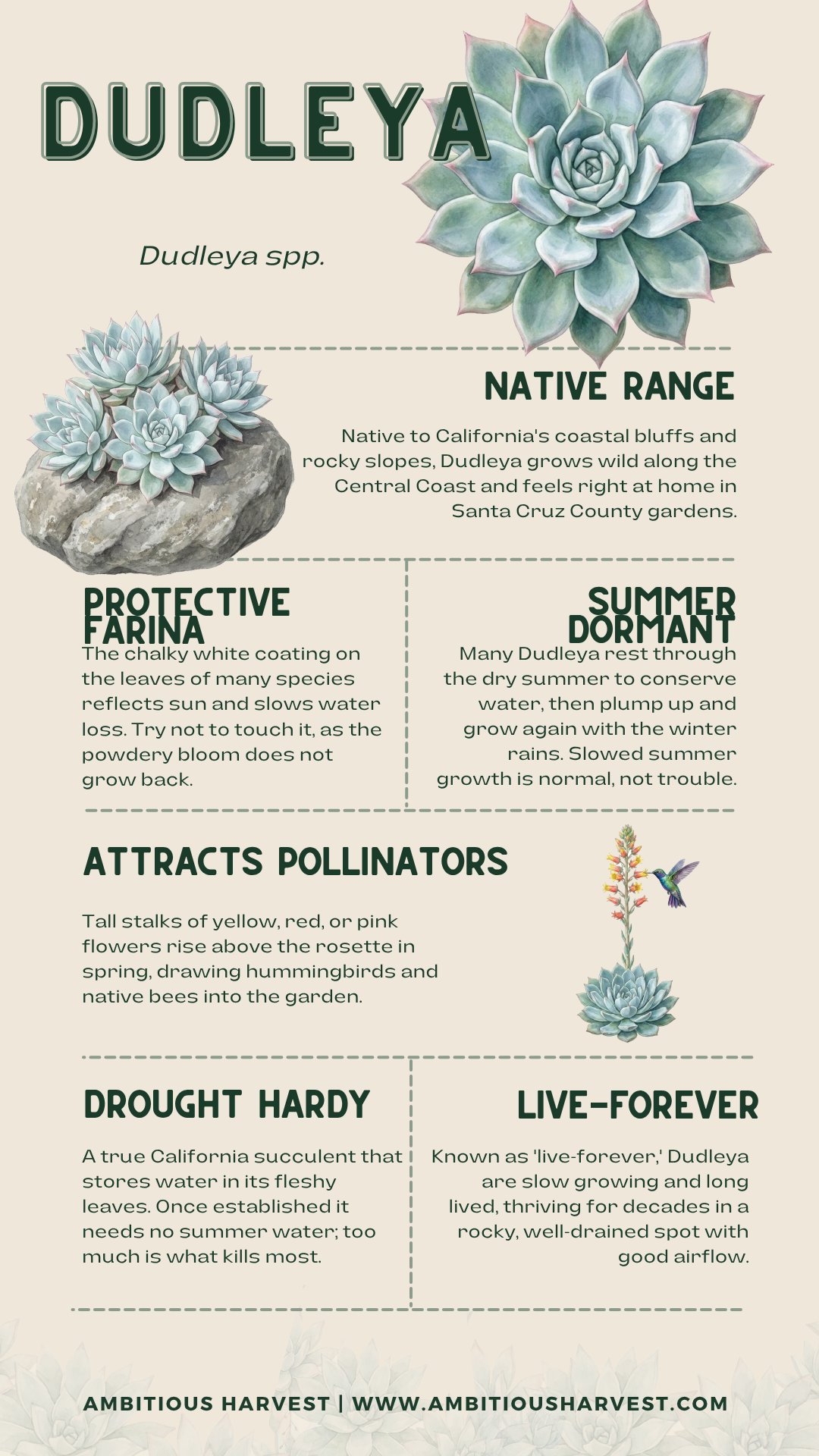
Dudleya are summer-dormant and winter-growing, following the natural rhythm of California's Mediterranean climate. They put on active growth during the cool, wet months from October through May, then slow down or go fully dormant during dry summer months. This dormancy pattern is an important distinction from many garden succulents that grow in summer. During dormancy, Dudleya may look a bit tired: outer leaves dry and curl inward, and the plant draws into itself. This is completely normal and not a sign of distress.
One of Dudleya's most distinctive features is farina, the powdery, waxy white coating that covers the leaves of many species. According to UC Master Gardener researchers, this chalky bloom serves multiple functions: it reflects intense sunlight (reducing heat stress), repels water (preventing rot in foggy conditions), and may deter some herbivores. The farina does not regenerate once rubbed off, so handle Dudleya carefully and avoid touching the leaves when planting.
Which Dudleya Species Can You Grow in Santa Cruz County?
Several Dudleya species are either native to our immediate area or adapted well to our conditions. Here are the most accessible and garden-worthy.
Dudleya farinosa (Bluff Lettuce)
This is the local species, growing wild on coastal bluffs from Monterey County to southern Oregon. You can see natural populations along the Santa Cruz County coastline. It forms compact rosettes 2 to 4 inches across, typically in clusters, with a heavy coating of white farina. Flower stalks appear in spring, bearing small pale yellow flowers that attract native pollinators.
In the garden, D. farinosa thrives in the same conditions it favors in the wild: rocky, fast-draining soil in a spot with ocean influence (fog, salt air). It handles full coastal sun, part shade, and the wettest winters without complaint, as long as drainage is excellent. This is the easiest Dudleya to grow in Santa Cruz and the best starting point for gardeners new to the genus.
Dudleya caespitosa (Coast Dudleya, Sea Lettuce)
Found along the Central California coast, D. caespitosa forms clusters of green to gray-green rosettes, typically 3 to 6 inches across. It has less farina than D. farinosa, giving it a greener appearance. The yellow flowers are held on branching stalks in spring and early summer.
D. caespitosa is adaptable and tolerant of garden conditions, handling a wider range of soils and light levels than some of the more specialized cliff-dwelling species. It is a good choice for rock gardens, raised beds, and mixed native plantings.
Dudleya pulverulenta (Chalk Dudleya)
Native to Southern California, D. pulverulenta is the dramatic one. It produces large solitary rosettes (up to 18 inches across in ideal conditions) covered in brilliant chalky white farina. The rosettes are striking, looking almost like living sculptures dusted in fresh snow. Flower stalks can reach 3 feet tall, bearing red to coral flowers.
While not native to Santa Cruz, D. pulverulenta grows beautifully here in well-drained, sunny locations. It is less cold-hardy than our native D. farinosa, so plant it in the warmest available microclimate (south-facing wall, protected coastal spot) and provide frost cloth if temperatures drop below 28 degrees.
Dudleya brittonii (Giant Chalk Dudleya)
Another Southern California and Baja native, D. brittonii is prized for producing the whitest farina of any Dudleya species. Individual rosettes can reach 12 to 18 inches across, and the chalky white coating is so thick that the plant looks almost artificial. It is cold-hardy to about 25 degrees Fahrenheit, making it borderline for the coldest Santa Cruz locations but fine along the coast.
Dudleya cymosa (Canyon Dudleya)
Found in rocky canyons and outcrops in the Coast Ranges, D. cymosa is more compact than the chalk dudleyas, with green to reddish rosettes 2 to 4 inches across. The bright yellow to orange-red flowers are particularly showy. Several subspecies exist, adapted to different local conditions. This species works well in rock gardens and walls.
Dudleya lanceolata (Lance-Leaved Dudleya)
A widespread species with narrow, lance-shaped leaves that are green to reddish, often without heavy farina. Found naturally from the San Francisco Bay Area to Baja California. D. lanceolata is among the more adaptable species for garden use, tolerating a broader range of conditions than strictly coastal types.
Why Is Dudleya Conservation a Serious Issue?
In recent years, Dudleya poaching has become a significant conservation crisis in California. Wild Dudleya populations, particularly rare species, have been targeted by organized poaching operations that strip entire cliff faces of plants for sale in overseas succulent markets, especially in East Asia, where Dudleya have become highly fashionable collectors' items.
According to the California Department of Fish and Wildlife, multiple large-scale poaching busts have occurred since 2018, with some cases involving thousands of illegally harvested plants. In several incidents, poachers were caught with vehicle loads of Dudleya stripped from coastal bluffs in Humboldt, Mendocino, and San Luis Obispo counties. Federal and state wildlife trafficking charges have been filed in multiple cases.
The impact on wild populations is severe. Many Dudleya species have small, localized populations. Removing even a few dozen plants from a cliff can eliminate a significant portion of a local population, and recovery is slow because Dudleya grow slowly and have specific habitat requirements.
What California law says:
Collecting native plants from public land without a permit is illegal under California law
Dudleya species are protected under the California Endangered Species Act where they are listed as threatened or endangered
Several species have additional federal protection under the Endangered Species Act
Even common Dudleya species are protected from collection on state and federal lands
Trafficking in illegally collected native plants can result in felony charges
What this means for gardeners:
Never collect Dudleya from the wild, even if they appear abundant. The plant you see clinging to a sea cliff may be part of a genetically distinct population that has taken decades or centuries to establish. Purchase only nursery-propagated plants from reputable sources. Ask your nursery about the provenance of their Dudleya stock. Ethical nurseries propagate from legally obtained mother plants and can tell you where their stock originated.
Several California native plant nurseries propagate Dudleya from seed or division and are good sources for garden plants. The UC Santa Cruz Arboretum plant sales sometimes include Dudleya. The California Native Plant Society chapter sales are another reliable source.
How Do You Plant and Grow Dudleya in Your Garden?
Site Selection
Dudleya want three things from their planting site: excellent drainage, good air circulation, and at least a few hours of direct sun.
In Santa Cruz County, the best sites are:
South or west-facing slopes and banks: Natural drainage, maximum sun exposure, and air movement. This is the closest analog to their native cliff habitats.
Rock walls and retaining walls: Dudleya thrive when planted in crevices or pockets in rock walls, where drainage is instantaneous and roots stay cool.
Raised rock gardens: Mound or berm a planting area with a mix of well-drained soil and rocks, then tuck Dudleya into pockets among the stones.
Containers: Excellent option for controlling drainage. Use terra cotta or hypertufa with a very gritty mix (60 to 70 percent pumice or perlite).
Sites to avoid: - Flat ground with heavy clay soil (waterlogging is guaranteed during winter rains) - Under trees or roof lines where drip concentrates on the plants - North-facing exposures with limited sun (Dudleya tolerate part shade but perform best with sun) - Irrigated beds near lawn or other plants that receive regular watering
Soil Preparation
If your soil does not drain very quickly, create a raised planting area or amend heavily. A good in-ground mix for Dudleya:
50 percent native soil (if sandy or loamy) or 30 percent native soil (if clay-heavy)
30 to 50 percent pumice, perlite, or crushed rock
20 percent coarse sand or decomposed granite
The goal is a mix that feels gritty, almost gravelly. Water poured onto this soil should absorb and drain through within seconds.
Top-dress around Dudleya with crushed rock or gravel, not bark mulch. This keeps moisture away from the crown (the critical junction between stem and roots where rot starts) and mimics the rocky substrate of natural Dudleya habitat.
Planting Technique
Plant Dudleya at or slightly above the surrounding soil level, never in a depression where water collects. If planting on a slope, angle the rosette slightly downward so that rain and condensation drain off the leaves rather than pooling in the center.
This angled planting is important because Dudleya rosettes are shaped like shallow cups. In nature, they grow on cliff faces and slopes where gravity keeps water from sitting in the crown. In a flat garden bed, water can accumulate in the rosette center and cause crown rot, especially during prolonged winter rains.
Handle plants gently to avoid rubbing off the farina. Hold them by the root ball or the base of the stem, not by the leaves.
Do not water immediately after planting. Wait 5 to 7 days to let roots callus, then give a deep watering and allow the soil to dry completely before watering again.
Watering
Once established (after one to two growing seasons), Dudleya typically need no supplemental irrigation in Santa Cruz County. They are adapted to survive on rainfall and fog moisture alone. The UC Marin Master Gardeners emphasize that overwatering is the primary cause of failure with Dudleya in garden settings.
During the first year, provide occasional deep watering during the dry season (June through September) to help roots establish. Once a month is sufficient. After the first year, the only time you should water established Dudleya is during an unusually prolonged dry spell (more than 6 to 8 weeks without any fog or rain), which is rare in our coastal climate.
In winter, do not water at all. Rain provides everything Dudleya need, and the combination of supplemental irrigation plus rainfall is a recipe for rot.
Fertilizing
Dudleya are adapted to nutrient-poor soils and require no fertilizer. In fact, fertilizing Dudleya can do more harm than good, promoting soft, leggy growth that is more vulnerable to rot and pests. Calscape lists Dudleya as needing fast-draining soil and very low summer water, no more than once a month once it is established. Leave them alone and let them grow at their own pace.
How Can You Use Dudleya in Landscape Design?
Dudleya are versatile landscape plants that work in many styles:
Rock gardens: This is the classic and most natural use. Build a mounded rock garden with local stone, fill pockets with fast-draining soil, and tuck Dudleya into crevices and ledges. Combine with other California natives like Eriogonum (buckwheat), Salvia (sage), and Eschscholzia (California poppy) for a fully native, zero-irrigation planting.
Living walls and vertical gardens: Dudleya's natural cliff-dwelling habit makes them ideal for living walls. They can grow in very little soil, their shallow roots grip into minimal substrates, and their rosette form is visually striking when viewed from below or at eye level. Gabion walls filled with rock can incorporate planting pockets for Dudleya.
Fire-wise Zone 0 plantings: Dudleya's high water content makes it naturally fire-resistant. Succulents hold a lot of water in their leaves, which is why they show up in fire-wise planting plans, though CAL FIRE asks that the first 5 feet around a structure stay clear of plants and be hardscaped with gravel, pavers, or concrete instead. A gravel-mulched bed of Dudleya directly adjacent to your home provides both beauty and fire safety.
Mixed native plantings: Combine Dudleya with other drought-adapted California natives for a planting that requires no irrigation, no fertilizer, and minimal maintenance once established. Good companions include: - Eriogonum fasciculatum (California buckwheat) - Salvia clevelandii (fragrant sage) - Erigeron glaucus (seaside daisy) - Armeria maritima (sea thrift) - Achillea millefolium (yarrow)
Green roofs and rooftop gardens: Dudleya's shallow root system, low water needs, and low weight make it an excellent candidate for green roof applications in coastal California. Several commercial green roof projects in the state have incorporated Dudleya species successfully.
Erosion control on slopes: Dudleya's root systems, while shallow, grip into rocky substrates effectively. Combined with Sedum and other mat-forming succulents, Dudleya can stabilize slopes while requiring no irrigation or maintenance. For more options, see our guide to the best succulents for coastal California. This is an excellent alternative to invasive ice plant (Carpobrotus edulis) for slope stabilization.
How Do You Propagate Dudleya?
Dudleya propagation is slower than most garden succulents (see our general guide to propagating succulents), which is another reason why wild collection is so damaging. Plants grow slowly and take years to reach maturity.
From offsets (division): Many Dudleya species produce offsets (pups) around the base of the mother plant. These can be carefully separated in spring or early fall when the plant is actively growing. Use a clean, sharp knife to cut the offset from the parent, ensuring each piece has some roots. Let the cut surface callus for several days in a dry, shaded location before planting in gritty soil. Water sparingly until new root growth is evident.
From seed: Dudleya can be grown from seed, but it requires patience. Seeds are tiny and germination is often irregular. Sow seeds on the surface of a moist, gritty mix (do not bury them), keep them in bright indirect light, and maintain light moisture until germination occurs (2 to 6 weeks). Seedlings grow very slowly, taking several years to reach transplanting size. This is primarily a method for dedicated propagators and native plant nurseries.
From leaf cuttings: Unlike Echeveria, Dudleya do not propagate reliably from individual leaf cuttings. This method is not recommended for most species.
Ethical propagation: If you have an established Dudleya in your garden that produces offsets, propagating and sharing them with other gardeners is a wonderful way to spread these plants without any impact on wild populations. Consider donating propagated plants to local native plant sales.
What Problems Affect Dudleya in the Garden?
Dudleya are tough, but they are not immune to problems. Many of these issues are common across all succulents in our climate (see succulent problems in California).
Crown rot: The most common issue, caused by water sitting in the rosette center during winter. Prevention is far easier than treatment: plant on a slope or angle, ensure excellent drainage, never overhead irrigate, and avoid flat planting in areas that receive direct rainfall. If rot appears (softening at the base, blackening of the stem), you can sometimes save the plant by cutting above the rotted area, letting the cut callus, and replanting in very dry conditions. But prevention is the better strategy.
Mealybugs: These small white, cottony pests cluster in leaf axils and on the undersides of leaves. Treat with 70 percent isopropyl alcohol on a cotton swab for small infestations. UC IPM guidelines recommend insecticidal soap or horticultural oil for larger outbreaks.
Bird damage: This is a real and underappreciated problem for Dudleya. Some bird species (particularly scrub-jays and crows) have been observed pulling leaves from Dudleya rosettes, possibly for moisture or nesting material. Protective mesh or bird netting may be needed in areas with heavy bird activity, at least until plants are well-established.
Snails and slugs: In our humid coastal climate, snails and slugs can damage Dudleya leaves, especially young plants. Copper tape around containers, iron phosphate baits (safe for wildlife), and hand-picking are effective controls.
Invasive plant competition: In natural habitats, Dudleya face intense competition from invasive species, particularly Carpobrotus edulis (highway ice plant), which smothers native vegetation. In your garden, keep invasive groundcovers away from Dudleya plantings.
Never collect dudleya from the wild. Buy from a grower who propagates their own stock instead, and our guide to the succulent nurseries worth the drive from Santa Cruz covers which ones do.
Frequently Asked Questions
Where can I buy Dudleya plants in the Santa Cruz area?
Look for nursery-propagated Dudleya at local native plant nurseries, California Native Plant Society chapter sales, and UC Master Gardener plant sales. The UC Santa Cruz Arboretum occasionally offers Dudleya at their plant sales. Some online California native plant nurseries ship Dudleya as well. Always ask about the provenance of the plants to ensure they are nursery-propagated, not wild-collected.
How long do Dudleya live?
Dudleya are remarkably long-lived for succulents. Some wild populations are estimated to be decades old, and individual rosettes can persist for many years. In garden conditions with good care, Dudleya can live 20 years or more. Their slow growth rate is part of what makes them so long-lived, and also part of why wild collection is so damaging to natural populations.
Can I grow Dudleya from seed collected from my own plants?
Yes, and it is an excellent way to propagate them ethically. Allow flower stalks to dry on the plant, then collect the tiny seeds from the dried capsules. Sow immediately in fall (when Dudleya naturally germinate in the wild) on the surface of moist, gritty soil. Be patient: seedlings are tiny and grow slowly. It may take 2 to 3 years before seedlings are large enough to transplant into the garden.
Do Dudleya need any special care during summer dormancy?
No, and this is one of the best things about growing them. During summer dormancy (roughly June through September), Dudleya need absolutely nothing from you. Do not water them, do not fertilize them, and do not be alarmed when outer leaves dry and curl. The plant is simply conserving energy and moisture until the rains return. Resume observation (but not necessarily watering) when fall rains begin and the plant shows new growth.
Can Dudleya grow in full shade?
Dudleya tolerate part shade (3 to 4 hours of direct sun with bright indirect light the rest of the day), but they do not thrive in full shade. In deep shade, Dudleya etiolate (stretch toward light), lose their compact rosette form, and become more vulnerable to rot. If your garden is mostly shaded, choose the sunniest available spot, such as a south-facing wall or the edge of a tree canopy where filtered light is strongest. Container planting allows you to position Dudleya in the best light.
Is it legal to collect Dudleya seed from wild plants?
Seed collection from wild plants on public land generally requires a permit, and regulations vary depending on the land management agency (state parks, national forests, BLM, etc.). Even where seed collection may be technically legal in small quantities, it is best to avoid disturbing wild populations entirely. Purchase plants or seeds from nurseries, propagate from your own garden plants, or participate in organized seed collection events led by native plant conservation groups.
Growing California natives is one of the most rewarding things you can do for your garden and for local ecosystems. For more native plant guides and water-wise gardening resources, join our free newsletter at Your Garden Toolkit.
