

Back to Eden Gardening: A No-Till, Wood Chip Mulch Method
A few of the product links in this guide are affiliate links. If you buy through one, Ambitious Harvest may earn a small commission at no extra cost to you, which helps keep these guides free. We only point to gear we would use in our own Santa Cruz garden. As an Amazon Associate, we earn from qualifying purchases. Read our full disclosure.
What Is Back to Eden Gardening and How Does It Work?
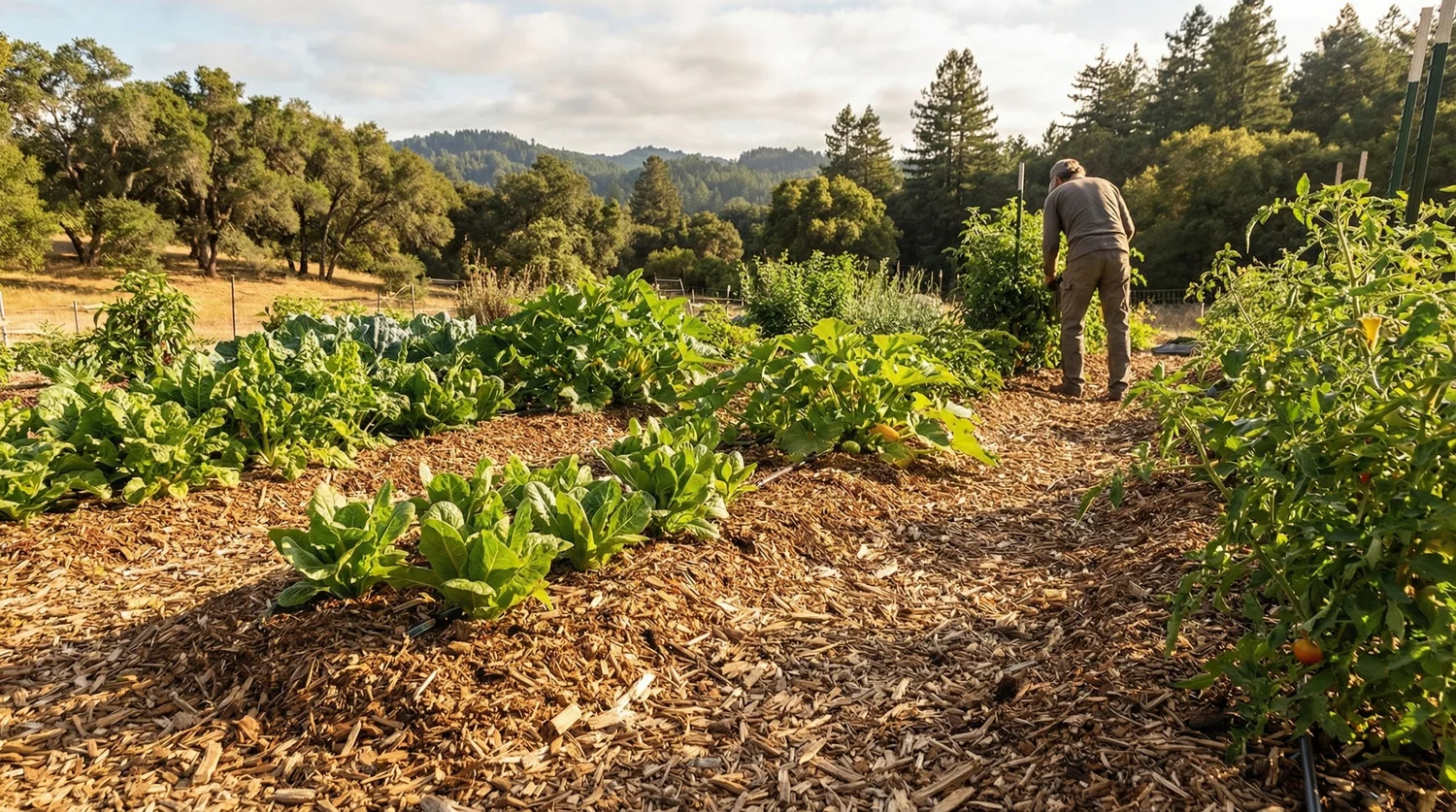
Back to Eden gardening is a no-till method that uses a deep, permanent layer of wood chip mulch to build soil, retain moisture, and suppress weeds without cultivation. UC research on wood chip mulch systems shows that a 4- to 6-inch layer of ramial wood chips (from branches under 3 inches in diameter) can reduce irrigation needs by 50 percent or more while increasing soil organic matter and biological activity over time. In Santa Cruz County, where dry summers demand water conservation and our coastal climate accelerates wood chip decomposition, this low-maintenance approach produces remarkably fertile gardens with minimal ongoing effort.
The method is based on observing forest floors, where fallen leaves, branches, and organic debris create a self-renewing layer of mulch that feeds the soil below. In a Back to Eden garden, you replicate this process by covering your growing area with a thick layer of wood chips. Over months and years, the bottom of the chip layer decomposes into dark, crumbly humus while the top layer continues to suppress weeds and hold moisture. You plant directly into the decomposed layer beneath the fresh chips, and the system largely takes care of itself. This guide covers how to source materials, build your beds, and manage this method in Santa Cruz County's specific conditions.
Where Can You Get Free Wood Chips in Santa Cruz County?
Wood chips are the primary input for this method, and the good news is that they are abundant and often free in our area. Sourcing enough chips is one of the most important steps in getting started.
Local arborists and tree service companies are the best source. When they chip trees and branches on job sites, they need to dispose of the material. Many companies will deliver a full truck load (typically 6 to 12 cubic yards) at no charge if you provide a convenient drop-off location. Contact tree services in the Santa Cruz area and let them know you accept chips. Some gardeners report receiving deliveries within days of making the request.
Chip Drop services and similar apps connect tree care professionals with gardeners who want free wood chips. You sign up, provide your address, and when an arborist finishes a job nearby, they deliver chips to your location. These services are active in the Santa Cruz and Monterey Bay area.
County and city green waste programs sometimes offer chipped material to residents. Check with local waste management services for availability.
Your own yard may provide chips if you own or rent a small electric chipper. Ramial wood chips (from branches under 3 inches in diameter) are superior to trunk wood chips because they contain more nutrients and decompose faster.
What to watch for: Avoid chips from black walnut trees (juglone inhibits many vegetables) and eucalyptus (oils slow decomposition). Cedar chips decompose slowly but are not harmful. A mix of species is generally fine and is what you will typically receive from an arborist.
For a standard Back to Eden garden, plan on 4 to 6 inches of chips over your entire growing area. One cubic yard of chips covers approximately 50 to 60 square feet at 6 inches deep. A 200-square-foot garden needs roughly 3 to 4 cubic yards to start, which is often a single arborist delivery.
How Do You Set Up a Back to Eden Garden From Scratch?
Setting up a Back to Eden garden requires some initial work, but the ongoing maintenance is dramatically less than conventional gardening. Here is the process adapted for Santa Cruz County conditions.
Step 1: Prepare the base. If you are converting lawn or weedy ground, start by laying a thick layer of newspaper (8 to 10 sheets) or flattened cardboard over the entire area. Overlap edges by 6 inches to prevent weeds from finding gaps. This smothering layer kills existing vegetation without any digging or herbicide use. Soak the cardboard or newspaper thoroughly after laying it.
Step 2: Add compost (optional but recommended). Spread 1 to 2 inches of finished compost or aged manure over the cardboard layer. This provides an immediate nutrient source and introduces beneficial soil organisms that will colonize the decomposing wood chips above. In Santa Cruz County, quality compost is available from local landscape supply yards and garden centers.
Step 3: Apply the wood chips. Cover the entire area with 4 to 6 inches of wood chips. Spread them evenly and do not compact them. The chips should rest loosely, allowing air and water to penetrate. This is your mulch, your weed barrier, and (eventually) your soil builder, all in one layer.
Step 4: Water deeply and wait. Soak the entire bed thoroughly. If you are setting up in fall (the ideal time in Santa Cruz), winter rains will keep the bed moist and drive decomposition. If setting up at another time, water weekly to keep the chip layer damp. Decomposition is fastest when chips stay consistently moist.
Step 5: Wait for decomposition to begin. The wood chip layer needs time to start breaking down before you plant in it. The bottom inch or two of chips will darken and soften within two to three months in our climate. You will see white fungal threads (mycelium) running through the chips, which is a sign of healthy decomposition. This fungal activity is beneficial and should be encouraged, not disturbed.
Timing note: If you set up your Back to Eden garden in October or November, it will be ready for spring planting. The wet winter months accelerate decomposition significantly. If you set up in spring and want to plant immediately, add extra compost on top and plant transplants into the compost layer while the chips below continue to decompose.
How Do You Plant in a Wood Chip Garden?
Planting technique in a Back to Eden garden is slightly different from conventional gardening. Understanding the method prevents common mistakes.
For transplants: Pull the wood chips aside to create a planting pocket, exposing the decomposed layer or compost beneath. Dig a hole in this lower layer, plant your transplant at the appropriate depth, firm the soil around it, and then push the wood chips back to within 2 to 3 inches of the plant stem. Leave a small chip-free zone around the stem to prevent moisture-related rot. The chips will continue to suppress weeds and hold moisture around the plant while staying off the stem itself.
For direct seeding: Clear a row or block in the chips down to the decomposed soil or compost layer below. Plant seeds into this exposed soil and keep the area chip-free until seedlings are 3 to 4 inches tall. Then gradually push chips close to (but not touching) the young plants. This is important because wood chips against tiny seedlings can smother them or create conditions for damping-off disease.
For root crops: Carrots, beets, radishes, and other root vegetables grow best in the fully decomposed layer beneath the chips, where the soil is loose and uniform. Clear chips away from the planting row entirely and do not replace them until after harvest. Root crops need soil contact, not chip contact, for proper development.
For perennial crops and fruit trees: The Back to Eden method excels with perennials. Spread chips in a wide ring around established fruit trees, berry bushes, and perennial herbs. Keep chips 6 inches away from tree trunks and woody stems to prevent moisture damage and rodent harboring. Over time, the chip ring builds incredible soil that feeds the trees naturally.
As seasons pass, the chip layer decomposes from the bottom up. What was once recognizable wood chips becomes dark, rich compost. You plant into this decomposed layer and add fresh chips on top to maintain the mulch depth. The system is self-renewing as long as you replenish the surface chips periodically.
What Are the Pros and Cons for Santa Cruz County Gardeners?
The Back to Eden method has genuine strengths and real limitations in our Central Coast climate. Weighing both helps you decide whether it suits your garden.
Pros specific to Santa Cruz County:
- Water conservation. The thick chip layer dramatically reduces evaporation during our dry summers. Many Back to Eden gardeners in mild coastal climates report watering 50 to 75 percent less than conventional gardens. This matters during drought years and water restrictions.
- Year-round decomposition. Unlike cold-climate regions where decomposition stops in winter, our mild temperatures keep fungi and microbes active in every month. Wood chips break down faster here than in most parts of the country.
- Slug management assistance. While wood chips can harbor slugs (a drawback discussed below), the open, loose structure of fresh chips is actually less hospitable to slugs than dense, moist ground-cover mulches like straw. Results are mixed, and slug management remains necessary.
- Excellent for fruit trees. Santa Cruz County's fruit trees (citrus, apple, stone fruit, avocado) respond beautifully to wood chip mulching. The slow nutrient release and consistent moisture mimic the forest-floor conditions where many fruit tree species evolved.
- Weed suppression. A 4- to 6-inch chip layer blocks most annual weed seeds from germinating. In our climate, where year-round warmth means year-round weed pressure, this is a significant time saver.
- Free materials. Arborist chips are abundantly available in our area, keeping setup costs near zero.
Cons specific to Santa Cruz County:
- Slug and snail habitat. The moist environment under wood chips can provide shelter for slugs and snails, which are already among our most persistent garden pests. Some gardeners find that chip-mulched beds require more slug management than bare-soil or straw-mulched beds. Iron phosphate bait and evening hand-picking help manage this issue.
- Slow start for annual vegetables. Wood chips take time to decompose into plantable soil. The first season may produce mediocre results for annual vegetables unless you supplement with compost. Expect the system to improve significantly in year two and beyond.
- Nitrogen tie-up in early stages. Fresh wood chips temporarily bind soil nitrogen as microbes consume it during decomposition. This can cause yellowing in nearby plants, especially leafy greens and young transplants. Adding nitrogen-rich amendments (blood meal, fish meal, or composted manure) to the planting zone prevents this.
- Not ideal for small-seeded crops initially. Carrots, lettuce seed, and other small seeds need fine, uniform soil to germinate. The coarse texture of decomposing chips is not suitable until fully broken down (usually year two or three).
- Aesthetic concerns. Some homeowners and HOAs find wood chip gardens less attractive than traditional beds. The appearance improves as chips age and darken, but a freshly chipped garden looks rough.
- Fire considerations in mountain areas. In the Santa Cruz Mountains and other fire-prone areas, large quantities of wood chips near structures may be a fire risk during dry season. Maintain defensible space per Cal Fire guidelines and keep chips away from buildings in high-risk zones.
What Grows Well in a Back to Eden Garden in Our Climate?
Some crops thrive in wood chip mulch systems from the very beginning, while others need the system to mature for a season or two before they perform well.
Excellent from year one:
- Tomatoes: Thrive in the warm, moisture-stable conditions under chip mulch. Plant transplants through the chips into compost-amended soil below. The consistent moisture reduces blossom end rot, a common calcium-uptake problem caused by inconsistent watering.
- Squash and pumpkins: Their aggressive root systems handle the coarse texture of decomposing chips without difficulty. Summer squash, winter squash, and pumpkins all perform well.
- Potatoes: An exceptional crop for Back to Eden gardens. Lay seed potatoes on the soil surface, cover with 6 inches of chips, and harvest by simply pulling back the mulch. The potatoes develop in the decomposing layer, clean and undamaged.
- Perennial herbs: Rosemary, thyme, oregano, sage, and lavender love the well-drained conditions and steady moisture of a chip-mulched bed. These Mediterranean herbs are well-suited to Santa Cruz's climate already, and wood chip mulch enhances their performance.
- Fruit trees and berries: Blueberries, raspberries, blackberries, strawberries, and all types of fruit trees benefit immediately from wood chip mulching.
Good from year two onward:
- Peppers: Perform adequately in year one with compost amendments but really thrive once the chip layer has partially decomposed and nitrogen availability stabilizes.
- Beans and peas: As nitrogen fixers, these legumes are less affected by nitrogen tie-up than other crops. They grow well from year one but produce even better once the soil biology is established.
- Brassicas: Broccoli, cauliflower, cabbage, and kale are heavy feeders that benefit from the rich soil that develops as chips decompose. Supplement with nitrogen in year one.
Wait for year three:
- Root crops: Carrots, beets, radishes, and parsnips need fully decomposed, fine-textured soil for straight root development. By year three, the original chip layer has broken down sufficiently for these crops.
- Direct-seeded small seeds: Lettuce, spinach, and other fine-seeded crops germinate best in the smooth, crumbly soil that develops after two to three years of chip decomposition.
How Do You Maintain a Back to Eden Garden Over Time?
One of the method's greatest appeals is its low maintenance. Once established, a Back to Eden garden requires significantly less work than conventional growing methods.
Replenish chips annually. Add 2 to 3 inches of fresh wood chips each fall or early winter. This maintains the mulch depth, continues the soil-building process, and refreshes the weed-suppressing layer. Over time, you need less because the existing chips decompose more slowly as the easily digestible materials are consumed first.
Never till or turn the soil. The entire system depends on undisturbed soil biology. Fungal networks (mycorrhizae) that develop in the decomposing chip layer are extremely beneficial for plant nutrient uptake but are destroyed by tilling. Earthworm channels and beneficial insect habitat are similarly disrupted by cultivation. Leave the soil alone and let biology do the work.
Add nitrogen selectively. In the first two years, side-dress heavy-feeding crops with blood meal, fish meal, or composted chicken manure to compensate for nitrogen tie-up. Apply these amendments in the planting zone, not broadcast over the chips. By year three, nitrogen availability typically stabilizes as the decomposition process reaches equilibrium.
Monitor moisture. Check soil moisture under the chips by pushing your hand through the mulch layer. The soil below should feel cool and slightly moist, not dry and not waterlogged. In Santa Cruz's dry summers, you may still need to water weekly, but the chip layer reduces frequency dramatically compared to bare-soil or lightly mulched gardens.
Manage paths and borders. Use landscape edging or raised bed borders to keep chips contained. Pathways between beds can also be mulched with chips, creating a unified, low-maintenance garden space.
Observe and adapt. Pay attention to which crops perform best in your specific setup. Keeping a garden journal helps you track what works and refine your approach each season.
The method rests on a bigger point: you do not need to till your soil every spring.
Frequently Asked Questions
Will wood chips make my soil too acidic?
This is a common concern that UC research has largely dispelled. Wood chip mulch applied to the soil surface has minimal effect on soil pH. The decomposition process at the soil-chip interface may temporarily lower pH slightly in that narrow zone, but this does not affect the root zone of most vegetables meaningfully. If you are growing acid-loving crops like blueberries, the slight acidification is actually beneficial. Test your soil if concerned, but most Santa Cruz gardeners find pH remains stable.
Do wood chips rob nitrogen from the soil?
Fresh wood chips on the soil surface can temporarily tie up nitrogen in the top inch or two where chips contact soil. This affects shallow-rooted seedlings more than established plants with deeper root systems. The effect is most noticeable in the first year and diminishes as the chips age. Adding nitrogen-rich amendments like blood meal or fish meal to the planting zone prevents deficiency symptoms. By year two or three, the decomposing chips actually release nitrogen.
Can you use dyed or treated wood chips?
Avoid dyed chips (red, black, or brown colored) in vegetable gardens. The dyes are generally considered nontoxic, but they indicate the chips were made from recycled wood products that may contain construction materials, pressure-treated lumber, or other contaminants. For food gardens, use only natural, undyed chips from known tree sources. Arborist chips are always natural and are the best choice.
How thick should the wood chip layer be?
Start with 4 to 6 inches of chips over the entire growing area. This depth provides effective weed suppression, meaningful moisture retention, and enough material for ongoing decomposition. Thinner layers (2 to 3 inches) still provide some benefit but need more frequent replenishment. Avoid layers thicker than 8 inches, which can create anaerobic conditions and prevent water from reaching the soil below.
How long before a Back to Eden garden is fully productive?
Expect modest results in year one for annual vegetables, noticeably better results in year two, and excellent results by year three. Perennial crops, fruit trees, and squash-family plants often show strong performance from the first season. The system improves every year as decomposition builds increasingly rich soil. Many practitioners describe year three as the point where the garden "takes off" and becomes nearly self-sustaining.
Is the Back to Eden method good for raised beds?
Yes. Wood chip mulch works extremely well inside raised bed frames. Fill the bottom of the bed with coarse material for drainage, add a layer of compost or garden soil, and top with 4 to 6 inches of wood chips. The raised bed walls contain the chips neatly and the combination of raised bed convenience with Back to Eden soil building produces outstanding results. This is a popular approach in Santa Cruz neighborhoods where aesthetics matter.
Can you use fresh wood chips, or do they need to age?
You can use fresh chips directly as a surface mulch. The nitrogen tie-up issue is primarily a concern at the chip-soil interface, not through the entire chip layer. However, if you plan to mix chips directly into soil (which is not recommended in this method), aging them for three to six months is advisable. For standard Back to Eden application as a surface mulch, fresh arborist chips are fine and actually provide more nutrients as they decompose than fully aged chips.
What about fire risk with wood chips in Santa Cruz County?
In fire-prone areas of the Santa Cruz Mountains and rural county, thick wood chip mulch near structures can be a fire concern during dry season. Follow Cal Fire defensible space guidelines: maintain a minimum 5-foot non-combustible zone around structures, and keep chips moist during high fire danger periods. In urban and coastal Santa Cruz, fire risk from garden mulch is minimal. Wet winter chips that have partially decomposed are far less flammable than dry, fresh chips.
Try the Back to Eden Method This Season
Back to Eden gardening is one of the simplest and most sustainable approaches to building garden soil. A single load of free arborist chips, spread over cardboard, starts a soil-building process that improves year after year with almost no ongoing effort. In Santa Cruz County's mild climate, decomposition stays active year-round, accelerating the transformation from raw chips to rich, living soil.
For research-based guidance on wood chip mulch and no-till methods, see UC Master Gardeners' Wood Chips: Pros and Cons, UC ANR's Work Less and Grow More with No-Till Gardening, and the UC Master Gardener mulch resource page.
Visit Your Garden Toolkit for planting guides, soil-building resources, and seasonal calendars to help you plan your no-till garden.
