

Growing Herbs on Your Windowsill in California: What Actually Thrives Indoors
A few of the product links in this guide are affiliate links. If you buy through one, Ambitious Harvest may earn a small commission at no extra cost to you, which helps keep these guides free. We only point to gear we would use in our own Santa Cruz garden. As an Amazon Associate, we earn from qualifying purchases. Read our full disclosure.
Some herbs grow well on a California windowsill; others struggle no matter what you do. According to UC ANR indoor herb growing guidelines, herbs like chives, mint, and parsley are among the most reliable choices for indoor growing, while sun-loving Mediterranean herbs like rosemary and full-size basil often underperform without supplemental lighting. In Santa Cruz and along the fog belt, where marine fog can reduce natural light for weeks at a time, understanding which herbs are realistic for indoor growing saves you both frustration and money.
Why Do Some Herbs Struggle Indoors While Others Thrive?
The fundamental challenge with growing herbs indoors is light. Most culinary herbs evolved in open, sunny environments. Outdoors in Santa Cruz, even during foggy summer months, herbs receive far more light than they do behind a window.
A south-facing window in a typical Santa Cruz home provides roughly 4 to 6 hours of direct sunlight during the spring and fall equinox periods. During summer, coastal fog can reduce this significantly. During winter, the lower sun angle and shorter days drop available light even further.
Most herbs need a minimum of 6 hours of direct sunlight to grow vigorously. Some, like basil and rosemary, prefer 8 or more hours. This is why indoor herb growing often disappoints: the plants survive but do not thrive. They become leggy, pale, and produce less of the aromatic oils that give herbs their flavor.
However, the story is not all discouraging. Several herbs are genuinely tolerant of lower light conditions and adapt well to indoor growing. And for those that need more light, a simple, affordable grow light makes a meaningful difference.
Understanding this distinction between "herbs that tolerate indoor conditions" and "herbs that need supplemental help" is the key to a successful windowsill herb garden.
What Herbs Actually Thrive on a Windowsill?
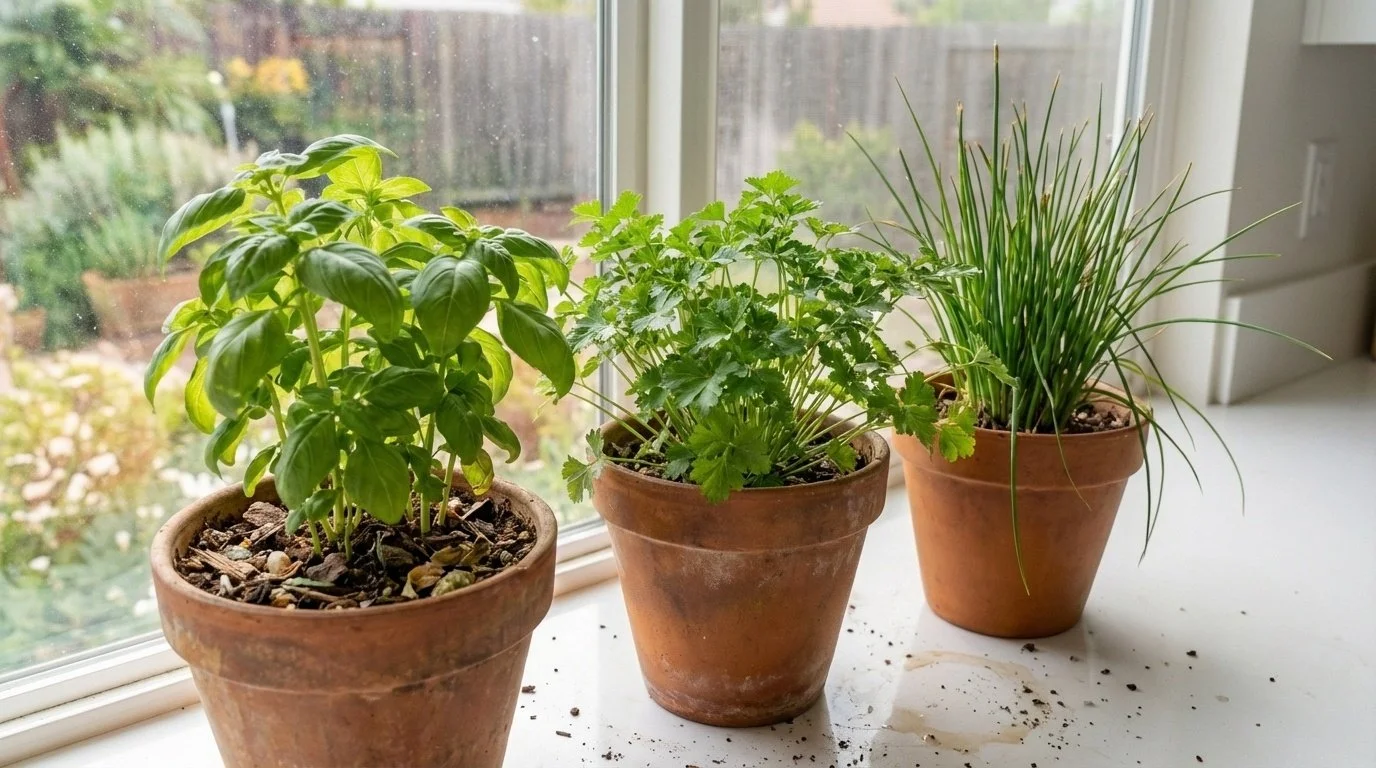
These herbs are your best candidates for a windowsill garden without supplemental lighting. They tolerate lower light, adapt to container growing, and maintain reasonable flavor production indoors.
Chives
Light needs: Moderate (4 to 6 hours) Indoor performance: Excellent Why it works: Chives are one of the most reliable indoor herbs. They tolerate lower light better than most alliums and continue producing even in less-than-ideal conditions. A pot of chives on a kitchen windowsill will slowly but steadily produce mild onion-flavored greens for snipping into eggs, soups, and salads. Cut from the outside edges and the plant continues growing from the center. Chives are also one of the few herbs that can handle the cooler temperatures near a window in winter.
Mint
Light needs: Moderate (4 to 6 hours) Indoor performance: Good to very good Why it works: Mint is a vigorous grower that adapts well to containers and moderate light. In fact, growing mint in a pot is often recommended even for outdoor gardens because its aggressive spreading habit can overwhelm garden beds. Indoors, a pot of mint stays contained and productive. Spearmint and peppermint both grow well on windowsills. The plant may become leggier indoors than outdoors, but regular harvesting (cutting stems back to a leaf node) keeps it bushy and productive. Mint also tolerates the humidity fluctuations common in Santa Cruz homes. For more on growing this versatile herb outdoors, see our guide to growing mint in Santa Cruz.
Parsley
Light needs: Moderate to bright (5 to 7 hours) Indoor performance: Good Why it works: Both flat-leaf (Italian) and curly parsley grow reasonably well indoors. They are slower-growing than in outdoor conditions, but a healthy plant in a south-facing window will produce enough for regular kitchen use. Parsley is a biennial, so a single plant can produce for many months before eventually bolting. Start from a small transplant rather than seed for faster results indoors, as parsley is notoriously slow to germinate (up to 3 weeks).
Cilantro
Light needs: Moderate (4 to 6 hours) Indoor performance: Moderate (with caveats) Why it works (and where it struggles): Cilantro actually prefers cooler conditions and will bolt (go to flower and seed) quickly in warm environments. This makes it a surprisingly good candidate for a cool windowsill during fall and winter in Santa Cruz. The challenge is that cilantro grows quickly, bolts, and needs to be replanted frequently. Think of indoor cilantro as a succession crop: plant a new small pot every 2 to 3 weeks for continuous harvest. Alternatively, grow cilantro as a microgreen for a faster, more reliable supply. For outdoor cilantro growing tips, see our Santa Cruz cilantro guide.
Oregano
Light needs: Moderate to bright (5 to 7 hours) Indoor performance: Moderate Why it works: Oregano is a hardy, adaptable herb that tolerates a range of conditions. It will not be as robustly flavored indoors as it is in full sun outdoors, but it produces adequately on a bright windowsill. Greek oregano is the best culinary variety. Keep the soil on the drier side, as oregano is drought-tolerant and prone to root rot in consistently moist conditions.
What Herbs Struggle Indoors Without Supplemental Light?
Be honest with yourself about these varieties. They can be grown indoors, but they will likely disappoint without a grow light.
Basil
Basil is the herb most people want to grow indoors, and it is also one of the most frustrating to grow on a windowsill alone. Basil is a tropical plant that needs warmth (above 65 degrees Fahrenheit at all times) and strong, direct light (6 to 8 hours minimum). On a Santa Cruz windowsill, basil frequently becomes leggy, pale, and susceptible to fungal issues. The leaves are smaller and less aromatic than outdoor-grown basil. If you are committed to indoor basil, use a grow light and keep the plant warm. Even then, expect more modest production than your summer garden delivers. For outdoor basil growing tips, see our basil growing guide.
Rosemary
Rosemary is a Mediterranean shrub that needs intense sunlight and excellent drainage. Indoors, it struggles with insufficient light, stagnant air, and the tendency for well-meaning growers to overwater it. UC Master Gardener publications note that rosemary needs a south-facing window with a minimum of 5 hours of sunlight, or fluorescent lights positioned 6 inches above the plants for 14 to 16 hours a day. If you want to try, choose a small, upright variety (not a trailing type), use a very well-draining potting mix (add extra perlite), water only when the soil is dry an inch down, and provide the brightest window available. Even so, rosemary is simply much better grown outdoors in California's climate.
Thyme
Like rosemary, thyme is a Mediterranean herb that craves full sun and dry conditions. It can survive on a bright windowsill but will grow slowly and produce less flavorful leaves than outdoors. If you have a south-facing window with strong afternoon sun, thyme may do passably well. Otherwise, grow it outdoors and bring cuttings inside for kitchen use.
Sage
Sage needs full sun and good air circulation. Indoors, it tends to become leggy and is prone to powdery mildew in the still, humid air of a home. Of the Mediterranean herbs, sage is perhaps the least suited to indoor growing.
Dill
Dill grows tall quickly and needs strong light. It also has a long taproot that does not adapt well to shallow pots. Indoor dill tends to be spindly and weak. Like cilantro, dill can be grown more successfully as a microgreen than as a full-size plant indoors.
How Do You Set Up a Windowsill Herb Garden in Santa Cruz?
Here is a practical setup guide optimized for Santa Cruz and coastal California conditions.
Choosing Your Window
South-facing is ideal. In Santa Cruz, a south-facing window receives the most consistent direct sunlight throughout the year. This is your best option for herbs without supplemental lighting.
West-facing is second best. Afternoon sun through a west-facing window provides several hours of direct light, though it may be hot and intense during summer months.
East-facing is adequate for low-light herbs. Morning sun is gentler and provides 3 to 4 hours of direct light. Chives, mint, and parsley can manage here.
North-facing is not suitable for most herbs without supplemental lighting. The indirect light from a north-facing window is simply not enough.
Containers and Soil
Use containers with drainage holes. This is non-negotiable. Herbs, especially Mediterranean varieties, will develop root rot quickly in waterlogged soil. Place a saucer underneath to catch drainage water and empty the saucer after watering.
For potting mix, use a well-draining blend. A standard potting mix with extra perlite (about 1 part perlite to 3 parts potting mix) works well for most herbs. For rosemary and thyme, increase the perlite ratio for even faster drainage.
Container size matters. Most herbs do well in 6 to 8-inch pots. Mint needs at least an 8-inch pot because of its vigorous root system. Chives can manage in a smaller 4 to 6-inch pot. Avoid very small pots (under 4 inches) because they dry out too quickly and restrict root growth.
Watering
The most common mistake with indoor herbs is overwatering. Indoors, soil dries more slowly than outdoors because there is less air movement and no wind. Check soil moisture before watering by inserting your finger about an inch into the soil. If it feels dry at that depth, water. If it feels moist, wait.
Water thoroughly when you do water, allowing water to flow through the drainage holes. Then do not water again until the soil dries. The frequency depends on your home's temperature, humidity, and the herb variety, but once or twice a week is typical for most herbs in Santa Cruz homes.
During winter, when homes are closed up and heating may reduce humidity, misting your herbs occasionally or placing pots on a pebble tray with water (not touching the bottom of the pot) can help maintain humidity around the plants.
Fertilizing
Indoor herbs need less fertilizer than outdoor plants because they are growing more slowly. A dilute liquid fertilizer (half-strength) applied every 4 to 6 weeks during the growing season is sufficient. Over-fertilizing can actually reduce the concentration of essential oils in herbs, making them less flavorful. The UC Master Gardener Program of Sonoma County notes that most potted herbs need fertile potting mix but little or no additional fertilizer, and woody-stemmed varieties like oregano, thyme, and sage should dry out between waterings.
Do You Need a Grow Light for a Fog Belt Home?
If you live in the Santa Cruz fog belt (particularly the western side of town, Westside neighborhoods, or areas closer to the coast), supplemental lighting makes a significant difference for indoor herbs.
Marine fog can reduce natural light to levels that even shade-tolerant herbs find challenging. During June and July, when Karl the Fog is at peak performance, your south-facing window might receive only 2 to 3 hours of direct sunlight on many days.
The good news is that effective grow lights for herbs are neither expensive nor complicated.
What to look for: - LED grow lights or full-spectrum LED shop lights - A light output of at least 2,000 lumens for a small herb garden (2 to 4 plants) - A timer (essential, so you are not manually switching lights on and off)
How to use them: - Position the light 6 to 12 inches above the top of the plants - Run the light for 10 to 14 hours per day (use a timer) - This supplements natural window light; you do not need to replace it entirely
Cost: - A basic 2-foot LED grow light costs $20 to $40 - A plug-in timer costs $5 to $10 - Electricity cost is minimal, a few dollars per month
For fog belt growers, the investment in a grow light transforms indoor herb growing from a frustrating exercise into a genuinely productive one. Basil, in particular, becomes much more viable with supplemental light.
How Do You Transition Indoor Herbs to Your Outdoor Garden?
One of the smartest strategies for California gardeners is starting herbs indoors and transitioning them outdoors when conditions are right. This works particularly well in Santa Cruz, where our mild climate allows outdoor herb growing for most of the year.
The key to successful transition is hardening off, gradually acclimating your indoor plants to outdoor conditions over 7 to 10 days.
Day 1-2: Place your herb pots outside in a shaded, protected spot for 2 to 3 hours, then bring them back inside.
Day 3-4: Increase outdoor time to 4 to 5 hours, still in mostly shade.
Day 5-7: Move plants into partial sun for 5 to 6 hours.
Day 8-10: Introduce full sun exposure for increasing periods. By day 10, the plants should be able to handle a full day outdoors.
Timing for Santa Cruz: The best transition window is late March through May, when outdoor temperatures are consistently above 55 degrees Fahrenheit at night and days are lengthening. For basil, wait until nighttime temperatures reliably stay above 50 degrees (typically April or May in Santa Cruz).
You can also go the other direction: bring outdoor herbs inside before winter to extend their productive life. Rosemary, sage, and thyme can be potted up from the garden in October and brought to a sunny windowsill for winter use. Just check for pests before bringing any outdoor plant inside.
What Are Realistic Expectations for an Indoor Herb Garden?
Realism serves you better than optimism when it comes to indoor herbs. Here is what to realistically expect:
Production will be lower than outdoors. An indoor herb plant may produce one-third to one-half the volume of the same plant grown outdoors in full sun. Plan your cooking accordingly.
Flavor will be milder. Herbs produce aromatic oils in response to sunlight, heat, and mild stress. The controlled, gentler indoor environment means less concentrated flavors. You may need to use more indoor-grown herbs in a recipe than you would use of outdoor-grown herbs.
Growth will be slower. What takes a week outdoors may take two or three weeks indoors. Be patient.
Some herbs will eventually decline. Even with good care, most herbs reach a point where they become woody, leggy, or exhausted after several months indoors. Replant or replace them rather than trying to revive a struggling plant.
It is still worth doing. Fresh herbs snipped from a windowsill pot, even if they are smaller and milder than their outdoor counterparts, are dramatically better than dried herbs from a jar. The convenience of having fresh chives, parsley, and mint steps away from your cutting board is real and meaningful.
Frequently Asked Questions
Can you grow herbs from grocery store cuttings on a windowsill?
You can root some herbs from fresh cuttings purchased at the grocery store. Basil, mint, and oregano root relatively easily in a glass of water. Place the cut end of a fresh stem (with lower leaves removed) in a glass of clean water, change the water every few days, and wait for roots to develop (usually 1 to 2 weeks). Once roots are an inch long, transplant into a pot with well-draining soil. Success rates vary, and the resulting plant may not be as vigorous as one started from seed or purchased as a nursery transplant.
How do you keep indoor basil from getting leggy and weak?
The primary cause of leggy indoor basil is insufficient light. If you do not have a south-facing window with strong direct sunlight, use a grow light. Beyond light, pinch off the growing tips regularly to encourage bushier growth. When you see a stem developing more than 3 or 4 sets of leaves, pinch off the top set. This redirects growth into side branches. Also, keep basil warm (above 65 degrees Fahrenheit) and avoid placing it near cold, drafty windows in winter.
Do indoor herbs attract pests?
Indoor herbs can attract common houseplant pests including fungus gnats, aphids, and spider mites. Fungus gnats are the most frequent issue and are usually caused by overwatering (the gnats lay eggs in moist soil). Let the top inch of soil dry between waterings to discourage them. Sticky yellow traps placed near your pots catch adult fungus gnats. For aphids and spider mites, a gentle spray of water or an application of insecticidal soap (available at local garden centers) is usually effective. Inspect new plants before adding them to your windowsill.
Is it better to start indoor herbs from seed or buy transplants?
For most indoor herb growers, buying small transplants or starter plants is the better approach. Starting herbs from seed indoors requires more light, more patience, and more space than most windowsills provide. Parsley takes up to 3 weeks to germinate; basil needs consistent warmth. A $3 to $5 transplant from a local nursery gives you a head start of 6 to 8 weeks over starting from seed. The exception is cilantro, which transplants poorly due to its taproot and is better started from seed directly in its final pot.
How long do windowsill herbs last before they need replacing?
It varies by herb. Chives can last for years in the same pot with minimal care. Mint can also persist indefinitely, though it benefits from dividing and repotting annually. Parsley is a biennial and will typically produce well for 6 to 10 months before bolting to seed. Basil may last 3 to 6 months indoors before becoming woody and less productive. Cilantro has the shortest indoor lifespan, bolting within 4 to 8 weeks, so plan for succession planting. When any herb becomes leggy, woody, or unproductive, start fresh with a new plant rather than trying to rehabilitate it.
Can you grow herbs under kitchen cabinet LED lights?
Under-cabinet LED lights in kitchens are designed for task lighting and typically do not provide the light intensity or spectrum that herbs need for meaningful growth. They might keep a small pot of chives alive for a few weeks, but they will not support sustained, productive growth. If you want to grow herbs in a spot without natural light, invest in an actual grow light designed for plants. The difference in output and spectrum is significant, and the cost is modest.
Ready to grow more of your own food, indoors and out? Download our free California Growing Guide at ambitiousharvest.com/your-garden-toolkit for seasonal planting tips, variety recommendations, and growing advice tailored to Santa Cruz and the Central Coast.
