

What to Feed Your Backyard Flock Year-Round in California
What to Feed Your Backyard Flock Year-Round in California
A complete feed formulated for the bird’s species and life stage should provide the base of a backyard flock’s diet. Laying hens need an appropriate layer ration or a veterinarian/extension-recommended mixed-flock program; scratch grain, garden forage, and kitchen scraps do not provide complete nutrition.
A few of the product links in this guide are affiliate links. If you buy through one, Ambitious Harvest may earn a small commission at no extra cost to you, which helps keep these guides free. We only point to gear we would use in our own Santa Cruz garden. As an Amazon Associate, we earn from qualifying purchases. Read our full disclosure.
What Commercial Feed Options Are Available at Santa Cruz County Feed Stores?
Your local feed store is the backbone of your flock's nutrition. Santa Cruz County has several reliable feed stores that carry quality poultry feed, and building a relationship with your feed store staff can save you time and money.
Westside Farm and Feed carries a range of poultry feeds from major manufacturers including Purina, Kalmbach, and Modesto Milling (a California-based organic option). They stock layer feed, all-flock/flock raiser, chick starter, scratch grains, and supplements. Staff can help you choose the right feed for your flock composition.
Corralitos Feed (Watsonville) is another solid option with good poultry feed selection. They tend to carry larger bag sizes (50-pound bags), which are more economical if you have space to store them properly.
The main feed types you will encounter:
Layer feed (16% protein): The standard daily feed for laying hens over 18 weeks old. Contains balanced protein, calcium (typically 3.5 to 4%), and vitamins formulated for egg production. Available in pellet, crumble, and mash forms. Pellets have the least waste; mash has the most. I use pellets for the reduced spillage.
All-flock or flock raiser (18% protein): A higher-protein formula suitable for mixed-species flocks (chickens, ducks, and geese together), growing birds, and non-laying birds. If you keep a mixed flock like I do, this is your base feed, with oyster shell offered separately for the layers. This approach lets each bird take the calcium it needs without forcing it on birds that do not need it.
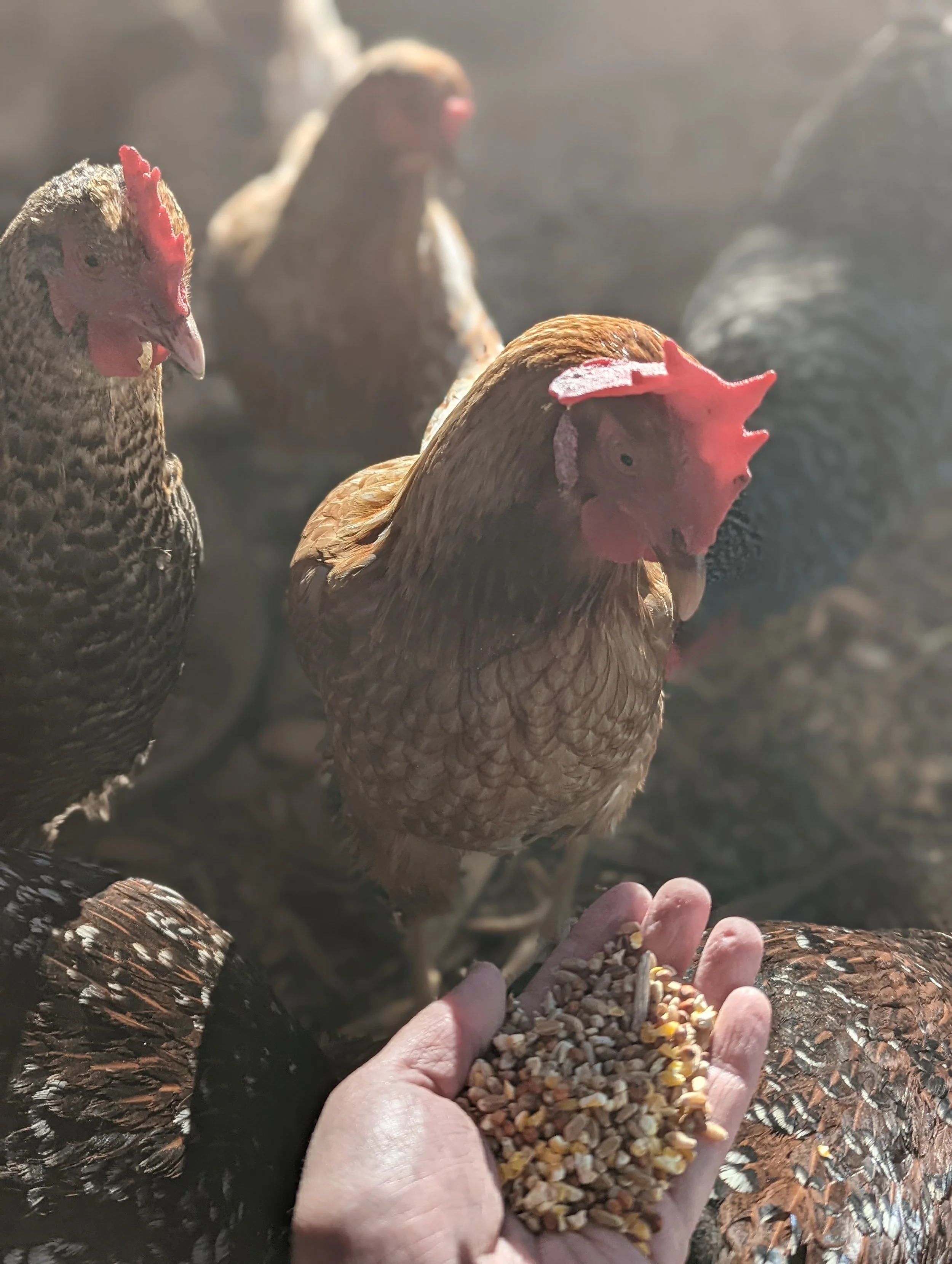
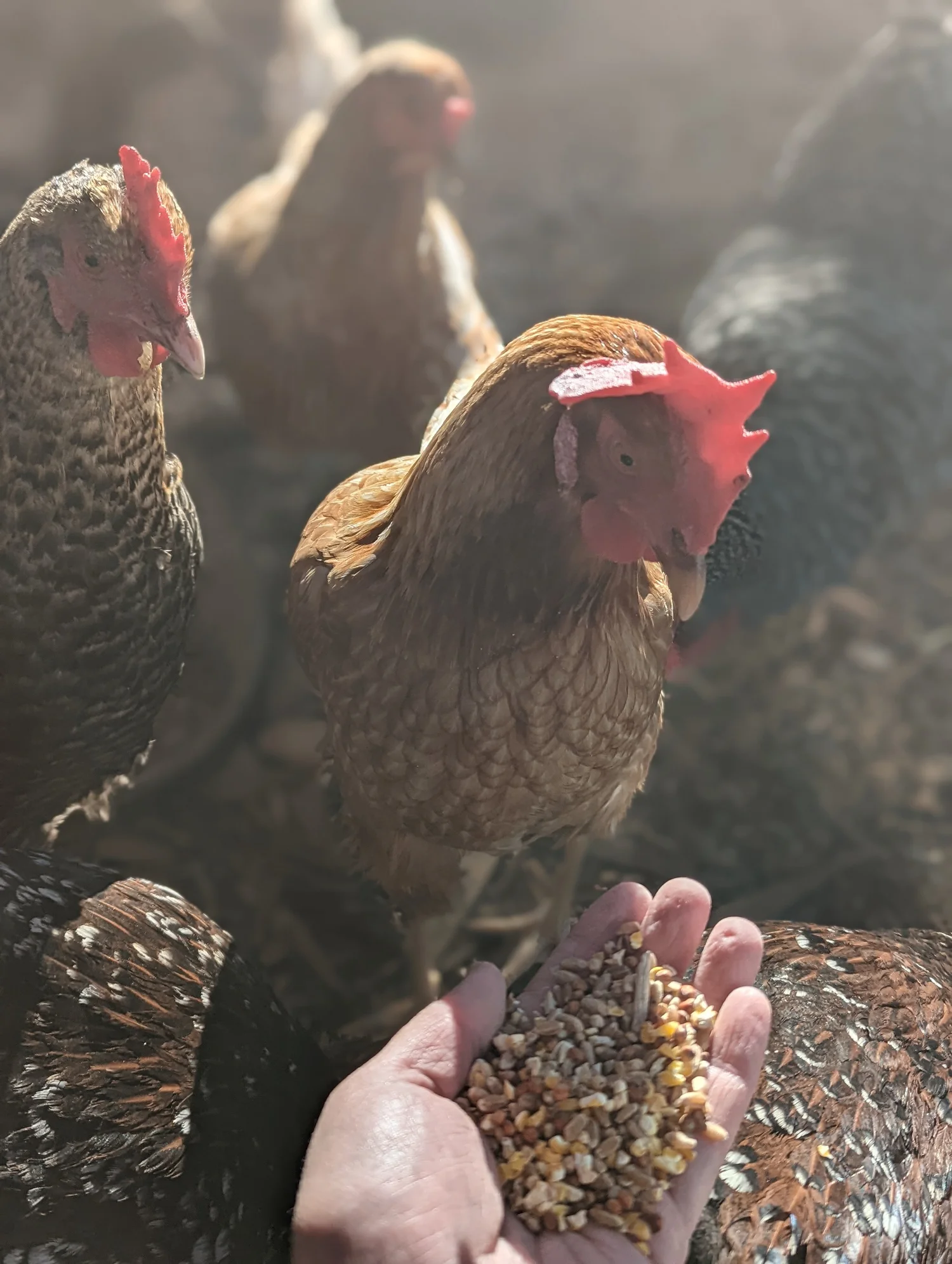
Scratch grains: A mix of cracked corn, wheat, and other grains. This is a treat, not a complete feed. Scratch grains lack the protein, calcium, and vitamin balance that poultry need. Use scratch as a training tool, an afternoon treat, or a cold-evening snack (the digestion process generates body heat). Scratch should make up no more than 10% of your flock's total diet.
Organic and specialty feeds: Several manufacturers offer certified organic, soy-free, and non-GMO poultry feeds. These cost 30 to 50% more than conventional feed. Whether the premium is worth it depends on your values and budget. The nutritional profiles are generally equivalent to conventional feeds. Modesto Milling is a California-based organic option that is widely available in our area.
Store all feed in rodent-proof containers. Metal trash cans with tight-fitting lids are the standard. A 50-pound bag left in its paper sack in the garage will attract rats within days. In Santa Cruz County, where we have significant rodent populations, proper feed storage is not optional.
A 50-pound bag of layer feed costs $20 to $30 for conventional, $30 to $45 for organic. For a flock of four standard-size laying hens, a 50-pound bag lasts approximately 5 to 6 weeks. Budget $15 to $25 per month for a small flock's feed costs.
How Should You Adjust Feeding Through the Seasons?
California's year-round mild climate means our seasonal feeding adjustments are less dramatic than in regions with harsh winters, but our birds' nutritional needs still shift throughout the year.
Spring (March through May): Egg production ramps up as daylight increases. Hens need maximum calcium support during peak laying. Ensure oyster shell is always available free-choice. Increase the amount of fresh greens available (spring gardens produce plenty of trimmings). Spring is also when natural forage becomes abundant. If your birds free-range, they will supplement their diet significantly with insects, worms, and young shoots. You may notice a slight decrease in feed consumption as foraging increases.
Summer (June through August): Our coastal summer is mild compared to inland California, but even Santa Cruz County gets warm spells. During hot days, birds eat less and drink more. Ensure unlimited fresh, cool water. Frozen treats (watermelon, frozen berries in water) help birds stay cool. Avoid high-energy feeds like scratch grains during hot weather, as the digestion process generates heat. Summer forage is abundant: insects, garden scraps from your harvest, and weeds. Egg production typically remains strong through our temperate summers.
Fall (September through November): Many birds molt in fall, losing and regrowing feathers. Molting requires significant protein because feathers are 85% protein (keratin). Increase protein during molt by offering high-protein treats: mealworms, sunflower seeds, scrambled eggs, or a temporary switch to a higher-protein grower feed (18 to 20% protein). Egg production typically drops during molt, as the bird's resources are directed toward feather regrowth. This is normal and not a sign of illness. Continue offering calcium, as some birds lay intermittently through molt.
Winter (December through February): Egg production naturally slows with shorter days. Some flock keepers add supplemental light to maintain production (14 to 16 hours of light triggers laying), but many choose to let their hens rest naturally. Either approach is valid. On cold evenings, a small handful of scratch grain before roost time provides a slow-digesting energy source that helps birds stay warm overnight. Our Santa Cruz County winters are mild enough that caloric needs increase only slightly compared to summer. The bigger winter challenge is keeping feed dry during rainy periods.
What Role Does Foraging Play in Your Flock's Diet?
Birds that forage supplement their commercial feed with a diverse range of proteins (insects, worms, grubs), greens (grass, weeds, clover), and minerals (from soil). This natural diet diversity improves egg yolk color, shell strength, and overall bird health. Research on pastured hens has shown their eggs carry more omega-3 fatty acids and more vitamin E than eggs from caged hens on a commercial diet (Penn State work by Karsten et al., Renewable Agriculture and Food Systems, 2010). and independent Mother Earth News egg testing).
In my Boulder Creek garden, my flock's foraging activities are a core part of their diet and a key reason I keep birds. The chickens work through garden beds after harvest, eating overwintering pests and weed seeds. The Runner ducks patrol for slugs and snails. The Toulouse goose grazes pathways and lawn areas, keeping grass short without a mower.
Foraging does not replace commercial feed. Even birds with excellent forage access need their base diet for balanced nutrition. Think of foraging as a supplement that enriches their diet, reduces feed costs by 10 to 20%, and provides behavioral enrichment. A bird that forages is a mentally healthier bird.
To maximize foraging value:
Rotate free-range areas so birds are not repeatedly working depleted ground
Plant forage-friendly cover in your run or free-range area: clover, dandelions, and chickweed are all nutritious poultry forage
Allow birds access to compost piles (supervised) where they will find insects and help turn the material
In the garden, let birds into beds after harvest for cleanup but keep them out of active growing areas
For birds kept primarily in a run without regular free-range access, bring forage to them. A bundle of weeds, a square of turf, or a pile of garden trimmings tossed into the run provides both nutrition and entertainment.
What Kitchen Scraps Are Safe for Poultry?
Kitchen scraps can be a valuable supplement to your flock's diet, but they need to be treated as treats, not a food source. Keep kitchen scraps to no more than about 10% of a bird's total diet so treats do not crowd out balanced nutrition, a limit widely recommended by poultry-extension programs.
Safe and nutritious scraps:
Leafy greens: Lettuce, kale, chard, spinach (in moderation, as it contains oxalic acid), cabbage, and herb trimmings. Hang a whole cabbage in the run for entertainment and nutrition
Vegetables: Cooked squash, pumpkin (and pumpkin seeds, which have natural deworming properties according to some poultry studies), cooked sweet potato, cucumber, zucchini, broccoli, peas, corn
Fruits: Watermelon (a summer favorite), berries, melon, apple (remove seeds), banana, grapes (cut in half to prevent choking)
Grains: Cooked rice, cooked pasta, oatmeal, stale bread (in small amounts, as bread has limited nutritional value)
Protein: Scrambled or hard-boiled eggs (an excellent protein boost during molt), mealworms, plain cooked meat scraps, plain yogurt in small amounts
Scraps to avoid (toxic or harmful):
Avocado: The skin, pit, and flesh contain persin, which is toxic to poultry. The ASPCA lists avocado as toxic to birds. Never feed avocado to your flock
Raw or dried beans: Contain phytohaemagglutinin, a toxin that is fatal to poultry. Cooked beans are safe in small amounts, but raw or undercooked beans are dangerous
Chocolate: Contains theobromine, which is toxic to birds (and dogs, for the same reason)
Onions and garlic: Large amounts can cause hemolytic anemia in poultry. Small amounts of garlic are sometimes used as a natural health supplement, but err on the side of caution and avoid feeding alliums
Citrus: While not technically toxic, large amounts of citrus can reduce calcium absorption and irritate the digestive tract. Occasional small pieces are harmless, but do not feed citrus regularly
Nightshade plant parts: Green potato skins, green tomatoes, and the leaves and stems of tomato and pepper plants contain solanine. Ripe tomatoes and cooked potatoes are safe
Moldy or rotten food: Mold produces mycotoxins that are harmful to poultry. If you would not eat it, do not feed it to your birds. Stale is fine; spoiled is not
Highly processed, salty, or sugary foods: Chips, candy, fast food, and similar items have no place in a poultry diet
When offering scraps, scatter them in the run rather than piling them in one spot. Scattering encourages natural foraging behavior and prevents dominant birds from monopolizing the food. Remove uneaten scraps before they spoil, especially in warm weather.
Why Is Calcium So Important and How Do You Provide It?
A laying hen needs roughly 4 to 5 grams of calcium daily to form a strong eggshell. Each egg contains about 2 grams of calcium in the shell alone. Without adequate calcium, hens produce thin-shelled or shell-less eggs, and over time, their own skeletal calcium reserves deplete, leading to weak bones, reduced mobility, and eventually death. This condition, called cage layer fatigue in commercial settings, occurs in backyard flocks when calcium supplementation is inadequate.
Oyster shell: The standard calcium supplement for laying poultry. Offer it free-choice in a separate container (not mixed into feed, as non-laying birds do not need extra calcium and excess calcium stresses the kidneys). Crushed oyster shell dissolves slowly in the gizzard, providing sustained calcium release. Available at all local feed stores for roughly $8 to $12 per 5-pound bag, which lasts months for a small flock.
Crushed eggshells: A free alternative. Bake used eggshells at 250 degrees for 10 minutes to sterilize them, then crush into small pieces and offer free-choice. Baking and crushing are important. Raw, uncrushed shells can teach birds that eggs are edible, leading to egg-eating behavior. Well-processed shells are unrecognizable as eggs.
Calcium in feed: Layer feed already contains 3.5 to 4% calcium, which covers a significant portion of a hen's daily needs. However, individual calcium requirements vary, and free-choice supplementation lets each hen regulate her own intake. UC ANR recommends both layer feed and free-choice oyster shell for optimal shell quality.
Ducks and geese that are laying also need calcium supplementation. The free-choice approach works for all species: birds that need calcium will eat it, and those that do not will leave it alone.
What Is Grit and Do Your Birds Really Need It?
Poultry do not have teeth. They grind food in their gizzard (a muscular organ in the digestive tract) using small stones and grit. Birds that free-range typically find enough natural grit from the ground, but birds kept primarily in a run may not have access to appropriate stones.
Provide poultry-sized granite grit free-choice in a separate container. Grit is inexpensive ($8 to $10 per 5-pound bag) and lasts a long time. Use chick-sized grit for birds under 8 weeks and adult-sized grit for mature birds.
Grit is especially important if your birds eat anything other than commercial feed: greens, scraps, foraged insects, or whole grains all require grinding. Birds on exclusively commercial crumble or pellet feed technically need less grit (the feed is already ground), but free-choice grit is cheap insurance and there is no downside to offering it.
Do not confuse grit with oyster shell. They serve different purposes. Grit grinds food. Oyster shell provides calcium. Both should be available free-choice, in separate containers.
How Do You Manage Feeding in a Mixed-Species Flock?
If you keep chickens, ducks, and geese together (as I do), feeding requires a few adjustments to ensure all species get what they need without anything harmful.
Base feed: An all-flock or flock raiser formula (18% protein, lower calcium than layer feed) works for all three species. This is the simplest approach for a mixed flock. Offer oyster shell free-choice for the layers to self-supplement their calcium needs.
Waterfowl-specific needs: Ducks and geese need niacin (vitamin B3) in higher amounts than chickens. Most all-flock feeds contain adequate niacin for waterfowl, but if you are using a chicken-specific formula, add brewer's yeast to the feed (1 tablespoon per cup) or supplement niacin in the water. Niacin deficiency causes leg problems in ducks and geese, particularly in young birds. The Merck Veterinary Manual notes niacin deficiency as a common nutritional disorder in domestic ducks, especially fast-growing ducklings.
Goose diet: Geese are primarily grazers. In a garden setting with good grass access, grass can make up 70 to 80% of an adult goose's diet during the growing season. Supplement with all-flock feed (roughly 1/2 to 1 cup per goose per day when adequate grass is available, more in winter or on poor pasture). Geese also need grit and, when laying, calcium. My Toulouse goose eats significantly less commercial feed than my chickens and ducks because she spends most of her day grazing.
Feeding stations: In a mixed flock, provide multiple feeding stations to prevent dominant birds from blocking access. My feeding area has a trough feeder for the chickens, a ground-level dish for the ducks, and a separate area where the goose can eat without competition. Separate stations also let you monitor how much each species is consuming.
Water access: This is technically a feeding topic because ducks and geese need water available during feeding. They eat by alternating bites of feed with sips of water to moisten and swallow the food. Place waterers near feeders for all species, with deeper water available for the waterfowl.
For guidance on transitioning young birds from starter feed to adult feed, see Raising Chicks and Ducklings in Santa Cruz: A First-Timer's Guide.
What Should You Do About Treats and Supplements?
The poultry treat industry has exploded, and feed stores now sell treat blocks, dried insect mixes, flavored scratch, and specialty supplements at premium prices. Most of these are unnecessary for a well-fed flock, but some treats and supplements do serve a purpose.
Worth offering:
Mealworms (dried or live): High in protein (about 50% by weight), excellent during molt or for training birds. Live mealworms are more nutritious than dried. Use as a treat, not a feed replacement
Black oil sunflower seeds: Good protein and healthy fat source, useful during molt and cold snaps. High in calories, so offer in moderation
Apple cider vinegar: Adding 1 tablespoon per gallon to water is a traditional poultry practice believed to support gut health. Scientific evidence is limited, but at this concentration it is harmless and many experienced flock keepers swear by it. Use in plastic waterers only, as vinegar corrodes metal
Pumpkin seeds: Contain cucurbitin, which has mild natural antiparasitic properties. Not a replacement for proper deworming, but a beneficial treat during pumpkin season
Not necessary for a well-fed flock:
Vitamin and electrolyte supplements (unless birds are recovering from illness or heat stress)
Expensive commercial treat blocks and cakes (make your own with suet and seeds for a fraction of the cost)
Probiotics and prebiotics (a well-managed flock on quality feed with foraging access develops healthy gut flora naturally)
The rule of thumb: if your birds are on quality commercial feed with oyster shell, grit, clean water, and some foraging access, they have everything they need nutritionally. Treats are for enrichment, training, and your enjoyment of the flock relationship. Keep them to 10% or less of the total diet.
For health issues that may be related to nutritional deficiency, see Common Health Issues in Backyard Chickens, Ducks, and Geese.
Frequently Asked Questions
How much feed does a backyard chicken eat per day?
A standard-size laying hen eats approximately 1/4 to 1/3 pound of feed per day (roughly 1/2 cup). This translates to about 1.5 to 2 pounds per week per bird. A flock of four hens goes through a 50-pound bag of feed in roughly 5 to 6 weeks. Actual consumption varies by breed, season, foraging access, and production level. Larger breeds and birds in heavy lay eat more. Backyard hens use roughly 4 pounds of feed per dozen eggs, which lines up with the 1.5 to 2 pounds per bird per week most keepers see.
Can I feed my chickens only kitchen scraps instead of commercial feed?
No. Kitchen scraps do not provide balanced nutrition for poultry. Laying hens need consistent levels of protein (16%), calcium (3.5 to 4%), and specific vitamins and amino acids that kitchen scraps alone cannot deliver. Scraps should make up no more than 10% of total diet. Birds fed primarily scraps show reduced egg production, poor shell quality, nutritional deficiencies, and weakened immune function. Commercial layer feed is formulated to meet all of a hen's nutritional requirements. Poultry-extension programs strongly advise against feeding laying hens on scraps alone.
Do I need to feed chickens differently in winter?
In Santa Cruz County, winter feeding adjustments are modest compared to colder climates. Our mild winters rarely require significant dietary changes. Offer a small handful of scratch grain in the evening before roost time for extra overnight warmth from digestion. Ensure water does not freeze on the rare cold mornings (it rarely does in most of the county). If hens are molting in late fall, increase protein with mealworms or sunflower seeds. Egg production naturally declines in winter due to shorter days, and feed consumption may increase slightly. Birds eat somewhat more in cooler months to fuel body heat, though in Santa Cruz County's mild winters the increase is modest.
What is the difference between layer feed and all-flock feed?
Layer feed contains 16% protein and 3.5 to 4% calcium, formulated specifically for laying hens over 18 weeks old. All-flock feed (also called flock raiser) contains 18% protein and lower calcium (around 1%), suitable for mixed flocks of different ages and species. The key distinction is calcium: too much calcium damages the kidneys of non-laying birds, roosters, and young birds. If you keep a mixed flock, use all-flock feed with free-choice oyster shell so only the birds that need extra calcium consume it. An all-flock feed with free-choice oyster shell is the standard extension recommendation for mixed-age and mixed-species flocks.
Is organic feed worth the extra cost for backyard chickens?
Organic poultry feed typically costs 30 to 50% more than conventional. The nutrient profiles are generally equivalent; the difference is in ingredient sourcing (certified-organic grains, no synthetic amino acids, no GMO ingredients) rather than nutrition. The primary differences are in ingredient sourcing: organic feeds use certified organic grains, no synthetic amino acids, and no genetically modified ingredients. Whether this premium is worthwhile depends on your personal values regarding organic agriculture. There is no scientific evidence that organic feed produces healthier birds or more nutritious eggs compared to quality conventional feed. Modesto Milling, a California-based organic manufacturer, is widely available locally (USDA Organic Standards, 2023).
How do I prevent rodents from eating my chicken feed?
Rodent management starts with feed storage and access control. Store all feed in metal containers with tight-fitting lids. Remove or secure feeders at night when birds are roosting (rats are primarily nocturnal). Use treadle feeders (which open only when a bird steps on the platform) to prevent rodent access during the day. Keep the area around the coop clear of spilled feed and debris. Elevate the coop to reduce rodent harbor space underneath. UC IPM emphasizes sanitation and exclusion over rodenticides for rodent control near poultry, since poisons pose a secondary-poisoning risk to birds and other wildlife.
Can ducks and chickens eat the same feed?
Yes, with caveats. An all-flock or flock raiser formula (18% protein, no added medication) is safe for both species. The one absolute rule: never feed medicated chick starter to ducklings, as the coccidiostat can reach toxic levels due to ducklings' higher feed consumption rate. Adult ducks need more niacin than chickens, so supplement with brewer's yeast (1 tablespoon per cup of feed) if using a chicken-specific formula. Offer oyster shell free-choice for laying birds of both species. This all-flock-plus-oyster-shell approach is the standard recommendation for mixed poultry flocks.
What garden plants are toxic to chickens if they eat them?
Several common garden plants are toxic to poultry. The most dangerous include foxglove (cardiac glycosides), oleander (extremely toxic, potentially fatal), nightshade family plant parts (green potato tubers, unripe tomatoes, leaves and stems of tomato and pepper plants), rhubarb leaves (oxalic acid), and azalea/rhododendron. Poultry generally avoid toxic plants when they have adequate feed and forage options, but it is wise to fence off known toxic plants or keep them out of free-range areas. The ASPCA toxic-plant database and UC's safe-and-poisonous-plants list are useful references, though for poultry specifically, extension and veterinary sources give the most bird-relevant guidance.
What should I feed my laying hens (layer feed, calcium, grit)?
Around 18 weeks, or when the first eggs appear, switch pullets to a complete layer feed running about 16 to 18 percent protein; the University of California notes laying hens also need extra calcium for strong shells, best offered free-choice as crushed oyster shell. Provide insoluble grit too, since hens that eat greens or scratch need it to grind food in the gizzard. Keep fresh water available at all times.
