

Greens Troubleshooting: Bolting, Bitterness, and Pests
A few of the product links in this guide are affiliate links. If you buy through one, Ambitious Harvest may earn a small commission at no extra cost to you, which helps keep these guides free. We only point to gear we would use in our own Santa Cruz garden. As an Amazon Associate, we earn from qualifying purchases. Read our full disclosure.
Why Do Your Greens Keep Bolting, Turning Bitter, or Getting Eaten?
Bolting, bitterness, and pest damage are the three most common frustrations for leafy green growers in Santa Cruz County, and each one has specific, preventable causes rooted in our local growing conditions. UC IPM notes that at higher temperatures lettuce may bolt and become bitter, so variety choice and planting timing are the main levers for California home gardeners. If your greens are not performing the way you want, understanding why helps you fix the issue rather than just replanting and hoping for the best.
Santa Cruz County's unique blend of coastal fog, inland warmth, and year-round mild temperatures creates specific challenges for greens that gardeners in other climates never face. Our long growing season is an advantage, but it also means that pest populations persist year-round and photoperiod-triggered bolting catches gardeners off guard during our warm, bright springs. Let's work through each problem systematically.
What Causes Bolting and How Can You Prevent It?
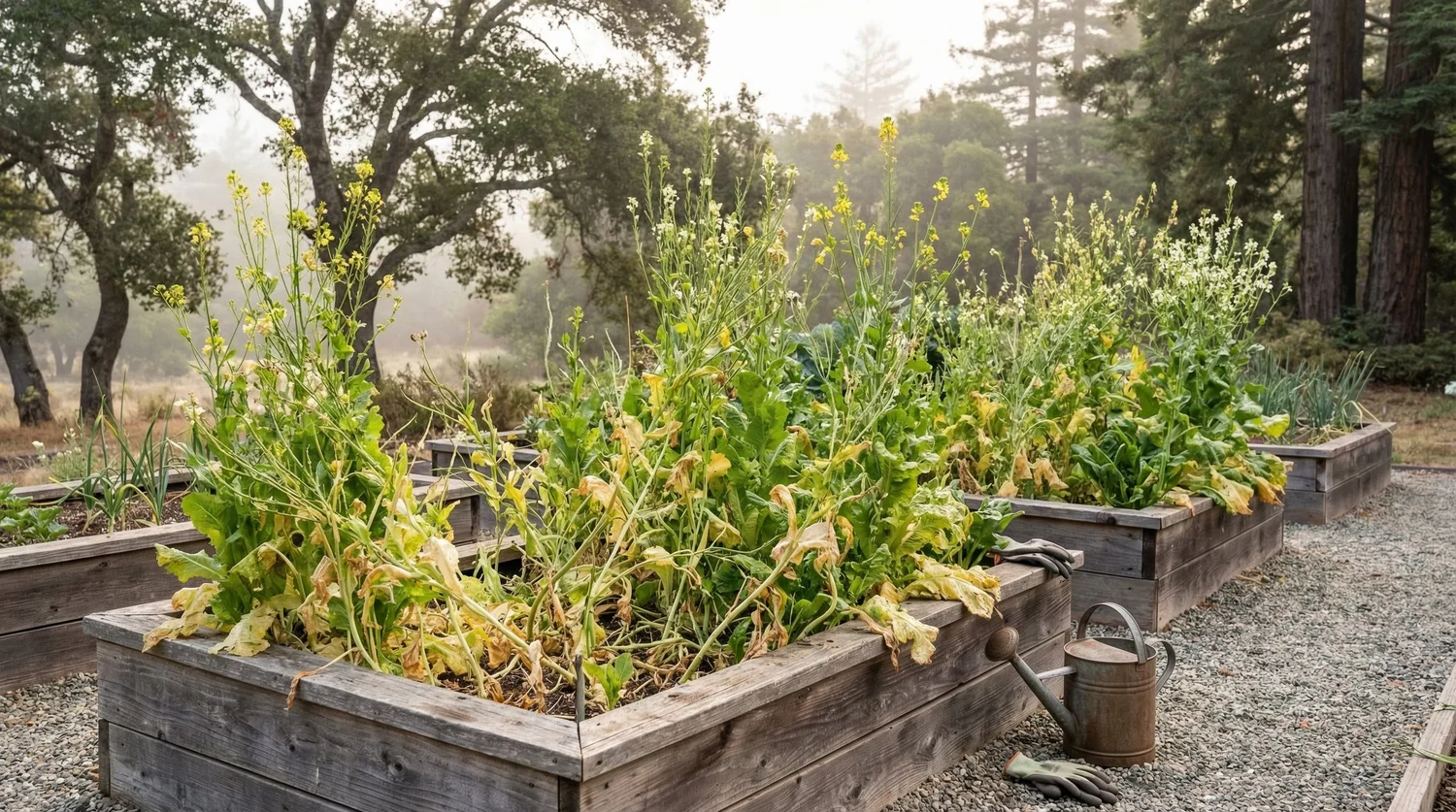
Bolting is the process by which leafy green plants shift from vegetative growth (producing leaves) to reproductive growth (producing flowers and seeds). When a plant bolts, it sends up a flower stalk, leaves become smaller and often bitter, and the plant's useful life as a food crop is essentially over. Understanding what triggers bolting is the key to preventing it.
Day length is the primary trigger. Most cool-season greens are long-day plants, meaning they are triggered to flower when day length exceeds a certain threshold, usually around 13 to 14 hours. In Santa Cruz County, we cross this threshold in mid-April and remain above it until late August. This is why spring-planted lettuce and spinach often bolt before producing a meaningful harvest, while fall-planted greens can produce for months.
Temperature accelerates the process. While day length initiates bolting, warm temperatures speed it up dramatically. A combination of long days and temperatures above 75 degrees almost guarantees rapid bolting in lettuce, spinach, arugula, and most Asian greens. Coastal Santa Cruz gardeners have an advantage here because fog keeps temperatures moderate, but inland gardeners in Scotts Valley, Ben Lomond, and the Pajaro Valley face stronger bolting pressure from April through September.
Stress is a secondary trigger. Inconsistent watering, root damage from transplanting, and nutrient deficiency can all trigger bolting even outside the primary bolting season. Plants under stress interpret their difficult conditions as a signal to reproduce before dying. Maintaining consistent moisture and avoiding root disturbance helps prevent stress-induced bolting.
Practical bolting prevention strategies
- Choose bolt-resistant varieties. Plant breeders have developed lettuce, spinach, and arugula varieties with much higher bolting thresholds. For lettuce, 'Jericho,' 'Muir,' and 'Nevada' are excellent bolt-resistant choices. For spinach, 'Bloomsdale Long Standing,' 'Space,' and 'Regiment' resist bolting significantly longer than older varieties. UC variety trials consistently show that bolt-resistant selections can add 3 to 6 weeks of productive life compared to standard varieties.
- Time your plantings strategically. Plant cool-season greens in early fall (September to October) or late winter (January to February) to maximize harvest before bolting pressure increases. Avoid planting greens that need 60 or more days to mature during March or April, as they will likely bolt before producing a full harvest.
- Provide afternoon shade. Shade cloth (30 to 50 percent shade rating) or the natural shade of taller crops can reduce both light intensity and temperature, slowing the bolting response. Position greens beds on the north side of trellised tomatoes, pole beans, or corn to take advantage of natural shade during the warm months.
- Keep soil consistently moist. Water stress accelerates bolting. Use drip irrigation on a timer and mulch around plants to maintain even soil moisture. Do not let soil dry out between waterings, especially during the warm season.
- Harvest frequently. Regular cut-and-come-again harvesting removes leaf tissue that contributes to the plant's energy reserves for flowering. Frequent cutting can delay bolting by keeping the plant focused on leaf regrowth rather than flower production.
Why Do Greens Turn Bitter and What Can You Do About It?
Bitter greens are one of the most disappointing garden experiences. You wait weeks for a beautiful head of lettuce or a flush of arugula, only to find the flavor so harsh that even salad dressing cannot mask it. Bitterness in greens has several distinct causes, and once you identify which one is affecting your crop, the solution is usually straightforward.
Heat-induced bitterness. This is the most common cause. When temperatures rise above 75 to 80 degrees, lettuce and many other greens produce increased levels of sesquiterpene lactones, the compounds responsible for bitter flavor. UC food scientists have documented that lettuce grown at 85 degrees contains up to three times the bitter compounds of lettuce grown at 65 degrees. In Santa Cruz County, this is primarily a problem from May through September in inland locations and during occasional warm spells on the coast.
Water stress bitterness. Greens that experience inconsistent watering, alternating between too dry and too wet, develop concentrated bitter compounds as a stress response. The fix is simple: water deeply and regularly, especially during warm weather. Mulching helps maintain even soil moisture. Drip irrigation on a timer is the most reliable solution for preventing water stress bitterness.
Age-related bitterness. As greens mature and approach bolting age, bitter compounds naturally increase. This is particularly noticeable in lettuce, endive, and radicchio. Harvest greens at a younger stage for the mildest flavor. Baby greens harvested at 3 to 4 inches tall are almost always milder than full-sized leaves from the same variety.
Variety differences. Some greens are naturally more bitter than others. Arugula, endive, radicchio, and mustard greens have inherent bitterness that is part of their flavor profile. If you find these greens too bitter for your taste, choose milder varieties (wild arugula is milder than cultivated arugula, for example) or mix small amounts of bitter greens into salads dominated by mild lettuce or spinach.
Practical strategies to reduce bitterness
- Harvest in the morning. Greens harvested in early morning, before the day warms up, are consistently milder than those picked in afternoon heat. The cool overnight temperatures allow bitter compounds to decrease, and full hydration dilutes their concentration.
- Chill after harvest. Plunging harvested greens into ice water for 10 to 15 minutes immediately after picking reduces bitterness noticeably. The cold shock slows the enzymatic processes that produce bitter compounds and crisps the leaves at the same time.
- Grow through the cool season. In Santa Cruz County, the most reliably mild-flavored greens come from fall, winter, and early spring plantings when temperatures stay below 70 degrees. Plan your heaviest greens production for October through April.
- Manage soil nutrients. Nitrogen deficiency can increase bitterness, while adequate nitrogen promotes lush, mild leaf growth. Keep greens well-fed with regular applications of compost and balanced organic fertilizer. Over-fertilization does not help, but maintaining adequate nutrition makes a real difference in flavor.
How Do You Manage Aphids on Greens?
Aphids are the most prevalent pest on leafy greens in Santa Cruz County, found in gardens from the coast to the inland valleys year-round. These small, soft-bodied insects cluster on the undersides of leaves and on young growing tips, sucking plant sap and excreting sticky honeydew that attracts sooty mold.
Identification. Look for clusters of small (1 to 3 millimeter), pear-shaped insects on leaf undersides, new growth, and stem tips. Common species on greens include green peach aphid, lettuce aphid, and cabbage aphid. Curling or distorted new leaves are often the first visible sign of aphid feeding. Check the undersides of leaves if you notice these symptoms.
Why they are worse on greens. Aphids prefer tender, nitrogen-rich plant tissue, which is exactly what well-fertilized greens provide. Lush lettuce, kale, and chard are aphid magnets. Our mild Santa Cruz County winters allow aphid populations to persist year-round rather than being killed by hard freezes, so populations can build quickly if left unchecked.
Biological control. Santa Cruz County gardens support excellent populations of natural aphid predators, including ladybugs, lacewings, syrphid flies, and parasitic wasps. These beneficial insects can control aphid populations effectively if you avoid broad-spectrum pesticides that kill them. Plant flowering herbs and wildflowers near your greens beds to attract and sustain beneficial insect populations. UC Integrated Pest Management research shows that gardens with diverse plantings near vegetables have significantly lower aphid populations than monoculture gardens.
Physical removal. A strong jet of water from the hose dislodges most aphids from sturdy greens like kale and chard. Repeat every few days until the population is under control. For more delicate greens like lettuce, use a gentler spray to avoid bruising leaves. This simple technique is often all that is needed, especially if beneficial insects are present to clean up the survivors.
Organic sprays. For heavy infestations, insecticidal soap or neem oil applied to leaf undersides provides effective control. Apply in the early morning or evening, not in direct sun, to avoid leaf burn. Multiple applications 5 to 7 days apart are usually necessary because these products only kill aphids on contact and have no residual activity. Always wash treated greens thoroughly before eating.
Row cover prevention. Lightweight floating row cover draped over greens beds prevents aphids from reaching plants in the first place. Secure edges with soil, boards, or landscape pins so aphids cannot sneak underneath. This proactive approach is more effective than treating infestations after they start, especially for high-value crops like lettuce that are damaged by even moderate aphid feeding.
How Do You Deal With Slugs and Snails on Greens?
Slugs and snails are arguably the most destructive pests on leafy greens in Santa Cruz County. Our maritime climate provides the cool, moist conditions these mollusks love, and they feed voraciously on the same tender leaves we want to eat. Seedlings and young transplants are particularly vulnerable and can be destroyed overnight by a single slug.
Understanding their behavior. Slugs and snails are most active at night and on cool, overcast days. They hide during sunny, dry periods under boards, mulch, dense foliage, and in cracks in the soil. They leave distinctive silvery slime trails that help you confirm their presence even if you never see the culprits directly. In Santa Cruz County, slug and snail activity peaks during the wet months (November through April) but continues year-round in irrigated gardens and foggy coastal areas.
Iron phosphate bait. This is the most effective and environmentally responsible control method. Iron phosphate baits (sold as Sluggo and similar products) are safe for use around food crops, pets, and wildlife. Scatter granules lightly around greens beds, refreshing after rain or heavy irrigation. UC research confirms that iron phosphate baits are as effective as older metaldehyde baits without the toxicity risks to pets and wildlife. Apply bait in the evening when slugs are becoming active for best results.
Handpicking. Go out with a flashlight an hour after dark and pick slugs and snails directly off your plants and surrounding soil. Drop them into a container of soapy water. This is surprisingly effective if done consistently for several nights in a row. Many experienced Santa Cruz County gardeners consider evening slug patrols a routine part of garden maintenance during the wet season.
Barriers. Copper tape applied around the edges of raised beds creates a barrier that slugs and snails dislike crossing. The copper reacts with their slime to produce a mild electric sensation. This method works best on raised beds with clean sides where slugs cannot find an untaped path over the barrier. Diatomaceous earth sprinkled around plants provides some barrier protection but loses effectiveness when wet, which limits its usefulness in our foggy, dewy climate.
Habitat management. Reduce slug and snail hiding places near your greens beds. Remove boards, bricks, and debris where they shelter during the day. Keep mulch pulled back a few inches from the base of plants. Trim overhanging vegetation that creates cool, damp hiding spots. While you want to maintain habitat for beneficial creatures in your garden, keeping the immediate vicinity of your greens beds open and dry reduces slug damage significantly.
Beer traps. Shallow containers filled with beer attract and drown slugs. Bury the container so the rim sits level with the soil surface. While beer traps do catch slugs, they are less effective than iron phosphate bait for protecting a full bed of greens. They work best as a supplementary control or monitoring tool rather than a primary strategy.
What Other Pests Target Greens in Santa Cruz County?
Beyond aphids and slugs, several other pests can cause problems on greens in our area. Most are manageable with the same integrated approach: prevention, monitoring, and targeted intervention.
Leaf miners. These tiny fly larvae tunnel between the upper and lower surfaces of leaves, creating distinctive winding trails or blotches. Leaf miners are common on chard, spinach, and beet greens in Santa Cruz County. Floating row cover is the most effective prevention. Once tunneling is visible, remove and discard affected leaves. The larvae inside the leaf are protected from sprays, so contact insecticides are not effective against active infestations.
Cabbage loopers and imported cabbageworms. These caterpillars feed on kale, collards, and other brassica family greens, chewing large holes in leaves. Bt (Bacillus thuringiensis) is an organic biological control that kills caterpillars when they ingest treated leaf tissue. Apply Bt to leaf surfaces when you first notice caterpillars or their damage. Row cover prevents the adult butterflies and moths from laying eggs on your plants in the first place.
Flea beetles. Tiny, jumping beetles that chew small round holes in arugula, mizuna, and other brassica greens. Damage is mostly cosmetic but can be severe on young seedlings. Row cover provides excellent protection. Flea beetles are most active in warm weather and less of a problem during the cool season when most greens grow best anyway.
Whiteflies. Small, white, moth-like insects that cluster on leaf undersides, particularly on kale and chard. They cause yellowing and weakening of plants over time. Yellow sticky traps help monitor and reduce populations. Insecticidal soap is effective when sprayed directly on whiteflies. Natural predators, including the tiny parasitic wasp Encarsia formosa, provide excellent biological control in Santa Cruz County gardens where broad-spectrum pesticides are avoided.
Gophers. While not a pest of the leaves themselves, gophers can pull entire lettuce and greens plants underground from below. If gopher activity is present in your garden, grow greens in raised beds with hardware cloth lining the bottom, or plant in containers. Gopher exclusion is far more reliable than trapping for protecting small, high-value plantings like greens beds.
What Diseases Affect Greens in Santa Cruz County?
Our mild, humid coastal climate creates conditions favorable for several fungal and bacterial diseases that target leafy greens. Good cultural practices prevent most disease issues.
Downy mildew. This fungal disease causes yellow patches on the upper surface of lettuce leaves with corresponding fuzzy gray or white growth on the undersides. It thrives in the cool, humid conditions common during Santa Cruz County's foggy months. Use resistant lettuce varieties when available, space plants for good air circulation, water at the base rather than overhead, and remove infected leaves promptly. UC plant pathologists note that downy mildew has become increasingly common on California lettuce as new pathogen races have emerged.
Powdery mildew. White, powdery patches appear on leaf surfaces, particularly on chard, kale, and peas. Unlike downy mildew, powdery mildew thrives in warm, dry conditions with cool nights, making it more common in late summer and fall. Improve air circulation, avoid overhead watering, and apply potassium bicarbonate or neem oil at the first sign of infection.
Damping off. This soil-borne fungal disease kills seedlings at the soil line, causing them to topple over and die. It is most common in cool, wet conditions with poor air circulation. Prevent damping off by using clean seed-starting mix, providing good ventilation, avoiding overwatering seedlings, and not sowing seeds too thickly. In the garden, damping off is rarely a problem in well-drained soil with good airflow.
Bottom rot. Lettuce heads that sit on damp soil can develop brown, slimy rot on their lower leaves. Raise plants off the soil surface by growing in raised beds, using mulch to keep lower leaves clean and dry, and spacing plants to allow airflow around the base. Harvesting outer leaves regularly (cut-and-come-again style) also helps by improving air circulation around the plant's center.
How Can You Create a Year-Round Pest Management Plan for Greens?
Rather than reacting to problems as they appear, a seasonal approach to pest and disease management keeps your greens healthy with less effort and fewer interventions.
Fall and winter (October through February). Slug and snail pressure is highest. Apply iron phosphate bait at planting and refresh monthly. Watch for aphids on kale and chard that persist through winter. Downy mildew risk increases in humid weather. Space plants generously and water in the morning so foliage dries before evening.
Spring (March through May). Aphid populations begin building rapidly. Monitor weekly and intervene early. Bolting pressure increases as days lengthen. Transition to bolt-resistant varieties by March. Caterpillar damage on brassica greens begins as cabbage white butterflies become active. Apply Bt or use row cover on kale and collards.
Summer (June through September). Bitterness and bolting are the primary challenges. Focus on heat-tolerant varieties, afternoon shade, and consistent watering. Flea beetles and whiteflies are most active. Leaf miners peak on chard and spinach. Row cover is your best multi-pest prevention tool during the warm season. Consider shifting to warm-season greens like New Zealand spinach and Malabar spinach.
Year-round practices. Maintain diverse plantings to support beneficial insects. Practice crop rotation, even within a small garden, to prevent disease and pest buildup. Remove crop debris promptly after harvest. Keep tools clean. Build healthy soil with regular compost additions, as healthy soil supports healthier, more pest-resistant plants.
Frequently Asked Questions
Why does my lettuce bolt even in cool weather?
Stress-induced bolting can occur even when temperatures are cool. The most common cause is root damage during transplanting, followed by inconsistent watering and nutrient deficiency. Handle transplants gently, minimize root disturbance, and maintain steady soil moisture. Some older varieties also have lower bolting thresholds than modern bolt-resistant selections. Switch to varieties like 'Jericho' or 'Muir' for significantly better bolt resistance.
Are bitter greens still safe to eat?
Yes, bitter greens are completely safe to eat. The bitter compounds (sesquiterpene lactones in lettuce, glucosinolates in brassicas) are natural plant chemicals that are not harmful and may even have health benefits. The issue is purely one of flavor preference. If your greens are too bitter to enjoy raw, try cooking them with olive oil and garlic, which reduces perceived bitterness significantly. Sauteed bitter lettuce is surprisingly good.
Can I use salt to control slugs?
While salt does kill slugs on contact, it also damages soil structure and can harm plants. Salt accumulates in soil over time, creating conditions hostile to plant growth. In Santa Cruz County's gardens, iron phosphate bait is a far better option. It controls slugs effectively without any negative impact on soil, plants, pets, or wildlife. Reserve salt for cooking and use iron phosphate in the garden.
How can I tell if my greens have downy mildew or nutrient deficiency?
Both can cause yellow patches on leaves, but they are distinguishable with a close look. Downy mildew produces yellow areas with angular edges that follow leaf veins, with fuzzy gray or white growth visible on the leaf underside. Nutrient deficiency causes more uniform yellowing, often starting with older lower leaves, without any fuzzy growth. If you are unsure, flip the leaf over. The presence of fuzzy fungal growth on the underside confirms downy mildew.
Do companion plants really help repel pests from greens?
The evidence for companion planting as direct pest repellent is mixed, but planting flowers and herbs near greens does help by attracting beneficial predatory insects. UC research supports planting alyssum, cilantro, dill, and fennel near vegetable gardens to support populations of aphid-eating syrphid flies and parasitic wasps. This habitat-based approach is more effective than relying on specific plant-to-plant repellent effects.
Should I spray neem oil on greens I am going to eat?
Neem oil is approved for use on food crops and breaks down quickly in sunlight. However, it leaves an unpleasant taste on raw greens if applied close to harvest. Allow at least 7 days between neem application and harvest for the best eating quality, and wash greens thoroughly. For crops eaten raw, physical controls (water spray, row cover, handpicking) are preferable to any spray whenever possible.
Why are my kale leaves full of holes but I never see any pests?
The most likely culprits are cabbage loopers or imported cabbageworms, which are green caterpillars that blend in perfectly with kale foliage. Look carefully at the undersides of leaves and along the leaf ribs. The caterpillars feed mainly at night or in early morning and hide during the day. Also check for the small, green, pellet-shaped droppings (frass) they leave behind, which are often easier to spot than the caterpillars themselves.
When is it time to give up on a greens planting and start over?
Replace your greens planting when you see any of these signs: the central stem is elongating and flower buds are forming (bolting has begun and cannot be reversed), leaves are consistently bitter despite cool temperatures and adequate water, pest damage exceeds 50 percent of foliage, or plants are producing small, tough leaves despite regular fertilization. Succession planting ensures you always have fresh replacements coming along when older plantings decline.
For comprehensive lettuce pest identification and management, the UC IPM guide for home garden lettuce covers aphids, slugs, and disease management with research-based recommendations for California conditions.
Grow Greens With Confidence
Bolting, bitterness, and pest damage are frustrating, but none of them are mysteries. Each has specific causes and practical solutions that work in Santa Cruz County's unique climate. By choosing the right varieties, timing your plantings to work with our seasons rather than against them, and staying ahead of pest pressure with prevention-first strategies, you can enjoy a reliable supply of tender, flavorful greens for most of the year.
Need help planning your greens garden? Visit Your Garden Toolkit for planting calendars, variety recommendations, and growing guides tailored to Santa Cruz County.
