

Growing Winter Squash in Santa Cruz County: From Planting to Storage
A few of the product links in this guide are affiliate links. If you buy through one, Ambitious Harvest may earn a small commission at no extra cost to you, which helps keep these guides free. We only point to gear we would use in our own Santa Cruz garden. As an Amazon Associate, we earn from qualifying purchases. Read our full disclosure.
Can You Really Grow Winter Squash in Santa Cruz County's Cool Climate?
Winter squash thrives in Santa Cruz County, but it requires more planning and patience than quick-producing summer squash because most varieties need 80 to 110 frost-free days from transplant to harvest. UC Cooperative Extension research on winter squash production in coastal California shows that variety selection and early planting timing are the two factors that most influence success, with short-season varieties like delicata and certain butternut types consistently outperforming long-season varieties in cooler coastal gardens. With the right approach, you can grow, cure, and store enough winter squash to carry your kitchen from September through February.
Winter squash converts abundant summer garden space and sunshine into food that lasts through the lean months. Unlike zucchini, which demands to be eaten the day it is picked, properly cured winter squash sits contentedly on a pantry shelf for months, offering dense, sweet flesh whenever you need it. For Santa Cruz County gardeners who want their garden to feed them year-round, winter squash is an essential crop.
Which Winter Squash Varieties Work Best Here?
The critical consideration for Santa Cruz County is days to maturity. Coastal gardens have cooler soil and air temperatures that slow plant development, effectively adding 10 to 20 days to the maturity dates listed on seed packets (which are based on ideal warm-climate conditions). Choose varieties with 85 to 100 days to maturity for coastal gardens, or up to 110 days for warmer inland locations.
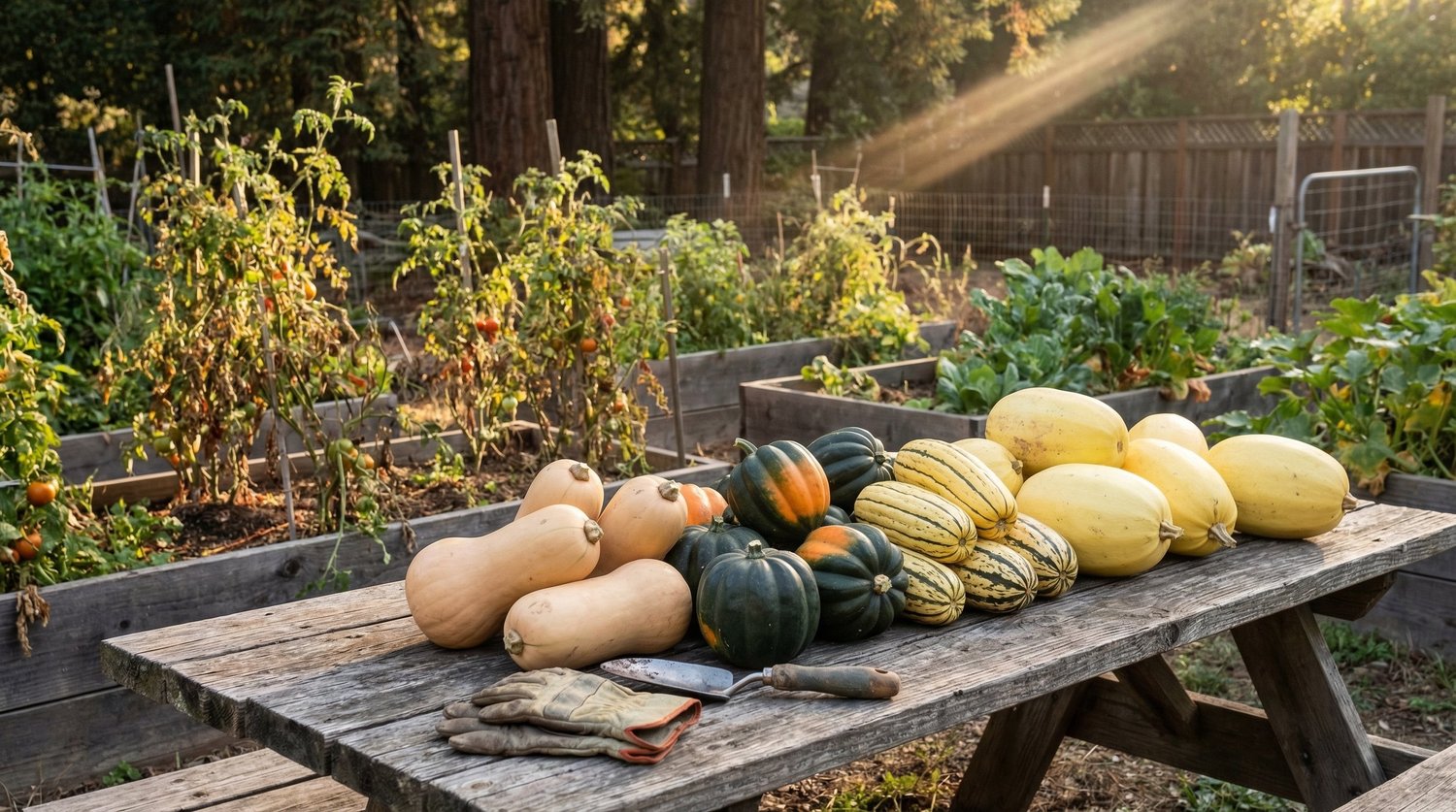
Butternut squash. The classic storage squash, butternut produces tan, bell-shaped fruits with dense, sweet orange flesh. 'Waltham Butternut' is the traditional variety at 100 to 110 days, which pushes the limits of coastal gardens but performs well inland. 'Honeynut,' a miniature butternut developed by Cornell University, matures in 90 to 100 days and produces personal-sized fruits with exceptionally sweet, concentrated flavor. UC taste panels have rated 'Honeynut' among the best-flavored winter squash varieties available. For coastal gardens, 'Honeynut' or 'Butterscotch' (another compact butternut at 95 days) are safer choices than full-size butternut varieties.
Delicata squash. Delicata is one of the best winter squash choices for Santa Cruz County because it matures in 80 to 90 days, well within the reach of even coastal gardens. The oblong, cream-colored fruits with green stripes have thin, edible skin and sweet, creamy flesh. 'Honey Boat' and 'Jester' are improved varieties with better disease resistance and higher sugar content than older delicata selections. The compact vines take up less space than most winter squash, making delicata a practical choice for smaller gardens.
Acorn squash. Acorn squash matures in 80 to 90 days and produces dark green, ribbed fruits perfect for halving and baking. 'Table Queen' is the classic variety, though newer selections like 'Table Star' offer improved flavor and slightly shorter maturity. Acorn squash has a shorter storage life than butternut (typically 2 to 3 months versus 4 to 6 months), so plan to use it first from your harvest. The compact bush types like 'Table Gold Acorn' work well in smaller spaces.
Kabocha squash. These Japanese-type squash produce dense, sweet, dry-textured flesh that is exceptional for roasting, soups, and tempura. 'Sunshine' (a red kabocha at 95 days) and 'Cha-Cha' (a green kabocha at 90 days) are reliable varieties for Santa Cruz County. Kabocha squash stores well for 3 to 4 months and develops sweeter flavor after a few weeks of storage. The vines are vigorous and need ample space.
Spaghetti squash. Maturing in 85 to 95 days, spaghetti squash produces oblong, pale yellow fruits whose flesh separates into noodle-like strands when cooked. It is one of the easiest winter squash to grow and consistently produces well in our climate. 'Vegetable Spaghetti' and 'Hasta La Pasta' are solid variety choices. Storage life is moderate at 2 to 3 months.
When and How Should You Plant Winter Squash?
Timing is more critical for winter squash than for summer squash because the fruits need enough warm days to develop fully before temperatures cool in fall.
Planting window. For most Santa Cruz County gardens, the planting window for winter squash is mid-May through early June. This timing allows plants to establish during warming spring conditions, flower and set fruit through the warm summer months, and mature by September or October. Planting earlier than mid-May risks cold soil that slows germination and growth. Planting later than mid-June, especially with longer-season varieties, risks immature fruit at the end of the growing season.
Starting indoors. For the earliest possible harvest, start seeds indoors in 4-inch pots 3 to 4 weeks before transplanting. Use a heat mat to maintain soil temperature around 75 to 85 degrees for fastest germination. Transplant after hardening off for a week, handling root balls gently because squash resents root disturbance. This indoor start effectively adds 3 to 4 weeks to your growing season, which can make the difference between fully mature and immature fruit for longer-season varieties.
Direct sowing. Direct sow seeds 1 inch deep after soil temperature reaches at least 60 degrees (65 to 70 degrees is better). Plant 2 to 3 seeds per hill, then thin to the strongest seedling. Space hills 4 to 6 feet apart for bush varieties and 6 to 8 feet apart for vining types. Direct-sown plants often develop stronger root systems than transplants, though they start later.
Soil preparation. Winter squash is a heavy feeder that benefits from rich soil. Dig in 3 to 4 inches of compost before planting. Many experienced growers plant squash in hills (slightly raised mounds of soil) that warm faster in spring and provide good drainage. At planting, use finished plant-based compost or manure compost whose producer documents a controlled composting process. Aging manure alone does not establish pathogen reduction.
How Do You Care for Winter Squash Through the Long Growing Season?
Winter squash occupies garden space for 3 to 4 months, which requires sustained attention to watering, feeding, and pest management throughout its long season.
Watering. Provide deep, consistent irrigation through the growing season. Winter squash needs 1 to 2 inches of water per week, delivered at the soil level through drip irrigation or soaker hoses. Avoid overhead watering, which promotes powdery mildew. During fruit development (July through September), consistent water is especially important for proper fruit sizing. As fruits approach maturity, gradually reduce watering to concentrate flavors and help the rind harden for storage.
Fertilization. Side-dress with a balanced organic fertilizer when vines begin to run and again when the first female flowers appear. A fertilizer higher in phosphorus and potassium than nitrogen (such as 4-8-4 or similar) supports fruit development over vine growth once flowering begins. Excessive nitrogen during the flowering period can promote lush vine growth at the expense of fruit production.
Vine management. Vining winter squash varieties can spread 10 to 15 feet in every direction. If space is limited, train vines along a fence or trellis, using slings made from old t-shirts or pantyhose to support heavy fruits. You can also redirect wandering vines by gently turning their growing tips to keep them within bounds. Pinching off the growing tips of vines in late August encourages the plant to direct energy into maturing existing fruits rather than producing new growth.
Protecting developing fruits. Place a piece of cardboard, wood, or straw beneath developing fruits to keep them off the damp soil, which prevents rot and slug damage. In our foggy coastal climate, ground moisture can be a significant cause of fruit loss. Elevating fruits just slightly off the soil surface makes a meaningful difference in harvest quality.
How Do You Know When Winter Squash Is Ready to Harvest?
Unlike zucchini, which is harvested immature, winter squash must be fully mature on the vine for best flavor and storage life. Harvesting too early results in watery, bland flesh that does not store well.
Visual cues. Mature winter squash develops its full varietal color: deep tan for butternut, dark green for acorn, golden for spaghetti squash. The rind becomes hard and cannot be easily dented with a fingernail. The stem where the fruit attaches to the vine dries and becomes woody and brown. For butternut, the skin transitions from green to uniform tan with no green streaks remaining.
The fingernail test. Press your fingernail firmly into the rind. If it penetrates easily, the squash is not mature. If the rind resists your nail and you cannot make an impression, the squash is ready. This simple test is the most reliable field indicator of maturity.
Stem condition. The stem connecting the fruit to the vine should be dry and corky. If the stem is still green and fleshy, the squash is not ready. Do not pull the fruit from the vine. Cut it with a sharp knife or pruners, leaving 2 to 3 inches of stem attached. The stem acts as a seal that prevents pathogens from entering the fruit during storage. Fruits harvested without an intact stem have significantly shorter storage life.
Timing with weather. In Santa Cruz County, most winter squash reaches maturity between late August and mid-October, depending on variety and planting date. Harvest before the first frost, which can come as early as late November in some inland areas. Light frost damages the vine and leaves but does not immediately harm the fruit. However, do not leave squash in the field through hard frost, which causes internal damage that shortens storage life.
How Do You Cure and Store Winter Squash?
Proper curing is the step that transforms winter squash from a fresh garden product into a pantry staple that lasts for months. Skipping or shortcutting this step significantly reduces storage life and flavor.
What curing does. Curing hardens the rind, heals minor surface wounds, and converts some starches to sugars, improving both storage life and flavor. According to UC Master Gardeners, curing is essential for long storage: cure most winter squash at 80 to 85F with good air circulation for seven to fourteen days. Cured, mature fruit held at 55 to 59F and 50 to 70 percent humidity keeps for up to 60 days, and flavor and sweetness improve during storage.
How to cure. Place harvested squash in a warm (75 to 85 degrees), dry, well-ventilated location for 10 to 14 days. In Santa Cruz County, a sunny porch, garage, or greenhouse works well in September and October when daytime temperatures are still warm. Turn each squash once during the curing period so all sides dry evenly. The rind should feel noticeably harder and more durable after curing.
The delicata exception. Delicata squash has thin skin and does not cure or store as long as thick-skinned varieties. Cure delicata for just 5 to 7 days and plan to use it within 2 to 3 months. Delicata is the first variety you should eat from your harvest, while butternut and kabocha are the last.
Long-term storage conditions. After curing, move squash to a cool (50 to 55 degrees), dry location with good air circulation. Do not stack squash directly on top of each other, as trapped moisture promotes rot. Place them on shelves or in a single layer on a table with space between each fruit. Check stored squash monthly. Use sound fruit with minor mechanical damage first, but discard squash with mold, rot, or weeping decay.
Expected storage life by variety. Butternut: 4 to 6 months. Kabocha: 3 to 4 months. Acorn: 2 to 3 months. Spaghetti: 2 to 3 months. Delicata: 1 to 3 months. These times assume proper curing and storage conditions. Warmer or more humid storage conditions shorten these windows.
What Challenges Does Winter Squash Face in Santa Cruz County?
Winter squash shares many pest and disease challenges with zucchini and other cucurbits, plus a few unique to its long growing season.
Powdery mildew. The same disease that affects zucchini also attacks winter squash, typically appearing in late summer when fruits are still developing. Butternut squash (Cucurbita moschata) has natural resistance to powdery mildew and is a smart choice for this reason. Other species (C. pepo and C. maxima) are more susceptible. Good air circulation, drip irrigation, and preventive applications of potassium bicarbonate help manage mildew pressure.
Pollination challenges. Winter squash produces fewer female flowers than summer squash, so every successful pollination matters. In foggy coastal areas where bee activity is reduced on cool mornings, hand-pollination ensures fruit set. Each female flower is open for only one day, so timing is critical. Pollinate in the morning when flowers are fully open. A single plant typically sets 3 to 6 mature fruits, depending on the variety.
Space demands. Vining winter squash takes up significant garden real estate. A single butternut vine can cover 60 to 80 square feet. If space is a constraint, choose compact bush varieties, train vines vertically on sturdy trellises, or grow winter squash in a dedicated area outside your main garden beds. Pumpkins share this space challenge and can be interplanted with winter squash if both are given adequate room.
End-of-season timing. The biggest challenge unique to winter squash is the race between fruit maturity and the end of warm weather. If fruits are not fully mature when cool fall weather arrives, they will not cure or store properly. This is why variety selection (choosing shorter-season types for coastal gardens) and early planting are so important. A mid-May start with a 90-day variety gives you mature fruit by mid-August, well before any weather concerns.
How Can You Use Winter Squash in the Kitchen?
Winter squash is one of the most versatile vegetables for cooking, and different varieties shine in different preparations.
Roasting. This is the simplest and arguably the best preparation for most winter squash. Cut in half, seed, brush with olive oil, and roast cut-side down at 400 degrees until tender. Delicata, butternut, and kabocha are all exceptional roasted. Roasting concentrates the natural sugars and develops caramelized flavors that boiling or steaming cannot match.
Soups and purees. Butternut is the classic soup squash because its smooth, dense flesh purees to a silky consistency. Kabocha also makes outstanding soup with a slightly drier, more intense flavor. A simple butternut soup with onion, garlic, broth, and a touch of cream is one of the best uses of homegrown squash.
Stuffed squash. Acorn and delicata halves are natural vessels for stuffing. Fill with rice, sausage, dried cranberries, and cheese, then bake until everything is tender and melded. The edible skin of delicata makes it especially convenient for stuffed preparations.
Spaghetti squash as pasta substitute. Roast or microwave spaghetti squash halves until the flesh separates into strands, then top with any sauce you would use on pasta. The mild flavor takes well to both tomato-based and cream-based sauces.
Seeds. Do not discard the seeds. Rinse off the pulp, toss with olive oil and salt, and roast at 325 degrees for 20 to 25 minutes until crispy and golden. Pumpkin and squash seeds are a nutritious, delicious snack and salad topping. Butternut and kabocha seeds are particularly good.
Frequently Asked Questions
Can I grow winter squash in a raised bed?
Yes, but plan for the vines to grow out of the bed and across surrounding ground or up a trellis. Plant at the edge of the bed and train vines outward. Bush varieties like 'Table Gold Acorn' or 'Butterbush' stay more contained and are better suited to raised bed culture. A 4-by-8-foot raised bed can support 2 to 3 bush-type winter squash plants or one vining type trained outward.
Do I need more than one winter squash plant for pollination?
A single plant produces both male and female flowers and can pollinate itself via insect activity. However, growing 2 to 3 plants increases the number of open flowers at any given time, which improves pollination rates and typically results in a larger harvest. If you have space for only one plant, hand-pollination is good insurance to ensure fruit set, especially in foggy coastal locations where bee activity may be reduced.
Why did my butternut squash stay green and never turned tan?
This usually means the squash was not fully mature when harvested. Butternut transitions from green to tan as it ripens on the vine, and the process cannot continue reliably after harvest. Leave butternut on the vine until all green coloring has disappeared and the stem is dry and corky. In coastal Santa Cruz County, choose shorter-season butternut varieties like 'Honeynut' to ensure full maturity before cool weather arrives.
Can different squash varieties cross-pollinate and ruin the fruits?
Cross-pollination between squash varieties does not affect the current year's fruit quality. The fruit you harvest this season is determined by the mother plant's genetics. Cross-pollination only matters if you save seeds, which will produce unpredictable offspring next year. You can safely grow butternut, acorn, delicata, and pumpkins in the same garden without any effect on this year's harvest.
How do I know if stored winter squash has gone bad?
Check stored squash monthly for mold, rot, or weeping decay, and discard affected fruit. Minor mechanical damage is different from spoilage: trim damaged areas only when the remaining squash is sound, and use it promptly. Color, firmness, or smell alone cannot guarantee safety.
Is it worth growing giant squash varieties in Santa Cruz County?
Giant varieties like 'Blue Hubbard' and 'Atlantic Giant' need 100 to 120 days and intense heat to reach their full potential. Coastal Santa Cruz does not provide enough heat units for these varieties to perform well. Inland gardeners with warm, sunny locations may have success with moderately large varieties, but the giant competition types are better suited to warmer California climates. Focus on small to medium varieties for the most reliable results in our area.
Can winter squash be frozen for longer storage?
Yes. Cook squash until tender (roasting is best for flavor), scoop out the flesh, and freeze in measured portions in freezer bags or containers. Frozen cooked squash maintains good quality for 6 to 12 months and is ready to use directly in soups, baked goods, and side dishes. Use only sound squash for cooking and freezing, including sound fruit with minor mechanical damage that will not store well. Discard moldy or rotten squash; cooking or freezing is not a salvage step for spoilage.
What is the nutritional value of winter squash?
Winter squash is rich in beta-carotene (vitamin A), vitamin C, potassium, and fiber while being low in calories. Butternut squash provides approximately 80 calories per cup of cooked flesh. The deep orange color indicates high carotenoid content, which increases as the squash cures and ages in storage. Nutritionally, winter squash is one of the most valuable crops a home gardener can grow, delivering substantial nutrition from relatively little garden space over a long storage season.
Grow Your Own Pantry Staple
Winter squash rewards the patient gardener with months of stored food from a single summer planting. Choose short-season varieties for the most reliable results in Santa Cruz County, plant in May, care for the vines through summer, and harvest when the rind is rock-hard and the stem is dry. Cure properly and you will have sweet, dense squash on your pantry shelf well into the new year. Few crops offer this combination of low maintenance, long storage, and genuine kitchen versatility.
Ready to plan your squash garden and beyond? Visit Your Garden Toolkit for planting calendars, variety guides, and growing resources tailored to Santa Cruz County.
