

Growing Pumpkins in Santa Cruz County: From Seed to Jack-o-Lantern
A few of the product links in this guide are affiliate links. If you buy through one, Ambitious Harvest may earn a small commission at no extra cost to you, which helps keep these guides free. We only point to gear we would use in our own Santa Cruz garden. As an Amazon Associate, we earn from qualifying purchases. Read our full disclosure.
Can You Grow Great Pumpkins in Santa Cruz County?
Pumpkins grow well throughout Santa Cruz County, with inland gardens producing the most impressive specimens thanks to warmer summer temperatures that drive the vigorous growth these plants need. UC Cooperative Extension notes that pumpkins require 90 to 120 frost-free days and consistent warmth to mature properly, making planting timing the most critical decision for Santa Cruz County growers who want ripe pumpkins by Halloween. Whether you want jack-o-lanterns for the front porch, sugar pumpkins for pie, or miniatures for table decorations, the key is starting early enough and choosing varieties matched to your microclimate.
Pumpkins are one of the most satisfying crops to grow, especially if you have kids. There is something magical about watching a tiny seed become a sprawling vine that produces impossibly large, orange fruit over the course of a summer. The process teaches patience, the plants demand space, and the harvest is its own celebration. Here is how to make it work in Santa Cruz County.
Which Pumpkin Varieties Are Best for Santa Cruz County?
Choosing the right variety is essential because pumpkins vary widely in days to maturity, from 85 days for small types to 120 or more days for giant varieties. In coastal Santa Cruz, shorter-season varieties are the safest choice. Inland gardens have more flexibility.
Jack-o-lantern varieties. For classic Halloween carving pumpkins, 'Howden' (115 days) is the traditional standard, producing 15 to 25 pound pumpkins with strong handles and a flat bottom that sits upright nicely. 'Magic Lantern' (100 days) is a shorter-season alternative that produces similar-looking pumpkins in less time, making it a better choice for coastal gardens. 'Cargo PMR' (100 days) adds powdery mildew resistance, which is a genuine advantage in our climate.
Pie pumpkins. 'Sugar Pie' (100 days) and 'New England Pie' (100 days) are the classic baking pumpkins, producing 5 to 8 pound fruits with dense, sweet flesh. 'Winter Luxury' (100 days) is considered by many to have the best pie flavor of any pumpkin, with a fine-grained, almost custard-like texture. For the most reliable pie pumpkin production in coastal Santa Cruz, 'Baby Pam' (90 days) matures faster while still producing excellent baking quality fruit at 4 to 6 pounds.
Mini and decorative pumpkins. 'Jack Be Little' (90 days) produces adorable miniature pumpkins about 3 inches across, perfect for table decorations and kids' projects. 'Baby Boo' (90 days) is a white miniature of similar size. 'Cinderella' or 'Rouge vif d'Etampes' (110 days) produces flat, deeply ribbed, red-orange pumpkins that look straight out of a fairy tale. These decorative types are conversation starters and are increasingly popular at fall markets.
White and specialty pumpkins. 'Lumina' (100 days) produces medium-sized white pumpkins that make striking jack-o-lanterns and decorations. 'Jarrahdale' (100 days), a blue-gray Australian variety, has beautiful slate-colored skin and excellent eating quality. 'Musquee de Provence' (110 days) produces large, deeply ribbed, tan-skinned fruits often seen at upscale markets. These specialty varieties add visual interest to fall displays and often have better culinary quality than standard orange types.
When Should You Plant Pumpkins for a Halloween Harvest?
Timing your pumpkin planting for Halloween is a matter of counting backward from October 31. This is one crop where planting date directly determines whether you hit your target or miss it entirely.
The math. If your chosen variety takes 100 days to mature, count back 100 days from when you want ripe pumpkins. For an October 31 harvest, that means planting around July 23. But add a 2-week buffer because Santa Cruz County's cooler temperatures slow development compared to the ideal conditions assumed in seed catalog maturity estimates. So the adjusted planting date is around July 9 at the latest. For 115-day varieties, the latest planting date moves to late June.
Recommended planting windows. For coastal Santa Cruz County gardens, plant pumpkins between mid-May and mid-June for the best combination of warm soil and enough growing time. For inland gardens in Watsonville, Scotts Valley, and the sunny parts of the San Lorenzo Valley, you can plant from early May through late June. Earlier planting within these windows gives you more buffer time and usually produces larger pumpkins.
Starting indoors. For the earliest possible start, begin pumpkin seeds indoors in 4-inch pots 3 to 4 weeks before your transplant date. Use biodegradable pots to minimize root disturbance at transplanting. Place pots on a heat mat at 75 to 85 degrees for fastest germination. Transplant seedlings after they develop 2 to 3 true leaves, handling root balls carefully.
Direct sowing. Pumpkins grow well from direct-sown seeds once soil temperature reaches 65 degrees or warmer. Plant seeds 1 inch deep, 2 to 3 per hill, with hills spaced 6 to 8 feet apart for vining types or 4 to 5 feet apart for compact varieties. Thin to the strongest seedling per hill after true leaves develop.
How Much Space Do Pumpkins Really Need?
Pumpkins are among the most space-demanding vegetables in the garden. Understanding their space requirements upfront prevents frustration and competition with neighboring crops.
Standard vining pumpkins. A single plant of a full-sized jack-o-lantern variety can spread 15 to 20 feet in every direction, covering 200 to 400 square feet. This is not an exaggeration. If you have a small garden, you need to either commit significant space to pumpkins or choose compact varieties. Many Santa Cruz County gardeners grow pumpkins in a dedicated area outside their main vegetable beds, along fence lines, or in an unused corner of the yard where the vines can spread freely.
Compact and semi-bush varieties. If space is limited, look for compact or semi-bush pumpkin varieties. 'Spirit' (semi-bush, 100 days) produces 10 to 15 pound jack-o-lanterns on shorter vines that spread 6 to 8 feet. 'Sugar Treat' (semi-bush, 100 days) is a compact pie pumpkin. These varieties are not truly bush plants, but their shorter vine length makes them workable in smaller gardens, especially when trained along a border or fence.
Vertical growing. Miniature and small pie pumpkins (under 5 pounds) can be grown on sturdy trellises or arbors. The vines climb readily with some initial training, and the small fruits can hang without support. Larger pumpkins need slings (made from old t-shirts, pantyhose, or mesh bags) to support their weight on a trellis. This is practical for pumpkins up to about 10 pounds but becomes impractical for larger varieties. A cattle panel arch makes an excellent pumpkin trellis that can double as a garden focal point.
Growing pumpkins in unexpected places. Pumpkin vines do not care what is underneath them. Some gardeners let vines sprawl across driveways, sidewalks, or unused lawn areas during the summer months. As long as the root zone has good soil and water, the vines can travel far from the original planting site. This creative approach lets small-garden growers produce pumpkins by borrowing space that is not otherwise in garden use.
How Do You Care for Pumpkins Through Their Long Growing Season?
Pumpkins occupy garden space for 3 to 4 months, requiring sustained attention to watering, feeding, and pest management.
Watering. Provide deep, consistent watering throughout the growing season. Pumpkins need 1 to 2 inches of water per week, delivered at the base through drip irrigation or soaker hoses. Avoid overhead watering, which wets the large leaves and promotes powdery mildew. During fruit development (typically July through September), consistent water is critical for proper fruit sizing. Pumpkins that experience water stress develop smaller, lighter fruits with thin walls that do not carve well.
Fertilization. Pumpkins are heavy feeders. Amend the soil generously with compost before planting and side-dress with balanced organic fertilizer when vines begin to run. Switch to a fertilizer higher in phosphorus and potassium (lower in nitrogen) once flowering begins to support fruit development. Too much nitrogen during the fruiting stage promotes vine growth at the expense of pumpkin production. Fish emulsion or kelp extract applied every 2 to 3 weeks keeps plants well-nourished.
Weed management. Keep the area around pumpkin plants weed-free during the first month while vines are establishing. Once vines spread and shade the ground, they suppress most weeds naturally. Mulch around the base of plants with straw or wood chips to reduce weeds and maintain soil moisture.
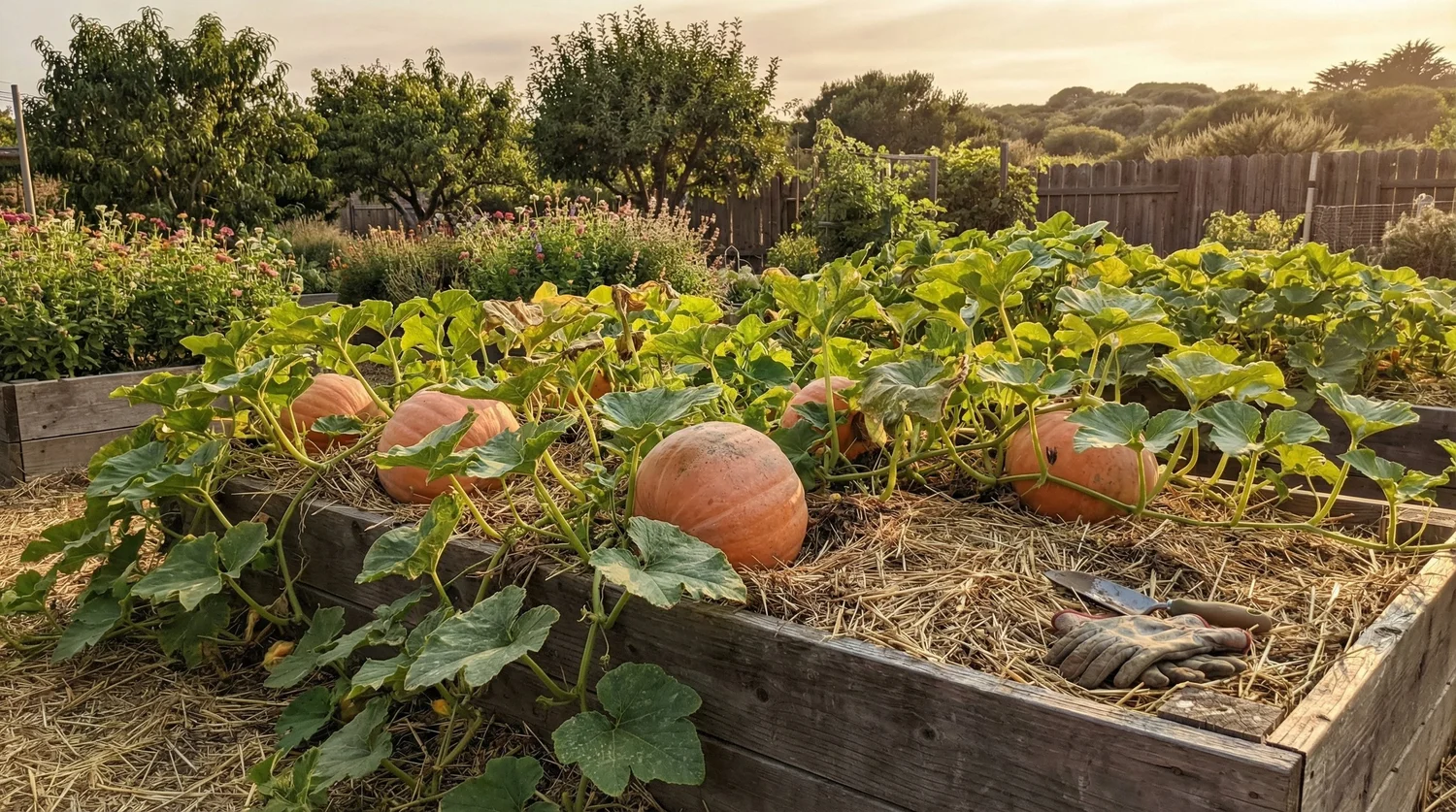
Protecting developing pumpkins. Place a piece of cardboard, straw, or a board under each developing pumpkin to prevent rot from soil contact. In our damp coastal climate, ground moisture and slug activity can damage the bottom of pumpkins that sit directly on soil. Rotate pumpkins slightly every week or two to prevent flat spots and ensure even coloring, but be gentle to avoid breaking the stem connection.
How Do You Handle Pollination for Pumpkins?
Pumpkin pollination works the same way as other squash: male and female flowers form separately on the same vine, and bees must transfer pollen from male flowers to female flowers for fruit to set.
Identifying flowers. Male flowers appear first, usually 7 to 10 days before female flowers. They sit on straight, thin stems. Female flowers have a small, round, pumpkin-shaped swelling at the base of the flower. Do not be concerned when the first wave of flowers produces only males. Female flowers are coming.
Pollination timing. Pumpkin flowers open in the early morning and close by midday. Pollination must occur during this window. Each female flower is receptive for only one day. In Santa Cruz County's foggy coastal areas, bee activity during cool mornings can be limited, which reduces natural pollination success.
Hand pollination. For insurance, hand-pollinate pumpkins the same way you would cucumbers or squash. In the morning, pick a fully open male flower, peel back the petals, and dab the pollen-bearing center onto the stigma inside a female flower. One male flower can pollinate 2 to 3 female flowers. Hand pollination is especially important for large jack-o-lantern varieties where each fruit matters. A poorly pollinated pumpkin will develop lopsided or abort entirely.
How many pumpkins per plant? A healthy vine typically sets 2 to 5 pumpkins, depending on variety and growing conditions. For the largest possible pumpkins, remove all but 1 to 2 fruits per vine and pinch off the vine tip after the last fruit you want to keep. This concentrates the plant's energy into fewer, larger pumpkins. For decorative miniatures, let the vine produce as many as it will.
How Do You Know When Pumpkins Are Ready to Harvest?
Harvesting at the right time ensures the best color, longest storage life, and easiest carving.
Color. A ripe pumpkin has reached its full, deep color. Orange varieties should be uniformly orange with no remaining green patches (though some varieties naturally have green streaks as part of their varietal pattern). Green areas on a pumpkin that should be solid orange indicate immaturity.
Rind hardness. Press your thumbnail firmly into the rind. A ripe pumpkin's rind is hard enough to resist your nail. If your thumbnail easily penetrates the skin, the pumpkin needs more time. A hard rind is also essential for good storage life and for carving jack-o-lanterns that hold their shape.
Stem condition. The stem connecting the pumpkin to the vine should be dry, woody, and beginning to cork over. A green, fleshy stem means the pumpkin is still developing. When the stem begins to dry naturally, the pumpkin has finished its growth cycle.
Sound test. Tap the pumpkin with your knuckles. A ripe pumpkin produces a hollow sound. An immature pumpkin sounds denser and duller. This test takes practice but becomes intuitive after a few seasons.
Harvesting technique. Cut the pumpkin from the vine using a sharp knife or heavy-duty pruners, leaving 3 to 4 inches of stem attached. Never carry a pumpkin by the stem, as breaking the stem creates an entry point for rot organisms and significantly shortens the pumpkin's life. Handle pumpkins carefully to avoid bruising, which also leads to premature decay.
How Do You Store Pumpkins After Harvest?
Proper post-harvest handling keeps pumpkins fresh and firm until you are ready to carve, cook, or display them.
Curing. After harvest, cure pumpkins in a warm (75 to 85 degrees), dry location for 10 to 14 days. This hardens the rind, heals minor surface scratches, and improves storage life. In Santa Cruz County, a sunny spot on a deck or patio works well during September and October. Bring pumpkins inside if rain is forecast, as extended moisture promotes rot.
Storage conditions. After curing, store pumpkins in a cool (50 to 55 degrees), dry location. Do not refrigerate. A garage, basement, or covered porch that stays cool but does not freeze is ideal. Good air circulation around each pumpkin is important. Do not stack pumpkins or place them directly on concrete, which can wick moisture and cause bottom rot. A piece of cardboard or straw beneath each pumpkin prevents this.
Expected storage life. Jack-o-lantern types like 'Howden' store for 2 to 3 months after harvest with proper curing. Pie pumpkins store for 2 to 4 months. Miniatures like 'Jack Be Little' store for 3 to 4 months. Specialty varieties like 'Jarrahdale' can store up to 6 months. Check stored pumpkins weekly and use any that show soft spots or mold promptly.
Timing for Halloween. For the freshest jack-o-lanterns on Halloween, do not carve pumpkins until 3 to 5 days before October 31. Carved pumpkins begin to deteriorate immediately and typically last 5 to 10 days before collapsing. To extend the life of carved pumpkins, spray the cut surfaces with a diluted bleach solution (1 tablespoon per quart of water) and keep them in a cool, shaded location when not on display.
What Challenges Do Pumpkins Face in Santa Cruz County?
Pumpkins share many challenges with other winter squash, plus a few unique to their large size and long growing season.
Powdery mildew. The dominant disease issue for pumpkins in our area. It typically appears in late summer and progressively kills foliage, reducing the plant's ability to size up developing fruit. Choose varieties with powdery mildew resistance when available. 'Cargo PMR' and 'Magic Lantern' have good resistance. Cultural management (drip irrigation, good spacing, removal of infected leaves) helps extend production.
Squash bugs. These gray-brown shield-shaped insects suck plant sap and inject toxins that cause wilting. Check leaf undersides for clusters of bronze eggs and crush them. Hand-pick adults in the early morning. Clean up old vine debris at the end of the season because squash bugs overwinter in plant residue. Squash bugs are present in Santa Cruz County but generally less severe than in hotter, drier regions.
Fruit rot. Ground contact combined with our coastal moisture can cause the bottom of pumpkins to rot before they mature. Elevate developing fruits on straw, cardboard, or wood to keep them dry. Check the undersides of pumpkins regularly and reposition if you see any soft or discolored areas developing.
Insufficient heat. Coastal Santa Cruz gardens may not provide enough heat units for the largest pumpkin varieties to mature fully. If you have tried growing large jack-o-lantern types and consistently end up with green, immature pumpkins by Halloween, switch to shorter-season varieties (100 days or less) or start plants indoors to gain extra warm growing weeks.
For a stage-by-stage view of that long season, see our pumpkin growth stages guide.
Frequently Asked Questions
Can I save seeds from my pumpkins to plant next year?
You can save seeds from open-pollinated (non-hybrid) pumpkin varieties, but be aware that all Cucurbita pepo varieties (which includes most jack-o-lantern pumpkins, acorn squash, zucchini, and pattypan squash) cross-pollinate freely. If you grew any of these other varieties nearby, your saved pumpkin seeds may produce unexpected offspring next year. For reliable results, either grow only one C. pepo variety or buy fresh seed each year.
How do I grow the biggest possible pumpkins?
For the largest pumpkins, choose a variety bred for size (like 'Big Max' or 'Dill's Atlantic Giant'), prepare the soil with generous amounts of compost and aged manure, provide consistent water and regular fertilization, and limit each vine to one or two fruits. Remove all other female flowers and fruit as they appear. Pinch off vine tips once your chosen fruit is set to direct all energy into that single pumpkin. Inland Santa Cruz County gardens with warm, sunny exposures produce the largest pumpkins locally.
Are pumpkin leaves and flowers edible?
Yes. Pumpkin leaves, young vine tips, and flowers are all edible and widely consumed in many cuisines. Young leaves can be sauteed like spinach. Male flowers (the ones without a fruit at the base) can be stuffed and fried, added to soups, or used in quesadillas. Harvesting male flowers does not reduce fruit production as long as you leave enough for pollination. Pumpkin seeds are also nutritious and delicious when roasted.
Can I grow pumpkins in raised beds?
You can start pumpkins in a raised bed, but the vines will quickly outgrow the bed and spread across surrounding ground. Plant at the edge of the bed and train vines outward. Compact varieties like 'Spirit' or miniatures like 'Jack Be Little' are the most practical choices for raised bed growing. Alternatively, position a raised bed next to a sturdy trellis or arch and grow small pumpkin varieties vertically.
Why did my pumpkin vine die suddenly in the middle of summer?
Sudden vine collapse is usually caused by squash vine borer (less common in coastal California) or by bacterial wilt transmitted by cucumber beetles. Fusarium crown rot, a soil-borne fungal disease, can also cause rapid vine death. If you see sawdust-like frass at the base of the vine, suspect vine borer. If the vine wilts progressively from one end, suspect bacterial wilt. In both cases, remove and destroy the affected plant to prevent spread. Rotating planting locations helps prevent soil-borne diseases.
Do pumpkins need full sun?
Pumpkins need at least 6 hours of direct sunlight, and 8 or more hours is strongly preferred. In Santa Cruz County's coastal areas where fog reduces sun exposure, choose the most open, south-facing location available. Pumpkins grown in partial shade produce smaller fruit, fewer fruit per vine, and are more susceptible to powdery mildew due to reduced air circulation and slower foliage drying. Full sun is one of the most important factors for pumpkin success in our climate.
What is the best way to cook homegrown pie pumpkins?
Cut the pumpkin in half, scoop out the seeds (save them for roasting), place halves cut-side down on a baking sheet, and roast at 375 degrees for 45 to 60 minutes until the flesh is completely soft. Scoop the flesh from the skin and puree in a food processor until smooth. Homegrown pie pumpkin puree is significantly better than canned, with richer flavor and better texture. Use it in any recipe calling for canned pumpkin, but reduce liquid slightly because fresh puree has more moisture.
How do I prevent my jack-o-lantern from rotting quickly after carving?
Carve your pumpkin no more than 3 to 5 days before Halloween. After carving, spray all cut surfaces with a diluted bleach solution (1 tablespoon bleach per quart of water) to slow mold and bacterial growth. Apply a thin layer of petroleum jelly to the cut edges to seal them. Display carved pumpkins in a cool, shaded location during the day and bring them indoors at night if possible. In Santa Cruz County's mild, humid coastal climate, carved pumpkins deteriorate faster than in drier climates.
Start Planning Your Pumpkin Patch
Growing pumpkins in Santa Cruz County is entirely achievable with the right variety, proper timing, and sufficient space. Count backward from Halloween to determine your planting date, choose a variety that matches your microclimate and available growing days, and give those hungry vines the water, food, and space they need. By October, you will have homegrown pumpkins that far outshine anything on a grocery store shelf, and the growing process itself is half the fun.
Ready to plan your complete fall garden? Visit Your Garden Toolkit for planting calendars, variety guides, and growing resources tailored to Santa Cruz County.
