Growing Flock Treats: Best Garden Crops for Chickens, Ducks & Geese
Some links in this guide are affiliate links. If you buy through them, we may earn a small commission at no extra cost to you. Read our full disclosure.
Growing Your Own Flock Treats: The Best Garden Crops for Chickens, Ducks, and Geese
The best garden crops to grow as treats for backyard chickens, ducks, and geese in coastal California include kale and other brassicas, pumpkins and winter squash, sunflowers, leaf amaranth, Swiss chard, peas, and comfrey. According to UC Agriculture and Natural Resources, supplemental greens and whole foods can improve feather quality, yolk pigmentation, and overall bird health when they remain within the widely accepted 10-percent treat guideline that limits treats to no more than one-tenth of a bird's total daily diet (UC ANR Poultry Nutrition, 2023).
Why Should You Grow Dedicated Flock Treats Instead of Just Tossing Garden Scraps?
Most flock keepers offer treats as an afterthought: a handful of outer lettuce leaves, a too-ripe zucchini, whatever is left after dinner. That approach works fine as far as it goes, but it leaves a lot of nutritional value on the table. A small dedicated flock treat bed, planted with the most nutrient-dense options for your specific birds, does something different. It gives you control over what your flock eats and when, lets you match crops to your birds' seasonal needs (higher protein in fall for molt, leafy greens in winter when forage is thin), and turns a modest patch of ground into a genuinely useful part of your overall flock management.
In Santa Cruz County, our climate is cooperative. We can grow something useful for our birds in almost every month of the year. The cool, foggy summers that frustrate tomato growers are ideal for the brassicas and leafy greens that chickens, ducks, and geese find most nutritious. Our mild winters keep comfrey alive and productive when most of the garden is dormant. The challenge is less about what the climate allows and more about planning which crops earn their bed space by delivering genuine nutritional value versus filler.
This article focuses specifically on crops you grow with the flock in mind. It is a different topic than letting your flock free-range through the garden, which you can read about in How Your Flock Can Work Your Garden. The goal here is purposeful growing: crops chosen for nutrition, yield relative to space, and ease of serving.
What Is the 10-Percent Treat Rule and Why Does It Matter?
Commercial poultry feed, whether layer pellets or an all-flock formula, is formulated to provide a complete and balanced diet. It contains precise ratios of protein, calcium, phosphorus, vitamins, and essential amino acids that a laying hen, growing duck, or mature goose cannot reliably get from garden crops alone. When treats exceed about 10 percent of a bird's total daily intake, they start displacing feed and diluting the nutritional balance that birds depend on.
The widely used guideline among poultry keepers is that treats of any kind should make up no more than 10 percent of a flock's daily diet, with balanced commercial feed supplying the rest. In practical terms, this means a standard-size laying hen eating roughly 1/4 pound of feed per day can handle about a tablespoon or two of fresh garden treats without any nutritional risk. For a flock of four hens, that is roughly a large handful of kale leaves or a quarter of a small pumpkin, shared among the group.
The 10-percent rule matters most for birds that love treats. Chickens will beg enthusiastically and eat past what is good for them if you let them. Ducks are less selective and will gorge on watermelon or melon until their crops are full of water-dense, low-protein food. Geese are the most disciplined; as natural grazers, they self-regulate better than chickens or ducks. Keep quantities modest, offer treats after birds have had access to their feed for the day, and you will not have nutritional problems.
For the complete feeding foundation that treats should supplement, see What to Feed Your Backyard Flock Year-Round in California.
Which Garden Crops Give Your Flock the Most Nutritional Value?
Not all garden produce is equally useful for a flock. Some crops are nutrient-dense powerhouses. Others are mostly water and roughage, fine in small amounts but not worth dedicating bed space to. Here is an assessment of the best options for Santa Cruz County, organized by what they offer nutritionally and how well they perform in our climate.
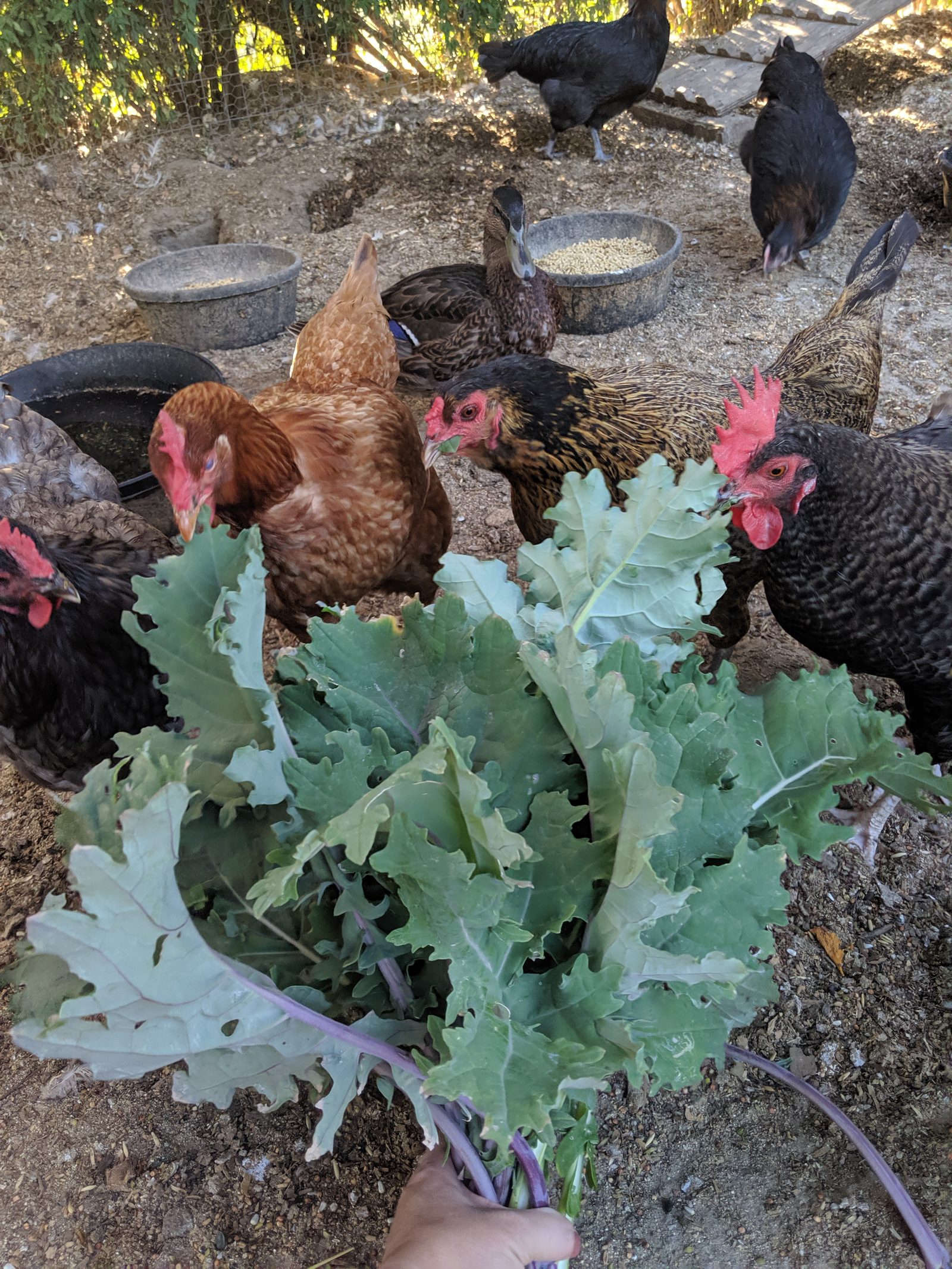
Kale and other brassicas (kale, collards, cabbage, broccoli): The single most useful category for a flock treat garden. Kale is high in vitamins A and K, provides a useful amount of calcium, and is one of the few crops that produces consistently through our foggy summers and mild winters. In coastal Santa Cruz County, Red Russian kale and Lacinato (Dinosaur) kale grow year-round with minimal attention. Hang a whole kale plant by its roots in the run to provide entertainment alongside nutrition; birds will strip it in an afternoon. Broccoli and cabbage are also excellent, and the whole plant, including leaves and stems after harvest, is fair game. Brassica leaves are among the most nutritious foods you can offer laying poultry. Fresh green forage supplies carotenes that carry through to the egg, which is why flocks with steady access to greens lay eggs with deeper orange yolks.
Pumpkins and winter squash: An outstanding dual-purpose crop. The flesh is high in beta-carotene (which converts to vitamin A), and pumpkin seeds contain cucurbitin, a compound with mild natural antiparasitic properties that some experienced flock keepers consider a useful seasonal benefit, though it is not a substitute for proper parasite management. A single Sugar Pie pumpkin vine or a Delicata squash plant takes up significant space but produces multiple fruits you can store and serve throughout fall and winter, a useful trick in months when the garden is less productive. Simply cut the pumpkin in half and set it in the run. Birds will excavate it completely, seeds and all.
Sunflowers for seeds: Sunflower seeds are high in protein (around 22 percent) and healthy fats, making them genuinely useful during fall molt when birds need extra protein for feather regrowth. Grow a row of Mammoth Gray Stripe or Hopi Black Dye sunflowers along a fence in a full-sun location. Direct-sow after the last frost risk passes, which in most of Santa Cruz County means late March through early May. Heads are ready to harvest in late summer or early fall. You can dry them in a warm, ventilated space and offer them throughout the winter. Do not offer sunflower seeds as a large-volume treat; they are calorie-dense and should be used as a targeted nutritional supplement during molt, not a daily snack.
Leaf amaranth: Underused in flock gardens and genuinely excellent. Amaranth leaves are high in protein (around 3 grams per 100 grams of raw leaf), iron, and calcium, and the plants grow fast in warm weather. In Santa Cruz County, plant after soil warms in May or June. A single plant can reach six feet tall and produce enormous yields of leaves that you can harvest repeatedly. The seeds, when the plants go to flower in late summer, are also nutritious for poultry. Varieties sold for grain production (like Golden Giant) work well for this purpose. Amaranth is drought-tolerant once established, a plus for hot-summer inland areas of the county.
Swiss chard: One of the most reliable year-round producers in our climate. Rainbow chard, Fordhook Giant, and Bright Lights all perform well in Santa Cruz County from early spring through winter. Offer chard leaves in moderation because chard contains oxalic acid, which can interfere with calcium absorption in large amounts. A handful of leaves two or three times a week is appropriate. Chard is best thought of as a rotation crop within your treat offerings rather than a daily staple.
Peas (shelling and snap types): Fresh peas are among the most enthusiastically received treats by all three species. Ducks and geese especially love them, and the vines themselves are palatable and nutritious. In Santa Cruz County, peas go in from October through February for spring production. Once harvest slows, pull the whole plant and toss it to the flock. Dried peas can cause digestive problems, so always offer fresh or cooked. Inoculate seeds with rhizobium before planting to fix nitrogen in your treat bed soil, improving it for subsequent crops.
Cucumbers and melons: High water content makes these outstanding hot-weather treats for hydration and cooling. Chickens will peck cucumber halves down to the skin. Ducks love a watermelon rind with flesh still attached. These are treats in the truest sense, not nutritional powerhouses, but they serve a real purpose on warm days when birds need to stay cool and hydrated. In our coastal climate, cucumbers grow well from late spring through summer; melons need the warmer inland microclimates or a warm wall to do well.
Herbs (oregano, parsley, thyme): Garden herbs offer more than flavor. Oregano contains carvacrol and thymol, compounds with documented antimicrobial properties that have attracted research interest for poultry health. Research has shown that oregano oil reduced Eimeria (coccidiosis-causing protozoa) in broiler chicks, though field results with fresh oregano as a treat are more modest. Parsley is high in vitamins A and C. Thyme has mild antimicrobial properties as well. These herbs grow easily in Santa Cruz County and can be offered as fresh sprigs or added to nest boxes as aromatic litter. They are genuine contributors to flock health in small amounts, not just pleasant extras.
Comfrey (cut-and-come-again forage): Comfrey is arguably the highest-value perennial you can plant in a dedicated flock garden. The leaves are extremely high in protein for a green plant (up to 23 percent crude protein on a dry-weight basis), contain B12 precursors, calcium, and iron, and a single established plant can be cut to the ground five or six times per season, regrowing fully each time. Plant once and it produces for decades. In Santa Cruz County, comfrey grows well in full sun to part shade, tolerates our dry summers with minimal irrigation once established, and stays green through most of our mild winters. Use Russian comfrey (Symphytum x uplandicum), which is a sterile hybrid that does not spread aggressively by seed the way true comfrey does. Offer fresh leaves directly; do not dry comfrey for poultry as the alkaloid content concentrates with drying.
A note on corn: Corn is often recommended in flock-keeping guides, and birds do love it. But corn has limited nutritional value relative to its space requirements and caloric density. It is mostly starch, relatively low in protein, and contributes to weight gain in birds that get too much of it. Scratch grain mixes already include cracked corn. Growing corn specifically for flock treats is not the best use of a treat bed unless you have abundant space. If you grow sweet corn for the family, offer spent cobs and husks to the flock; that is a fine use of a byproduct. Just do not dedicate bed space to corn when kale, comfrey, and amaranth deliver far more nutrition per square foot.
See the crop reference table below for a quick-scan summary of these options side by side.
When Should You Plant a Flock Treat Garden in Santa Cruz County?
Our climate lets you keep something growing for your flock in every season. The planning challenge is sequencing crops so that fresh material is available during the times your birds need it most, which roughly aligns with the calendar of their nutritional demands.
Fall is the critical season. Molt begins for most hens in September or October, and it is the time when high-protein supplements matter most. Conveniently, fall is also when sunflower heads dry for harvest and pumpkins are cured and ready. Plan for your highest-protein treat crops (sunflowers, comfrey cuts, amaranth seeds) to be available September through November.
Winter in Santa Cruz County is not the barren season it is elsewhere. Kale, chard, and collards produce steadily through December and February. Peas are going in the ground now and producing by late January. Comfrey slows but does not disappear. A well-planned treat bed keeps something available every week of the year.
Spring brings abundant new growth, and birds emerging from their winter reduced-production phase are ready for it. Fresh pea vines, bolting chard, kale flowers (all nutritious), and the first new comfrey leaves of the season make spring the richest treat season of the year. This is also when egg production peaks, so the nutritional support from garden treats is well-timed.
Summer in our coastal microclimate is the season many gardeners find limiting, but it is excellent for flock treats. Fog-tolerant crops like kale, comfrey, and amaranth continue producing. Cucumbers and summer squash come into peak production, offering hydration treats during the warmest days. If you are in a warmer inland pocket of the county (Los Gatos Creek corridor, Aptos, Corralitos), your treat garden will be even more productive in summer.
The planting calendar graphic below organizes this by month so you can plan your treat bed from a single reference.
How Should You Design a Dedicated Flock Treat Bed?
A 4-by-8-foot raised bed is enough space to grow meaningful quantities of flock treats without taking over your garden. If you can spare an 8-by-12-foot space, you will have enough to offer treats multiple times per week year-round for a flock of four to eight birds.
For a 4-by-8-foot bed, consider this simple layout: plant one comfrey plant at the back corner (it is permanent and will occupy that corner indefinitely), a row of kale or collards along the back, chard plants in the middle section, and rotating seasonal crops (peas in fall and winter, amaranth or cucumbers in summer) in the front where you can turn them over seasonally. Herbs can go in any edge or in a pot nearby.
A few practical notes for the treat bed. Keep it separate from your main kitchen garden so you can harvest freely without worrying about cosmetics. Beds close to the coop or run are convenient because you can toss fresh greens directly without walking far. If rabbits, deer, or gophers are issues in your yard, use the same protection you use for your main garden. Rodent pressure around a poultry operation is already a fact of life; do not let your treat bed contribute to it by leaving harvested produce on the ground overnight.
Birds themselves can be excellent treat-bed assistants at the end of a growing season. When a crop is spent, open the run gate (or carry birds there in a crate) and let them work the bed: they will eat every leaf, scratch for insects, and deposit manure that improves the soil for the next planting. This is the same concept covered more fully in How Your Flock Can Work Your Garden, applied specifically to your treat bed rotation.
What Should You Never Feed Your Flock from the Garden?
Several common garden plants and foods are genuinely dangerous for poultry. This is a different topic than plants that simply do not appeal to birds or that birds damage when given free-range access (covered in Best and Worst Garden Plants for a Free-Range Flock). The items below are toxic and must be kept out of the treat garden and away from your birds.
Avocado: The skin, pit, and flesh of avocado contain persin, a compound toxic to birds and many other animals. Even small amounts of avocado flesh can cause respiratory distress, weakness, and death in poultry. The ASPCA lists avocado as toxic to birds, and this applies to all poultry species. Do not grow avocado where birds can access fallen fruit, and never feed avocado as a treat regardless of how much they seem to want it.
Raw or undercooked beans: Raw beans and incompletely cooked beans contain phytohaemagglutinin (PHA), a lectin that is highly toxic to poultry. A small number of raw kidney beans can be lethal. This is a risk primarily when dry beans are stored near the coop or drop from a bean plant into the run. Cooked beans in small amounts are safe. Never offer dried or raw beans of any variety.
Rhubarb leaves: Rhubarb stalks are edible, but the leaves contain high concentrations of oxalic acid and anthraquinone glycosides. Poultry that consume rhubarb leaves can develop kidney damage, weakness, and death. Keep rhubarb plants fenced away from the run and do not compost rhubarb leaves where birds can access the compost pile.
Tomato, pepper, and potato plant parts (nightshade family): The leaves, stems, and unripe fruits of all nightshade family plants contain solanine and other glycoalkaloids. Ripe tomatoes and cooked potatoes are safe, but green potato skins, unripe tomatoes, and the foliage of any nightshade plant should never go to the flock. This is worth knowing because these plants are among the most common in California vegetable gardens.
Anything moldy: Mold produces mycotoxins that are harmful to all poultry species. Birds are more sensitive to some mycotoxins than mammals. Do not offer any food that shows mold, even if the affected area seems small.
Onions and garlic in large amounts: Small amounts of garlic are sometimes used intentionally as a health supplement and are unlikely to cause harm. Large quantities of alliums (onions, leeks, garlic) can cause Heinz body hemolytic anemia in poultry. Do not offer onion scraps as treats and keep birds away from large allium plantings in the garden.
The quick-reference card below pulls the key safe and avoid information together so you have it in one place for the treat garden.
How Do Different Flock Species Respond to Garden Treats?
Chickens, ducks, and geese are not equally enthusiastic about the same things, and knowing the differences helps you use your treat garden more effectively. If you are managing a mixed flock, which is covered in detail in Keeping a Mixed Flock: Chickens, Ducks, and Geese Together, you will notice these differences quickly.
Chickens are the most food-motivated of the three and will enthusiastically eat almost anything you offer. They particularly enjoy things they can peck apart: hanging kale, halved pumpkins, and corn cobs. They are less interested in large whole items they cannot immediately break into. Chickens benefit the most from high-protein treats during molt (September to November in most of Santa Cruz County) and from calcium-rich greens during peak laying in spring. Keep in mind that chickens are social eaters and dominant birds will monopolize treats if they are offered in a single location. Scatter greens throughout the run or use multiple serving spots.
Ducks love anything soft, wet, or easy to scoop with their bills. Peas are a perennial duck favorite because they can be scooped into shallow water dishes. Cucumbers, watermelon, and soft leafy greens are also enthusiastically received. Ducks are less effective than chickens at tearing apart tougher items like whole kale plants. For ducks, chop treats into manageable pieces or offer soft plant material they can work through easily. Ducks also need access to water during feeding to moisten and swallow their food, which means treat time works best near their water source.
Geese are primarily grazers and are less interested in most garden treats than chickens or ducks. They graze grass, clover, and broadleaf weeds by preference. However, they do appreciate fresh pea plants, comfrey leaves, and leafy greens that mimic their natural grazing diet. In a mixed flock treat scenario, the geese will often get crowded out by the chickens. Give geese their treats separately or scatter greens across a large area so they can graze at their own pace.
How Do Flock Treats Connect to the Broader Garden System?
A flock treat garden is most satisfying when it is part of a larger garden-and-flock loop rather than a standalone project. The flock produces manure that you can compost (see Composting with Chicken and Duck Waste) and use to feed next season's treat bed. The treat bed produces plant material that enriches the birds' diet. The birds process spent crops and weed pressure. It is a system, not just a bed of kale.
For new flock keepers who are also building their garden, a dedicated treat bed is a practical starting point that is lower-stakes than the main kitchen garden. You can experiment with comfrey, amaranth, and sunflowers without worrying about perfection. The flock is genuinely thrilled with imperfect produce, overcrowded plantings, and bolted greens that would embarrass you in the kitchen. That forgiveness makes the treat garden a good place to learn.
If you are still planning your flock setup or expanding your birds, visit Build Your Flock for guidance on choosing the right species and numbers for your yard and goals. The size of your flock should inform how much bed space is worth dedicating to treats, and the species mix affects which crops to prioritize.
The full collection of tools and resources for home gardeners and flock keepers in our area is available at your free Garden Toolkit. It includes guides and planning resources to help you make the most of both your garden and your birds throughout the year.
Frequently Asked Questions
How much garden treat food can I give my chickens, ducks, or geese each day?
Treats of any kind, including fresh garden produce, should make up no more than 10 percent of your birds' total daily diet. For a standard-size laying hen eating approximately 1/4 pound of feed per day, that equals a tablespoon or two of fresh produce as a daily supplement. For a flock of four hens, a large handful of kale or a halved small cucumber shared among the group is appropriate. Keeping treats to no more than 10 percent of the diet is the widely used guideline for preserving the nutritional balance of commercial feed.
What is the single best crop to grow for flock treats in Santa Cruz County?
Comfrey (Russian variety, Symphytum x uplandicum) is arguably the highest-value single plant for a flock treat garden. It can contain up to 23 percent crude protein on a dry-weight basis, is rich in calcium and B12 precursors, grows year-round in our mild climate, and can be cut five or six times per season from a single plant that lives indefinitely. It requires no annual replanting and thrives with minimal care. Always offer fresh comfrey leaves only, never dried, as alkaloid content concentrates with drying.
Are sunflower seeds good for backyard chickens during molt?
Yes. Sunflower seeds are among the most useful high-protein treats during the fall molt period. At roughly 20 percent protein, sunflower kernels give birds a useful protein boost during the fall molt, when regrowing feathers draws heavily on protein because feathers are almost entirely keratin. Offer dried sunflower heads or hand-stripped seeds in moderate amounts: a tablespoon or two per bird per day. They are calorie-dense, so use them as a targeted supplement rather than a daily routine treat.
Can I feed peas from my garden to my flock?
Fresh peas, snap peas, and pea vines are excellent and safe for chickens, ducks, and geese. Peas are high in protein and particularly popular with ducks, who can scoop them easily in water. The entire pea plant including vines and leaves is palatable and nutritious. Unlike raw beans, dried peas do not carry a lectin danger at the levels found in kidney beans or other dry beans. Fresh or frozen peas are always the safest choice, but dried peas can also be fed to chickens without the toxicity risk associated with dry beans. Offer fresh-harvested peas or spent pea plants pulled immediately from the garden whenever possible for the best palatability.
What garden plants are genuinely toxic to chickens and other poultry?
The most dangerous common garden plants for poultry are avocado (all parts contain persin, which is toxic to birds and can be fatal), raw or dried beans (phytohaemagglutinin can be lethal even in small quantities), rhubarb leaves (high oxalic acid and glycosides), the foliage and unripe fruit of nightshade family plants including tomato, pepper, and potato plants, and any moldy produce. UC Davis Veterinary Medicine identifies avocado as poisonous to chickens and the plant that most often causes trouble for pet birds, and the ASPCA Animal Poison Control Center lists avocado as toxic with persin as the toxic compound.
Do geese benefit from garden treats, or do they just eat grass?
Geese are primarily grazers and can meet much of their diet from grass and broadleaf weeds when they have access to good pasture. However, they do benefit from and enjoy fresh leafy greens, comfrey, pea plants, and chard from the treat garden, particularly in winter when grass growth slows in coastal Santa Cruz County. Geese in mixed flocks often get crowded out at treat time; offer their portion separately or scatter it widely so they can graze at their own pace.
How can I use my flock to help maintain the treat garden?
After a treat crop is spent, open access to that section of the bed and let birds work through it for a day or two. Chickens will scratch for insects, eat remaining plant material, and deposit manure. Ducks will probe for soil insects and slugs. Geese will graze any remaining green growth. The combined activity and manure deposit improves soil biology and fertility for the next planting cycle. This is the same principle behind garden integration practices covered in How Your Flock Can Work Your Garden. Rotate access carefully so birds do not establish in any one section long enough to compact soil or eliminate beneficial organisms.