

Keeping a Mixed Flock: Chickens, Ducks, and Geese Together
A few of the product links in this guide are affiliate links. If you buy through one, Ambitious Harvest may earn a small commission at no extra cost to you, which helps keep these guides free. We only point to gear we would use in our own Santa Cruz garden. As an Amazon Associate, we earn from qualifying purchases. Read our full disclosure.
Keeping a Mixed Flock: Chickens, Ducks, and Geese Together
Chickens, ducks, and geese can sometimes share outdoor space when each species' housing, water, feeding, and social needs are met. Published guidance does not establish a universal 25-to-50% mixed-flock space premium. Merck instead recommends basing space on species, bird size, and activity level.
Why Keep Multiple Species Together Instead of Separately?
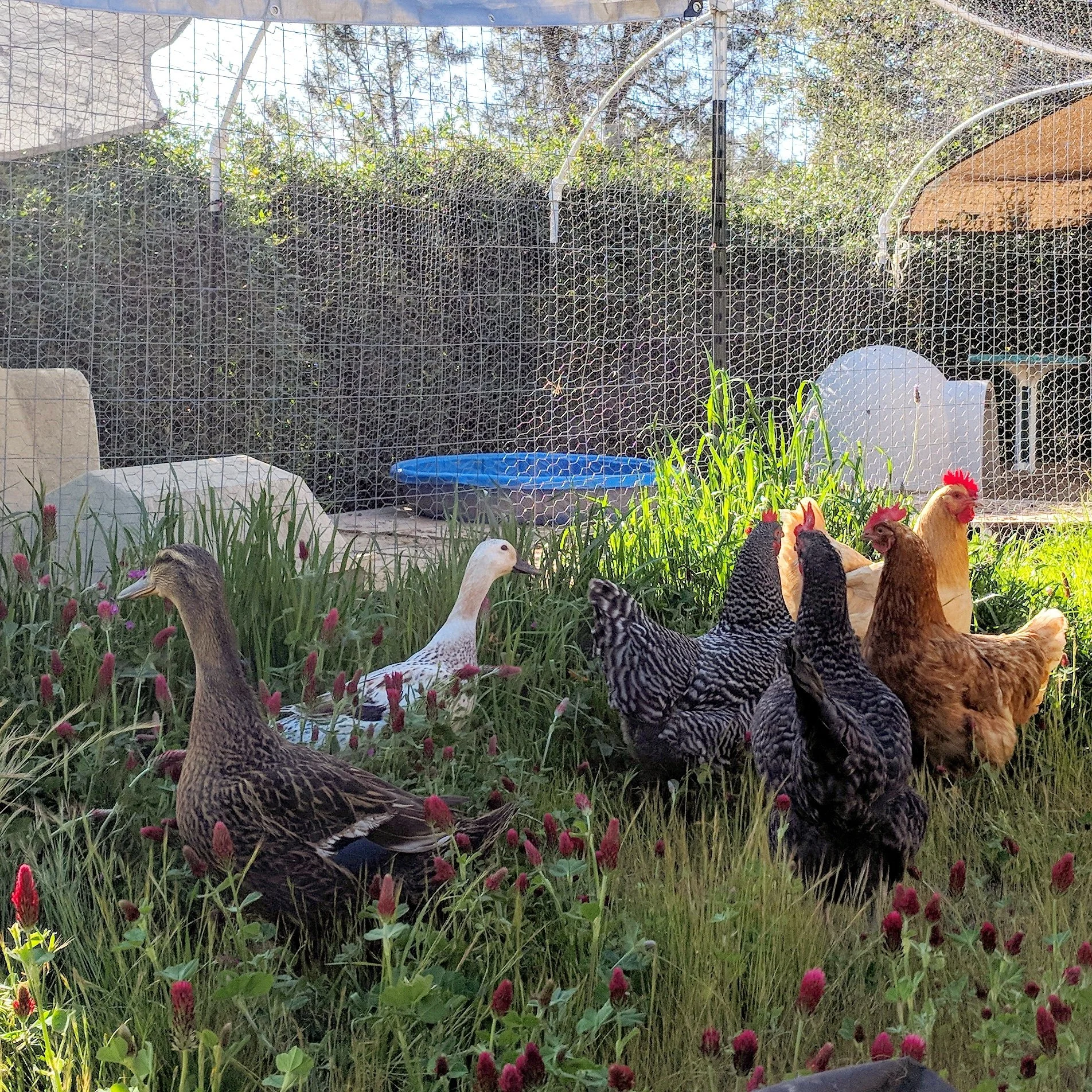
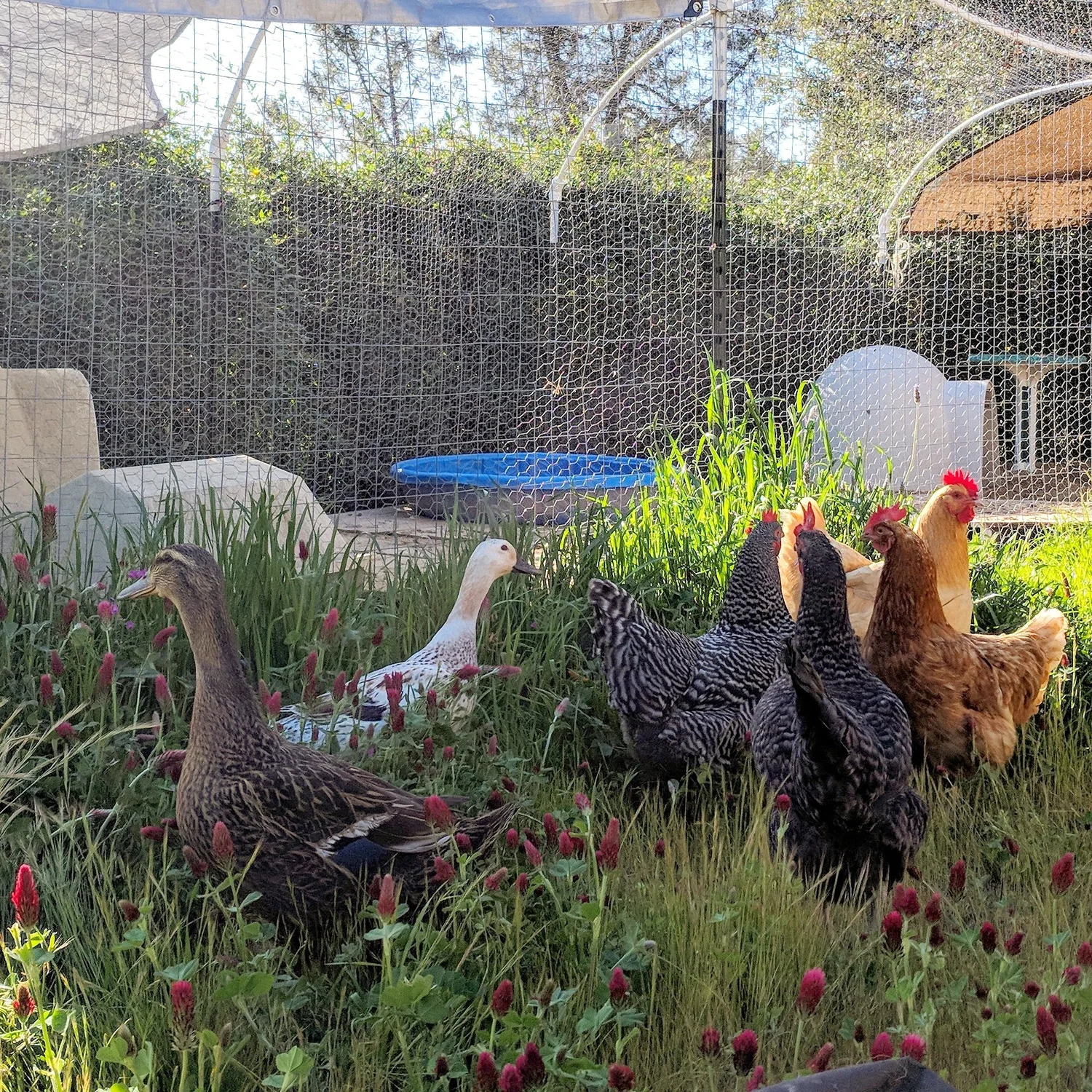
There are real, practical reasons to run a mixed flock rather than keeping separate coops for each species. In a garden setting, different species contribute different things. My flock in Boulder Creek includes a Toulouse goose, a Black Runner duck, a Mallard duck, and several chickens (a mix of breeds, some rescues from the Santa Cruz County Animal Shelter). Each species plays a distinct role in our garden ecosystem.
Chickens are the best scratchers. They turn soil, break up compacted ground, and find beetles and grubs that other species miss. Ducks are the undisputed slug and snail champions. Our Black Runner patrols the garden with an intensity that no chicken matches. The Toulouse goose keeps the grass trimmed, alerts the flock to aerial predators with her loud honking, and provides a certain social stability to the group through sheer size and presence.
Keeping them together also simplifies management in some ways. One predator-proof run protects all species. One garden free-range schedule works for everyone. And the social dynamics of a mixed flock are often calmer than a single-species flock because the separate social hierarchies reduce direct competition. Your chickens sort out their pecking order among themselves, your ducks form their own sub-group, and a goose simply exists as a large, opinionated individual who everyone respects.
The challenges are real, though. Water management is the biggest one. Feeding requires some planning. And housing needs differ between species. Getting these details right is the difference between a harmonious mixed flock and a messy, stressful situation.
How Much Space Does Each Species Need?
Space is the foundation of a peaceful mixed flock. Overcrowding causes aggression, feather picking, disease transmission, and general misery. Each species has different requirements, and when you house them together, you need to meet the highest standard, not the lowest.
Chickens
Chickens need dry, well-ventilated housing with roosting and nesting accommodations. Merck gives approximate indoor ranges of 1.5 to 2 square feet for laying hens and larger chickens and an outdoor range of 8 to 10 square feet, while noting that size and activity matter. Provide more room if birds crowd resources or the litter stays wet.
Ducks
Ducks rest on the floor and need dry bedding plus water managed so the shelter does not stay wet. Merck gives an approximate indoor range of 3 to 6 square feet and an outdoor range of 15 to 18 square feet for ducks and geese. Use those as planning ranges, then adjust for bird size and conditions.
The critical difference with ducks is water. They need water deep enough to submerge their entire head for cleaning their nostrils and eyes. This is not optional. Without head-dipping water, ducks develop eye infections and sinus problems. More on water management below.
Geese
Geese are larger and more active than most backyard chickens. Merck groups ducks and geese at approximately 3 to 6 square feet indoors and 15 to 18 square feet outdoors, with final needs determined by size, activity, and management rather than a universal per-goose minimum.
Geese are grazers. They eat grass as a primary food source, which means they need access to a grassy area or pasture. In a bare-dirt run, geese will need significantly more supplemental feed. If your run is on bare ground, plan for regular supervised garden time where the goose can graze on lawn and cover crops.
Total run calculation
For a small mixed flock like ours (one goose, two ducks, four chickens), the math looks like this:
Goose: 25 square feet
Two ducks: 40 square feet (20 each)
Four chickens: 60 square feet (15 each)
Water area: 25 square feet (for duck/goose water that stays separate from dry chicken areas)
Total: 150 square feet minimum
Our 35-by-15-foot run gives us 525 square feet, which is generous. That extra space makes an enormous difference in flock harmony. I strongly recommend erring on the side of more space, not less.
For run design details, see Designing a Predator-Proof Run for Your Garden Flock.
How Do You Manage Water for a Mixed Flock?
Water is the single biggest management challenge in a mixed flock, and it is the issue that most people underestimate. Chickens need clean drinking water. Ducks and geese need water to drink, clean their faces, and ideally to swim or bathe. These needs are fundamentally incompatible if you try to serve them from one source.
The chicken water problem
Chickens drink from nipple waterers, cups, or open dishes. They prefer clean water and will refuse water that is visibly dirty. Ducks and geese, within minutes of accessing any open water source, will turn it into a muddy, feed-filled soup. They dabble, they wash their bills, they dunk their food in the water before eating. This is natural duck and goose behavior, and you cannot train them out of it.
The solution is separate water systems. Mount nipple waterers or poultry cups at chicken head height (12 to 18 inches off the ground) for your chickens. Ducks and geese cannot use nipple waterers effectively due to their bill shape, so this naturally creates species-specific water access.
Duck and goose water stations
For ducks, provide at minimum a rubber livestock tub (like a 6-gallon rubber feed pan) deep enough for full head submersion. This needs to be dumped and refilled daily, sometimes twice daily in warm weather. Position it on a wire-over-gravel drainage pad to manage the inevitable splash zone. Without drainage, the area around duck water becomes a mud pit within days.
Building a drainage pad is straightforward: dig out a 4-by-4-foot area about 6 inches deep, fill with gravel, and lay a section of heavy-gauge wire mesh on top. The water drains through the gravel instead of creating mud. This single improvement transformed our run from a mud disaster to a manageable setup.
For swimming water (which ducks and geese love but do not strictly require), a rigid plastic kiddie pool or a stock tank works well. Change the water every 1 to 2 days. In summer, algae growth accelerates, so more frequent changes may be needed. I drain our duck pool onto garden beds since the nutrient-rich water acts as a mild fertilizer.
Water placement in the run
Position water stations away from the coop entrance and away from feeding areas. Ducks carry water in their bills as they walk, dripping and splashing. Keeping water far from the coop prevents the bedding from becoming saturated. A general rule is to place waterfowl water at the opposite end of the run from the sleeping area.
What Should You Feed a Mixed Flock?
Feeding a mixed flock requires some strategy because chickens, ducks, and geese have different nutritional needs, but you are not going to serve three separate meals three times a day. Here is a practical approach that works.
The base feed
Feed a nutritionally complete ration appropriate to the species and life stage, and make any shared-feeding plan with a poultry veterinarian or qualified nutrition source. Merck cautions that generic chicken layer pellets are not advised as the sole diet for waterfowl. Do not make a blanket medicated-feed decision without checking the product label, species, and veterinary guidance.
Provide free-choice oyster shell in a separate dish for laying hens. Chickens that need extra calcium for eggshell production will eat it, and those that do not need it (including ducks and geese, who get adequate calcium from most all-flock feeds) will leave it alone. Do not mix oyster shell into the feed, as this forces calcium on birds that do not need it and can cause kidney issues in young or non-laying birds.
Species-specific supplements
Ducks and geese have higher niacin requirements than chickens, and deficiency can cause leg and hock problems. Use a complete duck or waterfowl ration when available and seek species-specific nutrition guidance; a household brewer's-yeast ratio is not a reliable way to guarantee the required nutrient intake.
Geese: Geese are grazers and get a significant portion of their diet from grass and green plants. In a run without grass access, supplement with chopped greens (lettuce, grass clippings, weeds). During garden free-range time, geese will graze heavily, which reduces their pellet consumption. Our Toulouse goose eats noticeably less feed on days when she has had extended garden time.
Chickens: Provide grit (small stones) for chickens if they do not have access to natural grit in the run. Chickens use grit in their gizzard to grind food. Ducks and geese also need grit but tend to find natural sources more readily. A dish of poultry grit available free-choice covers all species.
For a complete feeding guide, see What to Feed Your Backyard Flock Year-Round in California.
Feeding station management
Provide at least two feeding stations in different locations. This prevents dominant birds from blocking access to food. In our run, one feeder hangs at chicken height (12 inches off the ground) and another sits at ground level where ducks and the goose prefer to eat. The hanging feeder stays cleaner because ducks cannot easily dabble in it.
Remove or cover feeders overnight to discourage rodents, which are a common problem in any poultry setup and a significant concern in Santa Cruz County where rats and mice are abundant.
How Does the Pecking Order Work in a Mixed Flock?
Every poultry species has a social hierarchy, and in a mixed flock, these hierarchies run in parallel rather than as one unified system. Understanding this makes flock management much easier.
Your chickens will establish their own pecking order. The most dominant hen or rooster runs the chicken social structure. Your ducks form their own pair bond or small group. If you have a drake, he leads the duck contingent. And a goose, particularly a single goose, often occupies a separate social space entirely, respected by everyone due to size and temperament.
In my flock, the chickens sort out their own hierarchy with the usual posturing and occasional pecking. The Runner duck and Mallard stick together as a pair and largely ignore the chickens. The Toulouse goose presides over everything with the calm authority that only a 15-pound bird can project. When the goose walks through the chicken group, they move aside. There is no aggression involved, just a mutual understanding of relative size.
Interspecies conflict points
Conflict usually arises around resources, not territory. The most common flashpoints are:
Food competition: A goose at a feeder can block chickens from eating. Multiple feeding stations solve this.
Water territory: Ducks may guard their water source. Providing multiple water points eliminates this.
Nesting areas: A broody duck may try to claim a chicken nest box, or vice versa. Provide species-specific nesting options.
Mating behavior: A drake may attempt to mate with chicken hens, which can injure them. A rooster may attempt to mate with ducks, which is equally problematic. If mating aggression becomes an issue, separate the offending bird during peak hormonal seasons (spring in Santa Cruz County).
Managing seasonal hormonal changes
Spring and early summer bring hormonal surges that increase aggression in all species. Roosters become more territorial, drakes become more persistent in mating, and geese can become genuinely aggressive during nesting season. In Santa Cruz County, this hormonal peak typically runs from February through May.
During this period, you may need to temporarily separate a particularly aggressive bird. Extra space, more hiding spots, and more supervised free-range time all help reduce tension. If you have a goose that becomes aggressive toward chickens during breeding season, temporary separation during the worst weeks is better than risking injury to smaller birds.
How Do You Design Housing for a Mixed Flock?
Chickens and waterfowl have fundamentally different housing needs, and trying to force them into one structure usually creates problems. The best approach is a shared run with separate sleeping quarters.
Chicken coop
Chickens need an elevated coop with roosting bars, nest boxes, and good ventilation. Standard coop design works fine. The coop should be raised off the ground (12 to 24 inches) for ventilation and to reduce rodent harborage. Chickens naturally seek elevation at night, so they will put themselves to bed in their coop as daylight fades.
Duck and goose shelter
Ducks and geese sleep on the ground and do not use roosts. They need a ground-level shelter with a wide door (waterfowl do not navigate narrow openings well), dry bedding, and excellent ventilation. A simple three-sided shelter with a roof works in our mild Santa Cruz County climate, though a four-sided structure with a closeable door provides better predator protection.
Ducks and geese produce significantly more moisture than chickens through their droppings and their habit of carrying water everywhere. Their shelter needs more ventilation and more frequent bedding changes than a chicken coop. In our setup, I change duck bedding twice per week compared to once per week for the chicken coop.
The shared run
The run itself should be fully enclosed with hardware cloth (not chicken wire, which predators can tear through). Our 35-by-15-foot run is enclosed with hardware cloth on all sides and over the top. This protects against the full range of Santa Cruz County predators: raccoons, foxes, coyotes, bobcats, hawks, ringtail cats, and weasels.
Within the run, create zones. A dry area near the chicken coop with sand or fine gravel substrate. A wet zone around the waterfowl water station with the drainage pad described above. A shaded area where all species can escape summer heat. And open space for the birds to move around freely.
For complete predator-proofing guidance, see Designing a Predator-Proof Run for Your Garden Flock.
What Health Issues Are Unique to Mixed Flocks?
Housing multiple species together creates some health considerations that single-species flocks do not face.
Moisture-related respiratory issues: The extra moisture from waterfowl can raise humidity in a shared shelter, increasing the risk of respiratory infections in chickens. This is the primary reason to keep sleeping quarters separate. Chickens breathing damp, ammonia-laden air from wet waterfowl bedding are much more susceptible to respiratory disease.
Different poultry species can share some infectious risks, but symptoms alone do not establish a parasite burden. Use veterinary examination or diagnostic testing when signs or flock history warrant it rather than treating or testing on an automatic calendar. USDA APHIS emphasizes clean water, clean bedding, and biosecurity for flock protection.
Different disease susceptibilities: Ducks are less susceptible to Marek's disease than chickens, but more susceptible to aspergillosis (a fungal respiratory infection that thrives in damp conditions). Geese are hardy against most poultry diseases but can carry and transmit some pathogens without showing symptoms. USDA notes that low pathogenicity avian influenza occurs naturally in wild waterfowl and shorebirds without causing illness and can infect domestic poultry with little or no signs, so a bird that looks healthy is not proof the flock is clear.
Foot health: Ducks and geese have webbed feet that are more sensitive to rough, rocky ground than chicken feet. Wire mesh flooring, sharp gravel, and splintered wood can cause foot injuries in waterfowl. Ensure a portion of your run has smooth ground, sand, or grass for waterfowl comfort.
Can You Add New Species to an Existing Single-Species Flock?
Yes, and it is often easier than adding new birds of the same species. When you introduce a different species, the existing pecking order is not directly threatened. Your chickens will be curious about the new duck, but they are not competing for the same social rank.
For new birds, use a separate quarantine area and do not deworm automatically. USDA APHIS recommends separating poultry species, maintaining clean water and bedding, and watching for signs of illness; a veterinarian can advise on testing and treatment based on the birds' origin and condition.
Most mixed flock keepers find that adding waterfowl to a chicken flock goes smoothly. Adding chickens to an established waterfowl group can be slightly more challenging if a goose has claimed the entire space as its territory. In that case, extend the see-but-not-touch phase and provide extra hiding spots for the chickens.
For breed selection guidance, see Choosing the Right Breeds for Coastal California Gardens.
Frequently Asked Questions
Can chickens and ducks share the same coop at night?
Shared overnight housing is harder to keep dry because waterfowl add substantial moisture. Provide species-appropriate resting areas, dry bedding, and strong ventilation, and separate birds if moisture or conflict cannot be controlled. USDA APHIS includes separating poultry species among its flock-protection practices.
Do you need a pond for ducks in a mixed flock?
No. Ducks need water deep enough to submerge their heads (about 6 to 8 inches) for cleaning their nostrils and eyes, but they do not require a full pond. A rubber livestock tub or rigid kiddie pool provides adequate water for bathing and cleaning. Change the water daily to prevent bacterial buildup and mosquito breeding.
Will a goose protect chickens from predators?
Geese are excellent alarm animals and will honk loudly at perceived threats, alerting you and the flock. However, geese cannot physically defend against most predators. A goose may deter a hawk through noise and wing displays but cannot stop a raccoon, fox, or coyote. Geese work best as part of a layered predator protection strategy, not as a replacement for secure fencing.
How do you prevent drakes from mating with chicken hens?
Drake-on-chicken mating attempts can injure hens because drake anatomy differs from rooster anatomy. If you see persistent mating attempts, separate the drake during peak hormonal season (February through May in Santa Cruz County). Keeping at least one female duck as a mate for the drake typically reduces unwanted cross-species mating behavior.
What is the best ratio of species for a small mixed flock?
Choose flock size from the available shelter and run space, the birds' sizes, and whether all birds can avoid conflict and reach feed and water. There is no evidence-backed universal rule that mixed flocks need 25 to 50% more run space; Merck provides species-specific planning ranges instead.
Can you keep a rooster with ducks and geese?
Yes, roosters generally coexist well with waterfowl. The rooster will focus his mating attention on the hens and largely ignore the ducks and geese. Occasionally a rooster will attempt to assert dominance over a duck, but a goose will quickly discourage any rooster aggression. Keep only one rooster per 8 to 10 hens to prevent over-mating.
Do mixed flocks have more parasite problems?
Some health risks can cross species, but testing frequency should reflect symptoms, exposure, and veterinary advice rather than an automatic annual rule. USDA APHIS prioritizes sanitation, clean water and bedding, species separation, and prompt attention to illness signs.
What is the hardest part of keeping a mixed flock?
Water management. Ducks and geese turn every water source into a muddy mess, which is incompatible with chickens' need for clean drinking water. Solving this with separate water systems (nipple waterers for chickens, open tubs for waterfowl) and proper drainage is the key to a successful mixed flock setup.
