

Growing Celosia in Santa Cruz County: Bold Texture for Warm Season Bouquets
A few of the product links in this guide are affiliate links. If you buy through one, Ambitious Harvest may earn a small commission at no extra cost to you, which helps keep these guides free. We only point to gear we would use in our own Santa Cruz garden. As an Amazon Associate, we earn from qualifying purchases. Read our full disclosure.
Why Should Santa Cruz County Gardeners Grow Celosia?
Celosia brings bold, velvety texture to warm-season bouquets, and in Santa Cruz County it belongs in your warmest ground. Summer temperatures here run from the mid-60s along the coast to the mid-80s inland, and that spread decides how well this plant does. According to University of Maryland Extension, celosia thrives in hot, dry conditions and generally performs poorly in cool, wet summers, so it suits warmer inland Santa Cruz County gardens better than the foggiest coastal sites. If you want dramatic, long-lasting color in your garden and your vase, celosia deserves a spot in your planting plan.
This tropical native is a real stretch for a fog-bound coastal garden, and it pays back a warm inland pocket far better than a cool one. The key is knowing which part of the county you garden in, then matching the type and the planting date to that. Given warmth and a strong start, these plants are low-maintenance and will produce for weeks.
What Are the Three Main Types of Celosia?
Celosia comes in three distinct forms, each with its own personality in the garden and in arrangements. All three belong to the amaranth family and share the same general growing requirements, but their flower shapes are dramatically different. The UC Master Gardeners of Santa Clara County cut flower planting chart describes celosia as ranging from 8 to 36 inches tall with vibrant colors suited for both fresh and dried arrangements.
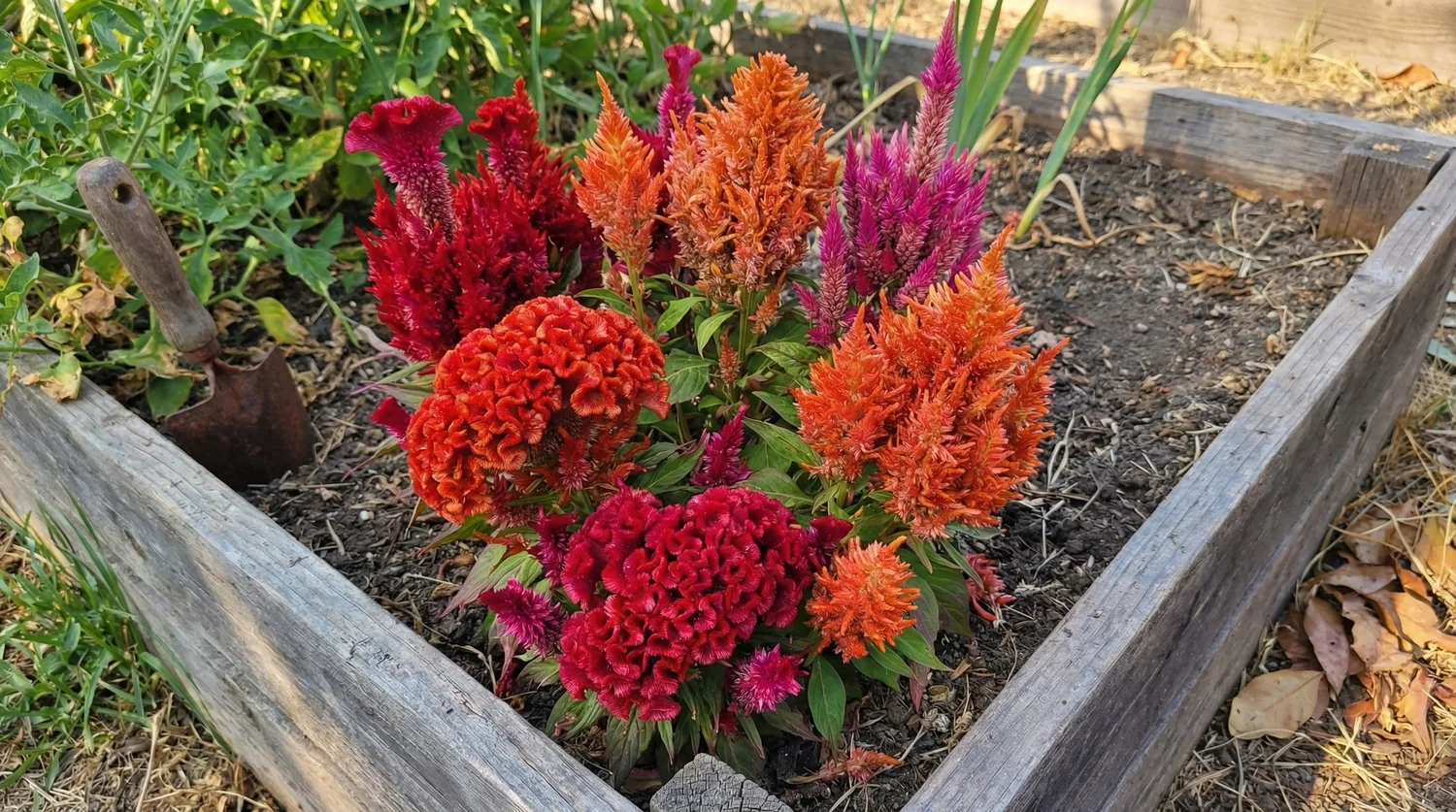
Crested celosia (Celosia cristata) produces the familiar brain-like or cockscomb flowers that can grow to impressive sizes. These dense, ruffled blooms come in deep reds, magentas, oranges, and yellows. Popular varieties for cutting include 'Chief Mix,' 'Bombay,' and 'Coral Garden.' The crested types make bold focal flowers in arrangements and can grow blooms up to 12 inches across in ideal conditions.
Plume celosia (Celosia argentea var. plumosa) features feathery, flame-shaped flower heads that add graceful movement to bouquets. The 'Century' and 'Fresh Look' series are reliable performers in Santa Cruz County gardens. Plume types tend to branch more freely than crested varieties, producing multiple stems per plant, which makes them excellent for repeated cutting throughout the season.
Wheat celosia (Celosia spicata) offers slender, tapered flower spikes that resemble wheat heads or tiny bottle brushes. The 'Flamingo Feather' series, with its soft pink-to-white gradient, is particularly popular with flower farmers and arrangers. Wheat celosia has a more delicate, airy quality than the other types and works beautifully as a filler flower. It also dries exceptionally well, holding its shape and most of its color for months.
Which Celosia Varieties Have a Chance in a Cool Coastal Garden?
The county's coastal influence works against celosia rather than for it. University of Maryland Extension advises transplanting only once night temperatures hold consistently above 65 to 70 degrees, and warns that exposure below 60 degrees stunts plants and triggers premature flowering. Coastal Santa Cruz summer nights often miss that bar, which is the real reason celosia underperforms near the water.
For coastal gardens from Santa Cruz to Davenport, where summer highs often stay in the 65 to 72 degree range, expect shorter stems, smaller heads, and later bloom than the seed packet suggests. Plume types such as the 'Fresh Look' series are the ones to try first, because they branch freely and keep pushing new stems even when growth is slow. Give them the warmest, most sheltered bed you have, and treat a coastal crop as a bonus rather than the plan.
Inland gardens in Scotts Valley, the San Lorenzo Valley, and toward Watsonville are where celosia actually belongs in this county. The warmer summer days in these areas support the full range of celosia types, including the large-flowered crested varieties that need sustained warmth to develop their biggest blooms. 'Chief Mix' and 'Bombay' series crested celosias are excellent choices for these warmer microclimates.
If you are growing primarily for cut flowers, the wheat type 'Flamingo Feather' is the most forgiving of the three if your site runs cool. It produces the longest, most useful stems and handles our temperature swings better than the crested types. Plant it in blocks of at least 12 plants for a meaningful harvest.
How Do You Start Celosia From Seed Successfully?
Celosia grows readily from seed, but it has a few quirks that trip up first-time growers. Understanding these will save you frustration and give you stronger transplants.
Timing your seed start. In Santa Cruz County, start celosia seeds indoors 6 to 8 weeks before your last expected frost date. For most of our area, that means sowing seeds in late February through mid-March for transplanting in late April to mid-May. This timing aligns with the UC Master Gardeners cut flower planting chart, which recommends seeding celosia in February and March with transplants going out in May and June. Celosia is frost-sensitive, so do not rush transplants outdoors.
Seed starting technique. Celosia seeds need light to germinate, so press them gently onto the surface of moist seed-starting mix without covering them. Keep the soil temperature between 70 and 80 degrees for best germination, which typically takes 7 to 14 days. A heat mat is helpful here, especially during our cool spring nights. Mist gently to keep the surface moist without disturbing the tiny seeds.
Avoiding the rootbound problem. Celosia has a critical sensitivity that many gardeners learn the hard way: if seedlings become rootbound in their containers, they will bloom prematurely at a stunted size and never recover their full growth potential. University of Maryland Extension warns that once seedlings are potbound they have been stunted and will never develop into full-sized plants, and that severely stunted celosias bloom prematurely with small flower heads and short stems. The solution is to pot up seedlings promptly when roots reach the edges of their cells, and to transplant into the garden before they become stressed.
Hardening off. Begin hardening off seedlings about 10 days before your planned transplant date. Move them outdoors to a sheltered spot for a few hours each day, gradually increasing exposure to direct sun and wind. Celosia is sensitive to cold, so bring seedlings inside any night the temperature drops below 50 degrees.
When and How Should You Plant Celosia in the Garden?
Timing your transplant correctly is the single most important decision for celosia success in Santa Cruz County. Plant too early and cold soil stunts growth permanently. Plant too late and you lose weeks of the warm season.
Soil temperature matters more than air temperature. Wait until soil temperatures reach at least 60 degrees at a 4-inch depth before transplanting celosia. In coastal Santa Cruz, this often does not happen until mid-May. Inland gardens may reach this threshold by late April. Use an inexpensive soil thermometer to check rather than guessing. Celosia planted in cold soil will sit dormant, become stressed, and produce disappointing results.
Site selection. Choose a spot that receives at least 6 hours of direct sun. In our coastal areas, a south-facing or west-facing bed that catches afternoon warmth is ideal. Celosia tolerates our coastal winds better than many tropical annuals, but a location with some wind protection will produce taller stems with less lodging.
Spacing. Space crested types 10 to 12 inches apart, plume types 8 to 10 inches apart, and wheat types 6 to 8 inches apart. Closer spacing encourages taller stems with smaller flowers, which is actually preferable for cut flower production. Wider spacing produces larger individual blooms, which is better for garden display.
Soil preparation. Celosia prefers well-drained soil with moderate fertility. Amend heavy clay soils with compost to improve drainage. Avoid overly rich soil or heavy nitrogen fertilization, which produces lush foliage at the expense of flowers. A balanced organic fertilizer worked into the bed before planting provides sufficient nutrition for the season.
Watering at planting. Water transplants thoroughly at planting and keep soil consistently moist for the first two weeks while roots establish. After that, celosia is moderately drought-tolerant and prefers to dry slightly between waterings. Overhead watering can promote fungal issues on the dense flower heads, so drip irrigation or soaker hoses are the better choice.
How Do You Cut Celosia for the Longest Vase Life?
Celosia is one of the longest-lasting cut flowers you can grow, with properly harvested stems lasting 10 to 14 days in a vase. The techniques for cutting and conditioning are straightforward but make a real difference in how long your bouquets look fresh.
When to cut. Harvest celosia when flower heads are about three-quarters open and showing full color. For crested types, this means the velvety ridges are fully developed but the edges are still tight. For plume types, cut when the plume has colored up but the tiny individual flowers at the base are just beginning to open. Wheat celosia should be cut when the spike shows color along most of its length.
How to cut. Cut stems in the early morning when they are fully hydrated. Use sharp, clean snips and cut stems as long as possible, at least 12 to 18 inches. Make your cut just above a leaf node to encourage the plant to branch and produce additional stems. Each celosia plant can produce 4 to 8 cuttable stems over the season with proper harvesting technique.
Conditioning. Strip all foliage that would fall below the waterline in your vase. Place stems immediately in clean water with a few drops of bleach or commercial flower preservative. Celosia stems have a slightly woody quality and benefit from a fresh cut at a 45-degree angle before arranging. Change the vase water every 2 to 3 days to maximize longevity.
Encouraging reblooming. Regular cutting is the best way to keep celosia producing. When you harvest a stem, the plant responds by sending out side shoots that will produce additional flowers. If you let flowers go to seed on the plant, it signals the plant that its job is done and new flower production slows dramatically.
How Do You Dry Celosia for Year-Round Arrangements?
All three celosia types dry exceptionally well, retaining much of their original color and form. Dried celosia has become increasingly popular in everlasting arrangements and wreaths, and it is one of the easiest flowers to preserve at home.
Air drying. The simplest method is to hang stems upside down in a warm, dry, dark location with good air circulation. Strip the leaves, bundle 3 to 5 stems together with a rubber band, and hang from a hook or line. Most celosia dries completely in 2 to 3 weeks. Crested types hold their shape remarkably well, while plume types become slightly more compact as they dry.
Silica gel drying. For the most vivid color retention, especially with crested varieties, bury flower heads in silica gel crystals in an airtight container. This method preserves nearly all of the original color intensity and takes about 5 to 7 days. It is worth the extra effort for special arrangements or craft projects.
Harvest timing for drying. If you plan to dry celosia, harvest slightly later than you would for fresh arrangements. Wait until flowers are fully open and at peak color. Slightly more mature flowers hold up better during the drying process and retain their shape more reliably.
What Pests and Problems Should You Watch For?
Celosia is one of the most trouble-free annual flowers you can grow in Santa Cruz County. It has very few serious pest or disease issues here, which is part of what makes it such a rewarding plant for beginning and experienced gardeners alike.
Spider mites. These are the most common pest on celosia in our area, particularly during warm, dry periods inland. Watch for fine webbing on leaf undersides and a stippled, faded appearance to the foliage. A strong blast of water from the hose dislodges most mite populations. For persistent infestations, insecticidal soap applied to leaf undersides is effective.
Aphids. Occasionally appear on young growth and flower buds. Our robust population of ladybugs, lacewings, and other beneficial insects usually keeps aphid numbers in check without intervention. If you do need to act, a direct spray of water or insecticidal soap handles the problem quickly.
Stem rot. Overwatering or poorly drained soil can cause stems to rot at the base. This is more common in heavy clay soils, which are found in parts of the Santa Cruz area. The prevention is simple: ensure good drainage and avoid keeping soil constantly saturated. Drip irrigation helps by keeping foliage and stems dry.
Premature flowering. As mentioned earlier, rootbound transplants or transplant shock can trigger premature flowering at a stunted size. This is a physiological response, not a disease, and there is no cure once it happens. Prevention through careful transplant timing and handling is the only approach.
How Does Celosia Fit Into a Cut Flower Garden Plan?
Celosia fills a specific and valuable role in a Santa Cruz County cut flower garden. It provides bold color and unique texture during the height of summer when many spring-blooming cut flowers have finished and fall flowers have not yet begun.
In a mixed cutting garden, plant celosia alongside other warm-season cut flowers like zinnias, sunflowers, and strawflowers. This combination gives you a diverse palette of textures and forms for arranging from July through October. The velvety density of celosia contrasts beautifully with the papery texture of strawflowers and the bold faces of zinnias.
For succession planting, sow a second round of celosia seeds indoors in late April for transplanting in June. This second planting extends your celosia harvest into late fall, providing fresh stems even as your first planting begins to wind down. In warmer inland pockets, celosia often continues blooming into late fall if frost holds off.
Consider growing celosia in dedicated cutting rows if you have space. Rows 3 feet wide with plants spaced 8 inches apart in a grid pattern maximize stem production per square foot. This approach, borrowed from small-scale flower farming, works well even in home gardens where you want a reliable supply of stems for weekly bouquets.
If you are starting tomatoes from seed in early spring, celosia seeds can share your seed-starting setup a few weeks later. They need similar conditions: bottom heat, consistent moisture, and bright light. This makes efficient use of your seed-starting equipment and growing space.
Frequently Asked Questions
Can celosia handle Santa Cruz County's coastal fog?
Not well. Celosia is a hot, dry-weather plant, and University of Maryland Extension says it performs poorly in cool, wet summers. In a fog-bound garden, choose plume or wheat types over crested varieties, because the dense crested heads hold moisture and develop fungal spots during long foggy stretches. Give it the warmest, most sheltered, best-drained bed you have, expect later and smaller blooms than an inland garden gets, and keep a fog-tolerant crop in reserve for that space.
Is celosia a perennial or an annual in Santa Cruz County?
Celosia is grown as a warm-season annual in Santa Cruz County. While it is technically a tender perennial in tropical climates, it cannot survive our winter temperatures, even in our mildest coastal zones. Plan to replant each spring. Celosia does self-sow in some gardens, particularly in sheltered beds with bare soil, though volunteer seedlings are unpredictable in variety and color.
How much water does celosia need?
Once established, celosia is moderately drought-tolerant and prefers soil that dries slightly between waterings. In coastal Santa Cruz, watering deeply once or twice per week is usually sufficient during summer. Inland gardens with higher temperatures may need three waterings per week. Overwatering causes more problems than underwatering with celosia, particularly stem rot in heavy soils. Drip irrigation is the best delivery method.
Can you grow celosia in containers?
Celosia grows well in containers at least 10 inches in diameter with good drainage holes. Use a quality potting mix rather than garden soil. Container-grown celosia needs more frequent watering than in-ground plants, sometimes daily during warm spells. Dwarf varieties like 'Kimono' and 'Armor' are better suited to pots than full-sized cutting varieties, which can become top-heavy in containers.
Will deer eat celosia?
Celosia is generally deer-resistant, which is a meaningful advantage in many Santa Cruz County gardens where deer pressure is significant. While no plant is completely deer-proof, celosia is rarely browsed. The deer-resistant plant list from UCCE Master Gardeners of El Dorado County includes cockscomb (Celosia cristata) among the annuals deer usually pass over, though that same list opens by stating there are no deer-resistant plants and that most deer skip these only when other food is available. It is a good choice for gardens on the urban-wildland edge where deer are regular visitors.
How do you save celosia seeds?
Allow one or two flower heads to mature fully on the plant until they feel dry and papery. Cut the heads and place them in a paper bag in a dry location for a week. Shake or rub the dried flower heads to release the tiny, shiny black seeds. Store seeds in a labeled envelope in a cool, dry place. Celosia seeds remain viable for 3 to 4 years with proper storage.
What is the best fertilizer for celosia?
Celosia performs best with moderate fertility. Work a balanced organic fertilizer into the bed before planting and side-dress once at midsummer. Avoid high-nitrogen fertilizers, which push leafy growth at the expense of flowers. A fertilizer with an N-P-K ratio of around 5-10-10 or similar encourages strong flowering. In our naturally fertile Santa Cruz County soils, many gardeners find that compost alone provides sufficient nutrition.
Can celosia grow in partial shade?
Celosia prefers full sun and produces the most flowers with at least 6 hours of direct sunlight. In partial shade, plants grow taller and leggier with fewer, smaller blooms. That said, in our hottest inland microclimates, light afternoon shade can prevent heat stress during rare heat waves. For coastal gardens where sun is already limited by fog, choose the sunniest spot available for celosia.
Bring Bold Texture to Your Garden This Season
Celosia delivers dramatic visual impact with very little fuss, provided you give it heat. In a warm inland garden you will have a steady supply of long-lasting cut flowers from midsummer through fall. On the foggy coast, give it your warmest bed and count a good year as a win. Start seeds in March, transplant after soil warms in May, and keep cutting regularly to encourage continuous blooming. Your summer bouquets will thank you.
Ready to plan your complete cut flower garden? Visit Your Garden Toolkit for planting guides, seasonal calendars, and more resources tailored to Santa Cruz County gardeners.
