

Mulberry Troubleshooting: Common Problems and How to Fix Them
A few of the product links in this guide are affiliate links. If you buy through one, Ambitious Harvest may earn a small commission at no extra cost to you, which helps keep these guides free. We only point to gear we would use in our own Santa Cruz garden. As an Amazon Associate, we earn from qualifying purchases. Read our full disclosure.
Mulberries are famously tough, but even these resilient trees can show yellow leaves, fruit problems, or declining vigor when something is off.
The good news is that most mulberry problems have straightforward solutions, and many "problems" are actually just normal mulberry behavior that gardeners misinterpret. CRFG notes that mulberries are generally free of serious pests and diseases, so when issues do appear, they're usually related to site conditions, watering, or simple misunderstandings about how mulberries grow.
This troubleshooting guide helps you separate normal mulberry quirks from true problems and offers practical fixes for Santa Cruz County gardens. If you are just getting started, our complete guide to growing mulberries in Santa Cruz covers the basics of site selection, planting, and care.
Why Are My Mulberry Leaves Turning Yellow?
Yellow leaves are the most common complaint, but the causes range from simple fixes to more serious issues.
Drought or Irregular Watering
CRFG notes that if mulberry roots become too dry during drought, fruit may drop before ripening and overall tree vigor can suffer. While mulberries are drought-tolerant once established, "tolerant" doesn't mean "thriving."
Symptoms:
Overall pale or yellow-green foliage
Wilting during hot afternoons
Premature fruit drop
Slow growth or small leaves
Fixes:
Deep, infrequent watering during dry periods, especially in the first few years and during fruit development
Mulch with 3-4 inches of organic material to buffer soil moisture and temperature
Avoid the opposite extreme of waterlogging, which causes different problems
Poor or Compacted Soil
Like most fruit trees, mulberries prefer deep, well-drained soil. Shallow, compacted, or poorly drained soils stunt growth and cause chronic underperformance.
Symptoms:
Persistently weak growth despite adequate water
Shallow root system visible at soil surface
Poor response to fertilizer
Trees that never seem to thrive
Fixes:
Improve drainage if water pools after rain
Add organic matter to soil surface (it will work down over time)
Avoid compacting soil in the root zone with foot traffic or equipment
In severe cases, consider relocating to a better site
Nutrient Deficiency or High Soil pH
Chlorosis (yellow leaves with green veins) often indicates iron or other micronutrient deficiency, frequently caused by high soil pH that locks up nutrients.
Symptoms:
Yellow leaves with distinctly green veins (interveinal chlorosis)
Youngest leaves most affected
Problem persists despite adequate water
Fixes:
Test soil pH; mulberries prefer slightly acidic to neutral soil
If pH is high (above 7.5), apply soil sulfur to gradually lower it
Chelated iron can provide short-term relief for chlorosis
Regular additions of acidic organic matter (compost, leaf mold) help over time
What Causes Branch Dieback in Mulberry Trees?
Dead branches or sections of the canopy indicate stress, damage, or poor pruning practices.
Mechanical Damage or Poor Pruning
Cuts too close to the trunk, bark tearing, or repeated topping can lead to dieback. CRFG advises against heavy pruning, because mulberries bleed at the cuts and cuts more than two inches across generally do not heal. Prune while dormant and keep cuts small.
Symptoms:
Dieback starting from pruning cuts
Dead stubs that never heal
Weak regrowth from topped branches
Bark damage or tearing
Fixes:
Prune in winter with clean cuts just outside the branch collar
Remove dead wood back to sound, green tissue
Use sharp, clean tools
Avoid topping; instead, make selective cuts to control size
Root Stress
Mulberry roots run heavy and shallow near the soil surface, so compaction, standing water, or trenching in the root zone shows up as decline in parts of the canopy. Trenching near trees for utilities or irrigation is a common culprit.
Symptoms:
Dieback in sections of the canopy
Decline that started after nearby construction or digging
Sparse foliage on one side of the tree
Fixes:
Avoid trenching or heavy traffic over the root zone (which extends well beyond the canopy)
Improve soil structure and drainage
Be patient; trees can recover from root damage but it takes time
Provide consistent water during recovery
Why Is My Mulberry Fruit White and Puffy?
One of the few diseases that specifically affects mulberries, popcorn disease turns developing fruit into white, puffy masses.
What It Is
Oklahoma State University Extension describes popcorn disease as a fungal infection (Ciboria carunculoides) that causes infected fruit to become enlarged, white, and irregular, resembling popped kernels.
The disease mainly affects white mulberries and hybrids; black mulberries are less commonly affected.
Symptoms:
Developing fruit becomes white and swollen instead of ripening normally
Affected fruit is puffy and irregular
Problem may affect some fruit while others develop normally
Fixes:
Remove and destroy infected fruit as soon as you see them to reduce fungal spread
Rake and dispose of fallen infected fruit; don't leave them under the tree
Avoid overhead irrigation that wets flowers and young fruit
Oklahoma State's guidance is that sanitation controls the disease, and our dry summers work in your favor
Why Is My Mulberry Tree Not Producing Fruit?
A mulberry that won't fruit is frustrating, but the causes are usually identifiable.
Tree Is Too Young
Many mulberries bear young, but CRFG notes that seed-grown mulberries can take ten years or more to bear, while grafted trees fruit while still small and young. Some trees fruit lightly at first and take time to reach their potential.
Solution: Give a grafted tree a few seasons to settle in before judging it, and check the label to be sure it is a named grafted cultivar rather than a seedling.
Male or Fruitless Tree
This is the most common cause of permanent fruitlessness. Fruitless mulberries are male clones that produce pollen but no fruit. They're sold as shade trees specifically to avoid fruit drop.
Symptoms:
Tree produces catkins (dangly flower clusters) in spring but never fruit
Problem persists year after year regardless of care
Tree may have been sold as a "shade mulberry" or came from unknown source
Solution: If an established tree in full sun produces catkins but no fruit year after year, it's likely male. Options are to remove it and plant a fruiting variety, or graft fruiting scion wood onto the existing tree.
Insufficient Light or Chronic Stress
Too much shade, severe drought, or repeated bad pruning can all reduce flowering and fruit set.
Fixes:
Improve light by removing competing shade or relocating smaller trees
Ensure adequate water during flowering and fruit development
Stop topping the tree and allow it to develop normal structure
What Is the "Messy" Fruit Problem?
This isn't a health issue, but it's the most common complaint about mulberries.
What's Happening
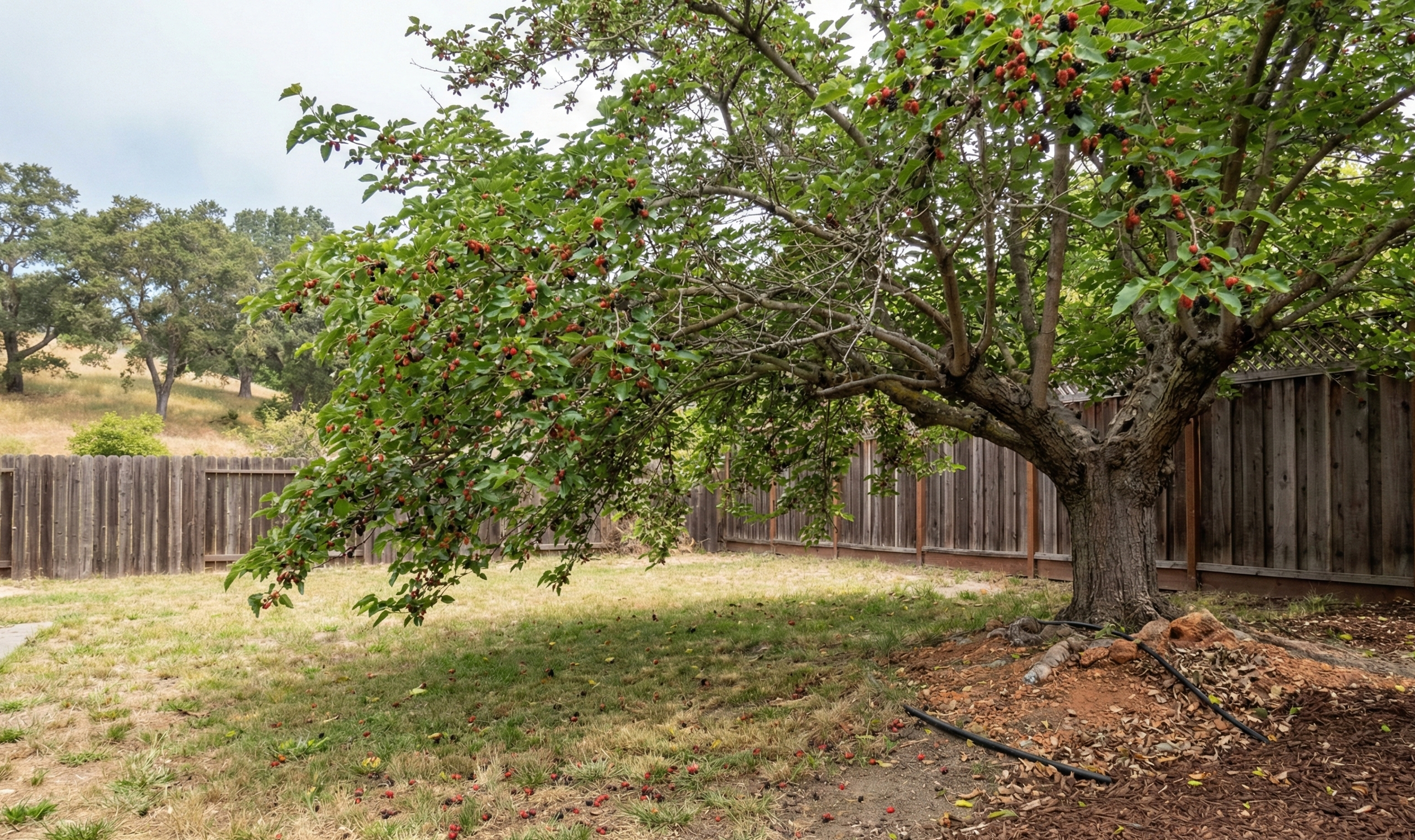
Ripe mulberries drop from the tree. That's how harvest works; it's not a defect. The fruit stains pavement, vehicles, decks, and anything else it lands on. CRFG advises against planting mulberries near a sidewalk, because fallen fruit stains the walkway and gets tracked indoors and recommends siting them where fruit drop is acceptable.
Management Strategies
Prevention (for new plantings):
Site mulberries in lawn, orchard areas, or wild edges, not over paving
Keep trees away from patios, decks, driveways, and parking areas
Consider the mature canopy size; fruit falls where shade falls
Mitigation (for existing trees):
Use groundcovers or low shrubs beneath to catch fallen fruit
Place a chicken run under the tree so birds clean up drops
Harvest actively by shaking branches over a tarp
Accept some staining as the price of abundant fruit
Not a solution: There's no spray or treatment that prevents fruit drop. It's how mulberries work.
How Do I Keep Birds Off My Mulberry Tree?
Birds are enthusiastic mulberry consumers, and this bothers some gardeners.
The Reality
CRFG notes that many birds feed on mulberries, and this is a feature of the tree, not a flaw. Mulberries produce so abundantly that there's usually plenty for both birds and people.
Management Options
For large trees: Accept bird sharing as part of having a mulberry. Netting a full-size tree is impractical. Harvest actively during peak season and you'll still get plenty.
For dwarf trees: Insect mesh or bird netting can be practical during ripening. Drape over the tree, pull it taut, and secure it at the base. Loose netting entangles birds and snakes, so keep it tight and take it down after harvest.
Strategic planting: A mulberry at the back of the property or near wild areas creates a "bird magnet" that may reduce pressure on other fruit trees closer to the house. Mulberries work especially well as part of a permaculture garden design.
What Pests Affect Mulberry Trees in California?
Mulberries have remarkably few pest problems in California. UC IPM lists the pests and disorders worth knowing on mulberry in most home garden settings.
Scale Insects
Occasionally present on bark and twigs, but rarely cause significant damage.
Fix: If scale becomes problematic, apply horticultural oil spray during winter dormancy.
Aphids
May appear on new growth but are usually controlled by natural predators.
Fix: Strong water spray dislodges aphids. Insecticidal soap for severe infestations. Usually not worth treating.
The Bottom Line
CRFG says mulberries are generally free of pests and diseases, though cankers and dieback can occur in California. If you're used to the pest management demands of apples or stone fruit, mulberries will seem almost magically trouble-free.
Can Mulberry Roots Damage Foundations and Sidewalks?
Mulberry roots can cause problems if trees are planted too close to hardscape or structures.
The Problem
Mulberries have heavy surface roots. UC Cooperative Extension notes those roots can lift and crack concrete when trees are planted too close to walkways, driveways, or foundations.
Prevention
Plant at least 6 feet from walkways, driveways, and foundations, which is UC Cooperative Extension's minimum, and give a full-size tree considerably more
Give roots room to spread; the root zone extends well beyond the canopy
Use dwarf or compact varieties in constrained urban spaces
Consider container growing for very limited spaces
If Problems Already Exist
Root barriers can sometimes redirect growth, but they're not foolproof. Significant infrastructure damage may require removing the tree. This is why site selection matters so much at planting time.
When Should I Remove a Mulberry Tree and Start Over?
Sometimes the best solution is starting fresh with a better tree or better site.
Consider Removal When:
A tree is clearly male/fruitless and you want fruit
Popcorn disease or other chronic problems persist despite sanitation efforts
The tree is badly sited (too close to structures) and causing infrastructure damage
Fruit quality is poor and not worth the space the tree occupies
The tree has never thrived despite years of good care
Starting Over Right
If you remove a mulberry, don't just plant another one in the same spot without understanding why the first one failed. Address site problems (drainage, soil, light) before replanting.
Choose a named, fruiting cultivar matched to your space and microclimate. Use CRFG's mulberry information and our variety guide to select an appropriate replacement.
Quick Reference: Symptom to Likely Cause
Frequently Asked Questions
Why are my mulberry leaves turning yellow?
Most commonly drought stress, nutrient deficiency, or high soil pH. Start by ensuring adequate water, then test soil if the problem persists. Yellow leaves with green veins specifically suggest iron deficiency.
Why isn't my mulberry producing fruit?
If the tree has never fruited, it may be male (fruitless). If it's young (under 3-4 years), be patient. If it's in heavy shade, improve light. If it fruited before and stopped, look for stress factors.
Is my mulberry dying?
Probably not. Mulberries are extremely resilient. Yellow leaves, some dieback, or light crops usually indicate stress, not death. Address watering, drainage, and nutrition before assuming the worst.
How do I stop birds from eating all my mulberries?
You probably can't, and you probably don't need to. Mulberries produce abundantly; there's usually enough for everyone. Harvest actively during peak season and accept some bird sharing.
Can I move a mulberry tree that's in the wrong spot?
Young trees (under 3-4 years) can be transplanted in winter dormancy. Older trees are difficult to move successfully. It may be easier to start fresh with a new tree in a better location.
My mulberry drops fruit everywhere. Can I stop this?
No. Fruit drop is how mulberries release ripe fruit. The solution is site selection: keep trees away from areas where staining matters, or use the fallen fruit (eat it, feed it to chickens, compost it).
The Bottom Line: Mulberries Are Tough
After reading through all these potential problems, you might wonder if mulberries are worth the trouble. They are. Most mulberry growers never encounter serious problems at all.
The issues covered here represent the full range of what could go wrong, not what typically does. In practice, a well-sited mulberry in reasonable soil with occasional water during dry spells will produce abundant fruit for decades with very little intervention. Compare that to the spray schedules, disease management, and careful pruning that apples, peaches, or even citrus demand, and mulberries start looking remarkably carefree.
If your mulberry is struggling, the cause is almost always environmental: wrong site, not enough water, or soil issues. Fix those fundamentals and the tree will likely recover. And if your biggest complaint is that birds eat some fruit or ripe berries fall on the ground, congratulations. Your mulberry is working exactly as intended.
Free Gardening Resources
Know Your Microclimate Worksheet: Understand your specific Santa Cruz County growing conditions
Garden Troubleshooting Guide: General problem-solving for vegetable and fruit gardens
