

Mulberries in Permaculture, Poultry Runs, and Wildlife Gardens
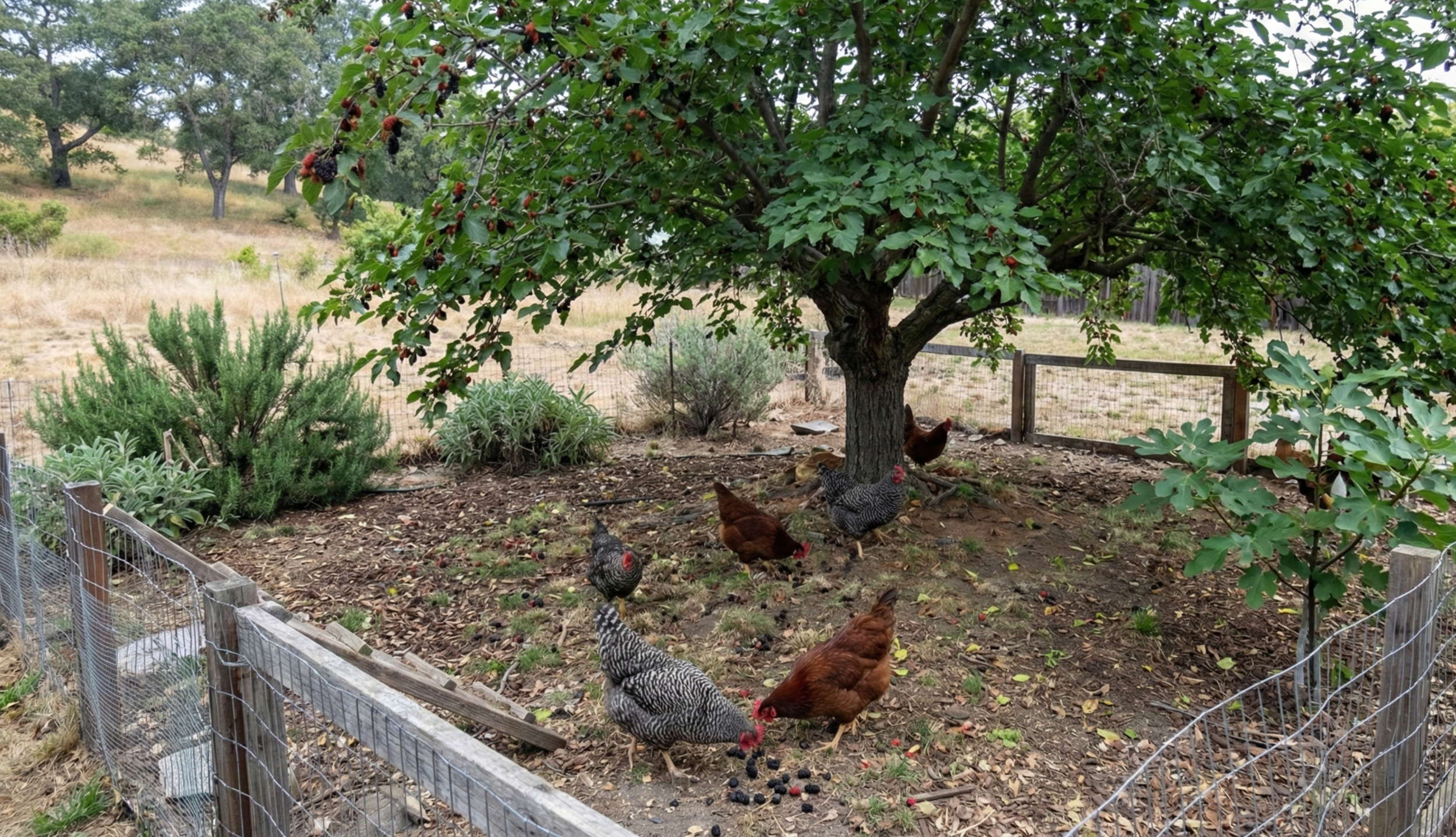
Mulberries are more than just dessert fruit. They're one of the best multi-purpose trees you can add to a food forest, chicken yard, or wildlife-friendly garden in coastal California. If you're new to mulberries, our complete guide to growing mulberries in Santa Cruz covers the basics.
CRFG highlights mulberries' drought tolerance, adaptability to various soils, and general lack of serious pests and diseases, all of which make them low-input trees perfect for permaculture systems. Permaculture writers praise mulberries as "stacked function" trees: food for people, shade for outdoor spaces, fodder for animals, and habitat for wildlife, all from a single planting.
If you're designing a productive, low-maintenance landscape in Santa Cruz County, mulberries deserve serious consideration.
Why Do Permaculture Gardeners Love Mulberries?
Permaculture design prioritizes plants that serve multiple functions with minimal inputs. Mulberries check every box.
Low Input, High Output
Once established, mulberries require remarkably little care:
Water: Drought-tolerant after the first few years; minimal irrigation needed in most Santa Cruz microclimates
Fertilizer: Light feeders that thrive without regular fertilization
Pest management: CRFG notes they're generally free of serious pests and diseases, and UC IPM confirms mulberries have few serious pest issues in California gardens; no spray schedule needed
Pruning: Tolerant of heavy pruning but don't require it for production
Compare this to apples (multiple spray applications, careful pruning, winter chill requirements) or citrus (frost protection, regular feeding, pest monitoring), and mulberries start looking very attractive.
Multiple Yields from One Tree
A well-placed mulberry provides:
Human food: Abundant fruit for fresh eating, preserving, and cooking (see our mulberry harvesting and recipes guide)
Animal feed: Fallen fruit feeds chickens, pigs, and other livestock
Wildlife habitat: Birds and other wildlife rely on mulberries as a food source
Shade: Dense canopy provides summer cooling
Fodder: Leaves can be used for livestock feed or mulch material
Biomass: Prunings add organic matter to compost or can be used as mulch
This "stacking of functions" is central to permaculture design, and few trees stack as many functions as mulberries.
Resilience and Adaptability
Permaculture sources note that mulberries tolerate a range of soils, handle drought, and adapt to various growing conditions. UC Cooperative Extension highlights mulberries as fast-growing, productive trees well-suited to California's climate. In an uncertain climate future, resilient plants matter. Mulberries will keep producing when fussier fruit trees struggle.
How Can Mulberries Manage Shade and Microclimates?
Strategic mulberry placement can modify your garden's microclimate in useful ways.
Summer Shade
Mature mulberries have broad, dense canopies that cast deep shade. CRFG notes that black mulberries in particular form low, spreading trees ideal for shade in mild climates.
Practical applications:
Plant on the west or south side of chicken coops to provide afternoon shade in summer
Use as patio shade trees (just keep them away from paving where fruit drop would stain)
Create cool zones in hot, exposed yards
Food Forest Overstory
In food forest design, mulberries can serve as overstory trees with smaller plants beneath. UC Master Gardeners of Monterey and Santa Cruz Counties recommend food forests as productive, low-maintenance garden systems, and mulberries are a natural fit for the canopy layer. Their pollard-tolerant nature lets you manage light levels by adjusting canopy density.
Design considerations:
Mulberry canopy shades plants beneath; choose shade-tolerant understory species (see our companion planting guide for pairing ideas)
Regular pruning opens canopy for more light penetration if needed
Fallen fruit fertilizes soil and feeds ground-dwelling creatures
Wind Protection
Dense mulberry growth can buffer wind for more tender plants. Site mulberries on the windward side of gardens exposed to prevailing winds.
How Do Mulberries Feed Chickens and Livestock?
If you keep animals, mulberries become even more valuable.
Chickens Under Mulberries
Permaculture and homestead sources point out that chickens relish fallen mulberries, and the fruit effectively "feeds the flock" while reducing wasted fruit on the ground.
Setup options:
Mulberry over the run: Plant a mulberry where branches overhang the chicken run. Birds get shade, dropped fruit, and insects attracted to fallen fruit.
Mulberry at run edge: Plant just outside the run fence with branches pruned to overhang. Provides benefits without roots inside the run disturbing coop structures.
Free-range access: If chickens free-range, they'll find mulberry trees and clean up drops on their own.
Benefits:
Supplemental nutrition for birds (mulberries are protein- and vitamin-rich)
Reduced feed costs during fruiting season
Less mess under the tree as chickens consume fallen fruit
Entertainment and foraging enrichment for confined birds
Other Livestock
Pigs especially love mulberries and will clean up fallen fruit enthusiastically. Goats browse mulberry leaves and young shoots. Even larger livestock like cattle will consume dropped fruit.
What Wildlife and Habitat Value Do Mulberries Provide?
CRFG notes that mulberry trees are heavily used by birds and other wildlife, which consume both fruit and leaves. This can be a feature or a frustration, depending on your perspective.
Bird Habitat
Mulberries are key early-summer food sources for songbirds, including:
Cedar waxwings
Thrushes
Mockingbirds
Orioles
Many others
In landscapes where native fruiting shrubs are limited, mulberries provide critical wildlife nutrition.
Strategic Wildlife Plantings
Frame bird attraction as a feature by planting mulberries strategically:
Back-of-property plantings: A mulberry at the back of your lot creates a "bird magnet" that may reduce pressure on other fruit trees closer to the house.
Wildlife corridor plantings: Along fence lines near riparian or wild areas where birds can feast without conflicting with human harvest.
Sacrificial trees: Some orchardists plant mulberries specifically to draw birds away from more valuable crops.
Beyond Birds
Other wildlife that may use mulberry trees:
Squirrels (fruit and nesting)
Various insects (some beneficial, most harmless)
Raccoons and opossums (fruit)
Can You Use Mulberry Leaves as Fodder and Mulch?
The leaves have value beyond shade.
Livestock Fodder
Traditional uses of mulberries include feeding leaves to silkworms (Morus alba is the silkworm's preferred food). CRFG notes that mulberry leaves have long been used as high-protein fodder for livestock in some regions.
Practical applications:
Goats readily browse mulberry leaves and shoots
Rabbits enjoy mulberry foliage
Fresh or dried leaves can supplement poultry diets
Chop-and-Drop Mulching
Permaculture systems often use "chop-and-drop" techniques where pruned material is left in place to decompose and feed the soil.
How to use mulberry prunings:
Light summer pruning on vigorous trees generates leafy branches
Chop or shred branches and spread as mulch under fruit trees and shrubs
Leaves decompose quickly, adding organic matter and nutrients
Woody stems decompose more slowly, providing longer-term mulch
Coppicing and Pollarding
Mulberries tolerate heavy pruning and can be coppiced (cut to ground level) or pollarded (cut to a trunk framework) to generate biomass for fodder and mulch while maintaining a productive tree.
What Are the Best Mulberry Design Patterns for Santa Cruz?
Here are specific ways to integrate mulberries into Santa Cruz County food gardens.
Pattern 1: Food Forest Overstory
Setup: One black mulberry or 'Illinois Everbearing' as a semi-open canopy, with citrus, berries, and herbaceous perennials below.
Why it works:
Mulberry provides dappled shade for heat-sensitive understory plants
Fallen fruit feeds soil organisms and provides forage for chickens if they have access
Regular pruning manages light levels for understory
Single tree provides fruit for family plus wildlife
Best varieties: Black mulberry (naturally compact) or any variety you're willing to prune for size.
Pattern 2: Chicken Run Edge Planting
Setup: 'Pakistan' or an alba/hybrid mulberry planted just outside the run fence, with branches pruned to overhang the run for shade and fruit.
Why it works:
Chickens get shade, fruit, and insect forage
Roots outside the run don't disturb coop structures
Tree benefits from chicken manure nutrients without root damage from scratching
Fruit that falls inside is consumed; fruit outside can be harvested for humans
Best varieties: Vigorous types like 'Pakistan' or 'Illinois Everbearing' that produce abundant fruit.
Pattern 3: Wildlife Corridor
Setup: Mulberry along fence lines near riparian or wild areas, where birds can feast with minimal conflict with other fruit trees.
Why it works:
Creates habitat corridor connecting wild areas
Draws birds away from prized fruit trees closer to house
Low-maintenance planting in areas you don't actively manage
Benefits local ecosystem
Best varieties: Any productive variety; seedlings even work for pure wildlife plantings.
Pattern 4: Productive Shade
Setup: Large mulberry on west side of outdoor living area, providing afternoon shade and fruit for family.
Why it works:
Reduces cooling costs and improves summer comfort
Easy fruit harvest (shake branches onto tarp)
Beautiful specimen tree with seasonal interest
Best varieties: 'Pakistan' for large fruit and vigorous growth, or black mulberry for more compact size.
Critical: Keep well away from paving where staining would be problematic.
Why Are Mulberries a Good Climate Fit for Santa Cruz?
Mulberries are particularly well-suited to Santa Cruz County conditions:
Mild winters: No frost protection needed; trees thrive in our Zone 9b/10a
Dry summers: Drought tolerance matches our Mediterranean climate
Variable soils: Adaptable to the range of soils found locally
Low input requirements: Fit water-wise, low-maintenance gardening styles
They're resilient anchor trees for low-input, diverse systems, exactly what permaculture design calls for.
How Do You Get Started with Mulberries in Permaculture?
If you're ready to add mulberries to your permaculture design:
1. Choose your pattern. Decide which design role(s) the mulberry will fill: overstory, chicken forage, wildlife habitat, shade, or some combination.
2. Select appropriate varieties. Match tree size to available space. See our variety guide for recommendations.
3. Site carefully. Keep away from paving and structures. Consider mature size and root spread.
4. Plant and establish. Water well the first year or two, then reduce as trees become drought-tolerant. You can also propagate mulberries from cuttings, grafting, or layering if you have access to an established tree.
5. Integrate with other elements. Add understory plants, connect to chicken systems, or let wildlife have access as your design dictates.
Frequently Asked Questions
Won't birds eat all my mulberries?
They'll eat some, but mulberries produce so abundantly that there's usually plenty for everyone. Strategic placement (wildlife trees in back, harvest trees closer to house) can help manage bird pressure.
How messy are mulberries in a food forest setting?
In a food forest, "mess" is resource. Fallen fruit feeds soil organisms, chickens, and wildlife. Dropped leaves become mulch. The system processes what would be waste in a conventional landscape.
Can I plant mulberries near other fruit trees?
Yes, but consider the shade. A mature mulberry casts dense shade that can reduce production of sun-loving trees. Give appropriate spacing or use shade-tolerant species nearby.
How many mulberries should I plant?
One productive tree provides more fruit than most families can use. Plant more only if you have specific uses (multiple chicken runs, wildlife habitat, etc.) or want extended harvest with different varieties.
Do mulberries attract pests that will spread to other crops?
No. Mulberries have few pest problems, and the pests they do have (mostly birds) aren't specific to mulberries. If anything, a mulberry may draw birds away from other fruit. For more details, see our mulberry troubleshooting guide.
Add a Mulberry to Your System
Few trees offer as much return on investment as a well-placed mulberry. Plant one this winter, water it through its first dry season, and then step back. Within a few years, you'll have shade where you need it, fruit for your family, forage for your chickens, and a gathering spot for birds and wildlife, all from a tree that asks almost nothing of you.
That's the permaculture promise: design once, benefit for years. Mulberries deliver on that promise better than almost any other fruit tree you can grow in Santa Cruz County.
Start with one tree in a role that fits your property, whether that's food forest overstory, chicken run companion, wildlife corridor, or productive shade. Once you see how much value a single mulberry adds, you may find yourself looking for spots to plant more.
Related Articles
Free Gardening Resources
Know Your Microclimate Worksheet: Understand your specific Santa Cruz County growing conditions
Seasonal Planting Calendar: Month-by-month guidance for Santa Cruz County
