

The Complete Guide to Watering Your Garden in Santa Cruz County: A Year-Round, Data-Driven Approach
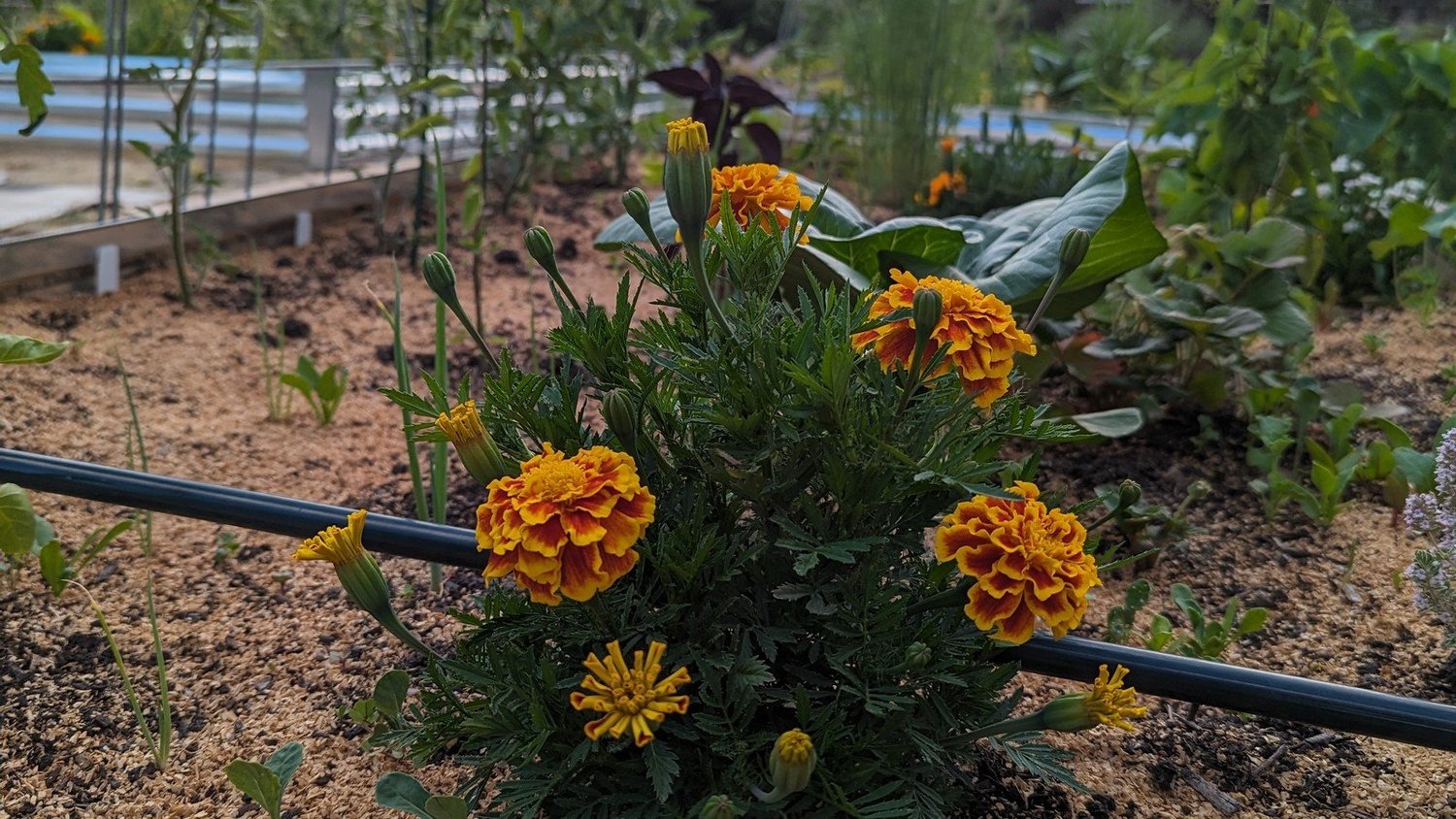
A mulched Boulder Creek garden bed with drip tubing visible at the soil surface, illustrating a practical seasonal watering setup. Photo: Adrienne Gaughan / Ambitious Harvest Co
A few of the product links in this guide are affiliate links. If you buy through one, Ambitious Harvest may earn a small commission at no extra cost to you, which helps keep these guides free. We only point to gear we would use in our own Santa Cruz garden. As an Amazon Associate, we earn from qualifying purchases. Read our full disclosure.
Santa Cruz County's Mediterranean climate creates a unique watering rhythm that catches many gardeners off guard. We get almost all our rain between November and March, then virtually nothing from May through September. Understanding this pattern (and how it plays out differently across our microclimates) is the key to watering effectively without wasting water or stressing your plants.
This guide provides a year-round framework for irrigation decisions based on local climate data, evapotranspiration science, and the practical realities of gardening in coastal, valley, and mountain environments. New gardener or seasoned grower, the goal is the same: give your plants what they need, when they need it, and not a drop more. The UC Master Gardener Program recommends irrigating vegetable gardens one to three times per week in summer, adjusting frequency based on root depth, soil texture, and local weather conditions.
Why Is Santa Cruz County Watering Different?
Before we get to seasonal specifics, it helps to understand the simple equation that drives all irrigation decisions.
Plants lose water through their leaves in a process called transpiration. Combined with evaporation from the soil surface, this creates evapotranspiration (ET), the total water "used" by your garden. ET rates depend on temperature, humidity, wind, and day length.
The irrigation equation is simple:
Water needed = ET (what plants use) minus Rainfall (what nature provides)
In Santa Cruz County, this equation produces dramatically different answers depending on the season:
Winter: ET is low (1 to 1.5 inches/month) and rainfall is high (4 to 6 inches/month). Result: rain exceeds plant needs. Irrigation off.
Spring: ET rises (2 to 4 inches/month) while rainfall drops (4 inches in March to under 1 inch in May). Result: transition from rain-fed to irrigation.
Summer: ET peaks (4 to 5 inches/month) and rainfall is essentially zero. Result: you provide 100% of water needs.
Fall: ET drops (3 inches in September to 1.5 inches in November) while rainfall gradually returns. Result: transition from irrigation back to rain-fed.
This pattern repeats every year with remarkable consistency. The specific timing shifts based on your microclimate, but the overall rhythm is predictable.
What Are Santa Cruz County's Three Watering Zones?
Conditions vary dramatically across the county. A garden in Boulder Creek follows different rules than one in Aptos or Watsonville. Here's how the three main zones compare:
Santa Cruz Coastal (Westside, Seabright, Live Oak, Aptos, Capitola)
Annual rainfall averages 30 to 33 inches, concentrated between November and March. Summer fog and marine influence keep temperatures moderate, with July highs around 75°F. The fog provides psychological relief but minimal actual moisture; your summer garden still depends on irrigation.
Coastal watering character: Latest to need spring irrigation, gentlest summer demand, quickest to transition off in fall. The marine layer is your friend.
San Lorenzo Valley and Mountains (Boulder Creek, Ben Lomond, Felton, Scotts Valley hills)
Annual rainfall reaches 50 to 55+ inches, among the highest in the county. However, nearly all of it falls in winter. Summer days are warmer than the coast (upper 70s to low 80s) with less fog, meaning higher evapotranspiration despite the wet reputation.
Valley watering character: Wettest winters, but summers can be surprisingly demanding. Sunny slopes dry fast; shaded canyon bottoms stay moister. Pay attention to microclimates within your own property.
Watsonville and Pajaro Valley (Watsonville, Pajaro, Freedom, agricultural areas)
Annual rainfall is lower at 22 to 25 inches, and soils tend toward sandy loam that drains quickly. Summer temperatures are similar to coastal areas, but without as much marine influence.
Watsonville watering character: Earliest to feel spring dryness, most frequent summer irrigation needed (due to fast-draining soils), slowest to transition off in fall. The commercial agriculture around you follows the same pattern; when farmers are irrigating, you probably should be too.
What Does the Year-Round Watering Calendar Look Like?
This table summarizes typical conditions and irrigation status by month across all three zones. Use it as a starting point, then adjust based on actual conditions in your garden.
| Month | Coastal Santa Cruz | San Lorenzo Valley | Watsonville / Pajaro Valley |
|---|---|---|---|
| January | Off (5–6 in rain) | Off (6–8 in rain) | Off (4–5 in rain) |
| February | Off (5–6 in rain) | Off (6–8 in rain) | Off (3–4 in rain) |
| March | Off; watch new plantings | Off; watch new plantings | Off; watch sandy beds late month |
| April | Light schedule late month | Spot water sunny slopes | Start gentle schedule mid-month |
| May | Regular schedule begins | Regular schedule, 2–3x/week | Full summer schedule |
| June | Summer schedule (2x/week) | Summer schedule (2–3x/week) | Summer schedule (3x/week) |
| July | Peak irrigation (~1 in/week) | Peak irrigation (~1.25 in/week) | Peak irrigation (~1 in/week, frequent) |
| August | Peak irrigation continues | Peak irrigation continues | Peak irrigation continues |
| September | Summer schedule continues | Summer schedule continues | Summer schedule continues |
| October | Reduce after storms | Reduce gradually | Reduce after storms; stay alert |
| November | Transition to off after storms | Off for most beds after 2–3 in rain | Transition to off late month |
| December | Off (3–4 in rain) | Off (5–6 in rain) | Off (2–3 in rain) |
Rainfall values are approximate long-term averages. Actual conditions vary year to year.
Season by Season
Each season has its own character and challenges. Here's an overview of each, with links to the complete seasonal guides.
Winter (December through February): Let Rain Do the Work
Winter is the easy season. Monthly rainfall of 4 to 8 inches across most of the county far exceeds the 1 to 1.5 inches plants actually use when temperatures are cool and days are short. Your job isn't to water; it's to manage drainage and protect the few exceptions that still need attention.
Key winter principles:
Turn irrigation off for established in-ground plants by late November or early December
Water only containers under eaves, covered beds, and areas that don't receive rainfall
Focus on drainage; if water pools in your garden, address it now
Use the downtime to maintain and repair your irrigation system
The exceptions that still need water:
Containers and pots under cover
Beds beneath dense tree canopy or eaves
New transplants until well-rooted
Any covered growing area (cold frames, hoop houses)
Read the complete Winter Watering Guide →
Spring (March through May): The Transition Season
Spring is when Santa Cruz County quietly flips from rain-fed to irrigation-dependent. The transition happens gradually: March often feels like late winter, May feels like early summer, and April is the unpredictable middle.
Key spring principles:
March usually needs no irrigation for established plants (around 4 inches of rain typically falls)
April is the gray zone; reduce frequency, skip after storms, check soil before watering
May requires regular irrigation in most situations (under 1 inch of rain, rising ET)
Watch new spring plantings closely; they need consistent moisture to establish
The spring pivot point: By late spring, rainfall no longer keeps up with plant water use. ET climbs to 3 to 4 inches per month while May rainfall drops below 1 inch. That gap is what your irrigation fills.
When to start irrigating by zone:
Coastal Santa Cruz: Late April to early May for most beds
San Lorenzo Valley: Mid-April for sunny slopes, late April for shaded areas
Watsonville: Early to mid-April, especially on sandy soils
Read the complete Spring Watering Guide →
Summer (June through August): You're the Rain Now
Summer is straightforward: rain isn't coming, and your garden depends entirely on you. July rainfall averages 0.01 inches, less than a single gallon over a 100-square-foot bed. Whatever your plants need, you're providing it.
Key summer principles:
A 100-square-foot vegetable bed needs roughly 60 to 70 gallons per week (about 1 inch of water)
Water deeply and infrequently (2 to 3 times per week) rather than shallowly every day
Mulch heavily; 3 to 4 inches of organic mulch can reduce water needs by 25 to 50%
Water early morning to minimize evaporation and disease risk
Summer water needs by zone:
| Zone | Monthly use (100 sq ft veggie bed) | Typical schedule |
|---|---|---|
| Coastal | ~250–270 gallons | 2 deep waterings per week |
| San Lorenzo Valley | ~270–300 gallons | 2–3 shorter waterings per week |
| Watsonville | ~260–280 gallons | 2–3 waterings per week |
Drought-tolerant plants and natives need significantly less, often 30 to 50% of vegetable bed water once established, or deep watering every 2 to 3 weeks rather than twice weekly.
Read the complete Summer Watering Guide →
Fall (September through November): The Handoff Back to Nature
Fall is the trickiest season because the right answer changes week by week. September behaves like summer. November behaves like winter. October is somewhere in between, and the exact timing depends on when storms actually arrive.
Key fall principles:
September still needs summer-level irrigation (rainfall averages only 0.1 inches)
October is transitional; reduce after storms, check soil before resuming
November shifts to winter mode once 2 to 3 inches of rain have fallen
New fall plantings need continued attention even as established plants transition off
Reading fall conditions: A "real" storm for irrigation purposes delivers at least 1 inch in a day or 2 to 3 inches over a week. Light drizzle doesn't count. After a real storm, check soil moisture at 4 to 6 inches depth; if it's cool and moist, skip irrigation until conditions change.
The fall handoff by zone:
Coastal Santa Cruz: Often off by mid-November after first significant storms
San Lorenzo Valley: Deep, shaded soils off by late November; sunny slopes may need occasional attention
Watsonville: Typically transitions off late November, slightly later than other zones
Read the complete Fall Watering Guide →
How Much Water Does Your Garden Actually Need?
Here's a quick reference for estimating water needs based on plant type and season. These assume a 100-square-foot bed in full sun.
| Plant type | Peak summer (July–Aug) | Shoulder season (May, Sept) | Mild season (April, Oct) |
|---|---|---|---|
| Summer vegetables (tomatoes, squash, peppers) | 60–70 gal/week | 45–55 gal/week | 30–40 gal/week |
| Leafy greens and herbs | 50–60 gal/week | 35–45 gal/week | 25–35 gal/week |
| Established ornamentals | 40–50 gal/week | 30–40 gal/week | 20–30 gal/week |
| Drought-tolerant plants / natives | 20–30 gal/week | 15–20 gal/week | 10–15 gal/week or less |
These are guidelines based on standard ET calculations. Actual needs vary with soil type, mulch depth, shade, and specific plant varieties. Use soil checks to verify.
How Do You Use the Soil Check Method?
Across all seasons, the most reliable way to know whether your garden needs water is to check the soil itself.
The Finger Test
Push your finger 3 to 4 inches into the soil.
Cool and moist, clumps when squeezed → Don't water yet
Dry and powdery at that depth → Time to water
The Screwdriver Test
Push a long screwdriver into the ground.
Slides in easily → Soil is moist
Meets resistance → Soil is dry
When to Check
Winter: Only when you're wondering about exceptions (containers, covered areas)
Spring: Weekly in April, twice weekly in May during dry stretches
Summer: Before each scheduled irrigation until you know your rhythm
Fall: After each storm to decide whether to skip irrigation
Research on garden soil moisture confirms that conditions can vary dramatically across short distances. Check multiple spots in your garden, not just one.
What Do Local Regulations Require?
Santa Cruz County's water efficiency rules apply year-round and are built around the assumption that irrigation should complement rainfall, not ignore it.
Key requirements:
Rain sensors or smart controllers that shut off irrigation during and after measurable rainfall
No watering during rain or within restricted windows afterward
No runoff onto sidewalks, streets, or neighboring properties
System maintenance to prevent waste from leaks and broken heads
Time-of-day restrictions (typically no midday watering when evaporation is highest)
During drought years, additional mandatory restrictions may apply. Check with your water provider for current rules.
What Are the Most Common Watering Mistakes by Season?
Winter mistakes:
Leaving irrigation running on autopilot (wasteful and potentially harmful)
Ignoring containers and covered areas (they still need you)
Not addressing drainage problems revealed by storms
Spring mistakes:
Starting irrigation too early based on a few warm days
Waiting too long and stressing new plantings
Using summer schedules before summer conditions arrive
Summer mistakes:
Watering shallowly every day instead of deeply 2 to 3 times per week
Watering at midday when evaporation is highest
Treating all plants the same regardless of water needs
Forgetting that containers dry out much faster than in-ground beds
Fall mistakes:
Stopping irrigation after the first light rain (September still needs summer watering)
Continuing summer schedules into November despite meaningful rainfall
Neglecting new fall plantings as established beds transition off
Frequently Asked Questions
How do I know which microclimate zone I'm in?
Consider your proximity to the ocean, elevation, and typical fog patterns. If you're within a few miles of the coast and regularly see morning fog, you're in the coastal zone. If you're in the Santa Cruz Mountains above 500 feet elevation with less fog, you're in the valley/mountain zone. If you're in or around Watsonville and the Pajaro Valley agricultural areas, you're in that zone. Many areas are transitional; observe your own conditions and adjust accordingly.
What if my garden spans multiple microclimates?
Many properties have sunny and shady areas, slopes and flats, or spots with different soil types. Treat them as separate zones with different watering schedules. A south-facing vegetable bed may need twice-weekly summer watering while a shaded native plant area needs water every two weeks. Group plants by water needs when possible.
How do El Niño and La Niña affect watering schedules?
El Niño years tend to bring wetter winters and springs, potentially extending the rain-fed season and delaying spring irrigation. La Niña years are often drier, meaning earlier spring watering needs and later fall transition. However, year-to-year variation is significant. Let actual conditions (not climate forecasts) guide your decisions.
Is drip irrigation better than sprinklers?
For most vegetable gardens and ornamental beds, drip irrigation delivers water more efficiently (directly to root zones, less evaporation) and keeps foliage dry (reducing disease). Sprinklers may be appropriate for lawns and large groundcover areas. Whatever system you use, make sure it's well-maintained and properly scheduled for each season.
How do I account for mulch in my watering calculations?
Heavy mulch (3 to 4 inches of organic material) can reduce water needs by 25 to 50% by slowing evaporation. If you're mulching heavily, you may be able to water less frequently than the guidelines suggest. Start with standard recommendations, then extend intervals if soil stays moist longer than expected.
What about clay soil versus sandy soil?
Clay soil holds water longer but absorbs it more slowly. Water deeply but less frequently, and watch for runoff that indicates you're applying water faster than soil can absorb it. Sandy soil drains quickly and needs more frequent watering with shorter run times. Know your soil type and adjust accordingly.
Should I water differently for native plants?
Yes. Most California natives are adapted to our dry summers and need significantly less irrigation than vegetables or traditional ornamentals once established. Many can survive on no summer water after their first few years. Research species-specific needs, and when in doubt, underwater rather than overwater natives.
How do I know if I'm overwatering or underwatering?
Underwatered plants show wilting (especially afternoon wilting that doesn't recover by evening), crispy leaf margins, premature flower/fruit drop, and soil that's dry several inches down. Overwatered plants show yellowing leaves (especially lower leaves), a limp appearance even when soil is wet, potential root rot, and soil that stays soggy. The soil check is your best diagnostic tool.
Free Water-Wise Gardening Resources
Download these guides to support your year-round watering strategy:
Water-Wise Gardening Guide - Comprehensive irrigation strategies, drought-tolerant plant suggestions, and water conservation techniques for Santa Cruz County.
Know Your Microclimate Worksheet - Identify your specific conditions including sun exposure, fog patterns, and soil characteristics that affect watering needs.
Seasonal Garden Tasks Checklist - Month-by-month maintenance guide including irrigation system care and seasonal adjustments.
Seasonal Planting Calendar - Know what to plant when, timed to work with our natural wet and dry seasons.
Garden Troubleshooting Guide - Diagnose common problems including water stress symptoms and irrigation issues.
How Do You Maintain a Year-Round Watering Rhythm?
Gardening in Santa Cruz County means working with a climate that's generous in winter and demanding in summer. The gardeners who thrive here are the ones who understand this rhythm and adjust their watering accordingly.
Winter gives you a break. Take it. Turn off the irrigation, fix what's broken, and let rain do what rain does.
Spring asks you to pay attention. Watch the transition from wet to dry, and start irrigating when your soil tells you it's time, not before, not after.
Summer requires commitment. Your garden depends entirely on you for four months. Establish a routine, water deeply, mulch heavily, and stick with it.
Fall rewards patience. Don't rush to turn things off, but don't keep watering through November storms either. Watch, adjust, and hand responsibility back to nature when nature is ready to take it.
This cycle repeats every year. Once you understand it, watering decisions become intuitive rather than stressful. You're not fighting the climate; you're working with it.
Related Articles
Where Can You Find Seasonal Watering Guides?
For detailed month-by-month guidance, explore each seasonal guide:
Winter Watering Guide - December through February: when to turn irrigation off and let rain take over
Spring Watering Guide - March through May: navigating the transition from rain-fed to irrigation
Summer Watering Guide - June through August: peak irrigation strategies for our dry season
Fall Watering Guide - September through November: scaling back and transitioning to winter
