

Hardware Cloth, Coop Locks, and Night Safety Guide
A few of the product links in this guide are affiliate links. If you buy through one, Ambitious Harvest may earn a small commission at no extra cost to you, which helps keep these guides free. We only point to gear we would use in our own Santa Cruz garden. As an Amazon Associate, we earn from qualifying purchases. Read our full disclosure.
Hardware Cloth, Coop Locks, and Night Safety: A Complete Predator Defense Guide
Half-inch, 19-gauge galvanized hardware cloth secured with screws and fender washers is the minimum standard for predator-proof poultry enclosures in areas with raccoons, weasels, and other dexterous predators. According to Penn State Extension, hardware cloth is the only wire mesh that reliably excludes the full range of common poultry predators, while chicken wire and welded wire fail against raccoons, weasels, and determined foxes (Penn State Extension, Predator-Proofing Poultry Housing).
Why Does Hardware Cloth Matter More Than Any Other Material Choice?
The wire mesh covering your coop and run is the single most important material decision in flock protection. Everything else, including locks, doors, and management practices, builds on this foundation. If the mesh itself fails, nothing else matters.
In Santa Cruz County, where raccoons, weasels, foxes, and ringtail cats all actively prey on backyard poultry, you need mesh that resists tearing, prying, and penetration by small predators. This eliminates chicken wire immediately. Standard chicken wire (also called poultry netting) is made from thin, twisted wire that raccoons can rip apart with their hands. It is designed to contain chickens, not to keep predators out.
Hardware cloth is welded wire mesh made from heavier gauge wire with a rigid grid pattern that resists the pulling, prying, and twisting motions that predators use to breach barriers. When properly installed, it creates a uniform barrier with no weak points for predators to exploit.
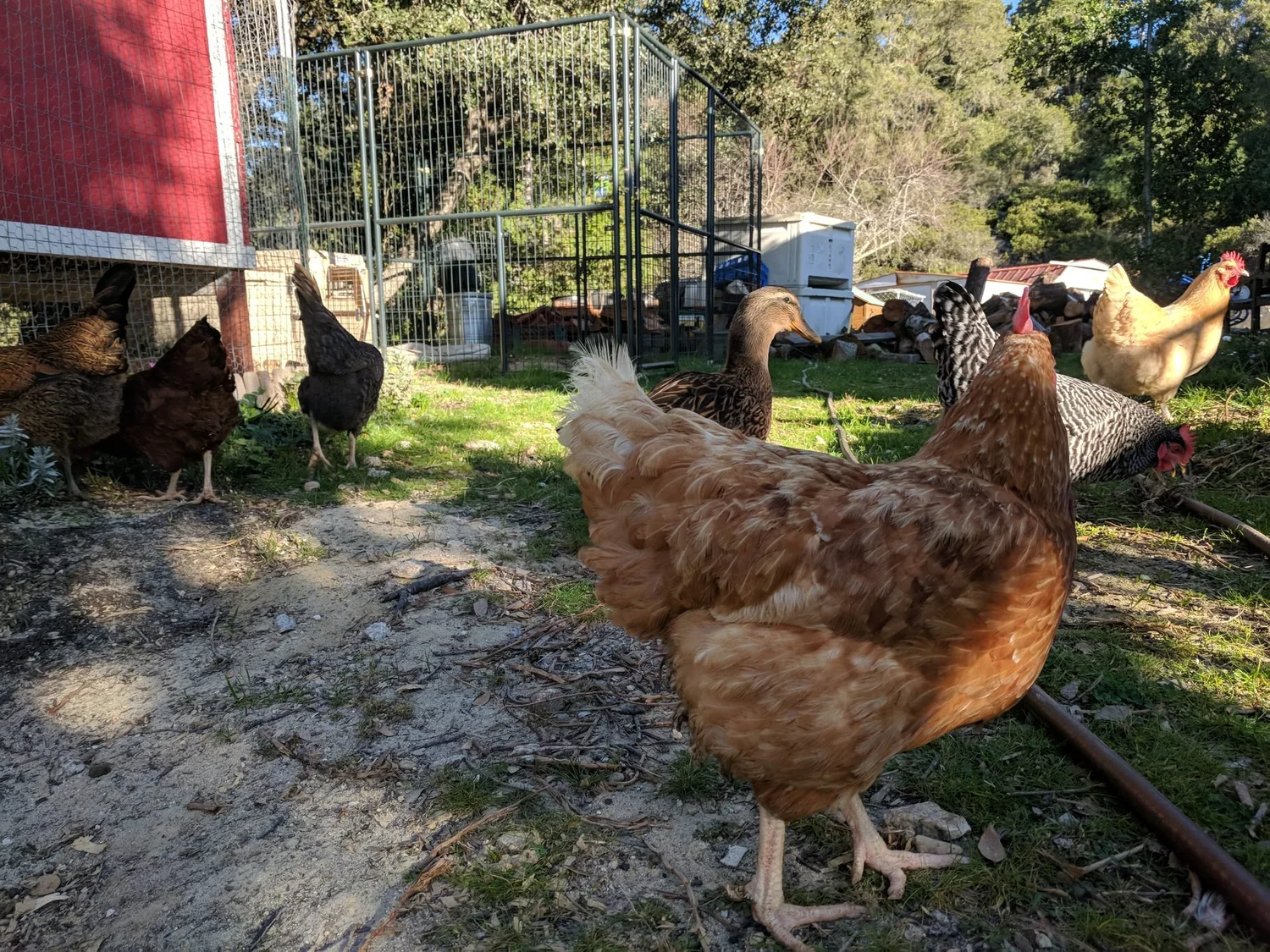
My 35-by-15-foot enclosed run in Boulder Creek is covered entirely in hardware cloth, including overhead panels. After years of nightly visits from raccoons, foxes, and at least one ringtail cat, the hardware cloth has held without a single breach. The investment in proper materials paid for itself the first time I found raccoon prints circling the run at dawn with all my birds safe inside.
This article focuses specifically on security hardware: mesh, locks, doors, and maintenance. For the overall run design and layout, see Designing a Predator-Proof Run for Your Garden Flock. For predator identification and behavior profiles, see Predator-Proofing Your Flock in Santa Cruz County.
What Gauge and Mesh Size of Hardware Cloth Do You Need?
Hardware cloth comes in different wire gauges (thicknesses) and mesh sizes (opening dimensions). Choosing the right combination depends on which predators you face and where the mesh will be installed.
Mesh Size: Half-Inch vs. Quarter-Inch
Half-inch mesh (openings of 0.5 by 0.5 inches) is the standard recommendation for most poultry applications. It excludes raccoon hands, weasels, snakes, and rats while allowing good airflow and visibility. For most Santa Cruz County flock keepers, half-inch mesh is the right choice for walls, ceilings, and door panels.
Quarter-inch mesh (openings of 0.25 by 0.25 inches) provides maximum security and is necessary in specific situations. Use quarter-inch mesh for brooder enclosures housing chicks or ducklings (small enough for mice and juvenile weasels to pose a threat through half-inch mesh), the bottom 18 inches of run walls if you have a persistent rat problem, and any area where you suspect weasel activity. The downside of quarter-inch mesh is that it reduces airflow, collects more debris, and costs significantly more than half-inch.
Wire Gauge: 19-Gauge vs. 23-Gauge
Wire gauge is counterintuitive: lower numbers mean thicker, stronger wire. The two common gauges for hardware cloth are 19-gauge (approximately 0.041 inches diameter) and 23-gauge (approximately 0.025 inches diameter).
19-gauge is the standard for predator-resistant enclosures. It is thick enough that raccoons cannot bend or break individual wires, and it holds its shape under the stress of a large animal pushing against it. Use 19-gauge for all walls, doors, and any surface within reach of a ground-level predator.
23-gauge is lighter and less expensive. It is adequate for overhead panels where the mesh only needs to stop hawks and climbing predators that are not applying sustained force. Using 23-gauge overhead and 19-gauge on walls is a reasonable cost-saving compromise that maintains security where it matters most. However, if budget allows, using 19-gauge throughout provides the strongest enclosure.
Galvanized vs. PVC-Coated
Standard galvanized hardware cloth is the most common and least expensive option. The zinc coating prevents rust, and it holds up well in our coastal climate for 10 to 15 years before needing replacement. Inspect annually for rust spots, especially along cut edges and at ground level where moisture contact is greatest.
PVC-coated (vinyl-coated) hardware cloth has a green or black plastic coating over the galvanized wire. It resists rust better than bare galvanized, blends visually into garden settings, and is slightly easier on hands during installation. It costs 20 to 40 percent more than standard galvanized. The practical advantage in our damp coastal climate is meaningful: PVC-coated hardware cloth in a fog-prone location like mine in Boulder Creek shows minimal corrosion even after years of constant moisture exposure.
How Should You Install Hardware Cloth for Maximum Security?
Proper installation is as important as material selection. A raccoon does not need to tear through hardware cloth if it can simply pull a poorly secured panel away from the frame.
Securing to Wood Frames
Never use staples as your primary fastener for hardware cloth. Standard poultry staples driven by hand or with a staple gun do not provide enough holding power. A raccoon can grip the wire and lever staples out of wood with moderate effort.
Use screws with fender washers instead. Fender washers (also called penny washers) are wide, flat washers that distribute force across several wire junctions. Use number 8 or number 10 wood screws with 1-inch or 1.25-inch fender washers, spacing them every 4 to 6 inches along the frame. This creates a connection that a raccoon cannot pull apart, because the force required to pull through the washer exceeds the wire's breaking strength.
If you prefer a faster installation, screw-secured poultry staples (designed for a drill or impact driver) provide better holding power than hammered staples, but they still do not match screws with fender washers for security. Use them for overhead panels where the threat level is lower, but use screws and washers anywhere a ground-level predator can reach.
Joining Panels
Where two pieces of hardware cloth meet, overlap them by at least 2 inches and secure with J-clips or hog rings every 3 to 4 inches. Do not leave gaps at panel joints. A weasel can squeeze through an opening just over an inch wide, and a raccoon can hook its fingers into any gap to begin tearing. The UC Davis poultry resources emphasize that panel joints are the most common failure point in otherwise well-built enclosures (UC Davis Veterinary Medicine, Backyard Poultry Housing).
Ground-Level Protection: The Buried Apron
Digging predators (foxes, coyotes, raccoons) will attempt to tunnel under your run walls. The standard defense is a buried apron: a strip of hardware cloth extending horizontally outward from the base of the wall, buried 2 to 4 inches underground. An 18-inch apron stops most diggers because they start digging at the base of the wall and hit the buried wire before they can tunnel deep enough to get under the wall.
An alternative to burying the apron is to lay it flat on the ground surface and cover it with soil, gravel, or pavers. This is easier to install and equally effective. Over time, grass grows through the mesh, anchoring it in place. This approach has the added advantage of being easy to inspect and repair.
Overhead Coverage
An open-top run is vulnerable to hawks, climbing predators (raccoons, foxes, ringtail cats), and coyotes that can jump surprisingly high fences. Covering the run with hardware cloth or welded wire provides complete protection. For large runs where full hardware cloth coverage is prohibitively expensive, consider a combination of welded wire panels (2-by-4-inch mesh) for the main overhead coverage with hardware cloth reinforcement around the perimeter edges where climbing predators would enter.
Bird netting is sometimes suggested as a cheaper overhead option, but it only deters hawks. It will not stop any climbing mammal and degrades quickly in UV light. For Santa Cruz County, where climbing predators are common, overhead netting is not adequate as a sole solution.
Which Lock Mechanisms Actually Defeat Raccoons?
Raccoons are the reason your coop needs real locks, not just latches. Their manual dexterity is extraordinary. Raccoons can lift simple hook-and-eye latches, slide barrel bolts, pull drawstrings, turn round knobs, and flip toggle latches. If a latch mechanism involves a single motion (lift, slide, turn, or pull), a raccoon can eventually figure it out.
Locks That Work
Effective raccoon-proof locks require two simultaneous motions or a motion that requires human-level fine motor skills.
Carabiner clips (spring-loaded snap hooks) are inexpensive, easy to use, and effective against raccoons. The mechanism requires squeezing and pulling simultaneously, which exceeds raccoon dexterity. Use aluminum carabiners rated for at least 75 pounds. Clip them through hasp hardware or through holes drilled in door frames and door edges.
Padlocks (combination or keyed) are completely raccoon-proof but slow to use daily. They are best for doors you access infrequently, like clean-out panels or secondary access points. For daily-use doors, the hassle of a padlock often leads to skipped locking, which defeats the purpose.
Two-step latches that require lifting and sliding simultaneously (like a spring-loaded barrel bolt or a gravity latch with a lift-and-turn mechanism) are effective as long as both motions must happen at the same time. Test the latch to make sure it cannot be operated with a single motion. If you can open it with one hand in the dark without looking, a raccoon can probably open it too.
Locks That Fail
Simple hook-and-eye latches are the most common coop latch, and they are almost useless against raccoons. A raccoon can lift the hook out of the eye within minutes. Sliding barrel bolts without a spring or secondary lock are nearly as easy for raccoons. Twist latches, wing nuts, and bungee cord closures all fail against raccoon dexterity. If your coop uses any of these as its only locking mechanism, upgrade immediately.
Redundancy Principle
Use two different locking mechanisms on each door. If one fails or is left unlocked accidentally, the second provides backup. The combination I use on my coop is a carabiner through a hasp plus a spring-loaded barrel bolt. Either one alone would stop a raccoon. Together, they provide complete confidence.
How Do Automatic Coop Doors Improve Night Safety?
Automatic coop doors are motorized doors that open and close on a timer or light sensor. They are one of the most valuable upgrades for flock safety because they eliminate the single biggest risk factor in predator losses: human inconsistency.
Every experienced flock keeper has a story about the one night they forgot to close the coop. Maybe you were running late, got distracted, or were away from home. An automatic door closes every night regardless of your schedule, your memory, or the weather.
Types of Automatic Coop Doors
Light-sensor doors open at dawn and close at dusk, adjusting automatically as day length changes through the seasons. This is the most natural option and ensures birds are locked in as soon as natural light fades. The downside is that on very cloudy days, the sensor may trigger early, and in areas with artificial light sources (street lights, porch lights), the sensor may not trigger at all.
Timer-based doors open and close at set times that you program. This gives you precise control but requires manual adjustment as day length changes. Set the closing time to 15 to 20 minutes after sunset to ensure all birds are inside, and check periodically that your settings match the current season.
Combination doors use both a light sensor and a timer, closing at whichever trigger comes first. This provides the most reliable operation across all conditions.
Important Features to Look For
The door panel should be made of aluminum or heavy-duty plastic, not thin plywood or foam board. A raccoon can chew through soft materials. The motor should have enough force to close firmly even if bedding or debris is in the track. Look for a door with an anti-crush safety feature that stops and reverses if it encounters resistance (to prevent injuring a bird caught in the opening).
Battery backup is essential. A solar-powered or plug-in door that fails during a power outage leaves your birds unprotected on exactly the kind of stormy night when predators are most active. Choose a door with battery operation or battery backup, and check batteries on a monthly schedule.
The door opening should be sized appropriately for your birds. Standard chicken doors are 10 to 12 inches wide and 12 to 14 inches tall. If you keep ducks or geese, you need a larger opening (at least 14 inches wide and 16 inches tall for ducks, larger for geese). My goose uses a separate, larger door that I operate manually because automatic goose-sized doors are uncommon.
What Maintenance Schedule Keeps Your Defenses Strong?
The best predator defenses degrade over time if you do not maintain them. Wood rots, hardware cloth corrodes, latches loosen, and doors develop gaps. A regular maintenance schedule catches problems before they become breaches.
Weekly Checks
Walk the perimeter of your run and coop at least once a week. Look for signs of digging along the base, loose or damaged hardware cloth, bent or pulled fasteners, and any gaps at door frames or panel joints. Test all locks to make sure they engage fully. Check the automatic door operation (if installed) by watching a full open and close cycle.
Monthly Checks
Once a month, do a more thorough inspection. Check hardware cloth for rust spots, especially at ground level and along cut edges. Test the tension of the mesh by pushing firmly against it in multiple locations; it should feel rigid and secure, not loose or bowed. Inspect the buried apron by probing the soil along the run perimeter for any exposed edges. Check automatic door batteries and clean the light sensor if applicable. Tighten any loose screws or replace any washers showing corrosion.
Seasonal Maintenance
Twice a year (spring and fall), do a comprehensive maintenance session. Replace any corroded hardware cloth panels. Reseat any screws that have loosened in the wood. Apply wood preservative to any framing that shows signs of rot. Clear vegetation away from the run perimeter (overgrown plants provide cover for predators and can damage hardware cloth through vine growth). Check the overhead covering for sagging, pooled debris, or damage. Replace any worn or weakened locks.
After Severe Weather
After heavy storms, high winds, or fallen tree events, do a complete inspection before letting birds out. Wind can loosen panels, falling branches can damage overhead coverage, and heavy rain can expose or shift the buried apron. Santa Cruz County gets significant winter storms that can cause structural damage even to well-built enclosures.
What Common Installation Mistakes Compromise Security?
Having helped several fellow flock keepers in the Boulder Creek area troubleshoot predator breaches, I have seen the same mistakes repeatedly.
Using staples instead of screws and washers is the most common error. Staples feel secure during installation but fail under the sustained pulling force of a raccoon over multiple nights. Even a well-driven staple does not distribute force across the mesh the way a fender washer does.
Leaving gaps at door frames is another frequent problem. A door that fits tightly when new can develop a quarter-inch gap as wood swells and shrinks through the seasons. That quarter-inch is enough for a weasel's paw and enough for a raccoon to get a grip and begin prying. Use weather stripping or overlapping hardware cloth flanges to seal door edges.
Mixing hardware cloth with chicken wire to save money undermines the entire enclosure. Predators find the weakest point and exploit it. A run that is 90 percent hardware cloth and 10 percent chicken wire is only as strong as the chicken wire sections.
Neglecting the overhead cover is increasingly common as people build larger runs. An uncovered run is vulnerable to hawks during the day and climbing predators at night. Even a 6-foot-tall run without overhead coverage can be breached by a raccoon, fox, or coyote.
Finally, skipping the buried apron because "my yard has hard soil" or "I have never seen a fox dig" is a gamble that eventually loses. Foxes and coyotes are powerful diggers, and even raccoons will dig if they are motivated enough. The buried apron is a one-time installation that provides permanent protection.
Frequently Asked Questions
What is the difference between hardware cloth and chicken wire?
Hardware cloth is welded wire mesh made from heavier gauge wire (typically 19-gauge) in a rigid grid pattern, usually with half-inch or quarter-inch openings. Chicken wire (poultry netting) is made from thinner, twisted wire in a hexagonal pattern. Hardware cloth resists tearing, prying, and penetration by predators. Chicken wire is easily torn by raccoons and allows weasels to pass through. Hardware cloth is the mesh to use wherever a predator can reach. The eXtension poultry program advises covering runs with welded wire and burying hardware cloth at least 12 inches into the ground to deter diggers.
How long does galvanized hardware cloth last outdoors?
Standard galvanized hardware cloth lasts 10 to 15 years in most outdoor conditions before corrosion significantly weakens it. In our coastal Santa Cruz County climate, where persistent fog and salt air accelerate corrosion, expect closer to 10 years for uncoated galvanized and 15 or more years for PVC-coated hardware cloth. Annual inspection for rust spots, especially at ground level and cut edges, helps you catch deterioration early.
Can raccoons really open latches?
Yes. Raccoons have highly developed manual dexterity and problem-solving ability. They can lift hook-and-eye latches, slide barrel bolts, turn round knobs, and flip toggle latches. According to animal behavior research, raccoons can remember solutions to mechanical problems for at least three years. Effective raccoon-proof locks require two simultaneous motions, such as carabiner clips (squeeze and pull) or two-step latches that require lifting and sliding at the same time.
Are automatic coop doors worth the cost?
For most flock keepers, automatic coop doors (typically $100 to $250) are one of the best investments in flock safety. They eliminate the risk of forgetting to close the coop at night, which is the most common cause of predator losses. Choose a model with battery backup, an anti-crush safety feature, and a door panel strong enough to resist raccoon prying. The cost is minimal compared to replacing lost birds and the emotional toll of a preventable attack.
Do I need to bury hardware cloth if I have concrete footings?
If your run sits on a continuous concrete footing or slab, you do not need a buried hardware cloth apron for digging predators. The concrete itself stops tunneling. However, make sure the hardware cloth panels are securely attached to the concrete at the base with concrete screws and appropriate anchors. Any gap between the base of the wire and the concrete surface is a potential entry point for weasels and juvenile predators.
What size mesh opening do I need for weasels?
Half-inch mesh (0.5-by-0.5-inch openings) excludes adult long-tailed weasels in most cases. However, juvenile weasels and the smaller least weasel (less common in our area) can fit through half-inch openings. If you have confirmed weasel activity, use quarter-inch mesh for the lower 18 inches of your run walls and around brooder areas. The eXtension poultry program notes that least weasels can squeeze through holes as small as one quarter of an inch across, which is why they typically get through chicken wire.
How often should I check my coop locks and hardware?
Test all locks weekly by ensuring they engage fully and resist pulling force. Check hardware cloth monthly for rust, loose fasteners, and gaps at panel joints. Do a comprehensive maintenance inspection twice yearly (spring and fall) including tightening screws, replacing corroded sections, and inspecting the buried apron. After severe storms or high winds, inspect everything before releasing your birds.
Can I use welded wire instead of hardware cloth for my run?
Welded wire (2-by-4-inch or 2-by-2-inch mesh) is adequate for overhead coverage where it only needs to stop hawks and climbing predators. However, it is not a substitute for hardware cloth on walls or lower panels. Raccoons and weasels can fit through 2-by-4-inch openings easily, and even 1-by-1-inch welded wire does not have the same resistance to prying and tearing as proper hardware cloth. Use hardware cloth for any surface within reach of a ground-level predator.
