

Growing Raspberries in Santa Cruz: What Actually Works
A few of the product links in this guide are affiliate links. If you buy through one, Ambitious Harvest may earn a small commission at no extra cost to you, which helps keep these guides free. As an Amazon Associate, we earn from qualifying purchases. Read our full disclosure.
A ripe raspberry slips off its core with almost no pull. Getting to that point starts with a sunny, well-drained spot and one piece of information from the nursery label: does this variety fruit on new canes or last year's canes? Santa Cruz County's cooler coastal sites can suit raspberries well, as UC Integrated Pest Management explains. Deep redwood shade and a waterlogged bed are different matters.
Keep the variety name when you plant. You will use it to choose a pruning routine, understand the first harvest and decide which canes to leave standing in winter. The sections below follow those decisions through a full season.
A small, accessible row is a good way to learn the crop. Give yourself room to reach the berries and remove spent canes; a patch that is pleasant to tend is much easier to keep productive.
Why Do Raspberries Belong in Santa Cruz?
The UC ANR raspberry guide describes the value of a cool growing climate. Along the coast, marine moderation can spare fruit the heat stress seen farther inland. That advantage still needs to be paired with enough light and drainage.
A sunny coastal garden and a shaded canyon are not the same growing site. Morning fog can moderate temperatures, while dense tree cover can leave too little light for a useful harvest. Watch the planting space itself before choosing it.
UC Master Gardeners of Santa Clara County notes that raspberries can grow in soil types ranging from sandy loam to clay, as long as the soil is deep and well-drained. Check the actual soil and drainage before committing a bed.
Here's what makes our county particularly good for raspberries:
- Moderate summer temperatures can reduce heat stress compared with hotter inland sites, though heat waves still need attention.
Morning fog that keeps temperatures moderate during fruiting
- Winter conditions suit some cultivars better than others; check the named variety against your site.
A long, mild fall that allows extended harvests from primocane types
A perennial planting that can remain in place when soil and site conditions suit it
That said, not every corner of Santa Cruz County offers identical conditions. Gardeners in the foggy Westside of Santa Cruz or coastal Aptos will have different considerations than those in sunnier Scotts Valley or the warmer San Lorenzo Valley. We'll address those microclimate differences throughout this guide.
How Do Raspberry Plants Grow?
The canes are the part of raspberry growing that trips people up. The plant survives underground from year to year, but each individual cane has a much shorter life. Once you can distinguish new canes from spent ones, pruning becomes a practical sorting job.
Raspberry plants are perennial at the roots and crown, meaning the underground portion lives for many years. However, the canes (the above-ground stems) follow a biennial cycle, living for just two years.
According to Gardening Know How, here's how the cycle works:
Year 1 (Primocanes): New canes emerge from the crown in spring. These first-year canes are called primocanes. On most traditional varieties, primocanes grow vegetatively all season without producing fruit.
Year 2 (Floricanes): Those same canes overwinter and return the following year as floricanes. This is when they flower, produce fruit, and then die after harvest. Meanwhile, new primocanes are already growing from the crown to continue the cycle.
The next choice determines when you harvest and how you prune. Both fruiting types can be useful; choose the routine you want to maintain.
Primocane-Fruiting vs. Floricane-Fruiting Varieties
Gardeners Path explains that raspberry varieties fall into two categories based on when they fruit:
Floricane-fruiting (summer-bearing) varieties follow the traditional pattern described above. They produce one crop per year, typically in early to mid-summer, on second-year canes.
Primocane-fruiting (everbearing/fall-bearing) varieties have been bred to fruit on first-year canes. They produce a crop in late summer to fall on the current season's growth. If you leave those canes standing through winter, they'll also produce a smaller early-summer crop as floricanes the following year before dying.
For gardeners who want a single fall crop, primocane-fruiting varieties offer a straightforward pruning routine:
Simpler pruning: You can cut all canes during dormancy and harvest from new growth later in the year, if the plant and site are suitable
- Harvest timing: Fall crops extend the season, but still need spotted wing drosophila monitoring.
- Earlier opportunity: A modest first-year crop may be possible on established primocanes.
- Simpler sanitation: Annual cane removal reduces some carryover but does not eliminate pests or root diseases.
We'll cover the primocane versus floricane decision in much more detail in our guide to Primocane vs Floricane Raspberries: Which Should You Grow in California?
What Are the Chill Hour and Climate Considerations?
Like many fruit crops, raspberries need a certain amount of winter cold to break dormancy and fruit properly. This is measured in "chill hours," typically counted as hours spent between roughly 32°F and 45°F during winter.
Chill requirements differ among cultivars. Use the nursery's cultivar information and local experience rather than relying on broad fruiting-type categories alone.
- Higher-chill cultivars need a site with sufficient winter cold.
- Requirements should be checked for the named cultivar.
- Lower-chill selections can be worth investigating in mild-winter sites.
Winter chill varies with exposure, elevation and the season. Do not treat a town name as a chill-hour measurement. Check locally observed performance and the supplier's cultivar information, especially in a warm coastal pocket.
This means:
- Coastal gardeners: compare the named cultivar's requirements with local experience rather than assuming all fall-bearing varieties are low-chill.
- Inland and mountain gardeners: assess the actual exposure and winter temperatures before selecting a higher-chill cultivar.
- Warm, sheltered gardens: investigate lower-chill options and confirm the individual cultivar's requirements; fruiting type alone does not establish its chill needs.
Summer heat matters as well as winter cold. The UC ANR guide emphasizes mild growing conditions. Fall-bearing plants can still encounter hot spells as fruit develops; provide water and, where needed, relief from strong afternoon heat.
How Do You Pick the Right Spot in Your Yard?
Choose a place you can reach from both sides of the row. Then look at sun and drainage. Those choices will affect every later job, from picking berries to spotting a wilted cane.
Sunlight Requirements
UC Master Gardeners of Santa Clara County recommends full sun for raspberries in cool coastal climates. In foggy areas like coastal Santa Cruz, Aptos, or the Westside, give your raspberries the sunniest spot available.
However, Greg Alder's detailed guide to growing raspberries in Southern California offers important nuance for warmer locations. He notes that in hotter areas, afternoon shade can actually improve raspberry performance by reducing heat stress.
For Santa Cruz County, here's how to adjust:
Foggy coastal areas (Aptos, Live Oak, Westside Santa Cruz): Plant in full sun. Fog provides natural cooling, so maximize sun exposure for best fruit production.
Inland valleys (Scotts Valley, parts of Soquel): Full sun works well, but if you have a spot that gets afternoon shade on the hottest days, raspberries will appreciate it.
Warmer, sunnier areas (Boulder Creek ridges, south-facing slopes): Morning sun with afternoon shade is ideal. Avoid planting against south or west-facing walls that will intensify heat.
Soil and Drainage
UC ANR and UC Master Gardeners emphasize that raspberries need deep, well-drained soil. They're particularly susceptible to root diseases in waterlogged conditions.
In Santa Cruz County, you'll encounter several common soil situations:
Heavy clay (common in many valley areas): Assess drainage first. A properly drained raised bed may help; heavy compost additions alone do not solve waterlogging. Raspberries really struggle with poor drainage.
Sandy loam (coastal areas): Excellent drainage, but amend with compost to improve water retention. Sandy soils dry out quickly in summer.
Sites near redwoods: Check sunlight, root competition, soil pH and drainage directly. Fallen needles do not tell you whether the rooting soil is suitable.
A gentle slope or raised bed helps drainage and air circulation, both important for disease control. If you're planting in an area with heavy winter rains, consider bermed rows to keep roots above standing water.
Avoid planting where: Tomatoes, peppers, eggplant, or other caneberries grew in the past 3-4 years. These crops share soil-borne diseases with raspberries, and rotating away from them reduces infection risk.
What Are the Best Raspberry Varieties for Santa Cruz?
There is no single best raspberry for the whole county. Start by choosing summer-bearing or fall-bearing, then narrow the list to cultivars with a useful record in conditions like yours. A thornless plant may be a welcome practical choice along a narrow path.
The UC ANR raspberry guide is a useful reference for planning the patch. A fall-bearing cultivar can simplify pruning if you choose a single fall crop, while a summer-bearing one suits gardeners who want the earlier harvest.
Here's a quick overview of variety categories that work well in Santa Cruz County:
Primocane (Fall-Bearing) Varieties
These named fall-bearing varieties offer different fruit colors and handling characteristics:
- Heritage: A widely grown fall-bearing cultivar to consider. Ask about its harvest timing and performance in sites like yours rather than assuming it suits every garden in the county.
Caroline: A red fall-bearing cultivar. Compare its season and named disease-resistance information with local nursery experience.
Joan J: Thornless, which makes harvesting much more pleasant. Good flavor and productivity.
Anne: Yellow raspberry with excellent sweet flavor. A yellow-fruited choice to compare for fresh eating.
Fall Gold: Another yellow-fruited option; compare its growth and harvest in your site rather than assuming it will outperform Anne.
Floricane (Summer-Bearing) Varieties
For gardeners who want the traditional early-summer raspberry season:
Willamette: Classic Pacific Northwest variety. Needs adequate chill but produces excellent berries in cooler parts of the county.
Tulameen: Large, beautiful berries with outstanding flavor. Check its winter requirements and local performance before choosing it.
Heat-Tolerant Options
For gardeners in the warmest microclimates:
Bababerry: Marketed as heat-tolerant. Can help in warmer spots, though shade and water management are usually more important than variety selection.
We cover specific variety recommendations in much more detail in our guide to Best Raspberry Varieties for Santa Cruz County Gardens.
How Do You Plant Raspberries in Santa Cruz County?
Buy healthy nursery plants and have the bed ready before they arrive. Bare roots should not sit exposed while you decide where the row belongs.
When to Plant
UC ANR and GrowOrganic recommend planting raspberries during the dormant season, from late fall through early spring when soil is workable.
In Santa Cruz County, this translates to:
Best timing: December through February for bare-root plants Acceptable: November through March, depending on weather Avoid: Planting during hot, dry weather (May through September)
Bare-root raspberries are worth comparing with potted plants when you shop during the dormant season. They're available from local nurseries and mail-order sources during the dormant season.
Container-grown plants give you more flexibility than bare roots, but avoid transplanting into waterlogged ground or a heat wave. A plant with leaves needs careful moisture checks while its roots establish in the surrounding soil.
Spacing and Layout
UC Master Gardeners and UC Master Gardeners of Inyo and Mono Counties suggest the following spacing:
Within the row: 2-3 feet between plants
Between rows: 6-10 feet, depending on your trellis system and access needs
For most home gardens, a single row works well. A short row can be easier to harvest and maintain. Learn its yield before allocating space for a larger preserving crop.
If you're growing in raised beds, plan for at least 3-4 feet of bed width to accommodate spreading canes.
Planting Steps
Prepare the soil: Prepare a weed-free, well-drained rooting area. Use compost according to the soil's needs; do not create a deep amended trench that collects water. Don't add high-nitrogen fertilizer at planting time.
Inspect your plants: Keep bare roots moist and follow the nursery's handling directions. Inspect for damaged roots and do not leave them exposed while preparing the bed.
Plant at the right depth: For potted plants, keep the top of the root ball level with surrounding soil. Bare-root placement differs: OSU Extension describes spreading roots in a shallow hole with the upper root attachment 1-2 inches below the surface.
Water thoroughly: Give plants a deep soaking after planting to settle soil around roots and eliminate air pockets.
Mulch: Apply 2-3 inches of wood chips, straw, or other organic mulch around plants (but not piled against canes) to retain moisture and suppress weeds.
Cut back canes: For newly planted bare-root canes, follow the nursery's instructions; OSU describes cutting canes to 6 inches if they are longer. Do not apply that cut automatically to leafy container plants.
How Do You Trellis Raspberries?
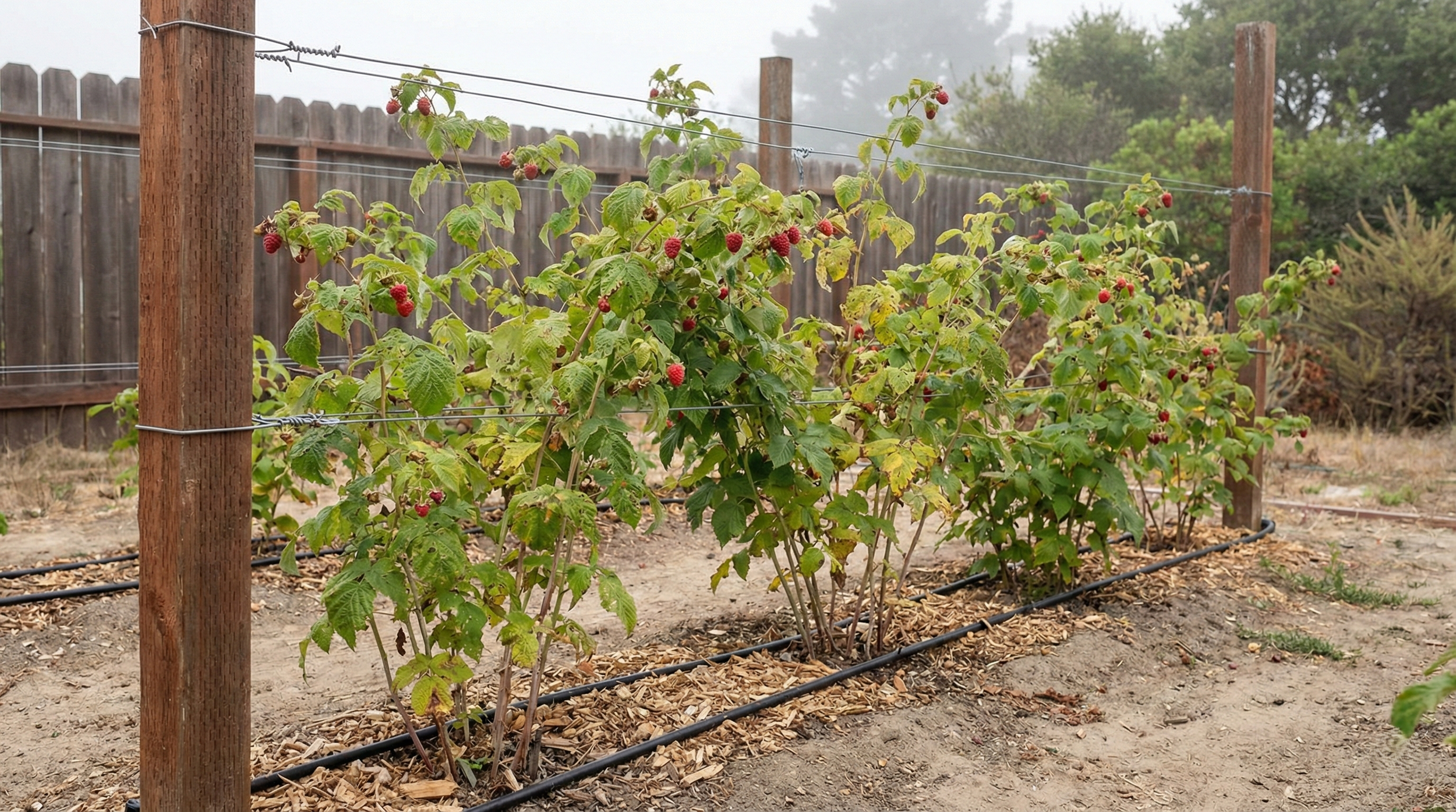
A support system earns its space the first time a fruit-laden cane bends across the path. Install it early so you can guide new growth into place instead of trying to untangle a mature patch. The options below suit different row layouts.
UC ANR and UC Master Gardeners describe several trellis options:
Simple Two-Wire Trellis
The most common home garden system uses posts at each end of the row with two wires stretched between them:
Lower wire: About 2 feet high
Upper wire: About 4 feet high
Posts: Sturdy 4x4s or metal T-posts, set at least 2 feet deep
As canes grow, tie or weave them to the wires for support. This keeps canes upright, improves light penetration, and makes harvesting much easier.
T-Trellis
A T-shaped crossbar at the top of each post allows two parallel wires at the same height. Canes grow up between the wires and are supported from both sides. This works well for vigorous varieties that produce lots of canes.
Fence-Line System
If you have an existing fence, you can train raspberries along it. This works best with chain-link or wire fencing where you can tie canes as needed.
We cover trellis construction and cane training in detail in our How to Prune Raspberries guide.
How Do You Water and Feed Raspberries?
Check the soil beneath the mulch during dry weather. Raspberries need moisture through growth and fruiting, but roots also need air. A timer setting is only useful if it leaves the root zone moist rather than saturated.
Watering
UC Master Gardeners emphasize that raspberries should not be allowed to dry out deeply during active growth and fruiting. At the same time, they're susceptible to root diseases in waterlogged soil.
Wet the active root zone, then adjust the interval to how quickly it dries. Sandy soil, containers and hot inland exposures may need shorter intervals than a sheltered bed near the coast. These irrigation options make it easier to put water where it is needed:
Drip irrigation: The ideal system. Delivers water directly to roots, keeps foliage dry (reducing disease), and minimizes water waste.
Soaker hoses: A budget-friendly alternative that works well under mulch.
Avoid overhead sprinklers: Wet foliage encourages fungal diseases.
Greg Alder notes that in warmer parts of California, more frequent watering and afternoon shade are crucial. For Santa Cruz County gardeners in hotter microclimates, this advice applies: during heat waves, check moisture more often and adjust before the root zone dries excessively.
There is no countywide watering interval. Check moisture and plant response, then adjust for soil, weather and the size of the planting.
Check current conditions on our Garden Conditions Dashboard for local watering guidance.
Fertilizing
Use soil fertility, plant growth and the fertilizer label to decide whether feeding is needed. Pale growth alone does not identify a deficiency.
A practical approach for home gardeners:
Late winter/early spring: Assess soil condition and existing organic matter before adding compost
Early spring: Apply needed nutrients at the labeled rate, keeping concentrated fertilizer away from canes
Mid-season: Investigate weak growth before feeding again; check moisture, roots and nutrient status
Avoid heavy nitrogen feeding late in the season, which can promote soft growth that's susceptible to disease and cold damage.
What Are the Basics of Pruning Raspberries?
Before cutting anything, find the variety name and decide whether you want one crop or two. A single winter cut is convenient for fall-bearing plants, but it would remove the next crop from a summer-bearing variety.
Primocane (Fall-Bearing) Varieties: Simple Approach
The easiest method: cut all canes to the ground in late winter (January-February). New primocanes will emerge in spring and produce fruit in late summer to fall.
This approach gives you one crop per year but offers major advantages:
No need to distinguish between primocane and floricane
Removes old canes and some pest or disease carryover; root problems and incoming pests remain possible
Opens up the planting for easy maintenance
Requires minimal skill or decision-making
Primocane Varieties: Two-Crop Approach
If you want both a fall crop and a smaller early-summer crop:
After fall harvest, leave the canes that fruited standing through winter
In early spring, cut the tips of those canes back to just below where they fruited
Those canes will produce a small early-summer crop as floricanes, then die
Meanwhile, new primocanes will produce your main fall crop
After the floricane crop finishes, remove those spent canes
This approach requires more attention but extends your harvest season.
Floricane (Summer-Bearing) Varieties
After harvest, remove canes that just fruited at ground level
Leave current-year primocanes in place (they'll fruit next year)
In late winter, retain healthy canes with enough separation for light, support and picking. Cane density depends on the row system and cultivar
Tip-prune remaining canes if they're taller than your trellis
We cover pruning techniques in complete detail (with visual guides) in our How to Prune Raspberries: A Step-by-Step Guide.
What Are Common Problems and Solutions?
A change in one cane can be easier to diagnose than a whole neglected patch. Look underneath leaves, check the soil and note whether old or new canes are affected before reaching for a treatment.
Yellow Leaves
UC Master Gardeners list several causes:
Overwatering or poor drainage: One possible cause. Check soil moisture and drainage.
Nutrient deficiency: Possible, but not diagnosed by leaf color alone. Test and identify the deficiency before adding iron or acidifying fertilizer.
Root disease: If drainage is good and nutrients are adequate, root rot may be present.
No Fruit
Possible causes include:
Wrong pruning: Cutting off all canes on a floricane variety eliminates next year's crop
Insufficient chill: Variety needs more winter cold than your location provides
Too much shade: Raspberries need good light to produce well
Young plants: First-year plantings often produce little fruit, especially floricane types
Cane Dieback
Canes that wilt, turn brown, or die back may indicate:
Cane blight: Fungal disease that enters through wounds. Practice good sanitation and avoid damaging canes.
Root rot: Check drainage and reduce watering if soil stays wet.
Borers: Insects that tunnel into canes. Remove and destroy affected canes.
Fruit Problems
Wormy fruit: Likely spotted wing drosophila (SWD), a serious pest in coastal California. Harvest frequently, refrigerate immediately, and consider exclusion netting.
Moldy fruit: Gray mold (botrytis) thrives in wet conditions. Improve air circulation, reduce overhead watering, harvest promptly.
Crumbly fruit: Often caused by poor pollination or virus. Seek a diagnosis before removing plants; poor pollination and viruses require different responses.
For complete troubleshooting guidance, see our Raspberry Problems: Pests, Diseases, and Common Issues guide.
What Should You Expect Year by Year?
The first season is mainly about building a patch you can care for. Harvest grows as plants establish, but dates and quantities vary with plant size, cultivar and site. Use the stages below to decide where to put your effort.
Year 1
For bare-root plantings, expect modest growth as plants establish their root systems. Primocane varieties may produce a small fall crop. Floricane varieties typically won't fruit until year 2.
Focus on: Getting plants established, maintaining even moisture, preventing weed competition.
Year 2
You'll see noticeably more canes and stronger growth. Established primocanes may carry a larger fall crop. Retained floricanes can produce their first summer harvest.
Focus on: Establishing pruning routine, thinning canes if crowded, setting up trellis if not already done.
Years 3-5
An established patch may carry more canes and fruit, but there is no guaranteed peak year. Keep access open as plants spread and respond to signs of decline.
Focus on: Maintaining annual pruning cycle, watching for disease or decline, keeping up with irrigation and feeding.
Beyond Year 5
A healthy patch can remain productive for years, while disease or unsuitable conditions may shorten its useful life. If you notice declining vigor, increased disease, or smaller harvests:
Consider renovating the patch (removing and replacing struggling plants)
Check for virus symptoms (mottled leaves, crumbly fruit, stunted growth)
Test soil and adjust fertility program
For more on long-term raspberry care, see our Raspberry Growth Stages: What to Expect Year by Year guide.
Where Can You Get Plants and Local Resources?
Local Nurseries
Many Santa Cruz County nurseries stock raspberry plants, especially during bare-root season (December-February). Call ahead to check availability:
San Lorenzo Garden Center (Santa Cruz)
Scarborough Gardens (Scotts Valley)
Sierra Azul Nursery (Watsonville; ask whether berries are currently offered)
Mail-Order Sources
For wider variety selection:
Raintree Nursery: Excellent selection and growing information
GrowOrganic/Peaceful Valley: Good organic options
One Green World: Unique varieties and good cold-climate selections
Getting Help
If you run into problems, these resources can help:
UC Master Gardeners of Monterey, San Benito and Santa Cruz Counties: gardening advice
UC Master Gardeners of Santa Clara County: Excellent caneberry resources (similar climate to ours)
Frequently Asked Questions
Can I grow raspberries in containers in Santa Cruz County?
A container can work if it is large enough for the cultivar, drains freely and is easy to water. Choose a compact variety rather than assuming every fall-bearing raspberry stays small. The Growing Raspberries in Containers guide covers the extra attention pots need.
What's the best raspberry variety for foggy coastal areas?
Caroline, Heritage and Joan J are options to investigate, not a guarantee for every foggy garden. Ask about local performance, give the plants adequate sun and compare the cultivar's ripening season with conditions in your own yard.
When do raspberries produce fruit in Santa Cruz County?
Timing varies by cultivar, site and season. The following are approximate planning windows: summer-bearing (floricane) varieties typically fruit from late May through July. Fall-bearing (primocane) varieties produce from August through October or November, depending on weather. Some gardeners grow both types for extended harvest from late spring through fall.
How do I tell if my raspberry is primocane or floricane fruiting?
Check the nursery tag for terms like "everbearing," "fall-bearing," or "primocane" (these all indicate primocane-fruiting). "Summer-bearing" or specific variety names like Willamette or Tulameen indicate floricane types. You can also observe: if canes that grew this spring produce fruit in late summer/fall, you have a primocane variety.
Why are my raspberry leaves turning yellow?
Start with moisture: is the root zone staying wet or drying too far? Then look at the pattern of yellowing and any cane dieback. Do not add iron or acidifying fertilizer merely because a leaf is yellow; persistent symptoms need a diagnosis.
Do I need two raspberry plants for pollination?
No, raspberries are self-fertile, so a single plant can produce fruit. However, most gardeners plant multiple canes in a row for better yields. Even with just one plant, you'll get berries (assuming it receives adequate sun and proper care).
How do I protect my raspberries from birds?
Bird netting can protect ripening berries when supported and secured carefully. Check it frequently for trapped wildlife and avoid loose loops. Install it over your trellis as the developing crop approaches ripening, using the fruit itself to guide timing. Secure edges and inspect daily; keep netting clear of fruit and avoid trapping birds or other animals inside. Remove netting after harvest to allow easier pruning and maintenance.
What causes wormy raspberries and how do I prevent them?
Spotted wing drosophila can damage ripening raspberries, including fall crops. Harvest frequently, cool picked berries promptly and remove fallen or damaged fruit. Fine-mesh exclusion needs to be fitted carefully and coordinated with pollination; ordinary bird netting is not insect exclusion. See UC IPM's spotted-wing drosophila guidance.
What Downloadable Guides Are Available?
These free PDF resources will help you succeed with raspberries and other garden projects:
Seasonal Planting Calendar: Month-by-month guide to what to plant in Santa Cruz County, including berry planting windows.
Know Your Microclimate Worksheet: Identify your garden's specific conditions to choose the right raspberry varieties and site.
Garden Troubleshooting Guide: Diagnose common plant problems including those affecting berries.
Companion Planting Guide: Learn what to plant near your raspberries for best results.
Make the first row easy to tend
Begin with a short row, a clearly labeled variety and a pruning plan. Keep the path open and the harvest within reach. A few berries picked at their best are a better first-season measure than filling the whole garden with canes.
Related Articles
Primocane vs Floricane Raspberries: Which Should You Grow in California? - Understanding the two fruiting types and which works best for your garden.
Best Raspberry Varieties for Santa Cruz County Gardens - Top-performing varieties matched to our local microclimates and conditions.
How to Prune Raspberries: A Step-by-Step Guide - Clear pruning instructions for both primocane and floricane types.
Growing Raspberries in Containers - How to grow productive raspberry plants in pots and small spaces.
Raspberry Growth Stages: What to Expect Year by Year - A timeline of raspberry development from planting to peak production.
Raspberry Problems: Pests, Diseases, and Common Issues - Diagnose and solve common raspberry growing challenges in California.
Raspberry growing at a glance
- Start with the tag
- Keep the cultivar name and fruiting type. A compact raspberry is not automatically fall-bearing.
- Site and water
- Choose adequate light and well-drained soil. Check root-zone moisture; do not rely on a fixed weekly amount.
- First season
- Prioritize roots, access and support. A small primocane crop may be possible, but is not assured.
- Cultivar choices
- Caroline, Joan J, Heritage, Anne and Fall Gold are fall-bearing choices to investigate. Raspberry Shortcake is compact and summer-bearing; retain new canes for the next crop.
- Care through the year
- Match pruning to fruiting type, remove spent or unhealthy canes, monitor ripening fruit and keep picking access open.
- Coast, inland or container
- Actual exposure and soil determine care. Neither a town name nor a container promises success.
Choose a raspberry pruning routine
- Fall-bearing: one crop
- Cut canes during dormancy for a crop on new canes later in the growing season.
- Fall-bearing: two crops
- Keep the unfruited lower portions for an earlier crop, then remove those spent canes. New canes carry the later crop.
- Summer-bearing
- Remove spent fruiting canes and retain healthy new canes for the following crop.
- Chill and location
- Check the named cultivar. Fruiting type alone does not establish a chill-hour requirement or assign it to a town.
- Pests and disease
- Fall fruit is still exposed to spotted wing drosophila. Cane removal does not eliminate root disease or incoming pests.
Watch the patch develop
- Establishment
- Keep roots appropriately moist, control weeds and provide support. First-year fruit depends on the plant and fruiting type.
- An established patch
- Record actual harvest and maintain access as canes spread. There is no guaranteed peak year or yield per foot.
- Ongoing care
- Use the correct annual pruning routine, monitor ripening fruit and investigate symptoms early.
- Declining vigor
- Check drainage, nutrition and disease before renovating. A new patch may be appropriate when the cause is understood.
