

Fruit Trees in a Fire-Wise Santa Cruz Garden
Some product links are affiliate links. If you buy through one, Ambitious Harvest may earn a commission at no extra cost to you. As an Amazon Associate, we earn from qualifying purchases. Read our full disclosure.
No fruit tree is fireproof, and an irrigated orchard is not a shield for your home. Fruit trees may fit into a well-planned landscape, but their location, mature size, surrounding fuels and ongoing care matter more than a label promising fire resistance. Start with defensible space and home hardening, then decide where a tree can fit.
That still leaves room for the pleasure of an apple picked outside the kitchen or a winter bowl of persimmons. The planning question is whether you can give that tree enough space, water and attention without creating a path for fire toward the house. In Santa Cruz County, a steep hillside, a shaded canyon and a small coastal lot will need different answers.
What does “fire-resistant fruit tree” really mean?
The UC ANR Fire Network cautions against relying on fire-resistant plant labels. All plants can burn, and evidence behind species rankings is limited. Green foliage can dry rapidly under intense heat; a healthy-looking canopy does not cancel out dry leaves or branches beneath it.
You will find citrus and deciduous fruit trees on some UC fire-resistant plant lists and apples in commercial tree-selection guides. Treat these as suggestions to investigate, not tested rankings that prove an apple safer than a fig or guarantee protection from either.
A manageable tree gives you a chance to keep up with pruning and cleanup. A tree squeezed between a wooden fence and the eaves creates a different problem, whatever its species. Our fire-wise landscaping guide can help you think through the wider garden before choosing fruit varieties.
Work out the planting space before choosing the tree
Sketch the house, decks, sheds, fences and existing vegetation. Mark where a new tree's branches will reach at maturity, not just where the trunk will go. Include enough access to inspect the tree, collect fruit and remove debris.
CAL FIRE's defensible-space guidance starts beside the home and works outward. The zones are a planning framework; the fire authority responsible for your address can explain applicable requirements and site conditions.
The first 5 feet: plan a space free of plant fuel
Plan the area immediately beside buildings and decks with noncombustible materials such as gravel or paving, rather than a new fruit tree or container orchard. This is the plant-free planning recommendation used in this guide; ask your fire authority about the requirements and any vegetation provisions that apply to your property. A dwarf label does not make a plant noncombustible. Keep fallen leaves out of this area as nearby trees grow.
From 5 to 30 feet: examine every connection
A small tree needs more than a gap around its trunk. Consider branches, nearby shrubs, furniture, fences and the building together. An espalier on a noncombustible support still carries combustible vegetation; it is not permission to train fruit against the house.
From 30 to 100 feet, or the property line: plan for separation and access
This area may offer room for fruit trees, but it is not automatically a suitable orchard site. Slope, neighboring vegetation, access and water supply can limit the layout. Avoid buying a row of trees before those constraints are clear.
Use the current CAL FIRE spacing guidance rather than a universal orchard spacing number. Its tree-canopy separation examples increase from 10 feet on slopes below 20 percent, to 20 feet on 20 to 40 percent slopes, and 30 feet on slopes above 40 percent. These are gaps between canopies, not trunk-to-trunk planting distances. Local requirements and the full arrangement of fuels still matter.
Vertical spacing matters too. Shrubs, dry grass, stacked branches and low limbs can connect ground-level fire to a canopy. A production-pruned fruit tree is not automatically free of these connections. If the required clearance would mean stripping most of a dwarf tree's crown, get site-specific advice about its placement instead of making damaging cuts to force it into the plan.
Choose fruit for your growing conditions, not a fire ranking
UCSC's Reliable Fruit Tree Varieties for Santa Cruz County is a useful horticultural starting point. It is a 2012 local growing guide, not a fire test or a current nursery inventory. Pair its recommendations with the light, winter chill, drainage and frost conditions at your site. Our Santa Cruz microclimate guide helps frame those questions.
Ask about rootstock as well as variety. Two trees bearing the same fruit name may need very different amounts of space. Also check whether a compatible pollination partner is needed and whether you actually have room for it.
Apples
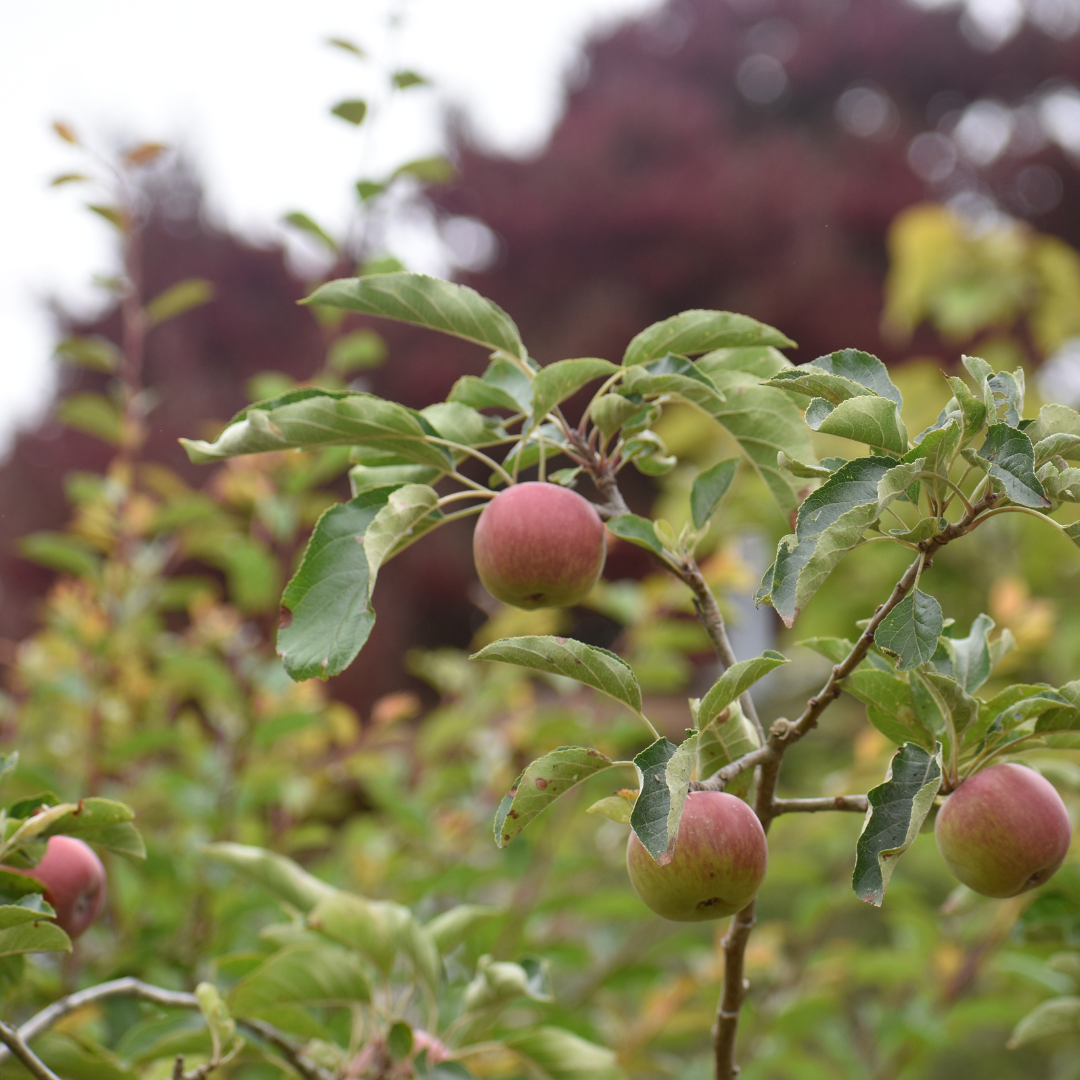
Apples are among the locally reliable fruit groups in the UCSC guide, which includes Gala, Fuji and Gravenstein among its varieties. Those names are candidates to discuss, not a coast-versus-mountains prescription. Match the rootstock and cultivar to the site and the height you can maintain.
Before planting, imagine reaching the far side of the mature canopy with a rake and collecting a heavy crop. A tree that you cannot comfortably maintain is a poor fit even if its fruit is a favorite.
Citrus
Consider citrus only after checking frost exposure, available warmth, drainage and the water it will need. Evergreen leaves are not a fire-safety exemption. A container may help you manage a small tree, but it also needs a suitable permanent location; parking it beside a deck or doorway changes the fuel arrangement there.
Ask a local nursery to distinguish the cultivar from the rootstock and to explain the expected size. Avoid choosing a lemon, lime or mandarin solely because a tag says compact.
Figs
The UCSC list includes Black Mission and Brown Turkey. It also qualifies local fig performance by variety. Ask about ripening at a site like yours before making space for one.
Give as much thought to eventual spread and cleanup as to the first harvest. Claims that fig bark cannot catch embers or that fleshy leaves make the tree exceptionally fire-resistant should not drive the purchase.
Plums, pluots and cherries
Plums and pluots appear among the guide's reliable groups; cherries receive more qualified treatment. Lapins, Stella and Craig's Crimson are the cherry examples it identifies as relatively reliable. That is growing advice, not a promise of a crop every year.
Confirm pollination requirements before buying. A second tree may help with fruit production, but it also needs space of its own. Include that mature canopy in the planting sketch rather than adding it later wherever it fits.
Pomegranates
The local guide is cautious about pomegranates, identifying Wonderful and Sweet as exceptions to generally poor cropping. It does not support a blanket recommendation for every sunny corner of the county.
Separate the question of whether a tree can survive from whether it will produce fruit you enjoy. Similarly, the choice of drought-tolerant plants does not establish their fire safety. Keep the water plan and the defensible-space plan connected without treating them as interchangeable.
Pears
European and Asian pears are included in the reliable local fruit groups. Ask about drainage, rootstock and disease management for your particular site. Heavy soil does not mean a tree can tolerate standing water, and extra irrigation is not a fire-protection treatment.
When you compare varieties, remember that resistance to fire blight refers to a plant disease. It does not describe resistance to wildfire.
Persimmons
Fuyu and Hachiya appear in the UCSC local variety guide. They are worth discussing if you want an autumn fruit tree and can accommodate its mature size.
Easy care still includes care. Plan how you will collect fallen fruit and leaves, inspect branches and reach the ground beneath the canopy. No persimmon variety removes those responsibilities.
Maintain the orchard you can realistically look after
One tree with room around it is a useful place to start. You can learn how much water, pruning and cleanup that site needs before committing to several more.
Check irrigation before the dry season
Inspect emitters, tubing and connections, and confirm that water reaches the intended root area. Set irrigation according to the tree, soil, weather and available water, not a blanket every-seven-to-fourteen-days schedule. If plants remain stressed despite watering, investigate the cause rather than simply increasing the timer.
DIG raised-bed drip kit is designed for vegetable beds. If considering it for fruit trees, confirm that its components and coverage meet the tree-specific irrigation plan; the product listing does not establish that suitability. A timer cannot guarantee delivery if a line blocks, a pump loses power or the water supply fails.
UC Marin's fire-smart maintenance guidance says to irrigate normally rather than wetting down the property on Red Flag warning days. Keep routine garden care separate from emergency action. Follow CAL FIRE evacuation instructions promptly. Never delay leaving to water trees.
Prune for the species and the situation
Keep up with dead material and unwanted growth, but do not top a tree or remove most of its crown to chase a generic clearance figure. Large limbs, uncertain tree stability and difficult access call for a qualified arborist.
Pruning season is not the same for every fruit tree. In particular, UC IPM recommends summer pruning for apricots and cherries to reduce Eutypa infection risk. Wet-weather pruning can expose susceptible trees to disease. Consult species-specific advice in our California fruit-tree guide before scheduling major work.
If a branch presents an immediate hazard, have it assessed promptly rather than waiting for a routine pruning date. Fire-season preparation should happen ahead of hazardous weather, not become a last-minute cutting project.
Keep mulch and debris from making continuous fuel
Use noncombustible materials nearest structures. Outside that immediate area, assess mulch type, depth and its connections to vegetation and buildings; organic mulch still burns. Do not automatically spread fresh chips throughout the orchard before fire season or assume that being beyond 30 feet makes every mulch arrangement acceptable.
Collect pruning debris and dry leaves instead of leaving piles under trees or against a fence. Pick up fallen fruit for orchard sanitation. Decide where compost and green-waste material will go before cleanup day, so the work does not simply move a pile closer to the house.
Underplanting also deserves a look. A green surface may hide dry stems underneath. Keep the orchard floor inspectable and avoid treating strawberries, thyme or other groundcovers as a blanket solution to ladder fuels.
Talk to nurseries with a site plan in hand
Bring your measurements, photographs and questions about water, frost, rootstock and pollination. Ask what is suitable for your growing conditions, then check the layout against fire guidance. Nursery stock is not a certification of defensible-space compliance.
Sierra Azul Nursery in Watsonville lists fruit trees among its offerings. Ask about current varieties and sizes before visiting.
San Lorenzo Garden Center is another place to inquire about fruit-tree availability and local growing advice.
Far West Nursery provides a further local contact. Confirm the specific tree and rootstock rather than assuming a broad nursery listing means it is in stock.
If you are considering a plant sale through Love Apple Farms, check its current offerings directly; do not assume a sale includes fruit trees.
For deciduous trees sold bare-root, our bare-root fruit-tree guide explains what to consider before bringing one home. Finish the placement plan first. A seasonal sale is not a reason to squeeze another tree into an unsuitable space.
Frequently asked questions
Are any fruit trees fireproof?
No. Nor is there a reliable safety ranking that makes an apple, citrus or fig an automatic choice near a house. Assess its location, size, condition and surrounding fuels.
Can I keep an existing fruit tree?
Possibly, but that needs a site assessment. Start with its relationship to the house and other fuels, then consider its health and the maintenance required. Do not assume every tree can stay, or that severe pruning will make a poor location suitable.
How close can a fruit tree be to my house?
Use the current CAL FIRE guidance and consult your local fire authority about the actual site. Plan with mature branches and nearby structures in mind. A single trunk-distance rule cannot account for the entire arrangement.
Can I use wood mulch under fruit trees?
Keep combustible mulch out of the immediate 5-foot area beside structures. Farther out, its material, depth and placement matter. Break up continuous combustible connections and follow the recommendations that apply to your property.
What about berries and grapevines?
They need the same placement and maintenance review. Dry berry canes, tangled vines and combustible trellises can add fuel. A fruit-bearing vine running toward a building is not made safe by its harvest.
Should I add extra water during a Red Flag warning?
Follow normal irrigation and local water restrictions rather than wetting down the property as a protective measure. Prepare systems before fire season, and follow emergency instructions promptly. Trees can wait; evacuation cannot.
Which fruit trees should I avoid?
Avoid committing to a tree you cannot fit, maintain or adequately water. Choose for your conditions and available space, then assess fire exposure. Unsupported species rankings are less useful than identifying the actual problems on your site.
What if my well or water supply is limited?
Work out a sustainable water budget before planting. Fewer trees may be the better choice. Drought tolerance does not mean a young tree needs no establishment water or that a mature tree will crop well without irrigation. Do not build the plan around uninterrupted pump power during a fire.
Resources for planning the next step
Use our Garden Toolkit to find available local gardening resources. Keep seasonal planning resources alongside your own maintenance notes, and use microclimate resources when comparing fruit choices.
CAL FIRE Defensible Space: current spacing and maintenance guidance.
Ready for Wildfire: Defensible Space: the zones and links to broader home preparation.
UCSC Reliable Fruit Tree Varieties for Santa Cruz County: local horticultural background, not a fire-safety ranking.
UC Firewise: Fire Resistant Plants: plant characteristics to consider alongside the Fire Network's cautions about lists.
Fire Safe Council of Santa Cruz County: local defensible-space information.
Before the next nursery trip, choose one possible planting spot and draw the mature tree into it. If the canopy, access or watering plan does not fit, change the plan while it is still on paper. That is much easier than trying to make a crowded orchard work later.
