

Raised Bed Gardening in the Bay Area: Start Here
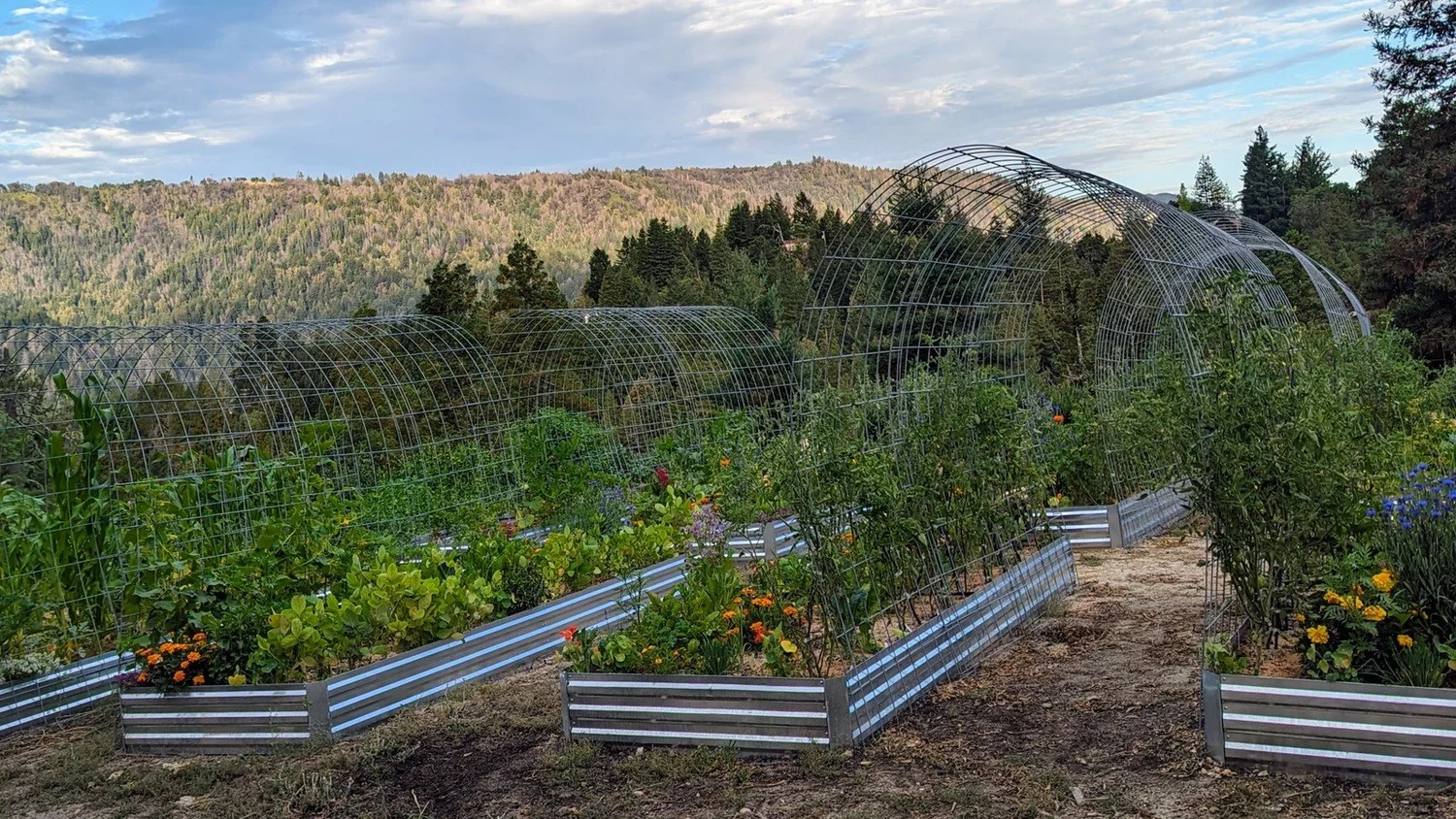
A Boulder Creek garden with multiple raised beds, hoop trellises and mixed seasonal crops. Photo: Adrienne Gaughan / Ambitious Harvest Co
A few of the product links in this guide are affiliate links. If you buy through one, Ambitious Harvest may earn a small commission at no extra cost to you, which helps keep these guides free. We only point to gear we would use in our own Santa Cruz garden. As an Amazon Associate, we earn from qualifying purchases. Read our full disclosure.
A 4-by-8-foot raised bed, 12 to 18 inches tall, filled with a 60/30/10 mix of topsoil, compost, and perlite, is the ideal starting garden for Bay Area and Santa Cruz County gardeners. According to UC Master Gardeners of Alameda County, raised beds solve the three most common local gardening challenges: clay soil, gopher damage, and poor drainage. Line the bottom with half-inch hardware cloth to keep gophers out from day one.
If you're planning your first vegetable garden or looking to expand, raised beds are one of the best investments you can make. This guide covers everything you need to know to build and fill raised beds that will produce abundantly for years.
Why Raised Beds Work So Well Here?
Raised beds aren't just a trendy gardening method. They offer real advantages that are especially valuable in Santa Cruz County's growing conditions.
You control the soil quality. Most local soils are either heavy clay (common in Scotts Valley, parts of Santa Cruz, and inland areas) or sandy and depleted (coastal areas). With raised beds, you import exactly the soil mix your vegetables need from day one.
Gopher protection. This might be the number one reason Santa Cruz gardeners choose raised beds. The UC IPM Program confirms that pocket gophers are present in virtually every California county. Installing hardware cloth or gopher wire on the bottom creates a barrier that keeps gophers from tunneling up into your beds and decimating your crops overnight.
Better drainage. Our winter rains can saturate ground-level gardens, leading to root rot and fungal diseases. Raised beds drain faster and warm up quicker in spring, giving you an earlier start on the growing season.
Extended growing season. The soil in raised beds warms up faster in spring and stays warmer longer into fall. This matters when you're trying to coax tomatoes to ripen in a coastal microclimate or get a jump on spring planting.
Easier on your back. At 12 to 24 inches high, raised beds reduce bending and kneeling. This makes gardening more accessible and sustainable long-term.
No soil compaction. You never walk on the soil in raised beds, so it stays loose and well-aerated. Plant roots can penetrate easily, and beneficial soil organisms thrive.
What Size Raised Bed Should You Choose?
The most popular raised bed dimensions are 4 feet wide by 8 feet long. This size is practical for several reasons.
Four feet wide lets you reach the center of the bed from either side without stepping in. Your arms can comfortably reach 2 feet, so 4 feet wide keeps everything accessible.
Eight feet long is a standard lumber length, minimizing waste and cuts. It also provides 32 square feet of growing space, enough for a good variety of crops without being overwhelming.
Height matters too. Most vegetable roots don't need more than 12 inches of soil depth, though deeper is better for root crops like carrots and parsnips. Common heights:
12 inches: Adequate for most vegetables, more affordable
18 inches: Better for root crops, easier to work if you have mobility issues
24 inches: Creates a waist-high bed, excellent for accessibility
You can customize dimensions to fit your space. A 3x6 bed works great in a narrow side yard. Two 4x4 beds can fit on a small patio. Just keep the width at 4 feet or less for easy reach.
What Materials Work Best for Raised Beds?
Your choice of materials affects cost, longevity, aesthetics, and how well your beds perform.
Wood
Untreated cedar or redwood are the traditional choices. Both resist rot naturally and last 10 to 15 years or more. They're beautiful, easy to work with, and safe for growing food. The UC Master Gardeners of Sonoma County also recommend these as the best options for food-growing beds.
Cedar is more readily available and less expensive than redwood. You can find cedar boards at most local lumber yards and home improvement stores.
Avoid pressure-treated wood unless it's specifically rated for organic gardening. Older pressure-treated lumber contained arsenic and chromium. Modern versions use copper compounds, which are considered safer but still leach into soil over time. If budget is tight and you choose pressure-treated, line the inside with heavy plastic before filling.
Douglas fir or pine are cheaper alternatives but rot faster (5 to 7 years). They can work for short-term beds or if you're on a tight budget and plan to rebuild eventually.
Where to buy locally:
San Lorenzo Garden Center (235 River Street, Santa Cruz) carries cedar and sometimes has pre-cut raised bed kits
Scarborough Gardens (33 El Pueblo Road, Scotts Valley) is connected to Scarborough Lumber, which stocks cedar boards
Home Depot and Lowe's stock cedar boards
Local lumberyards in Santa Cruz and Watsonville carry cedar and redwood
Metal
Galvanized steel beds have become popular in recent years. They're durable (lasting 20+ years), modern-looking, and conduct heat well, which can benefit warm-season crops.
The downside is cost. Metal beds are typically more expensive than wood. In coastal areas, they may rust faster due to salt air, though galvanized steel holds up reasonably well.
Corrugated metal roofing panels can be fashioned into beds for a rustic look. Make sure any metal you use hasn't been treated with harmful chemicals.
Other Options
Concrete blocks are inexpensive and last forever. Stack them two high for adequate depth. The look is utilitarian but functional.
Stone or brick creates beautiful, permanent beds. Expensive and labor-intensive but stunning if you're creating a showcase garden.
Avoid: Railroad ties (treated with creosote, toxic), treated landscape timbers, tires (leach chemicals), and any material that might contaminate your soil.
How Do You Build a Raised Bed?
You don't need advanced carpentry skills to build a basic raised bed. Here's a simple approach using 2x12 boards for a 4x8 bed that's 12 inches deep.
Materials Needed
Three 8-foot cedar or redwood 2x12 boards (two for the long sides, one cut in half for the short sides)
Eight 3-inch exterior deck screws or timber screws per corner (32 total)
Four 4x4 posts cut to 12 inches (optional, for extra support at corners)
Hardware cloth or 1/2-inch galvanized wire mesh for gopher protection
Staples or screws to attach wire mesh
Tools Needed
Drill with screwdriver bit
Saw (circular saw or hand saw)
Measuring tape
Level
Wire cutters
Work gloves
Assembly Steps
Step 1: Cut one 8-foot board in half to create two 4-foot pieces for the short sides.
Step 2: Lay out your boards in a rectangle on level ground where the bed will sit.
Step 3: Attach corners. Pre-drill holes to prevent splitting, then drive 3-inch screws through the long boards into the ends of the short boards. Use at least 4 screws per corner. If using 4x4 corner posts, attach them on the inside corners first, then screw the boards into the posts.
Step 4: Check for square. Measure diagonally from corner to corner. Both measurements should be equal. Adjust if needed.
Step 5: Attach gopher wire to the bottom. Flip the assembled frame over. Cut hardware cloth or wire mesh to fit, allowing 6 inches of extra material on all sides. Fold the excess up the sides and staple or screw it to the boards. Overlap seams by 6 inches if you need multiple pieces.
Step 6: Position the bed in its final location. Make sure it's level. You can set it directly on grass or weeds (they'll die and decompose beneath the bed). Some gardeners excavate 2 to 3 inches down to nestle the bed into the ground for extra stability.
Step 7: Line the inside (optional). If you're concerned about wood preservatives leaching into your soil, line the interior walls with heavy plastic sheeting, leaving the bottom open for drainage.
Pre-Made Options
If building isn't your thing, several companies sell raised bed kits:
Gardener's Supply Company ships modular cedar kits that snap together without tools
Birdies Garden Beds makes attractive galvanized steel beds in various sizes
Locally, Scarborough Gardens and San Lorenzo Garden Center sometimes carry pre-made kits or can point you toward local suppliers
The trade-off is cost. Kits are convenient but typically 2 to 3 times more expensive than building your own from lumber.
What Soil Mix Should You Use?
Don't skimp on soil. Your plants will only be as healthy as the soil they're growing in. Filling a raised bed requires more soil than most people expect. A 4x8 bed that's 12 inches deep needs about 32 cubic feet, or roughly 1.2 cubic yards of soil.
The Ideal Mix
A balanced raised bed soil mix contains:
60% topsoil for structure and bulk
30% compost for nutrients and organic matter
10% drainage material like rice hulls, perlite, or vermiculite
This creates a loose, well-draining medium rich in organic matter. The UC Master Gardeners of Contra Costa County recommend a similar approach: roughly one-third topsoil, one-third compost, and one-third drainage material such as perlite or pumice. For a deeper look at building healthy garden soil, see our California soil amendments guide.
Sourcing Materials Locally
Bulk soil and compost:
Aptos Landscape Supply (5035 Freedom Boulevard, Aptos) delivers bulk compost, topsoil, and aged bark
Central Home Supply (180 El Pueblo Rd, Scotts Valley) offers soil blends and compost
Bagged products:
San Lorenzo Garden Center carries quality organic compost
Dig Gardens (Santa Cruz and Aptos locations) sells Coast of Maine and other premium bagged products
Scarborough Gardens stocks various compost brands
Look for products labeled for vegetable gardens or organic gardening. Avoid anything with chemical fertilizers or moisture-retaining crystals.
Avoid Pure Compost
Don't fill beds with 100% compost. It's too rich, holds too much moisture, and compacts over time. Compost is an amendment, not a growing medium on its own. Always mix it with topsoil and drainage material.
The Budget Approach
If you're filling multiple large beds, costs add up quickly. Here's a more affordable method:
Fill the bottom third with rough organic matter: branches, leaves, old sod, kitchen scraps. This is called hugelkultur and provides slow-release nutrients as it decomposes.
Add a layer of cardboard or newspaper to prevent soil from sifting down.
Fill the top two-thirds with your soil mix.
This method reduces the amount of purchased soil needed while creating a rich, living bed.
Where Should You Place Your Raised Beds?
Sun exposure comes first. Place beds where they'll receive at least 6 to 8 hours of direct sun daily. In Santa Cruz, this often means the south or west side of your property. Understanding your yard's local microclimates will help you find the best spot.
Orient beds north to south if possible. This maximizes sun exposure and minimizes shading between plants. If you're on a slope or have space constraints, east to west works fine too.
Leave space between beds. Allow at least 2 to 3 feet between beds for comfortable access with wheelbarrows, watering cans, and harvesting baskets. Wider paths (3 to 4 feet) make the garden feel more spacious and accessible.
Consider irrigation access. You'll need to water these beds, especially through our dry summers. Position them where you can easily run drip lines or reach with a hose. For tips on keeping water use efficient, see our water-wise gardening guide.
Think about expansion. Even if you're starting with one or two beds, plan your layout as if you might add more later. A thoughtful design now saves awkward reconfigurations later.
How Do You Maintain Your Beds?
Raised beds are low-maintenance compared to in-ground gardens, but they still need care.
Add compost annually. Soil level will drop over time as organic matter breaks down. Top-dress with 1 to 2 inches of compost each spring or fall. The UC Master Gardener Program recommends adding 2 to 3 inches of compost for every 6 to 8 inches of bed depth when refreshing soil.
Mulch heavily. A 2 to 3-inch layer of straw, shredded leaves, or compost on the soil surface conserves water, suppresses weeds, and moderates soil temperature.
Rotate crops. Don't plant the same family of vegetables in the same bed year after year. Rotation prevents disease buildup and nutrient depletion. Move tomatoes, peppers, and eggplants (nightshade family) to a different bed each season. Same with brassicas (broccoli, kale, cabbage) and cucurbits (squash, cucumbers, melons). Companion planting can also help you get the most out of each bed.
Watch for settling. Wood beds may shift slightly as the ground beneath them settles. Check that they remain level. Metal beds are more stable but can heave in our wet winters if drainage is poor underneath.
Inspect gopher wire annually. If gophers are active in your area, check for breaches in your wire mesh. A determined gopher will find weak spots.
What Are Common Raised Bed Mistakes?
Building beds too wide. Anything over 4 feet wide forces you to step into the bed to reach the center, compacting the soil and defeating a major benefit of raised beds.
Skimping on depth. Six-inch-deep beds don't give roots enough room. Aim for 12 inches minimum.
Using poor-quality soil. Cheap topsoil is often just subsoil or fill dirt with no organic matter. It compacts, drains poorly, and provides little nutrition. Invest in good soil from the start.
Not protecting from gophers. If gophers are in your neighborhood, they will find your beds. Install wire mesh from the start. It's much harder to retrofit later.
Forgetting about drainage. Raised beds on solid surfaces like concrete need drainage holes in the bottom or a layer of gravel. Otherwise, water has nowhere to go.
How Do You Start Simple?
If you're new to gardening, start with one or two beds. Master the basics, see what grows well in your specific microclimate, then expand. It's better to have two thriving beds than five neglected ones.
Raised beds are an investment, but they'll serve you well for many years. The improved soil quality, gopher protection, and ease of maintenance make them worth every bit of effort and expense.
Frequently Asked Questions About Raised Beds
How much does it cost to build a raised bed in Santa Cruz?
A basic 4x8 cedar raised bed costs roughly $150 to $250 for materials (lumber, screws, and hardware cloth for gopher protection). Filling it with quality soil adds another $100 to $200 depending on whether you buy bulk or bagged products. Pre-made kits and metal beds cost more, typically $200 to $400 before soil. The investment pays off through years of productive growing.
Do I really need gopher wire on the bottom?
In Santa Cruz County, yes. Gophers are nearly universal here and will find unprotected beds. The UC IPM Program recommends lining the bottom of raised beds with hardware cloth as the most reliable exclusion method for small gardens. Installing 1/2-inch hardware cloth or galvanized wire mesh on the bottom before filling is far easier than retrofitting later. Extend the mesh 6 inches up the inside walls for extra protection. This single step saves countless plants and endless frustration.
What's the best wood for raised beds?
Untreated cedar or redwood are ideal because they resist rot naturally and last 10 to 15 years. Cedar is more affordable and readily available. Avoid pressure-treated lumber for vegetable gardens due to chemical leaching concerns. Douglas fir or pine work on a tight budget but only last 5 to 7 years before rotting.
How deep should my raised bed be?
Twelve inches is adequate for most vegetables. Eighteen inches is better for root crops like carrots and parsnips, and also easier to work if you have back or knee issues. Twenty-four inches creates a true waist-height bed for maximum accessibility. Deeper beds cost more to fill but provide more root space and better moisture retention.
Can I put raised beds directly on grass?
Yes. Lay cardboard over the grass first, then position your bed and fill with soil. The grass will die and decompose beneath, adding organic matter. Some gardeners excavate 2 to 3 inches first to nestle the bed into the ground for extra stability. Either approach works well.
How much soil do I need to fill a raised bed?
A 4x8 bed that's 12 inches deep needs approximately 32 cubic feet or 1.2 cubic yards of soil. That's roughly 16 two-cubic-foot bags of potting mix, which gets expensive quickly. Buying bulk soil from a landscape supply company is much more economical for multiple beds. Use the hugelkultur method (filling the bottom third with branches and organic matter) to reduce the amount of purchased soil needed.
Should I use landscape fabric in my raised bed?
No. Landscape fabric restricts root growth, prevents beneficial soil organisms from moving through, and eventually breaks down into plastic fragments. Use hardware cloth on the bottom for gopher protection, but leave the soil in contact with the ground beneath so worms and microbes can colonize your beds.
How often should I replace the soil in raised beds?
You don't need to replace soil in healthy raised beds. Instead, replenish annually by top-dressing with 1 to 2 inches of compost in spring or fall. This maintains fertility and replaces organic matter that breaks down over time. Rotate crops to prevent disease and nutrient depletion. Well-maintained raised bed soil actually improves year after year.
Free Raised Bed Resources
Beginner Garden Setup Checklist. Step-by-step checklist for setting up your first garden, including site assessment and bed preparation.
Gopher Control Guide. Comprehensive guide to protecting your garden from gophers, including hardware cloth installation details.
Seasonal Planting Calendar. Month-by-month planting guide so you know what to grow in your new raised beds.
Companion Planting Guide. Plan your raised bed layout with plants that grow well together.
