

DIY Ollas: Sustainable Watering Made Simple
A few of the product links in this guide are affiliate links. If you buy through one, Ambitious Harvest may earn a small commission at no extra cost to you, which helps keep these guides free. We only point to gear we would use in our own Santa Cruz garden. As an Amazon Associate, we earn from qualifying purchases. Read our full disclosure.
DIY Ollas: Sustainable Watering Made Simple
Ollas are one of the most water-efficient irrigation methods available to home gardeners, and you can build them from inexpensive terracotta pots in an afternoon. According to University of Arizona Cooperative Extension, olla irrigation may save 60 to 70 percent of water compared with watering by can, because it delivers moisture straight into the root zone instead of across the surface. For Santa Cruz County gardeners navigating drought restrictions and rising water costs, ollas offer a proven, low-tech solution with thousands of years of history behind it.
What Exactly Is an Olla and How Does It Work?
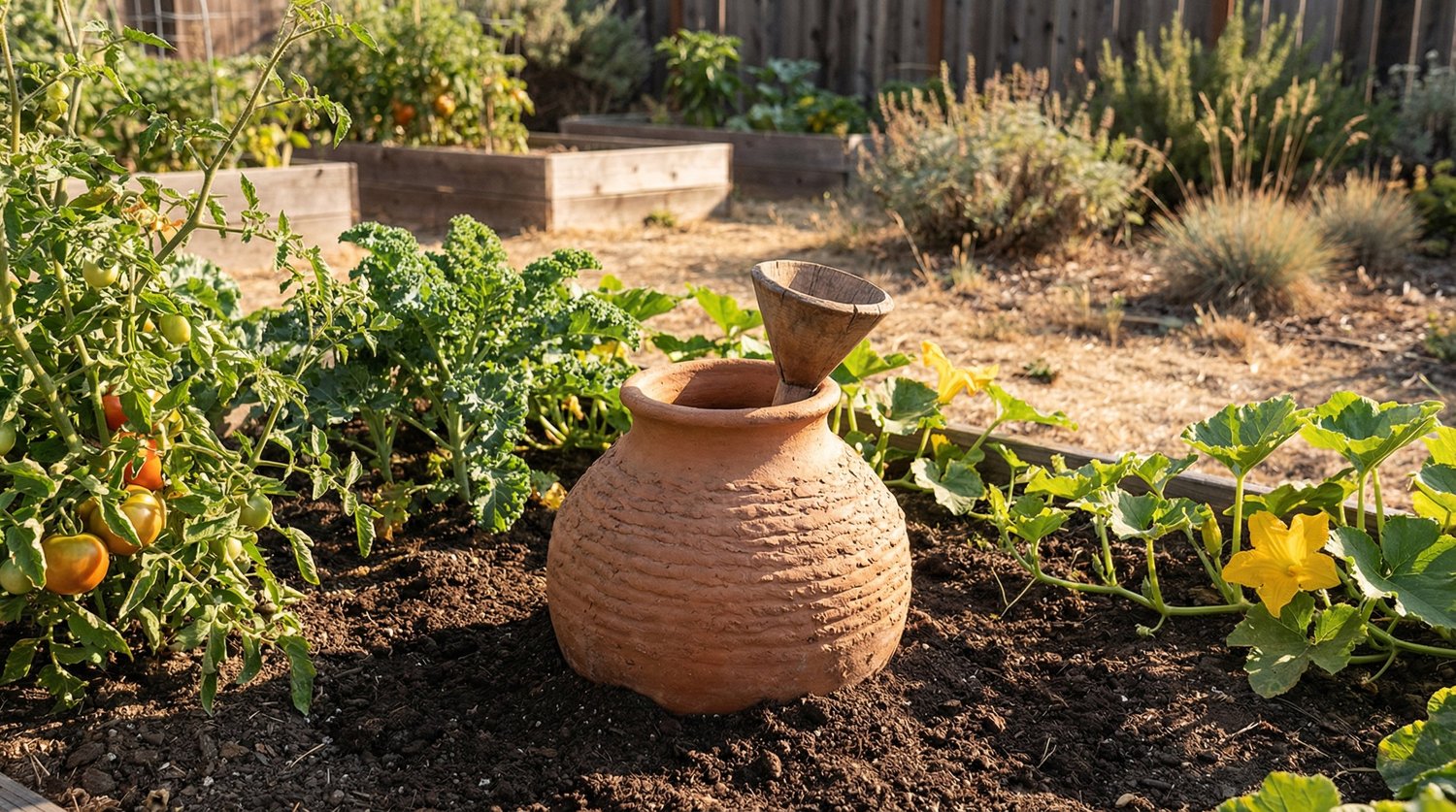
An olla (pronounced "oy-ah") is an unglazed clay vessel buried in the soil and filled with water. The porous terracotta walls allow water to seep slowly into the surrounding soil through a process driven by soil moisture tension. When the soil around the olla is dry, water moves through the clay walls faster. When the soil is moist, the flow slows or stops. This self-regulating mechanism means the olla delivers water precisely when and where plants need it, with no timer, no electricity, and no moving parts.
The technology is ancient. Archaeological evidence from China and North Africa shows farmers using clay pot irrigation over 4,000 years ago. The principle has not changed because it did not need to. Physics handles the distribution. Soil suction pulls water through the micropores in the unglazed clay at a rate that matches the surrounding soil's dryness. The result is a consistently moist root zone without the waste of surface evaporation, runoff, or deep percolation past the roots.
In Santa Cruz County's Mediterranean climate, where summer rainfall is essentially zero and water conservation is a permanent concern, ollas make particular sense. They work in raised beds, in-ground gardens, and even large containers. They pair well with drought-tolerant landscaping and native plantings. And once buried, they are invisible, requiring nothing from you except occasional refilling.
How Do You Make an Olla from Terracotta Pots?
Commercial ollas are available but expensive, often $25 to $40 each. Making your own from standard terracotta flower pots costs a fraction of that and takes about 15 minutes per olla, plus drying time for the sealant.
Materials needed per olla:
- Two unglazed terracotta pots of the same diameter (6-inch, 8-inch, or 10-inch depending on your needs)
- One flat terracotta saucer that fits the pot rim (for the lid)
- Waterproof silicone sealant or marine-grade epoxy
- A small piece of flat stone, tile, or a cork to plug the drainage hole in one pot
Step 1: Seal the drainage hole on one pot. This will be the bottom of your olla. Apply waterproof silicone sealant over the drainage hole on the inside and outside of the pot. Press a flat stone or piece of tile over the outside hole for extra security. Let it cure fully according to the sealant manufacturer's directions, typically 24 hours.
Step 2: Join the two pots rim to rim. Apply a generous bead of silicone sealant around the rim of the sealed pot. Press the second pot (drainage hole still open, pointing up) onto the sealant, rim to rim, creating a roughly egg-shaped vessel. The open drainage hole at the top becomes the fill opening. Smooth the sealant around the joint, filling any gaps completely. This joint must be watertight.
Step 3: Let the sealant cure. Allow 24 to 48 hours for the silicone to cure fully before using the olla. Test by filling with water and checking the joint for leaks. A small amount of seepage through the clay walls is exactly what you want. Leaking from the joint is not. If the joint leaks, add more sealant and let it cure again.
Step 4: Add a lid. The terracotta saucer placed over the top opening serves as a lid, preventing mosquitoes from breeding in the standing water and reducing evaporation from the fill hole. A flat rock works too. The lid does not need to be sealed because you will remove it for refilling.
What Size Olla Should You Make?
Olla size determines the watering radius and how often you need to refill. The general relationship is straightforward: bigger ollas water a larger area and need less frequent refilling.
Small ollas (6-inch pots): Hold roughly 1 to 1.5 quarts of water. The effective watering radius is about 12 to 18 inches from the olla wall. Best for small raised beds, herb gardens, and individual plant stations. Expect to refill every 2 to 4 days in summer, depending on soil type and plant size. These are also the right size for large container plantings (pots 18 inches or wider).
Medium ollas (8-inch pots): Hold roughly 2 to 3 quarts. Watering radius extends about 18 to 24 inches. Good for standard garden beds with medium-spaced vegetables. Refill every 3 to 5 days in summer. This is the most versatile size for general vegetable gardening.
Large ollas (10-inch pots): Hold roughly 3 to 5 quarts. Watering radius of 24 to 36 inches. Best for large, established plantings and areas where you want to minimize maintenance. Refill every 5 to 7 days in most conditions. These work well for perennial beds, fruit tree basins, and larger crop areas.
Soil type affects performance. Sandy soils (common near the coast in Santa Cruz County) drain faster, meaning water moves through the olla walls and into the soil more quickly. You will refill more often, but the watering radius may be slightly smaller because water percolates downward fast. Clay soils hold moisture longer, so ollas drain more slowly but maintain a moist zone for a longer period. The loamy soils found in many inland Santa Cruz County gardens offer the best balance.
How Do You Install Ollas in Your Garden?
Proper placement makes the difference between an olla that transforms your watering routine and one that just sits in the ground being inefficient. Think about where plant roots are and where water needs to go.
Dig a hole deep enough so the olla sits with only the top 1 to 2 inches and the fill opening above the soil surface. The rest of the vessel should be underground, surrounded by soil in direct contact with the clay walls. That contact is what allows water to move from the olla into the root zone. Air gaps between the olla and surrounding soil break the moisture tension and stop the flow.
Backfill around the olla with the native soil you removed, pressing it firmly against the clay walls. Do not use gravel or sand as backfill because they create drainage channels that defeat the purpose. If your native soil is very heavy clay, mixing in a small amount of compost can improve the contact while maintaining good capillary action.
Plant around the olla, placing transplants or seeds within the effective watering radius. For a medium (8-inch) olla, plant within 18 to 24 inches of the olla wall. Closer is better for seedlings that have not yet developed extensive root systems. As roots grow, they will find the moisture gradient surrounding the olla and concentrate in that zone.
In a typical 4-by-8-foot raised bed, 2 to 3 medium ollas provide good coverage. Place them evenly spaced along the center of the bed, with plants arranged around each olla. For a 4-by-4-foot bed, a single large olla in the center may be sufficient for moderate-water plants.
Which Crops and Plants Work Best with Olla Irrigation?
Ollas work with virtually any garden plant, but some crops benefit more than others. The most dramatic results come from plants that need consistent root-zone moisture but suffer when their foliage gets wet.
Tomatoes are ideal olla companions. They need deep, consistent moisture to prevent blossom end rot and cracking, but wet leaves invite fungal diseases. Ollas deliver water to the roots without splashing soil onto lower leaves. Place ollas 12 to 18 inches from the tomato stem at planting time so roots grow toward the moisture.
Peppers and eggplant also thrive with olla irrigation. Like tomatoes, they prefer consistent moisture at the roots and dry foliage. Their relatively compact root systems fit well within the watering radius of a medium olla.
Squash and cucumbers benefit from ollas, particularly in Santa Cruz County where powdery mildew is a persistent problem. Keeping water off the leaves is one of the best cultural controls for mildew. The large root systems of squash vines will find olla moisture from up to 3 feet away as they mature.
Herbs like basil, parsley, and cilantro do well with small ollas in a dedicated herb bed. Mediterranean herbs like rosemary, lavender, and thyme prefer drier conditions and may not need olla irrigation at all after establishment, though ollas can help them through the first summer after planting.
Fruit trees and berry bushes benefit from large ollas placed at the drip line during their first few years of establishment. As trees mature and develop extensive root systems, ollas become less necessary but remain useful during extreme heat or extended dry periods.
For container gardens, small ollas solve the chronic problem of uneven watering. Bury a 6-inch olla in the center of a large pot and let it regulate moisture while you are away for the weekend. This is one of the most practical olla applications for busy gardeners.
How Much Water Do Ollas Actually Save?
The water savings from olla irrigation are significant and well-documented. Research from arid agriculture programs reports reductions of 50 to 70 percent compared to surface watering methods like sprinklers and hand watering. The savings come from three sources.
First, there is virtually no evaporation loss. Water moves from the olla directly into the soil at root depth, bypassing the soil surface where evaporation is highest. On a hot summer day in Santa Cruz County, surface watering can lose 30 to 50 percent of applied water to evaporation before it reaches the roots. Ollas lose almost nothing.
Second, there is no runoff. Water from ollas moves laterally through the soil at a rate the soil can absorb. There is no puddling, no runoff down sloped beds, and no water wasted on pathways or unplanted areas. Every drop goes into the root zone.
Third, the self-regulating nature of ollas prevents overwatering. A timer-controlled drip system delivers the same amount of water whether the soil needs it or not. An olla responds to actual soil conditions, slowing its flow when the soil is moist and increasing it when the soil dries. This prevents waterlogging and the associated root problems.
For a practical Santa Cruz County example: a 4-by-8-foot raised bed watered with a hose or watering can might use 15 to 20 gallons per week in summer. The same bed with 3 medium ollas might use 6 to 8 gallons per week, refilling each olla twice. Over a 20-week dry season (May through September), that is a savings of roughly 180 to 240 gallons per bed. Scale that across multiple beds and the numbers become meaningful for both your water bill and water conservation.
How Do You Maintain Ollas Through the Seasons?
Olla maintenance is minimal, which is one of their strongest selling points. During the growing season, the main task is refilling. Check water levels every 2 to 4 days by lifting the lid and peering inside, or dip a stick to gauge the level. Refill with a hose, watering can, or even collected rainwater.
Over time, mineral deposits from your water supply can build up on the outside of the olla, reducing porosity. If you notice the olla draining more slowly than when new, scrub the exterior with a stiff brush and a diluted vinegar solution (1 part vinegar to 4 parts water). Rinse well and let it dry. This usually restores full flow.
Algae can grow inside the olla if sunlight reaches the water through the fill opening. The terracotta saucer lid prevents most algae growth. If algae does develop, scrub the interior with the vinegar solution and rinse thoroughly. Algae is cosmetic rather than harmful, but it can eventually clog the clay pores if left unchecked.
At the end of the growing season (typically late October or November in Santa Cruz County), you have two options. You can leave ollas buried through winter, which works fine in our mild climate where hard freezes are rare. Drain the water out before any predicted frost below 28 degrees Fahrenheit to prevent the clay from cracking as water expands on freezing. In most Santa Cruz County winters, this precaution is only occasionally needed.
Alternatively, dig up ollas in fall, scrub them clean, and store them in a dry location over winter. This extends their lifespan and gives you a chance to inspect the sealant joint and reapply if needed. Well-maintained DIY ollas last 3 to 5 years. The terracotta will eventually become saturated with minerals and lose some porosity, at which point you can repurpose the pots and build new ones.
How Do Ollas Compare to Drip Irrigation?
Both ollas and drip irrigation are efficient, root-zone delivery systems. The choice between them depends on your garden size, budget, and how much setup complexity you want to manage.
Drip irrigation wins for large-scale gardens. Covering a 500-square-foot vegetable garden with ollas would require dozens of units and constant refilling. A drip system with a timer handles that area automatically. Drip also works better for row crops with uniform spacing.
Ollas win for small to medium gardens, raised beds, and situations where simplicity matters. There is nothing to break, no timer to program, no emitters to clog, and no lines to winterize. Ollas are completely silent and invisible once installed. They work during power outages and water shutoffs (as long as they are already full).
Cost comparison favors ollas for small gardens. Two 8-inch terracotta pots cost about $6 to $10 total. Silicone sealant adds another $5 to $8, enough for multiple ollas. A basic drip system for a single 4-by-8 bed runs $20 to $40 for tubing, emitters, and connectors, plus a timer ($15 to $30) if you want automation. For one or two beds, DIY ollas are cheaper. For a large garden, drip irrigation is more cost-effective per square foot.
Many gardeners use both: drip for large beds and row crops, ollas for raised beds, containers, and individual plantings like fruit trees. The two systems complement each other well. You might also consider ollas as a backup system. During fire season, when water pressure drops or usage restrictions tighten, a pre-filled olla keeps your most valuable plants alive without drawing from the hose.
Can You Use Ollas in Drought-Tolerant and Native Plant Gardens?
Ollas are an excellent tool for establishing drought-tolerant plants and California natives. Even plants that are drought-tolerant once established need consistent water during their first 1 to 2 years in the ground. Ollas provide that establishment irrigation without the overhead spray that many natives dislike.
California native plants evolved with dry summers and often develop root rot when summer irrigation wets the soil surface around their crown. Ollas deliver water below the surface, encouraging roots to grow downward without saturating the crown area. This makes them ideal for establishing manzanita, ceanothus, native bunch grasses, and other plants that resent surface moisture during the dry season.
Place a large olla 18 to 24 inches from the base of a newly planted native shrub or tree. Fill it through the first two dry seasons, then assess whether the plant has established enough root depth to survive without supplemental water. Many native plants will be fully self-sufficient by the third year, at which point you can remove the olla and redeploy it elsewhere.
For succulent and low-water ornamental beds, ollas provide a safety net during heat waves. A buried olla in a succulent garden can keep plants hydrated through the hottest weeks without the constant surface moisture that rots succulent stems. Fill it only during extreme heat, and leave it dry the rest of the time.
What Are Common Mistakes to Avoid with Ollas?
The most common mistake is using glazed pots. Glazed terracotta has a waterproof coating that prevents water from seeping through the clay walls. Only unglazed, raw terracotta works for ollas. If you are unsure whether a pot is glazed, wet the outside surface. Unglazed terracotta absorbs water and darkens visibly. Glazed clay repels water and stays the same color.
Using poor-quality sealant is another frequent problem. Regular caulk, school glue, or construction adhesive will not hold up to constant water contact and soil pressure. Use aquarium-safe silicone sealant or marine-grade epoxy. These are designed for permanent water contact and remain flexible as the clay expands and contracts with temperature changes.
Placing ollas too far from plants reduces their effectiveness. Roots need to be within the watering radius to benefit. For new plantings, position transplants within 12 inches of the olla wall. As the season progresses and roots expand, they will find the moisture gradient and grow toward it.
Forgetting to check water levels is the most practical mistake. An empty olla does nothing. During peak summer in Santa Cruz County, check ollas every 2 to 3 days. Setting a phone reminder helps until checking becomes habit. Some gardeners paint a mark on a dipstick at the halfway point so they can quickly gauge the water level without guessing.
Skipping the lid leads to mosquito breeding. Standing water in an open olla is an invitation for mosquitoes to lay eggs. Always cover the fill opening with a saucer, flat stone, or other solid cover. If you forget and find larvae in the water, dump it out, refill, and cover. A few drops of food-safe mineral oil on the water surface also prevents mosquito larvae from breathing.
Ollas also break the daily-watering habit; here is why you should not water your garden every day, even in a California summer.
Frequently Asked Questions
How long does it take for an olla to empty?
It depends on soil moisture, soil type, temperature, and plant water demand. In summer, a medium (8-inch) olla in a vegetable bed typically empties in 3 to 5 days. In cooler weather or moist soil, it may take a week or more. Sandy soils draw water faster than clay soils. The rate adjusts automatically to match soil conditions.
Can I add liquid fertilizer to the olla water?
You can, but use caution. Dilute liquid fertilizers can work, but organic fertilizers with suspended particles may clog the clay pores over time. If you fertilize through ollas, use a clean, fully dissolved product at half the recommended strength. Chemical fertilizers can leave mineral deposits that reduce porosity. Many gardeners prefer to top-dress with compost or dry fertilizer on the soil surface and let the olla handle only water delivery.
Do ollas work in clay soil?
Yes, but the moisture moves more slowly through clay than through sand or loam. In heavy clay, the watering radius may be slightly smaller because water does not spread as far laterally. The upside is that clay soil holds moisture longer, so you refill less often. Press the backfill soil firmly against the olla walls to ensure good contact and eliminate air gaps.
Will tree roots damage or invade my ollas?
Tree roots can grow around and even crack terracotta ollas over time. Avoid placing ollas within the root zone of large, aggressive-rooted trees like willows, elms, or ficus. For fruit trees, place ollas at the drip line where feeder roots are active, not against the trunk where structural roots could apply pressure. Check ollas placed near trees annually for root interference.
Can I use ollas in winter in Santa Cruz County?
You can leave ollas in the ground through winter in most Santa Cruz County locations since hard freezes are rare. Drain the water before any predicted frost below 28 degrees Fahrenheit to prevent cracking. Winter rainfall typically provides enough moisture for dormant and cool-season plants, so you may not need to fill ollas from November through March. Resume filling in spring as the rains taper off.
How many ollas do I need for a standard raised bed?
For a 4-by-8-foot raised bed, 2 to 3 medium (8-inch) ollas provide good coverage. Place them evenly spaced along the center of the bed. For a 4-by-4-foot bed, a single large (10-inch) olla in the center often suffices. Adjust based on your plants' water needs: thirsty crops like tomatoes and squash may need ollas spaced closer together, while herbs and greens need less coverage.
Are commercially made ollas better than DIY versions?
Commercial ollas are made from a single piece of clay without a sealant joint, which eliminates the most common failure point in DIY versions. They also come in sizes and shapes optimized for garden use. However, they cost $25 to $40 each, compared to $5 to $8 for a DIY version. For most home gardeners, DIY ollas perform just as well at a fraction of the cost. If one fails, you just build another.
Do ollas attract gophers or other pests?
The moisture zone around an olla can attract gophers, who are drawn to areas of moist soil where roots (their food) concentrate. If gophers are active in your area, consider placing ollas inside wire gopher baskets (the same hardware cloth cages used to protect bulbs and root balls). Voles and moles may also explore the moist zone but are not attracted to the olla itself.
Start Saving Water Today
Ollas are one of those rare garden solutions that are simple to build, inexpensive, and genuinely effective. In a climate like Santa Cruz County's, where every drop of summer water matters, they let you grow a productive garden while using a fraction of the water that conventional methods require. Build a few this weekend, bury them in your beds, and watch how your plants respond to steady, efficient root-zone moisture. For more on olla irrigation research, see UC Cooperative Extension's Olla Irrigation guide, Gardening with Limited Water resources, and drought-tolerant garden strategies.
Visit Your Garden Toolkit for more water-saving techniques and planting guides for our local growing conditions.
Keep Reading
- Summer Garden Irrigation for Fire Safety
- Container Gardening: Growing Vegetables, Herbs, and Flowers in Pots
- Drought-Tolerant Gardening in Santa Cruz
