

Best Cover Crops for Home Gardens in California: What to Plant and When
A few of the product links in this guide are affiliate links. If you buy through one, Ambitious Harvest may earn a small commission at no extra cost to you, which helps keep these guides free. We only point to gear we would use in our own Santa Cruz garden. As an Amazon Associate, we earn from Read our full disclosure.
Best Cover Crops for Home Gardens in California: What to Plant and When
The best cover crops for California home gardens include crimson clover, fava beans, and field peas for nitrogen fixation, cereal rye and oats for biomass, and buckwheat for fast summer coverage. UC Sustainable Agriculture Research and Education Program (UC SAREP) research confirms that these species are well adapted to California's Mediterranean climate and provide measurable improvements to soil health within a single growing season.
Choosing the right cover crop can feel overwhelming when you are looking at a catalog full of unfamiliar names. The good news is that most cover crops are forgiving and easy to grow. The key is matching the species to your season (fall/winter or spring/summer), your soil goals, and your garden calendar.
This guide profiles the most reliable cover crop species for California home gardeners, organized by the season when you sow them. For each, you will find when to plant, what it does for your soil, how it grows, and how to terminate it. For more depth on cover cropping on the Central Coast, see our complete guide to cover crops in Santa Cruz.
What Are the Best Fall and Winter Cover Crops?
Fall and winter is the primary cover crop season in California. Sow these species from mid-September through November, and they will grow through our mild, rainy winters with little to no irrigation. For variety-specific timing and rotation strategies, see our guide to winter cover crops for California gardens.
Crimson Clover (Trifolium incarnatum)
When to sow: October through early November in most of California. In Santa Cruz County, sow with the first rains.
Growth habit: Grows 12 to 24 inches tall with a dense, upright form. Produces stunning deep red flower heads in late winter to early spring.
What it does for soil: Fixes roughly 70 to 130 pounds of nitrogen per acre (SARE, Managing Cover Crops Profitably). Adds moderate biomass. The flowers are outstanding for pollinators, attracting native bees, honeybees, and beneficial insects.
How to terminate: Cut at the base when flowers are about 50% open, before seeds form. This is the peak nitrogen content. Leave the cut material on the surface as mulch or lightly incorporate it. Wait 2 to 3 weeks before planting.
Best for: Beds where you want a nitrogen boost for heavy-feeding crops like tomatoes, corn, or squash. Also excellent as a pollinator strip along garden edges.
Seeding rate for home gardens: Scatter seed thickly, about 1 to 2 ounces per 100 square feet. Lightly rake into the top quarter-inch of soil.
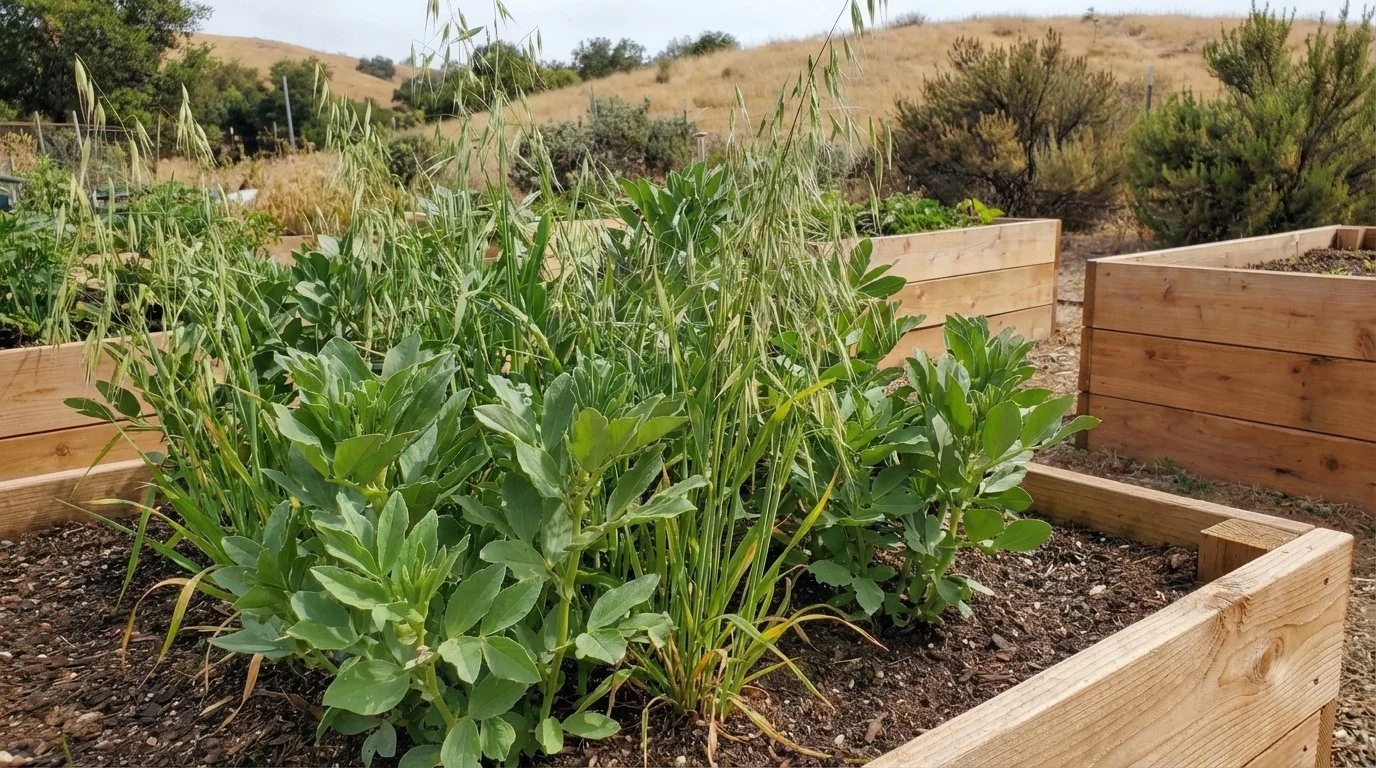
Fava Beans (Vicia faba)
When to sow: October through December in Santa Cruz County. Favas are cold-hardy and actually prefer cool weather for establishment.
Growth habit: Upright, sturdy plants reaching 3 to 5 feet tall. Thick stems, large leaves, fragrant white-and-black flowers.
What it does for soil: Excellent nitrogen fixer, contributing roughly 100 to 200 pounds of nitrogen per acre. Produces heavy biomass. The thick stems and large leaves create substantial organic matter when incorporated. Deep roots help break up compacted soil.
How to terminate: Chop at the base when in full bloom, typically March in Santa Cruz. For a dual-purpose approach, harvest the beans for eating and then chop the remaining plant material. See our guide to terminating cover crops for detailed techniques.
Best for: Gardeners who want both a cover crop and a food crop. Also excellent for beds with compacted or heavy clay soil.
Seeding rate: Plant seeds 4 to 6 inches apart, about 1 inch deep. About 1 pound per 100 square feet.
Field Peas (Pisum sativum subsp. arvense)
When to sow: October through November. Like favas, they prefer cool conditions.
Growth habit: Vining, 2 to 4 feet tall, with tendrils that will climb neighboring plants or supports. Pairs exceptionally well with oats or cereal rye, using the grain stalks as a living trellis.
What it does for soil: Fixes 50 to 120 pounds of nitrogen per acre. The vine habit and fine roots create excellent soil coverage and root exploration of the upper soil layers. In an Oregon State University Extension cover crop trial, cereal rye and pea mixtures produced less biomass than the single-species plots, and spring pea on its own produced the most biomass of the replicated spring treatments.
How to terminate: Cut at ground level when peas begin to flower. If growing with a grain partner, cut both at the same time. Residue breaks down relatively quickly because of the low carbon-to-nitrogen ratio.
Best for: Mixes with grains. The classic pea-oat combination is one of the most reliable cover crop blends in California.
Seeding rate: About 2 to 4 ounces per 100 square feet when planted alone, or 1 to 2 ounces when mixed with a grain.
Bell Beans (Vicia faba var. minor)
When to sow: October through November.
Growth habit: Smaller than regular fava beans, reaching 2 to 3 feet. More branching, denser canopy. Small purple and white flowers.
What it does for soil: Strong nitrogen fixer, comparable to favas. Bell beans have been a staple cover crop on California's Central Coast for decades. UC SAREP includes them among the top recommended legume cover crops for the state.
How to terminate: Mow or chop at flowering stage. Plants are smaller and easier to manage than full-sized favas. Residue decomposes within 2 to 3 weeks.
Best for: Gardeners who want fava-like benefits in a more compact, easier-to-manage package.
Seeding rate: About 2 to 3 ounces per 100 square feet.
Cereal Rye (Secale cereale)
When to sow: September through November. Cereal rye has the widest planting window of any winter cover crop.
Growth habit: Upright grass, 3 to 5 feet tall at maturity. Dense, fibrous root system that can extend 3 feet or more into the soil, one of the most extensive of any annual cover crop.
What it does for soil: Produces massive biomass (top growth and roots). Excellent at scavenging residual soil nitrogen, preventing it from leaching during winter rains. The dense top growth suppresses weeds effectively. Does not fix nitrogen, but excels at holding and recycling existing soil nutrients.
How to terminate: Cut or mow before seed heads emerge (typically when the plant reaches the "boot" stage, when the seed head is still enclosed in the leaf sheath). Cereal rye is one of the harder cover crops to terminate by cutting alone because it can regrow from the crown. Cutting at least twice, or tarping after cutting, ensures clean termination.
Best for: Weed-infested beds, erosion-prone slopes, and situations where maximum biomass is the goal. Also excellent in mixes with legumes.
Seeding rate: About 2 to 4 ounces per 100 square feet.
Annual Ryegrass (Lolium multiflorum)
When to sow: September through October for best establishment.
Growth habit: Bunch-type grass, 1 to 2 feet tall. Very dense, fine-textured root system that thoroughly explores the top 12 inches of soil.
What it does for soil: The fine, dense root system is outstanding for improving soil structure, particularly in heavy clay soils. Good weed suppressor and nutrient scavenger. Annual ryegrass can take up roughly 50 to 100 pounds of nitrogen per acre, holding it safely in plant tissue through winter.
How to terminate: Mow short before seed heads form. In warm Santa Cruz springs, annual ryegrass may try to set seed earlier than you expect, so watch it carefully. Can be persistent if allowed to reseed.
Best for: Clay soils that need structural improvement. Also good for pathways and borders.
Seeding rate: About 1 to 2 ounces per 100 square feet. Seeds are small, so mix with sand for more even distribution.
Oats (Avena sativa)
When to sow: September through November.
Growth habit: Upright grass, 2 to 4 feet tall. Fast establishing, with a moderately dense root system.
What it does for soil: Quick ground coverage, good biomass production, and effective nutrient scavenging. Oats are more cold-sensitive than cereal rye and will winter-kill in regions with hard freezes. In Santa Cruz County, this is rarely an issue, so oats typically survive through winter.
How to terminate: One of the easiest grains to terminate. Cut at the base before seed heads mature. Unlike cereal rye, oats rarely regrow from cut stubble. You can also simply tarp them, and they will die within 1 to 2 weeks under a dark cover.
Best for: Beginners. Oats are perhaps the most forgiving cover crop for new growers. They establish fast, they are easy to terminate, and they mix well with nearly any legume.
Seeding rate: About 2 to 4 ounces per 100 square feet.
Hairy Vetch (Vicia villosa)
When to sow: September through October for best results.
Growth habit: Vigorous vine that can reach 4 to 6 feet if it has something to climb. Forms dense mats of foliage. Purple flowers in spring.
What it does for soil: One of the highest nitrogen-fixing cover crops, producing roughly 100 to 200 pounds of nitrogen per acre. The vigorous growth also provides heavy biomass and excellent weed suppression.
How to terminate: This is the catch with hairy vetch. It is vigorous enough that termination requires attention. Mow or cut at peak bloom, then consider tarping the residue for a week to prevent regrowth. Not recommended for beds you need to plant quickly.
Best for: Experienced cover croppers who want maximum nitrogen fixation and do not mind a more aggressive plant. Excellent mixed with cereal rye.
Seeding rate: About 1 to 2 ounces per 100 square feet.
What Are the Best Spring and Summer Cover Crops?
Summer cover crops are less commonly used in home gardens, but they fill an important niche: covering beds between spring harvest and fall planting, or occupying beds that will not be used until the following year. For warm-season options and timing details, see our summer cover crops for California guide.
Buckwheat (Fagopyrum esculentum)
When to sow: April through August, once soil temperatures are consistently above 55 degrees Fahrenheit.
Growth habit: Fast-growing broadleaf, 2 to 3 feet tall. Matures in just 30 to 45 days. Produces masses of small white flowers that are magnets for pollinators and beneficial insects.
What it does for soil: Buckwheat excels at mobilizing phosphorus from soil minerals, making it available to subsequent crops. UC ANR's Cover Crop Database notes that buckwheat's root exudates can solubilize phosphorus that is otherwise locked up in calcium and iron compounds in the soil. It also suppresses weeds through fast growth and dense canopy cover.
How to terminate: Cut at peak bloom (typically 4 to 6 weeks after sowing). Buckwheat decomposes very rapidly. You can sow a second crop of buckwheat immediately after cutting the first for continuous coverage. One caution: buckwheat sets seed quickly, and if you let it go past bloom, it will self-sow aggressively.
Best for: Quick turnarounds between crops. If you have 5 to 6 weeks between harvesting garlic and planting fall brassicas, buckwheat is the perfect filler. Also outstanding as a pollinator planting.
Seeding rate: About 2 to 3 ounces per 100 square feet.
Cowpeas / Black-Eyed Peas (Vigna unguiculata)
When to sow: May through July, when soil temperatures reach 65 degrees Fahrenheit or warmer.
Growth habit: Bushy or semi-vining, 1 to 3 feet tall depending on variety. Heat-loving, thrives in summer conditions that would stress cool-season legumes.
What it does for soil: Fixes nitrogen during the warm season when winter legumes cannot grow. Adds moderate biomass. Tolerates heat and moderate drought once established.
How to terminate: Cut at flowering stage. Cowpea residue breaks down quickly due to its low carbon-to-nitrogen ratio.
Best for: Warm inland areas of Santa Cruz County (San Lorenzo Valley, Scotts Valley) where summer heat can be significant. Also good for beds resting over summer.
Seeding rate: About 2 to 3 ounces per 100 square feet.
Sorghum-Sudan Grass (Sorghum bicolor x S. bicolor var. sudanense)
When to sow: May through June, once soil temperatures are above 65 degrees Fahrenheit.
Growth habit: Tall, coarse grass reaching 5 to 8 feet if left uncut. Produces massive amounts of above-ground biomass and an extremely deep, extensive root system.
What it does for soil: The deep roots (which can reach 4 to 6 feet in good conditions) are excellent for breaking hardpan and improving deep soil structure. The sheer volume of biomass adds significant organic matter. Also effective at suppressing weeds through its dense, tall canopy.
How to terminate: Mow when plants reach 3 to 4 feet, and they will regrow. For final termination, mow at the base after several cuttings, or wait for fall frost (though frost termination is unreliable in Santa Cruz). Can be labor-intensive in small gardens.
Best for: Large gardens or new garden plots that need major soil rehabilitation. Not practical in small raised beds.
Seeding rate: About 1 to 2 ounces per 100 square feet.
Sunn Hemp (Crotalaria juncea)
When to sow: May through July. Needs warm soil (above 65 degrees Fahrenheit) and warm air temperatures.
Growth habit: Upright, 4 to 6 feet tall. Yellow flowers. Despite its name, it is a legume, not related to hemp.
What it does for soil: Impressive nitrogen fixation for a warm-season crop, combined with substantial biomass production. UC SAREP includes sunn hemp as a recommended warm-season cover crop for California, noting its ability to produce both nitrogen and biomass in a single summer season.
How to terminate: Mow or cut at early bloom. In Santa Cruz's mild coastal areas, sunn hemp may grow more slowly than in warmer inland valleys. It performs best in the warmest parts of the county.
Best for: Warm inland gardens where maximum nitrogen fixation during summer is the goal.
Seeding rate: About 1 to 2 ounces per 100 square feet.
How Do You Choose the Right Cover Crop for Your Situation?
With so many options, here are some practical guidelines for making your choice.
If your main goal is adding nitrogen: Choose a legume (crimson clover, fava beans, field peas, or bell beans for winter; cowpeas or sunn hemp for summer).
If your main goal is adding organic matter: Choose a grain or grass (cereal rye, oats, or annual ryegrass for winter; sorghum-sudan grass for summer).
If your main goal is breaking compacted soil: Choose daikon radish (fall) or sorghum-sudan grass (summer).
If you want the best of multiple benefits: Plant a mix. A legume-grain combination (such as field peas and oats, or fava beans and cereal rye) gives you nitrogen fixation, biomass, and structural benefits in one planting.
If you are a beginner: Start with crimson clover (fall/winter) or buckwheat (spring/summer). Both are easy to grow, easy to terminate, and provide visible, satisfying results.
If you have heavy clay soil: Annual ryegrass, daikon radish, or cereal rye will do the most to improve structure over time.
If you have sandy soil: Legumes (especially favas and bell beans) add both nitrogen and organic matter that sandy soils desperately need.
For more on understanding your soil type and its needs, see our composting guide for building soil organic matter from the ground up.
What About Mustard and Daikon Radish?
These two deserve mention even though they do not fit neatly into the legume or grain categories.
Mustard (Sinapis alba or Brassica juncea) is a brassica cover crop sown in fall. It grows fast, produces moderate biomass, and has the unique benefit of biofumigation. When mustard plant tissue is chopped and incorporated into soil, glucosinolate compounds break down into isothiocyanates, which can suppress soilborne pathogens, nematodes, and some weed seeds. UC Davis field trials of over-winter mustard cover crops ahead of processing tomatoes found no evidence of soilborne disease suppression, so treat biofumigation as unsettled rather than as a reliable benefit. However, do not plant mustard before brassica vegetables (broccoli, cabbage, kale) because they share disease problems.
Daikon radish (Raphanus sativus var. longipinnatus) grows a thick taproot that drills into compacted soil. Plant in September or October, and by winter the radish roots may extend a foot or more into the ground. In hard-freeze climates, the roots winter-kill and decompose in place, leaving behind perfect planting holes. In Santa Cruz, daikon may not winter-kill reliably, so plan to terminate it by cutting before it bolts in spring.
Frequently Asked Questions
Where can I buy cover crop seed locally in Santa Cruz County?
Several options are available in the Santa Cruz area. Local nurseries and garden centers often carry common cover crop seeds like crimson clover, fava beans, and oat seed in bulk bins or packets. Feed and farm supply stores may carry larger quantities at lower per-pound prices. Online suppliers such as Peaceful Valley Farm Supply (based in Grass Valley, California) offer a wide selection of cover crop seeds and mixes specifically suited to California conditions, with shipping throughout the state.
Can I just scatter seeds on top of the soil without any preparation?
Broadcasting onto bare, raked soil works well for small-seeded cover crops like clover, ryegrass, and mustard. A light raking after scattering improves seed-to-soil contact and germination rates. For larger seeds like fava beans and field peas, poking them into the soil about an inch deep gives better results. You do not need to prepare a perfect seedbed. Cover crops are tougher and more forgiving than most vegetable seeds.
Do I need to fertilize cover crops?
No. The whole point of cover crops is that they build fertility rather than consume it. Legumes fix their own nitrogen from the air. Grains and grasses scavenge whatever nutrients are already present in the soil. If your soil is extremely depleted, a light application of compost before sowing can help cover crops establish, but it is not necessary in most situations. The UC Marin Master Gardeners confirm that cover crops are self-sufficient and do not require supplemental fertilizer.
Will cover crops attract gophers or other burrowing pests?
Cover crops do not specifically attract gophers, but gophers are opportunistic and may move into beds with lush root growth. If gophers are already a problem in your garden, cover crops will not make the situation dramatically worse. The same management strategies (trapping, gopher baskets for permanent plantings) apply regardless of whether you are growing cover crops or vegetables.
How long should I wait after terminating a cover crop before planting vegetables?
Allow 2 to 4 weeks between terminating a cover crop and planting vegetables. This waiting period lets the initial decomposition happen, during which soil microorganisms temporarily tie up nitrogen as they break down the carbon-rich plant material. Planting too soon can mean your vegetables compete with decomposers for nitrogen. The waiting period is shorter for legume residue (which is low in carbon relative to nitrogen) and longer for grass residue (which is high in carbon).
Can I grow cover crops alongside my vegetables?
Yes, this practice is called "living mulch" or "intercropping with cover crops." Low-growing white clover is the most common choice, planted as a living ground cover between rows of taller vegetables. It suppresses weeds, fixes nitrogen, and protects soil. The main challenge is competition. Make sure your cover crop does not compete with vegetables for light, water, or nutrients. Keep living mulches mowed short and maintain adequate spacing around vegetable plants.
Choosing and growing cover crops does not have to be complicated. Start with one or two species that match your season and soil goals, and expand your repertoire over time. The most important step is simply getting seeds into the ground instead of leaving your soil bare.
For more soil-building strategies and seasonal planting reminders, visit Your Garden Toolkit to grab our free gardening resources.
