

Succulent Problems in Coastal California | Rot, Pests & Fixes
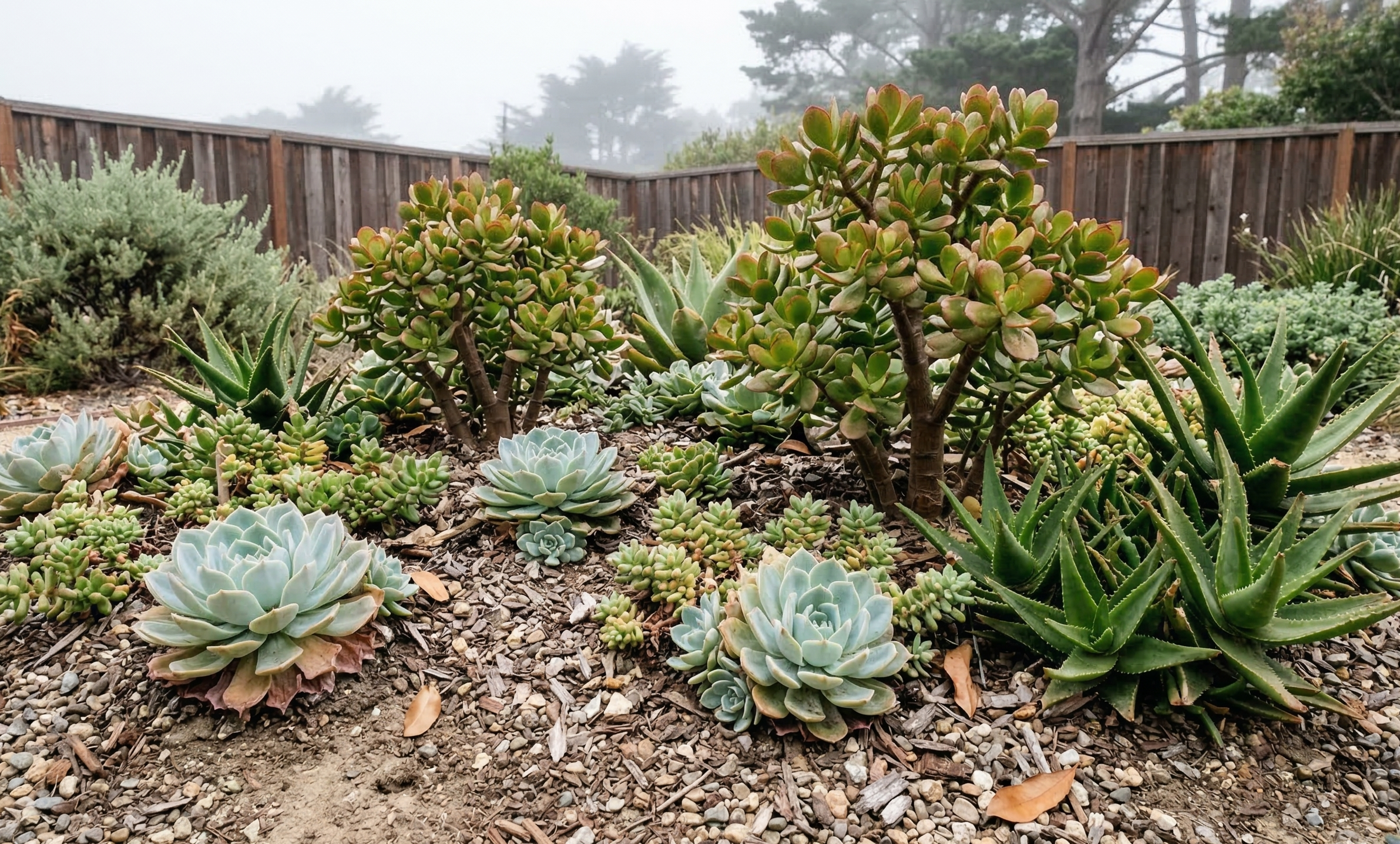
Succulent Problems in Coastal California: Rot, Pests, and Etiolation
Root and stem rot caused by excess moisture is the number one killer of succulents in coastal California, responsible for more plant losses than all other problems combined. According to the UC Integrated Pest Management Program, the fungal and water mold pathogens behind most succulent rot (Phytophthora, Pythium, Fusarium, and Botrytis) thrive in exactly the conditions our coast provides: cool temperatures, high humidity, and prolonged soil moisture. Understanding these challenges, and a handful of other common issues, is the difference between a thriving succulent garden and a frustrating cycle of replacement.
The good news is that nearly every succulent problem in our climate is preventable. The solutions are not complicated, but they do require accepting the fact that coastal California is not the desert, and succulent care here must be adjusted accordingly.
What Causes Root Rot in Coastal Succulents and How Do You Fix It?
Root rot is not a single disease but a group of conditions caused by various soil-borne pathogens that attack succulent roots when they sit in wet soil for too long. The result is the same regardless of the specific pathogen: roots turn brown or black, become mushy, and lose their ability to absorb water and nutrients. The plant above ground begins to wilt, discolor, and soften as it slowly dies from the bottom up.
Why Root Rot Is So Common on the Coast
In inland or desert areas, succulent growers worry mainly about overwatering. On the California coast, the moisture threat comes from multiple directions:
Fog condensation deposits water on soil surfaces and leaf surfaces almost daily during summer months, adding moisture that the gardener did not apply
Winter rainfall saturates soil for extended periods (Santa Cruz averages 30 inches annually, the San Lorenzo Valley closer to 50 inches)
Cool temperatures slow evaporation, so soil stays wet much longer than it would in warmer climates
High humidity reduces transpiration (the process by which plants lose water through their leaves), meaning roots continue to sit in wet soil even when the plant is not actively taking up water
UC researchers studying container plant diseases have documented that the combination of cool, wet soil and reduced oxygen (waterlogged soil lacks the air spaces roots need) creates ideal conditions for Phytophthora and Pythium, which are technically water molds rather than true fungi. These organisms produce swimming spores that travel through wet soil to infect healthy roots.
How to Identify Root Rot
Root rot often progresses for weeks before above-ground symptoms appear. By the time you notice something is wrong, the root system may be severely compromised.
Early signs: - Lower leaves turning yellow, translucent, or mushy (not just dry and papery, which is normal leaf reabsorption) - The plant feeling wobbly or loose in its soil, as though the roots have lost their grip - A slight softness at the base of the stem, just above soil level - Slowed growth that cannot be explained by dormancy
Advanced signs: - Stem turning black or dark brown at the soil line - A foul smell from the soil or plant base (healthy succulents do not smell) - Leaves falling off with the slightest touch - The entire plant collapsing or tipping over
To confirm: Gently unpot the plant and examine the roots. Healthy succulent roots are white or light tan and firm. Rotted roots are brown to black, mushy, and may fall apart when touched. If the rot has reached the stem, you will see dark, wet-looking tissue inside when you cut into it.
How to Treat Root Rot
If caught early, some succulents can be saved:
Remove the plant from its soil immediately. Shake off all old soil from the roots.
Cut away all rotted roots with a clean, sharp knife or scissors. Cut until you reach firm, white tissue. If rotted tissue extends into the stem, cut the stem above the rot line. If the stem is rotten all the way through, the plant cannot be saved from the root end, but you may be able to take a stem or leaf cutting from healthy tissue above the rot.
Let the cut surfaces dry and callus for 3 to 7 days in a warm, dry location with bright indirect light.
Repot in completely fresh, fast-draining soil in a clean container. Do not reuse the old soil, which harbors pathogens.
Do not water for 7 to 10 days after repotting.
Resume watering very cautiously, waiting until the soil is thoroughly dry before each watering.
Realistically: If more than half the root system is gone or if rot has entered the main stem, the chance of saving the plant as-is is low. Your better option is to take healthy cuttings from the unaffected upper portion and propagate new plants. See our propagation guide for detailed instructions.
How to Prevent Root Rot
Prevention is far more effective than treatment.
Improve drainage. This is the single most impactful step. Amend in-ground soil with 50 percent pumice or perlite. Use containers with drainage holes and fast-draining soil mix. Raise planting beds above grade.
Use mineral mulch, not organic. Gravel, decomposed granite, or crushed rock around succulent stems keeps the crown dry. Bark mulch and wood chips hold moisture against stems and decompose into water-retentive mush.
Stop watering in winter. Once regular rains begin (usually November), stop all supplemental irrigation for in-ground succulents. Container succulents under cover may need occasional water, but far less than in summer.
Choose fog-tolerant species. In the fog belt, grow Aeonium, Dudleya, Aloe arborescens, and Sedum rather than rot-prone species like Echeveria, thin-leaved Crassula, and desert cacti.
Improve air circulation. Space plants generously. Prune surrounding vegetation that blocks airflow. Avoid planting in enclosed, still-air corners.
What Causes Stem Rot and Crown Rot?
Stem rot and crown rot are closely related to root rot but affect the above-ground portions of the plant. Crown rot specifically targets the growing point at the center of a rosette where new leaves emerge.
Crown rot is particularly common in rosette-forming succulents (Echeveria, Sempervivum, Dudleya, Aeonium) when water sits in the center of the rosette. In our foggy, rainy climate, water accumulates in these natural cups and does not evaporate quickly, creating a perfect environment for Botrytis (gray mold) and other fungal pathogens.
Prevention of crown rot: - Plant rosette-forming succulents at a slight angle (especially Dudleya) so water drains out of the center - Avoid overhead watering; direct water at the soil, not the plant - In winter, consider placing a small plastic or glass cover over vulnerable rosettes during prolonged rain (not touching the plant, just deflecting rain) - Choose species with naturally water-shedding rosette shapes or heavy farina coatings
Stem rot often follows root rot as infection moves upward, or it can start at the stem base where soil stays wet against the tissue. The same prevention strategies apply: fast-draining soil, mineral mulch, and keeping the stem base dry.
What Are the Most Common Succulent Pests in Coastal California?
A few of the product links in this guide are affiliate links. If you buy through one, Ambitious Harvest may earn a small commission at no extra cost to you, which helps keep these guides free. We only point to gear we would use in our own Santa Cruz garden. As an Amazon Associate, we earn from Read our full disclosure.
Mealybugs
Mealybugs are the most frequently encountered succulent pest in our area. These small (1 to 3 mm) soft-bodied insects appear as white, cottony clusters in leaf axils, between tightly packed rosette leaves, on stems, and on roots. They feed by piercing plant tissue and sucking sap, weakening the plant and leaving behind sticky honeydew that attracts sooty mold.
According to UC IPM Program resources, mealybugs reproduce rapidly in warm, sheltered conditions, and a succulent collection can become heavily infested before the problem is obvious because the insects hide in protected crevices.
How to identify mealybugs: Look for white, waxy, cotton-like clusters. The insects themselves are oval-shaped and covered in a white waxy coating. They tend to congregate in leaf axils (where the leaf meets the stem), at the base of rosettes, and under leaves. On roots, they appear as white patches on the root surface when you unpot a plant.
Treatment: - Light infestations: Dab individual mealybugs with a cotton swab dipped in 70 percent isopropyl alcohol. The alcohol dissolves the waxy coating and kills the insect on contact. Repeat every few days until all visible mealybugs are gone. - Moderate infestations: Spray the entire plant with insecticidal soap (following label directions) or a 50/50 solution of isopropyl alcohol and water with a few drops of dish soap. Be thorough, spraying into all crevices. Repeat every 7 to 10 days for 3 to 4 applications to catch newly hatched mealybugs. - Heavy infestations: If a plant is heavily infested, consider discarding it to protect the rest of your collection. Mealybugs spread easily between plants, and a badly infested specimen is a source of reinfestation. If the plant is valuable, isolate it far from others, unpot it, wash the roots under running water to remove root mealybugs, treat with insecticidal soap, repot in fresh soil in a clean container, and monitor closely.
Prevention: Inspect new plants carefully before adding them to your collection. Quarantine new acquisitions for 2 to 3 weeks. Keep plants healthy and stress-free, as stressed plants are more susceptible to infestation. Remove dead leaves that provide hiding spots.
Scale Insects
Scale insects are less common than mealybugs on succulents but do appear, particularly on Aloe, Agave, and jade plants (Crassula ovata). They appear as small (1 to 4 mm) brown, tan, or gray bumps that look like tiny helmets or shells attached to stems and leaves. Underneath each shell, the insect feeds on plant sap.
Treatment: Scale insects are protected by their hard shell, which makes contact insecticides less effective. Scrape individual scale off with a fingernail or old toothbrush. For larger infestations, UC IPM recommends horticultural oil spray, which suffocates the insects. Apply during the crawler stage (when juvenile scale are moving and have not yet formed their protective shell), typically in spring and early summer.
Aphids
Aphids occasionally appear on succulent flower stalks and new growth, particularly on Aeonium, Aloe, and Dudleya during their bloom periods. They are small (1 to 3 mm), pear-shaped, and may be green, black, or brown. They cluster on tender new tissue and flower buds.
Treatment: A strong spray of water from a hose dislodges aphids effectively. For persistent infestations, insecticidal soap works well. Ladybugs and lacewings are natural predators that help control aphids in the garden. According to UC IPM, encouraging beneficial insects is often the most sustainable long-term aphid management strategy.
Fungus Gnats
Fungus gnats are tiny (2 to 3 mm), dark-winged flies that hover around the soil surface of potted plants. The adults are a nuisance, but the larvae (small white maggots living in the top inch of soil) can damage fine succulent roots. They thrive in consistently moist organic soil, which is one more reason to use fast-draining, mineral-heavy soil mixes for succulents.
Treatment: Allow soil to dry completely between waterings (this kills larvae). Yellow sticky traps near plants capture adults. Bacillus thuringiensis subspecies israelensis (Bti), available as a soil drench, kills larvae without harming plants. Switching to a more mineral-based soil mix (more pumice, less organic matter) makes the growing medium less hospitable to fungus gnat larvae.
What Causes Etiolation and How Do You Fix It?
Etiolation is the stretching and elongation of succulent stems and leaves in response to insufficient light. Instead of growing compact and colorful, the plant grows tall and spindly, with widely spaced leaves and washed-out color. It is one of the most common aesthetic problems for succulents in the Santa Cruz fog belt, where many days (especially in summer) start with heavy fog that does not burn off until midday or later.
How to Identify Etiolation
Rosette-forming succulents (Echeveria, Graptoveria) grow tall stems with leaves spaced far apart instead of stacking tightly into a compact rosette. The rosette opens up and flattens rather than cupping inward.
Upright succulents (Crassula, Kalanchoe) lean toward the nearest light source and develop thin, weak stems.
Colors fade. Succulents that should be vivid purple, red, orange, or blue-gray turn plain green when they do not receive enough light. The bright pigments (anthocyanins and carotenoids) that produce vivid succulent colors are produced in response to UV light and temperature stress, both of which are reduced in foggy, mild conditions.
What to Do About Etiolation
The hard truth: Etiolation cannot be reversed in the affected tissue. A stretched stem will not shrink back to its original compact form. The good news is that you can manage it going forward and use propagation to start fresh.
Move the plant to more light. Gradually increase sun exposure over 1 to 2 weeks (sudden moves from shade to full sun cause sunburn, covered below). South and west-facing locations receive the most light in Santa Cruz. Spots that clear of fog earliest in the day are the best choices.
Behead and propagate. If a rosette-forming succulent has stretched beyond redemption, cut the rosette head off the stretched stem, let it callus, and replant it. The rosette will root and grow compactly if given sufficient light. The remaining stem stump may produce new compact rosettes from dormant buds.
Choose the right species for your light. If your garden is in the fog belt with limited sun, some etiolation is nearly inevitable for sun-loving species like Echeveria and Graptoveria. Consider switching to species that tolerate lower light: Aeonium (surprisingly shade-tolerant), Haworthia/Haworthiopsis, Gasteria, and Sansevieria. These genera retain their compact form in bright indirect light without needing full sun.
Container solutions. If you love sun-demanding succulents but live in the fog belt, grow them in containers that you can move to follow the sun. A rolling plant stand makes it easy to shift pots to the sunniest spot on your patio as conditions change.
What Causes Sunburn on Succulents?
This seems contradictory (succulents are sun-loving plants, right?), but sunburn is a genuine and common problem, especially when plants are moved abruptly from shade or indoor conditions to full sun.
How Sunburn Happens
Succulents acclimate to their light environment. A plant that has been growing in shade, indoors, or in a fog-belt garden has lower levels of protective pigments and a thinner cuticle (the waxy outer coating on leaves) than one growing in full sun. When suddenly exposed to intense direct light, the leaf tissue overheats and cells are damaged. This manifests as white, brown, or bleached patches on leaves, usually on the side facing the sun.
UC IPM describes plant sunburn as damage to bark, foliage, and fruit caused by excessive exposure to solar radiation, usually in warm weather and often where soil moisture is short.
How to Prevent and Treat Sunburn
Prevention (acclimate gradually): When moving any succulent from lower to higher light conditions, do it slowly: - Week 1: Morning sun only (before 10 AM), shade the rest of the day - Week 2: Morning sun plus early afternoon (until 1 PM) - Week 3: Full sun exposure
This 2 to 3 week acclimation period allows the plant to ramp up protective pigment production and thicken its cuticle.
Treatment: Sunburned tissue does not heal. The damaged patches are permanent on that leaf. However, the plant is usually not seriously harmed. New growth will be acclimated to the current light level and will not burn. You can leave burned leaves in place (they still photosynthesize) or remove them for appearance if the plant has enough healthy leaves to sustain itself.
Particular risk moments: - Bringing indoor succulents outside in spring - Moving plants from a nursery (often grown under shade cloth) to your full-sun garden - After a week of fog clears to sudden intense sunshine (common in Santa Cruz in July and August) - Newly propagated plants that have been rooting in indirect light
What Causes Edema on Succulent Leaves?
Edema (also spelled oedema) appears as raised, corky, or scab-like bumps on succulent leaves. It is not a disease or pest problem. It is a physiological condition caused by the plant absorbing water faster than it can transpire (release) it. The excess water pressure causes individual cells to burst, and the damaged tissue forms a corky scar.
Edema is particularly common in coastal California because our high humidity reduces transpiration while fog and dew add moisture to the soil. It is most often seen on Echeveria, jade plants, and Kalanchoe.
How to manage edema: - Reduce watering frequency - Improve air circulation around plants - Avoid watering on cool, humid days when transpiration is already low - The bumps on affected leaves are permanent but cosmetic; they do not harm the plant
What Is the White Powder on My Succulent Leaves?
If your succulent's leaves are covered in a fine white or silvery powder, it is almost certainly farina, a natural waxy coating produced by the plant. Farina is especially prominent on Dudleya, Echeveria, and Graptoveria species. It is not a disease. It protects the plant from UV radiation, repels water, and may deter some pests.
Important: Do not try to wash off farina. It does not regenerate once removed, and the plant will be more vulnerable to sun damage and moisture issues without it. Handle high-farina plants by the pot or the base, not by the leaves.
If the white substance is fuzzy or cottony (rather than a smooth powder), it is likely mealybugs. See the mealybug section above.
If you see a white, powdery coating that was not there before and rubs off easily to reveal green tissue underneath, it could be powdery mildew, a fungal disease that occasionally affects succulents in humid conditions. UC IPM recommends improving air circulation, reducing overhead moisture, and applying horticultural oil or sulfur-based fungicide if the infection is severe.
What Causes Bird Damage on Succulents?
This is a problem that many coastal California gardeners experience with Dudleya in particular. Scrub-jays, crows, and occasionally other bird species have been observed pulling leaves from succulent rosettes, seemingly for moisture content or out of curiosity.
Bird damage on Dudleya often looks like leaves torn or pecked from the rosette, leaving ragged stumps. It can be frustrating, especially on slow-growing species that take years to replace lost leaves.
Deterrents: - Lightweight bird netting draped over vulnerable plants (remove once plants are well-established and less vulnerable) - Reflective tape or pinwheels near plantings (temporary effectiveness, birds often habituate) - Planting in locations less accessible to birds (wall crevices, elevated containers near buildings) - Providing a bird bath nearby (birds may be seeking moisture from succulent leaves due to lack of water sources)
How Do You Deal with Winter Rain Damage?
Prolonged winter rain is the background threat behind many of the problems discussed in this article. It drives rot, encourages fungal diseases, promotes etiolation during gray weeks, and stresses species adapted to drier conditions.
Strategies for managing winter rain:
For in-ground plantings: - Ensure drainage is excellent before the rainy season starts (test in October, amend if needed) - Top-dress with mineral mulch to keep stems and crowns dry - Plant on slopes, mounds, or raised beds so water flows away - Accept some losses among sensitive species; this is part of gardening on the coast
For container plantings: - Move sensitive species under eaves, porch roofs, or other rain-protected locations - Tilt pots slightly so excess water drains out rather than pooling on the soil surface - Stop watering entirely for containers exposed to rain - Check drainage holes; soil sometimes clogs them from the inside
For cold-sensitive species in the San Lorenzo Valley: - Frost cloth on cold nights (below 28 degrees) - South-facing walls and rock features absorb daytime heat and radiate it at night - Container growing allows quick relocation to protected areas during cold snaps
California rule: Nearly every succulent problem in our climate traces back to excess moisture. Fast-draining soil, mineral mulch, proper spacing, and species matched to your microclimate prevent most issues before they start.
Frequently Asked Questions
My succulent is turning yellow. Is it dying?
Not necessarily. Yellowing lower leaves on a succulent are often normal. Many species reabsorb nutrients from older lower leaves as they produce new growth at the center. These leaves turn yellow, then papery, and eventually dry up and fall off. This is healthy. However, if multiple leaves are yellowing simultaneously, especially upper leaves, or if the yellow leaves feel soft and translucent rather than dry, suspect overwatering or root rot. Check the roots and adjust your watering.
Why is my Echeveria stretching even though it gets sun?
In the Santa Cruz fog belt, even a "sunny" spot may not provide the 6 to 8 hours of direct sun that Echeveria need to stay compact. If fog rolls in by mid-morning and does not clear until afternoon, your plant may be getting only 3 to 4 hours of useful light. Move the plant to your sunniest location (south or west-facing, away from fog-trapping structures), or accept that Echeveria may simply etiolate in your microclimate. Consider switching to more shade-tolerant species like Aeonium.
How do I know if I am overwatering or underwatering my succulent?
Both conditions can cause leaf drooping and discoloration, but the texture tells the story. Overwatered leaves are soft, translucent, mushy, and may fall off with a touch. Underwatered leaves are wrinkled, slightly puckered, and feel thin but firm, not mushy. An underwatered succulent is easily fixed by a good watering. An overwatered succulent may already have root rot and needs immediate intervention: stop watering, check roots, and treat as described in the root rot section.
Is the black spot on my Agave a disease?
Black spots on Agave leaves can have several causes. If the spot is dry, hard, and on the leaf surface, it is likely sun damage or physical injury, cosmetic but not harmful. If the spot is soft, wet, and expanding, it may be a bacterial or fungal infection (sometimes called Agave snout weevil damage, though the weevil itself is rare in coastal areas). For soft, spreading black spots, cut away affected tissue, clean the cut with dilute hydrogen peroxide, and improve drainage and air circulation around the plant.
Can I save a succulent that has completely rotted at the base?
If the stem is mushy all the way through at the soil line, the root system is gone and the lower plant cannot be saved. However, if there is any firm, healthy tissue above the rot line, you can save genetics by taking a cutting. Slice the stem above the rot until you find solid, white or green tissue with no brown or mushy areas. Let this cutting callus for 5 to 7 days, then treat it as a stem cutting propagation. Many succulents recover fully from this process.
Do I need to spray my succulents with fungicide preventatively?
For most home gardeners, preventive fungicide application is not necessary or recommended. UC IPM takes an integrated approach, emphasizing cultural practices (proper drainage, spacing, mineral mulch, appropriate watering) as the primary defense against fungal disease. If you provide the right growing conditions, fungal problems are uncommon. Fungicide sprays are best reserved for specific, identified fungal infections rather than blanket preventive application, which can disrupt beneficial soil organisms.
Healthy plants start with the right knowledge. Visit our Garden Toolkit for free troubleshooting guides, seasonal care reminders, and California-specific growing resources delivered straight to your inbox
