

Ollas: Ancient Irrigation That's Perfect for Santa Cruz Gardens
An Ancient Solution to a Modern Problem
California gardeners face a fundamental challenge every summer: how do you keep vegetables alive and productive during months without rain? Drip irrigation is one answer. Mulching is another. But there's an older, simpler technology that many Santa Cruz gardeners are rediscovering: ollas.
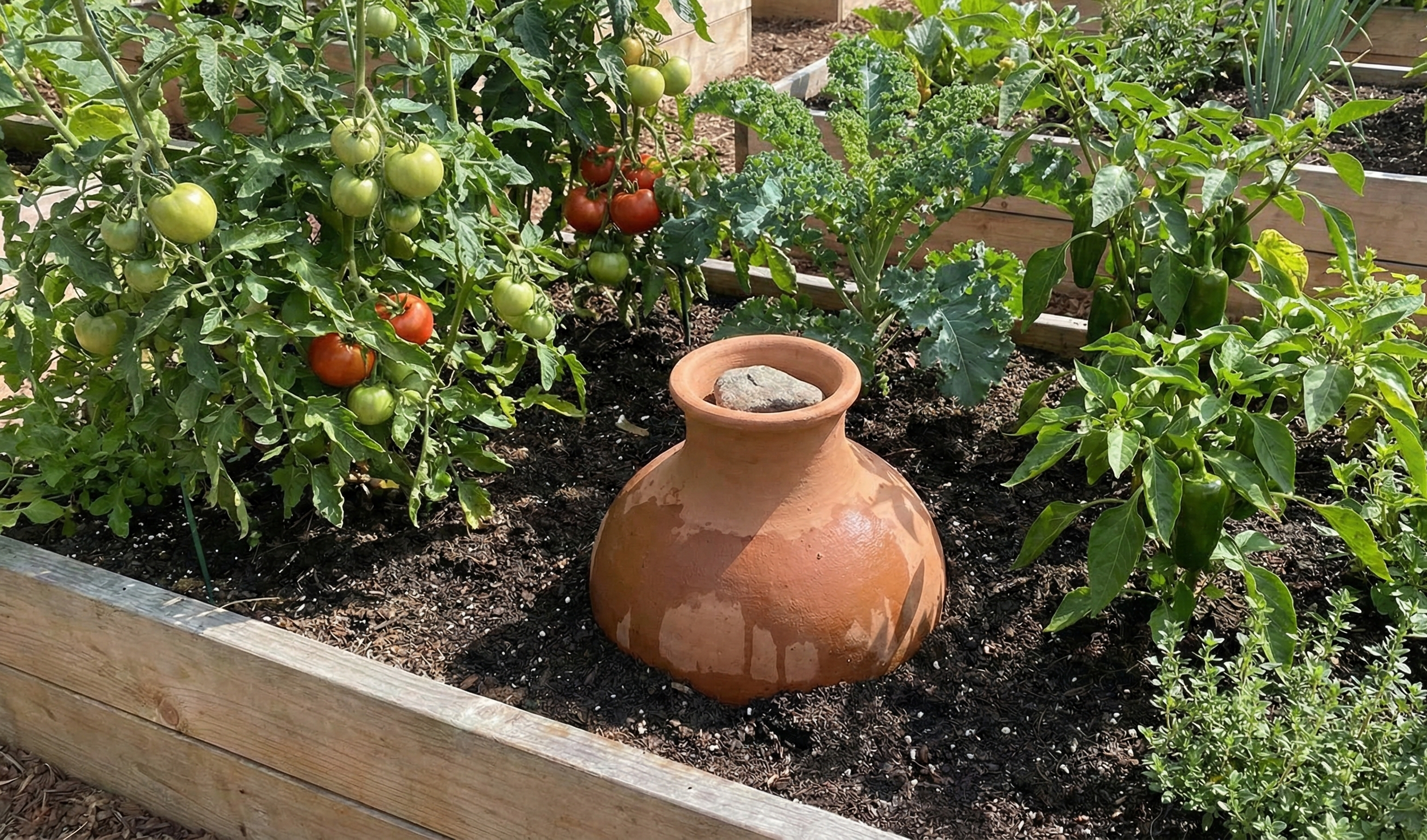
Ollas (pronounced "oy-yahs") are unglazed clay pots buried in the soil and filled with water. The porous clay slowly releases moisture directly into the root zone, providing a steady supply of water where plants need it most. No electricity, no timers, no clogged emitters. Just clay, water, and gravity.
This isn't some trendy garden hack. Ollas have been used for over 4,000 years, from ancient China to North Africa to Indigenous communities throughout the American Southwest. They work. And in our Mediterranean climate with its bone-dry summers, they make more sense than ever.
How Ollas Work
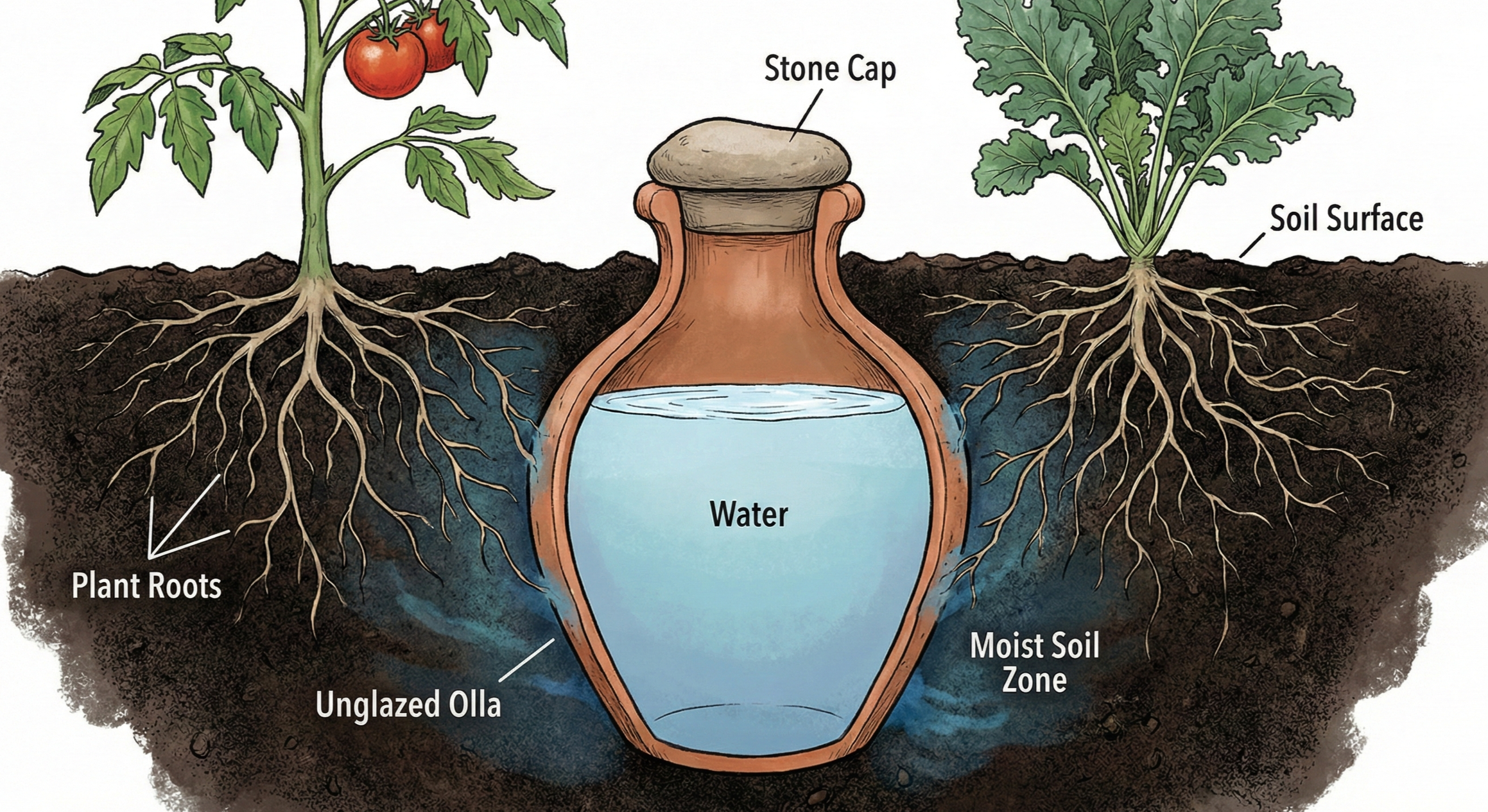
The science is simple. Unglazed terra cotta is porous, so water slowly seeps through the clay walls into the surrounding soil. But here's the clever part: ollas are self-regulating.
When soil is dry, water moves through the clay faster. When soil is moist (after fog drip or the rare summer rain), the water flow slows down. The roots of nearby plants grow toward the moisture source and cluster around the olla, taking what they need.
This means:
No overwatering: Water releases only as fast as the soil can absorb it
No underwatering: The reservoir provides a constant supply between refills
Minimal evaporation: Water moves directly through the soil, not across the surface
Deep root growth: Plants send roots down toward the moisture rather than staying shallow
Studies suggest ollas use 50 to 70 percent less water than surface irrigation for the same plant growth. In a drought-prone state where every drop counts, that's significant.
Why Ollas Make Sense in Santa Cruz
Our local climate is ideally suited to olla irrigation.
Dry summers: From May through October, Santa Cruz County gets almost no rain. Ollas provide consistent moisture through this long dry stretch without the complexity of drip systems.
Water costs: Municipal water isn't cheap, and it's getting more expensive. Using less water saves money.
Clay soil challenges: Parts of Santa Cruz County have heavy clay soil that's slow to absorb water. Surface irrigation often runs off before it can soak in. Ollas deliver water below the surface, bypassing this problem entirely.
Foggy coastal areas: In Aptos, Live Oak, and coastal Santa Cruz, summer fog can actually provide some moisture. Ollas respond automatically, releasing less water when the soil is already damp from fog drip.
Sandy soil challenges: Conversely, areas with sandy soil (parts of the San Lorenzo Valley, some coastal locations) drain quickly. Ollas provide a slow, steady supply rather than water that rushes past the root zone.
Whether you're gardening in heavy clay in Soquel or sandy loam in Scotts Valley, ollas adapt to your conditions.
Choosing the Right Olla
Ollas come in various sizes, and matching the olla to your garden makes a difference.
Small ollas (1 to 2 quarts):
Good for container gardens and small raised beds
Water a radius of about 12 inches
Need refilling every 2 to 3 days in hot weather
Work well for individual tomato plants or small herb groupings
Medium ollas (1 to 2 gallons):
The most versatile size for vegetable gardens
Water a radius of about 18 inches
Need refilling every 3 to 5 days depending on conditions
Good for most raised bed situations
Large ollas (3 to 5 gallons):
Best for in-ground beds and larger plantings
Water a radius of up to 3 feet
Can go a week or more between refills
Ideal for squash hills, melon patches, or fruit trees
What to look for:
Unglazed terra cotta: The entire pot must be unglazed for water to seep through. Glazed or painted pots won't work.
Lid or cover: A lid prevents evaporation and keeps debris (and mosquitoes) out. Some ollas come with fitted lids; others can be covered with a saucer or flat stone.
Thick walls: Thicker clay releases water more slowly and lasts longer. Cheap, thin-walled pots may crack or release water too quickly.
Where to find ollas:
Local pottery studios sometimes make them
Online retailers (Dripping Springs Ollas, Growoya)
DIY options (more on this below)
Some local nurseries stock them seasonally
Installing Ollas in Your Garden
Proper installation ensures your ollas work effectively.
Step 1: Choose your location
Position ollas in the center of your planting area, surrounded by the plants you want to water. For a 4x4 raised bed, one medium olla in the center works well. For a 4x8 bed, consider two ollas spaced evenly.
Step 2: Dig the hole
Dig a hole slightly larger than your olla, deep enough that only the neck will be exposed above soil level. The buried portion is where water seeps out, so you want most of the pot underground.
Step 3: Place the olla
Set the olla in the hole. The opening should sit 1 to 2 inches above the soil surface to prevent soil from washing in when you water.
Step 4: Backfill carefully
Fill around the olla with soil, tamping gently to eliminate air pockets. Don't pack too tightly. You want good soil contact without crushing the clay.
Step 5: Plant around it
Plant vegetables, herbs, or flowers in a ring around the olla, spacing them at the edge of the olla's watering radius. Roots will find the moisture and grow toward it.
Step 6: Fill and cover
Fill the olla with water and cover with a lid, saucer, or flat stone to prevent evaporation and keep out pests.
What to Plant Around Ollas
Almost any vegetable benefits from olla irrigation, but some are especially well-suited.
Excellent choices:
Tomatoes: Love consistent moisture. Olla irrigation reduces blossom end rot caused by uneven watering.
Peppers: Similar benefits to tomatoes.
Squash and melons: Thirsty plants that appreciate steady water.
Cucumbers: Consistent moisture means less bitterness and better production.
Eggplant: Thrives with even water supply.
Good choices:
Beans and peas: Benefit from consistent moisture during flowering and pod set.
Leafy greens: Less likely to bolt with steady water.
Brassicas: Appreciate even moisture.
Less ideal (but still works):
Root vegetables: Carrots, beets, and radishes do fine, but their spreading root systems may not cluster around the olla as efficiently.
Drought-tolerant herbs: Rosemary, lavender, and sage prefer drier conditions and may not need olla irrigation.
Maintaining Your Ollas
Olla care is minimal but important.
During the growing season:
Check water levels regularly. How often depends on weather, plant size, and olla size. Start by checking every other day and adjust based on what you find.
Refill before empty. Letting ollas dry out completely stresses plants. Top off when about half empty.
Watch for clogs. Mineral deposits or algae can slow water release. If an olla seems to empty very slowly, it may need cleaning.
End of season:
Empty and remove. Before the rainy season (or before frost in colder microclimates like Boulder Creek), empty ollas and bring them inside or store under cover.
Clean thoroughly. Scrub inside and out with a stiff brush to remove mineral deposits. For stubborn buildup, soak in a vinegar solution (1 part vinegar to 10 parts water) for a few hours.
Let dry completely. Store dry ollas in a shed, garage, or other protected location. Wet clay can crack if it freezes.
Troubleshooting:
Water disappears too quickly: The olla may have a crack, or soil may be extremely dry. Check for damage, and consider supplemental watering while soil moisture builds up around the olla.
Water level doesn't drop: Mineral deposits may be clogging the pores. Clean the olla thoroughly. If the problem persists, the clay may be too dense or partially glazed.
Plants look stressed despite full olla: Roots may not have reached the olla yet. This is common with newly installed ollas. Give plants a few weeks to find the moisture, supplementing with surface watering if needed.
DIY Ollas: The Budget Option
Commercial ollas can be pricey, often $30 to $60 for larger sizes. If you're outfitting a big garden, costs add up quickly. Fortunately, you can make functional ollas from standard terra cotta pots.
Simple two-pot method:
Get two unglazed terra cotta pots of the same size.
Use silicone caulk or waterproof epoxy to seal the drainage hole of one pot (this will be the bottom).
Use the same sealant to glue the two pots together rim-to-rim, creating a closed vessel.
Let cure completely (24 to 48 hours).
Bury with the sealed end down. Fill through the open drainage hole of the top pot.
Cover the hole with a small saucer or stone.
Single pot method (even simpler):
Seal the drainage hole of an unglazed terra cotta pot.
Bury the pot with the open end up.
Cover with a saucer.
The single pot method is easier but holds less water and has more evaporation from the open top. The two-pot method creates a more traditional closed olla.
Cost comparison:
Two 8-inch terra cotta pots: $8 to $12 total
Tube of silicone: $5 to $8 (enough for many ollas)
DIY olla cost: roughly $10 to $15 each
For a large garden, DIY ollas can save significant money.
Ollas vs. Other Irrigation Methods
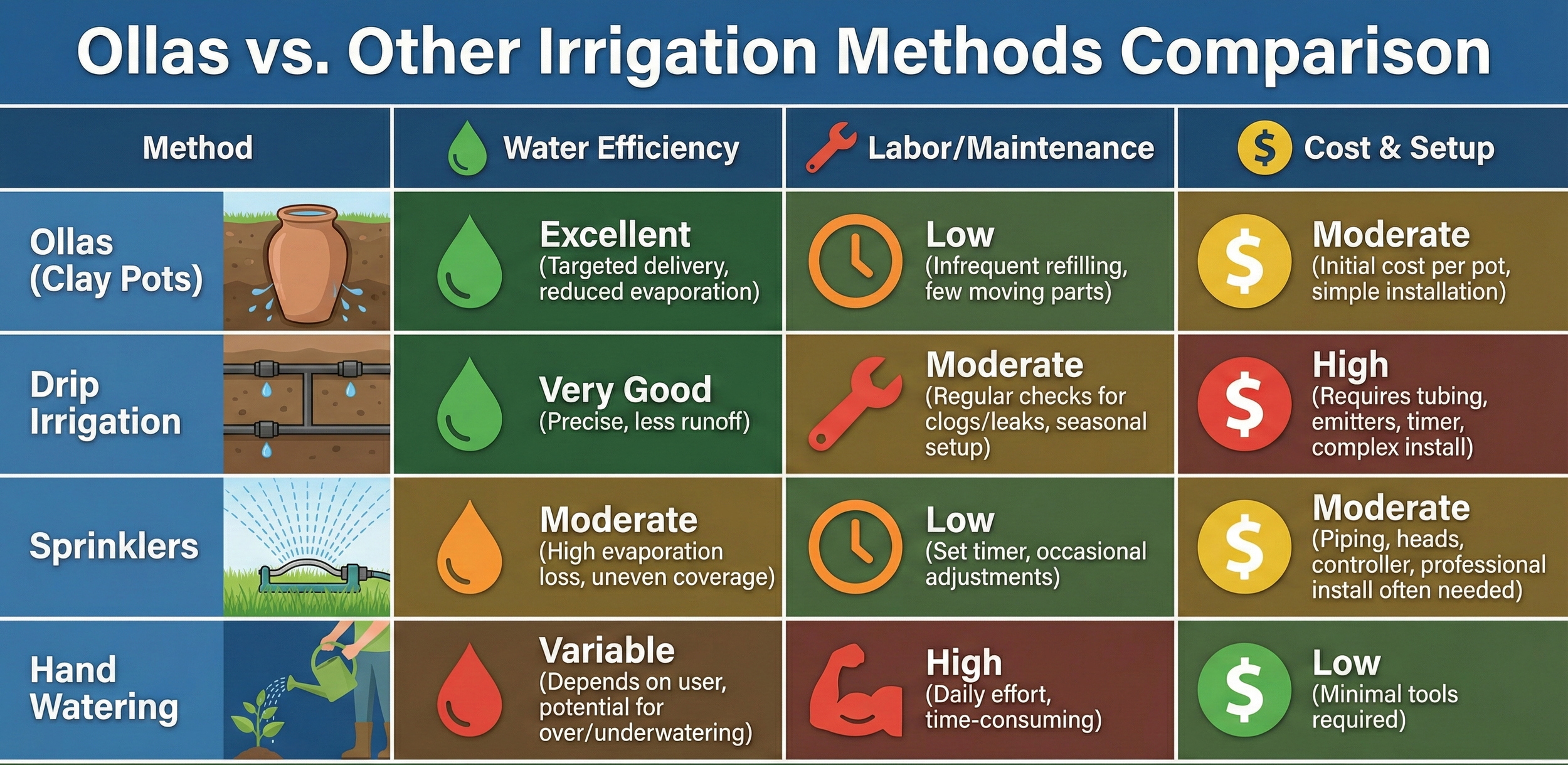
How do ollas compare to other water-wise options?
Ollas
Water efficiency: Excellent
Cost: Moderate to high
Maintenance: Low
Best for: Small to medium beds, containers
Drip irrigation
Water efficiency: Very good
Cost: Moderate
Maintenance: Moderate (clogs, repairs)
Best for: Larger gardens, rows
Soaker hoses
Water efficiency: Good
Cost: Low
Maintenance: Low to moderate
Best for: Rows, paths
Hand watering
Water efficiency: Variable
Cost: Low
Maintenance: High (time)
Best for: Small gardens, spot watering
Sprinklers
Water efficiency: Poor
Cost: Low to moderate
Maintenance: Low
Best for: Lawns (not vegetables)
Ollas work beautifully for raised beds, container gardens, and smaller in-ground plots. For very large gardens or row crops, drip irrigation may be more practical. Many gardeners use both: ollas for intensive raised beds and drip for larger areas.
Combining Ollas with Other Water-Wise Practices
Ollas work even better when combined with other water-conservation strategies.
Mulch: A thick layer of mulch (3 to 4 inches) around your ollas and plants reduces surface evaporation dramatically. Straw, wood chips, or leaves all work well.
Shade cloth: In hot inland areas like Boulder Creek or Watsonville, shade cloth during heat waves reduces plant water needs.
Right plant, right place: Grouping plants by water needs lets you put ollas where they're most needed and skip them for drought-tolerant plantings.
Rainwater harvesting: Fill your ollas with collected rainwater during the wet season to reduce municipal water use.
Fog drip collection: In coastal areas, fog collectors can provide water for ollas during our foggy summers.
An Ancient Practice for Modern Challenges
Climate change is making California's dry seasons longer and more intense. Water is becoming scarcer and more expensive. We need every tool available to grow food sustainably.
Ollas aren't a silver bullet. No single technique is. But they're a remarkably effective, low-tech, time-tested approach to getting water where it needs to go. They've worked for 4,000 years across multiple continents and climates.
In a Santa Cruz garden facing another long, dry summer, that ancient wisdom is worth rediscovering.
