

Growing Douglas Iris in Santa Cruz County
Douglas Iris: The Easy Native for Shady, Foggy Gardens
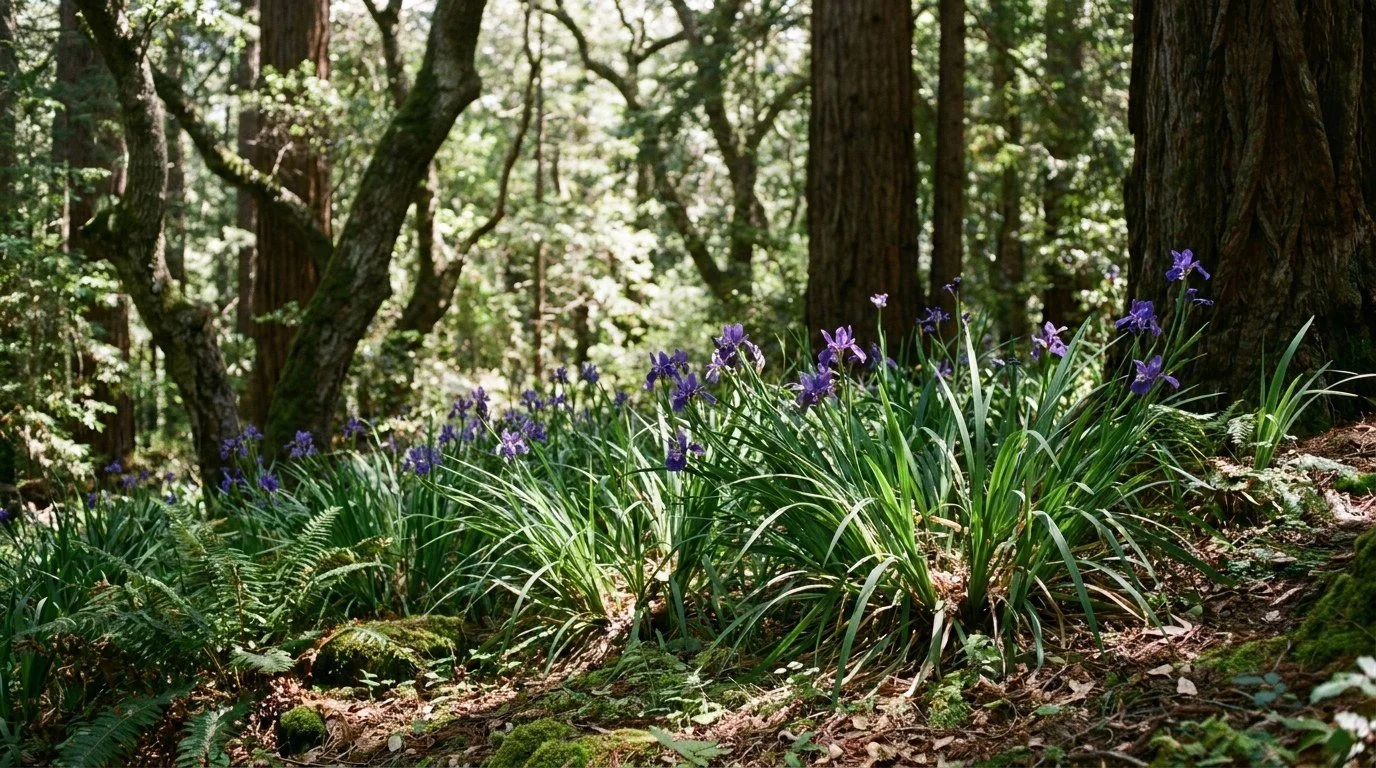
Douglas iris (Iris douglasiana) is an evergreen, clump-forming California native with grassy, sword-shaped leaves and purple-to-blue flowers that open from late winter into early summer (roughly March through June). Unlike most plants on a typical native list, it does not need a hot, sunny slope to be happy. It is one of the few California natives that genuinely thrives in part shade and along the coast, which makes it a quiet workhorse for the kind of foggy, tree-shaded yards that are so common in Santa Cruz County.
If you have struggled to find a tough, good-looking native for the shadier corners of your garden, this is the plant to start with. It is a coastal wildflower at heart, found through coastal Northern and Central California into southern Oregon, often in coastal prairie and at the edges of mixed-evergreen and redwood forest, according to Calflora. That native habitat tells you almost everything about how to grow it here.
Why Should I Grow Douglas Iris in Santa Cruz County?
Most native plant guides skew heavily toward full sun, drought, and dry slopes. Douglas iris is the welcome exception, and that is its biggest selling point for our county. Here is what makes it worth a spot in the garden:
It tolerates shade and coastal fog. It will grow in full sun, part shade, or deep shade near the coast, which gives you a reliable, evergreen native for spots where lavender and ceanothus would sulk.
It naturalizes and fills in. Over a few seasons it forms slow-spreading clumps of grassy foliage that knit together into an attractive, low-care groundcover.
Deer tend to leave it alone. Calscape lists it as deer resistant, and the leaves are bitter and unpalatable. No native is truly deer-proof, but this one rarely gets browsed.
It holds slopes. Its rhizomes and fibrous roots help anchor soil, so it is useful for erosion control on the shaded banks and creekside edges common in the San Lorenzo Valley.
It feeds early pollinators. The spring flowers are an important nectar source for native bees and hummingbirds at a time when little else is blooming.
It is evergreen. The arching, dark green foliage looks good year-round, so the planting never goes bare.
Where Does Douglas Iris Grow Best in Santa Cruz County?
Match the plant to its native habitat and it will mostly take care of itself. In Santa Cruz County that means leaning into the cooler, moister, partly shaded parts of the landscape.
The coastal fog belt is ideal. Along the coast and on the marine-influenced mid-county benchlands, the cool air and overcast mornings keep the foliage fresh and let you grow it in bright spots, even full sun, with little fuss.
The San Lorenzo Valley and redwood edges are another natural fit. Douglas iris is at home in dappled light at the edge of mixed-evergreen and redwood forest, so the part-shade understory of an oak or the bright margin of a redwood grove suits it well. Give it forest-edge light rather than deep, dry shade directly under a redwood canopy.
Be honest about where it struggles. In the hotter, drier inland pockets of the Pajaro Valley and warmer banana-belt sites, full afternoon sun plus dry summer heat is harder on it, so there it wants afternoon shade and a little more moisture. The one thing it dislikes everywhere is soggy soil at the crown in the warm months, which invites rot.
How Do You Plant Douglas Iris?
Fall is the best time to plant, so the roots can settle in during the cool, wet season ahead. Our wet winters and dry summers are exactly the rhythm this plant evolved with.
Pick the spot. Part shade is the safe default countywide. On the immediate coast, full sun is fine; inland, give it afternoon shade.
Mind the drainage. Douglas iris likes heavier soils enriched with organic matter, but it does not want water pooling at the crown. On flat, clay-heavy ground, plant on a slight mound or slope so water drains away.
Set it at the right depth. Plant so the rhizome sits at or just below the soil surface, not buried deep. Burying the crown is a common cause of rot.
Space for spread. Give each plant roughly 18 to 24 inches. The clumps widen slowly and will fill the gaps.
Water in well. Soak after planting, then let winter rains do most of the work. You can find detailed habitat and propagation notes in the USDA NRCS plant guide for the species.
How Do You Care for Douglas Iris?
Once established, this is a genuinely low-maintenance plant. The trick is to honor its seasonal water needs and tidy it occasionally.
Watering. Give it moderate moisture through the winter and spring growing season, then ease off in summer. Near the coast it is quite drought-tolerant once settled. In sunnier or inland spots, an occasional deep soak every two to four weeks keeps the foliage looking fresh, per Calscape. Avoid frequent shallow summer watering right at the crown.
Grooming. The evergreen foliage can look tatty by late summer or after bloom. Pull or trim out the brown leaves to refresh the clump, and remove spent flower stalks. Skip fertilizer; this native rarely needs it and too much encourages floppy growth.
Dividing. Every few years the centers of older clumps can thin out. Divide in fall, lifting the clump and splitting it into sections that each have healthy roots and a few fans of leaves, then replant promptly. This renews vigor and gives you free plants to spread around the garden.
What Plants Grow Well With Douglas Iris?
Because it shares the cool, shaded, woodland-edge niche, Douglas iris pairs naturally with other shade-tolerant natives and companions. A few combinations that work well in our county:
Under coast live oaks, where its grassy clumps read like a natural understory.
With native ferns such as western sword fern, for a layered redwood-edge look.
With coral bells (Heuchera), whose airy flower stems and mounding leaves contrast nicely with the iris foliage.
With wild ginger, redwood sorrel, or yarrow to fill the ground between clumps in part shade.
You can buy many of these as native companion plants if a local nursery is sold out.
What Problems Should I Watch For?
Douglas iris has few serious problems, but two are worth knowing.
Crown and rhizome rot is the main risk, and it almost always traces back to summer water sitting at the crown or poorly drained soil. The fix is prevention: plant high, keep summer watering moderate and away from the base, and do not mulch heavily over the rhizome.
Slugs and snails will chew on tender new growth, especially in damp, shaded gardens after winter rains. Hand-pick in the evening, or use an iron-phosphate bait that is safer around pets and wildlife.
Two honest cautions round out the picture. First, the foliage and rhizomes are toxic if eaten, and the plant is listed as toxic to dogs, cats, and horses, so site it away from pets and grazing animals and keep curious children in mind. Second, it can spread and hybridize. The clumps widen over time, and if you plant several Pacific Coast iris varieties together they will cross and self-sow, so named flower colors will not stay true. In a managed garden this is easy to control by dividing; just plant it where a slowly expanding patch is welcome.
Where Can You Buy Douglas Iris in Santa Cruz County?
Douglas iris is one of the more widely available native irises, so you have good local options. Check native-focused and independent nurseries, the California Native Plant Society Santa Cruz County chapter plant sales, the Arboretum at UC Santa Cruz, and garden centers that carry natives. Spring flower season and fall (the best planting time) are when stock is fullest.
If you cannot find it locally, you can order Douglas iris plants online and plant them out in fall. For larger plantings or slope stabilization, buying a few and dividing them over a couple of seasons is the most economical route.
Frequently Asked Questions About Douglas Iris
Does Douglas iris grow in shade?
Yes. It is one of the few California natives that genuinely tolerates part shade and even deep shade near the coast. It is an excellent choice for the shadier, redwood-edge and oak-understory gardens common in Santa Cruz County, though it also takes full sun in the cool coastal fog belt.
Is Douglas iris evergreen?
Yes. It keeps its grassy, sword-shaped foliage year-round, so the planting never goes bare. The leaves can look tired by late summer, but trimming out the brown ones quickly refreshes the clump.
Is Douglas iris toxic to pets?
The leaves and rhizomes should not be eaten, and the plant is listed as toxic to dogs, cats, and horses. It is not a plant to grow where pets graze or where livestock have access. For most home gardens this is a minor concern, since animals tend to avoid the bitter foliage, but it is worth knowing.
When does Douglas iris bloom?
It flowers from late winter through spring, with most blooms appearing roughly March into early summer depending on your microclimate. The flowers are usually purple to blue, and sometimes cream, lavender, or pale yellow.
How do I divide Douglas iris?
Divide in fall, every few years, when the center of a clump starts to thin. Lift the clump, split it into sections that each have healthy roots and a few leaf fans, and replant promptly at the same shallow depth. This keeps clumps vigorous and gives you new plants for free.
Will Douglas iris spread or take over my garden?
It spreads slowly by widening clumps rather than running aggressively, so it is easy to keep in bounds with occasional dividing. The one thing to know is that planting several Pacific Coast iris varieties together encourages crossing and self-sowing, so flower colors will not stay true to type.
