

Cleveland Sage: A Fragrant California Native to Grow
A few of the product links in this guide are affiliate links. If you buy through one, Ambitious Harvest may earn a small commission at no extra cost to you, which helps keep these guides free. Read our full disclosure.
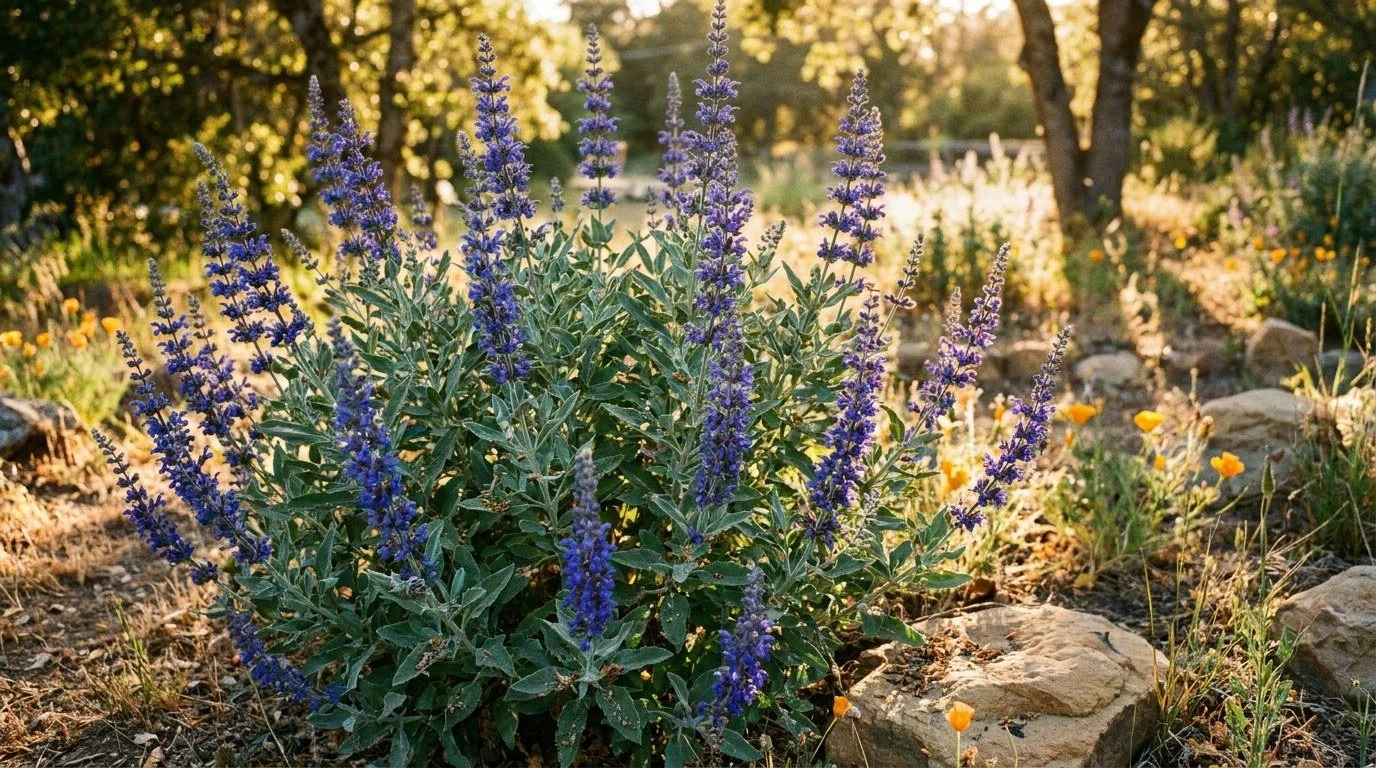
If you have ever brushed past a sage on a hot afternoon and stopped to breathe in the scent, you already understand the appeal of Cleveland sage. Salvia clevelandii is widely considered one of the most fragrant of all California native sages, and its gray-green leaves release a sweet, resinous perfume at the lightest touch. Add tall stems stacked with whorls of blue-purple flowers, a steady parade of bees and hummingbirds, and almost no thirst for water once it settles in, and you have one of the most rewarding shrubs a California gardener can plant.
The popular cultivar 'Winnifred Gilman', a selection introduced through Strybing Arboretum (now the San Francisco Botanical Garden), is the one most often sold in nurseries. It is a little more compact than the species, with reddish stems and especially vivid indigo-blue flowers. Most of the advice below applies to both the straight species and 'Winnifred Gilman'.
Here in Santa Cruz County we need to be clear about one thing up front. Cleveland sage is native to the warmer, drier hills of Southern California, not our cool coastal fog belt. That does not mean you cannot grow it here. It means you have to give it what it expects: full sun, fast drainage, and dry feet. Get those right, and it will thrive.
Why Should I Grow Cleveland Sage in Santa Cruz County?
The first reason is the fragrance. According to Calscape, the California Native Plant Society's plant guide, a single Cleveland sage can perfume an entire garden on a warm summer afternoon. Run your hand along the foliage near a path or seating area and you get a clean, herbal scent that is part true sage, part mint, part something all its own.
The second reason is the show. From late spring into summer, upright stems carry tiered clusters of flowers in rich blue-purple, arranged in distinct whorls like beads stacked along a wand. The blooms are striking in the garden and they make excellent cut flowers. Even after the petals drop, the round seed heads dry to a warm brown and hold their sculptural shape for months, so you can leave them standing or cut them for dried arrangements.
The third reason is wildlife. Cleveland sage is a genuine pollinator magnet, and we cover that in detail below. The fourth reason is toughness. This is a water-wise, low-input shrub that, once established, can carry your garden through a dry California summer with little or no irrigation.
Where Does Cleveland Sage Grow Best in Santa Cruz County?
Our county is really several gardens stacked together, and Cleveland sage has clear preferences among them.
The inland and warmer sites suit it best. Gardens in the Pajaro Valley, the warmer benches of the San Lorenzo Valley, and the sunny inland neighborhoods around Scotts Valley and the foothills give Cleveland sage the heat and the long dry summer it evolved for. The sunny banana-belt pockets along the coast that escape the heaviest fog can also work well.
The coastal fog belt is where you have to be careful. In the cool, humid air close to the ocean, Cleveland sage is more prone to powdery mildew on the leaves and to root rot if the soil stays damp. You can still succeed here, but you need to stack the odds in your favor: choose the hottest, brightest, most open spot you have, plant on a slope or a raised mound, and improve drainage aggressively. A south-facing or west-facing bed against a warm wall, with gravelly soil and good air movement, is far better than a low, shaded, still corner.
The rule of thumb across all our microclimates is simple. The cooler and foggier your site, the more sun and drainage Cleveland sage needs, and the less you should water it.
How Do You Plant Cleveland Sage?
Fall is the ideal planting time in California. Putting plants in the ground from October through early winter lets the roots establish during the rainy season so they are ready for their first dry summer. Spring planting works too, but you will need to water a bit more attentively through that first summer.
Follow these steps for a strong start:
- Pick full sun. Aim for at least six hours of direct sun, and more near the coast. Cleveland sage gets leggy and blooms poorly in shade.
- Prioritize drainage. This is the single most important factor. Cleveland sage wants fast-draining, lean soil. If you have heavy clay, plant on a mound or berm raised six to twelve inches, or improve a wide area with coarse sand or fine gravel rather than rich compost.
- Do not over-amend. Skip the heavy compost and fertilizer. Lean native soil produces a denser, more fragrant, longer-lived plant. Rich soil encourages soft, floppy growth.
- Dig wide, not deep. Set the plant so the top of the root ball sits slightly above the surrounding soil to keep the crown dry. Backfill with native soil and firm it gently.
- Give it room. A mature 'Winnifred Gilman' reaches roughly three to four feet tall and wide, and the straight species can spread wider, so space plants accordingly and keep them off walkways.
- Water in, then ease off. Soak the root ball at planting, then water deeply but infrequently through the first dry season while roots extend.
How Do You Care for Cleveland Sage?
The good news is that an established Cleveland sage barely needs you. The most common way to kill one is kindness in the form of too much water.
The UC Marin Master Gardeners note that sages need well-drained soil and are susceptible to root rot (UC Marin Master Gardeners). In cool, humid coastal air, keeping water off the foliage and watering only at the base further reduces powdery mildew. The takeaway for our county is clear: water at the base, never with sprinklers, and let the soil dry out between waterings.
For watering, Calscape advises limiting summer water to no more than about once a month, and notes that established plants can go without irrigation entirely. In our climate, a deep soak every three to four weeks during the hottest stretch is plenty for the first year or two. After that, many gardens can rely on winter rain alone, especially inland. If you are unsure, water less. A slightly dry Cleveland sage recovers; a waterlogged one rots.
Skip the fertilizer. These plants are adapted to poor soils, and feeding them does more harm than good. A light gravel mulch helps keep the crown dry and the roots cool without trapping moisture against the stems the way bark mulch can.
How and When Should You Prune Cleveland Sage?
Pruning keeps the plant tidy and encourages more bloom, but the cardinal rule is to avoid cutting into old, bare wood. Like many woody salvias, Cleveland sage is slow or unwilling to resprout from leafless old stems, so a hard cutback can leave you with permanent gaps or a dead plant.
Keep it simple:
- Light tip pruning. After the main bloom, or in late fall, trim the stems back by about a third, always cutting above a set of healthy green leaves. This shapes the plant and promotes denser growth.
- Deadheading. You can remove spent flower spikes to encourage a longer bloom season, or leave some standing for the seed heads and the birds.
- Pruning. Calscape's maintenance note for Cleveland sage is short: deadhead to extend the bloom season, and prune in fall if you want to reduce its size.
Never shear a Cleveland sage into a tight ball, and never cut all the way down to bare wood expecting fresh growth.
What Plants Grow Well with Cleveland Sage?
Cleveland sage looks and grows best alongside other sun-loving, drought-tolerant California natives that share its dislike of summer water. Good companions for a low-water, pollinator-friendly bed include:
- California buckwheat (Eriogonum), another pollinator powerhouse with long-lasting flower heads.
- Manzanita and ceanothus (California lilac) for evergreen structure and early bloom.
- California poppy and other natives for color at the sage's feet.
- Deergrass or other native bunchgrasses for movement and contrast.
- Toyon as a taller backbone shrub in a dry native border.
The key is matching water needs. Pair Cleveland sage with thirsty plants and someone always loses. Group it with fellow dry-garden natives and the whole bed thrives on the same lean schedule.
What Pollinators Does Cleveland Sage Attract?
This is where Cleveland sage truly earns its place. Calscape lists it as a draw for native bees, bumblebees, butterflies, and hummingbirds, and the UC Master Gardener Program of Sonoma County highlights ornamental native salvias as outstanding habitat plants for our region (UC Master Gardener Program of Sonoma County). The tubular blue flowers are tailor-made for long bee tongues and hummingbird bills.
Beyond nectar, Cleveland sage serves as a larval host plant for several moth species, which means it feeds caterpillars as well as adult pollinators. The dried seed heads also draw small seed-eating birds like lesser goldfinches in late summer and fall. Plant a single shrub near a patio and you will have a front-row seat to the show all season.
What Are Common Problems with Cleveland Sage?
Most trouble traces back to one of three causes, and all three are preventable.
Root rot from too much water or poor drainage. This is the number one killer, especially in our coastal soils. Root rot pathogens like Phytophthora and Pythium are activated by excess water, so the fix is prevention: fast-draining soil, a raised planting position, base watering only, and a dry summer. If a plant wilts even though the soil is moist, suspect rot rather than thirst.
Powdery mildew in the fog. The white, dusty film that shows up on leaves in cool, humid coastal conditions comes from still, damp air. Improve air circulation by spacing plants generously and pruning for openness, keep water off the foliage, and choose your sunniest, breeziest spot. Removing affected stems helps the plant look fresh through summer.
Legginess and sparse bloom. A Cleveland sage that flops open in the middle or flowers poorly is almost always getting too much shade, too much water, or too much rich soil. More sun, leaner soil, less water, and light annual tip pruning will tighten it up over time.
Where Can You Buy Cleveland Sage in Santa Cruz County?
Cleveland sage and 'Winnifred Gilman' are widely sold at California native plant nurseries, and locally grown plants tend to establish best. Check independent garden centers and native specialty growers around Santa Cruz, Watsonville, and the San Lorenzo Valley, and watch for the seasonal native plant sales hosted by the local chapter of the California Native Plant Society, usually in fall, which is also the best time to plant.
If you cannot find one locally, mail-order native and water-wise nurseries are a reliable backup. You can often find Cleveland sage plants and other drought-tolerant native shrubs shipped to your door. When you order, look specifically for the 'Winnifred Gilman' selection if you want the most compact form and the deepest blue flowers.
Frequently Asked Questions About Cleveland Sage
Is Cleveland sage the same as culinary or garden sage?
No. Cleveland sage (Salvia clevelandii) is an ornamental California native grown for its fragrance, flowers, and pollinator value, not for cooking. The kitchen herb is common sage, Salvia officinalis. While Cleveland sage leaves smell wonderful and are sometimes used to scent rooms or in homemade blends, it is not a substitute for culinary sage in recipes.
Can I really grow Cleveland sage in foggy coastal Santa Cruz?
Yes, with care. It is native to drier Southern California, so in our fog belt it needs the hottest, sunniest, most open spot you have, sharp drainage (ideally a raised mound or slope), and very little summer water. Inland sites like the Pajaro Valley and warmer San Lorenzo Valley benches are easier, but coastal gardens can succeed if you nail sun and drainage.
How much should I water an established Cleveland sage?
Very little. Calscape recommends limiting summer water to about once a month at most, and many established plants need no irrigation at all. Water deeply but rarely, always at the base rather than overhead, and let the soil dry between waterings. Overwatering is the most common cause of failure.
How big does 'Winnifred Gilman' get?
'Winnifred Gilman' typically reaches about three to four feet tall and wide, a bit more compact than the straight species, which can spread wider over time. Give it room to mound out and keep it off paths so you do not have to shear it.
When and how do I prune it?
Prune lightly after bloom or in late fall, cutting stems back by about a third and always above healthy green leaves. Do not cut into bare old wood, because Cleveland sage often will not resprout from it. Deadheading spent spikes can extend the bloom, though leaving some seed heads feeds the birds.
Why are the leaves on my Cleveland sage turning white and dusty?
That is powdery mildew, a fungal issue triggered by cool, humid, still air, which is common in our coastal microclimate. Improve air circulation by spacing and opening up the plant, keep water off the foliage, give it more sun, and remove badly affected stems. A drier, brighter, breezier location prevents most of it.
A Native Worth Growing
Cleveland sage rewards a light touch. Give it sun, sharp drainage, and a dry summer, resist the urge to pamper it, and it returns the favor with months of fragrance, blue-purple bloom, and a garden full of bees and hummingbirds. In a county where water is precious and pollinators need all the help we can offer, that is a generous trade. Plant one this fall in your sunniest, best-draining bed, and let it earn its keep.
