

California Fuchsia: Hummingbird Magnet for SC Gardens
A few of the product links in this guide are affiliate links. If you buy through one, Ambitious Harvest may earn a small commission at no extra cost to you, which helps keep these guides free. Read our full disclosure.
California Fuchsia: The Native That Saves Its Best for Last
By the time late summer rolls around in Santa Cruz County, a lot of the garden has gone quiet. The poppies are long gone, the salvias have slowed, and the hills have faded to gold. Then, just when you think the color is finished for the year, California fuchsia (Epilobium canum, once known as Zauschneria californica) lights up with brilliant scarlet and orange tubular flowers. It blooms from late summer well into fall, often when little else is offering anything at all, and it does it on almost no water.
That timing is the whole point. California fuchsia is one of the most reliable late-season nectar plants you can grow here, and hummingbirds find it fast. If you have ever wanted a tough, drought-tolerant native that earns its keep in the hardest, driest stretch of the year, this is the plant. Here is how to grow it well in our local conditions.
Why Should I Grow California Fuchsia in Santa Cruz County?
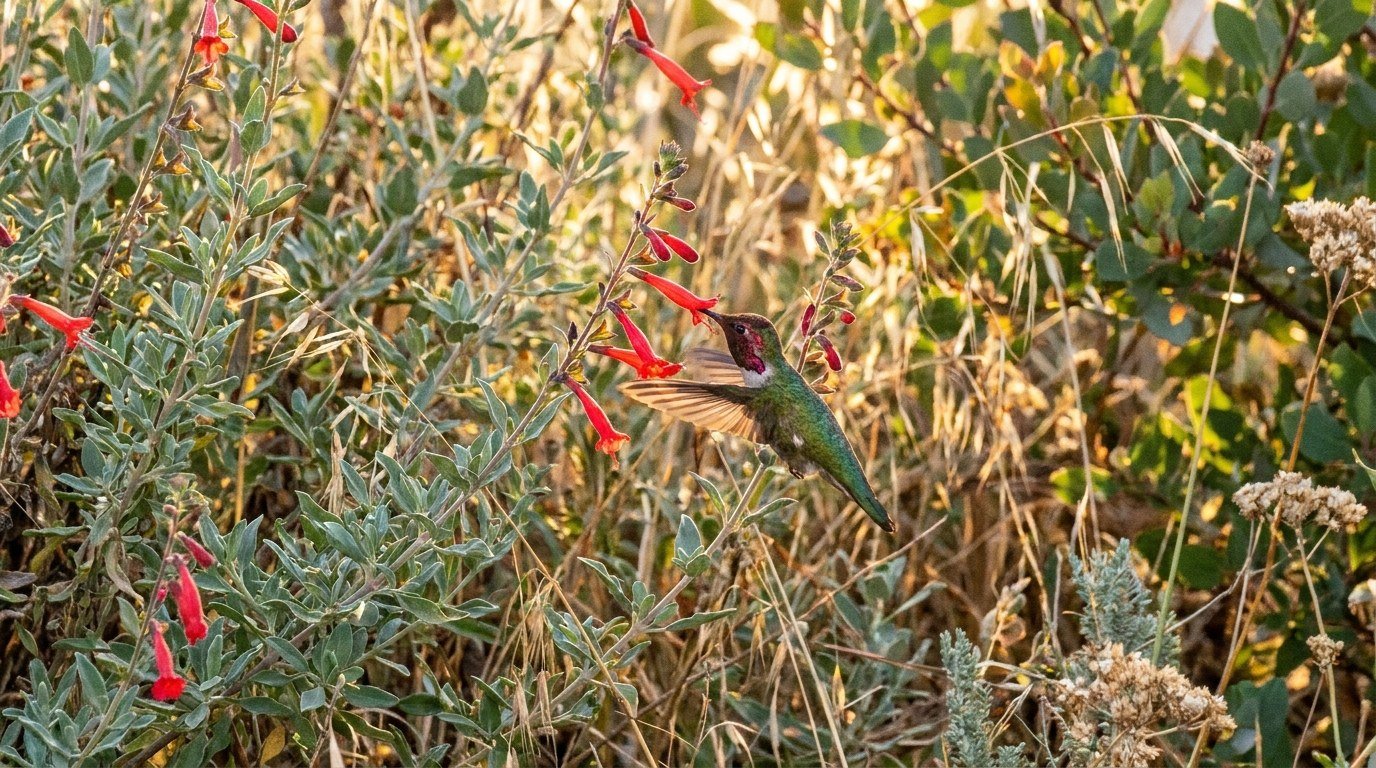
The short answer is hummingbirds and timing. California fuchsia produces narrow, tubular flowers in fiery red and orange that are practically built for a hummingbird's bill. According to the California Native Plant Society's Calscape database, it is often the only native flowering at the height of summer in a given area, which makes it a critical food source when nectar is scarce. The plant is so closely tied to hummingbirds that they are its primary pollinator, though bees and butterflies visit the flowers too, and it is self-compatible enough to set some seed on its own.
It is also genuinely low-trouble once it settles in. California fuchsia is drought-tolerant, takes our lean coastal and hillside soils in stride, and asks for very little summer water. For a county that swings between fog-cooled coast and hot inland valleys, that adaptability matters. You get a long, late bloom, steady wildlife traffic, and a plant that does not punish you for going on vacation in August.
Blooms late summer into fall, when most natives have finished.
A premier nectar source for Anna's and Allen's hummingbirds.
Very low summer water once established.
Thrives in lean, fast-draining soils that defeat fussier plants.
Where Does California Fuchsia Grow Best in Santa Cruz County?
California fuchsia is forgiving, but it rewards a sunny, well-drained spot. Our local microclimates each ask for a slightly different approach.
Coastal fog belt: Along the immediate coast and in the fog-cooled neighborhoods around Santa Cruz and the North Coast, give it the sunniest, most open position you have. Plants here often need no summer water at all once established, since the marine layer keeps things from baking. Just make sure drainage is sharp, because cool soil plus moisture is the one combination California fuchsia dislikes.
San Lorenzo Valley and shaded sites: Up in the redwoods and along the San Lorenzo Valley, deep shade is the limiting factor. California fuchsia tolerates part shade, but bloom drops off quickly without strong light. Look for a clearing, a south-facing slope, or the open edge of a property rather than tucking it under a canopy.
Pajaro Valley and inland: In the warmer inland areas around Watsonville and the Pajaro Valley, full sun is easy, but heavier soils hold water. Plant on a slope or a raised berm, amend for drainage if your soil is clay, and water a bit more often in the first summer. In the warmest inland gardens an occasional deep soak, no more than once a month, can keep it looking lusher through the heat.
Wherever you are, the rule is the same: sun, and soil that drains. California fuchsia evolved on dry banks and rocky slopes, so a spot that mimics that will keep it happy for years.
How Do You Plant California Fuchsia?
The best planting window here is fall, after the first rains begin and the soil has cooled but is still warm enough for roots to settle. Fall planting lets the roots establish over the wet season so the plant is ready to handle its first dry summer. Spring planting also works if you commit to careful first-year watering.
Keep it simple:
Choose the sunniest, best-draining spot you have. A slope or berm is ideal.
Dig the hole the same depth as the nursery pot and slightly wider. Do not plant deep.
Skip rich amendments and heavy compost. California fuchsia prefers lean soil, and rich, moisture-holding beds encourage flop and rot.
Water well at planting, then settle into a deep-but-infrequent rhythm through the first year.
Space plants 2 to 3 feet apart and remember it will spread to fill in.
A light gravel or decomposed-granite mulch suits it better than thick bark or compost, since it keeps the crown dry and echoes the plant's natural habitat.
How Do You Care for California Fuchsia Once It Is Established?
This is where California fuchsia shines: it barely needs you. The single most common way gardeners lose it is overwatering. The UC Master Gardeners note that water needs are low once established, though some varieties bloom a little better with occasional summer water. In our coastal gardens you can often turn the hose off entirely after the first year. Inland, an occasional deep soak during the worst heat is plenty.
Hold off on fertilizer. Lean soil keeps the plant compact and floriferous, while feeding tends to produce soft, leggy growth that sprawls and blooms less. If the plant gets floppy or open in the middle by midsummer, that is usually a sign of too much water, too much shade, or too rich a soil rather than too little food.
How Do I Keep California Fuchsia Tidy and Prune It?
California fuchsia spreads by underground rhizomes and by self-seeding, so its enthusiasm is the trade-off for its toughness. In a wild or naturalized bank, that spreading is a feature. In a tidy border, you will want to manage it.
To keep it in bounds, simply pull or dig the runners and stray seedlings that wander past where you want them each spring. It pulls easily and is not deep-rooted, so this is a low-effort chore, not a battle.
The big annual job is the winter cutback. After the fall flowers fade, cut the whole plant down nearly to the ground in late fall or early winter, right around the onset of the rainy season. This hard prune is what keeps the plant dense, fresh, and full of bloom the following year instead of woody and sparse. A light pinch of the tips in spring encourages even bushier growth. That one cutback, plus occasional runner control, is essentially the entire maintenance calendar.
What Plants Grow Well with California Fuchsia?
California fuchsia pairs naturally with other sun-loving, low-water California natives that share its lean-soil preferences. Good companions for a Santa Cruz County water-wise bed include:
California buckwheat (Eriogonum), which blooms earlier and hands off to the fuchsia's fall show.
Salvias such as hummingbird sage and Cleveland sage, which extend the nectar season.
Deergrass and other native bunchgrasses for structure and contrast.
Manzanita, ceanothus, and toyon as a backbone of evergreen shrubs.
Yarrow and California poppy for a relaxed, meadowy underplanting.
Group it with plants that also want sun and sharp drainage, and you can run the whole bed on the same minimal watering schedule.
What Are the Common Problems With California Fuchsia?
For such a tough plant, the issues are few and almost always tied to too much care rather than too little.
Overwatering and poor drainage. This is the number one killer. Soggy soil, especially in cool coastal conditions, leads to crown rot. When in doubt, water less.
Legginess and flop. Too much shade, rich soil, or extra water produces sprawling, sparse growth. Full sun, lean soil, and the annual winter cutback fix this.
Aggressive spreading. The rhizomes and self-sown seedlings can crowd neighbors. UC Master Gardeners recommend removing unwanted seedlings and shoots to keep it in check. It is easy to pull, so stay a little ahead of it.
Rust. In humid, crowded, or overwatered conditions you may see rust on the foliage. Improve air circulation, cut back on water, and the hard winter prune that removes old growth helps prevent it carrying over.
Notice the pattern: sun, sharp drainage, and restraint with the hose prevent nearly every problem on this list.
Where Can You Buy California Fuchsia in Santa Cruz County?
California fuchsia is widely available at native-focused nurseries, and fall is the best time to shop for it. Locally, check the UC Santa Cruz Arboretum plant sales and the California Native Plant Society Santa Cruz County chapter sales, which often carry several forms. Independent and native nurseries around the Monterey Bay frequently stock it as well, and you can browse current availability through the Calscape nursery finder.
If you are filling a larger bed or ordering online, you can also find California fuchsia plants from mail-order native specialists. Look for named selections like 'UC Hybrid' or 'Everett's Choice' if you want a particular height or flower color, and consider picking up a few native companion plants at the same time to build out a water-wise border.
Frequently Asked Questions About California Fuchsia
How much water does California fuchsia need?
Very little once established. In coastal Santa Cruz County gardens, most plants need no summer water after their first year. In hotter inland spots like the Pajaro Valley, an occasional deep soak no more than once a month is enough. Overwatering is the most common cause of failure, so err on the dry side.
When does California fuchsia bloom?
From late summer into fall, typically peaking from August through October. This late timing is its biggest asset, since it provides color and hummingbird nectar after most other natives have stopped flowering.
Is California fuchsia invasive?
It is not invasive in the harmful, weedy sense, but it does spread by underground rhizomes and self-seeding and can crowd quieter neighbors. In a wild bank that is welcome. In a formal border, pull stray runners and seedlings each spring to keep it where you want it.
When and how should I cut back California fuchsia?
Cut the entire plant nearly to the ground in late fall or early winter, around the start of the rainy season, after the flowers fade. This single hard prune keeps it dense and full of bloom the next year. A light tip pinch in spring encourages bushier growth.
Will California fuchsia grow in the shade under redwoods?
It tolerates part shade but will not bloom well in deep shade, which is common in the San Lorenzo Valley and other redwood areas. Give it the sunniest open spot you have, such as a clearing or a south-facing slope, for the best flower show.
Does California fuchsia really attract hummingbirds?
Yes, reliably. Its tubular scarlet and orange flowers are a favorite of Anna's and Allen's hummingbirds, which are its main pollinator, though bees and butterflies visit as well. Planting a patch in full sun is one of the simplest ways to bring more hummingbirds into a Santa Cruz County garden in late summer.
