

California Buckwheat: A Native Shrub for Santa Cruz
A few of the product links in this guide are affiliate links. If you buy through one, Ambitious Harvest may earn a small commission at no extra cost to you, which helps keep these guides free. As an Amazon Associate, we earn from qualifying purchases. Read our full disclosure.
What Is California Buckwheat (and How Is It Different From Cover-Crop Buckwheat)?
Before anything else, let us clear up a name that trips up almost everyone. When most gardeners type "buckwheat" into a search bar, they are thinking of the fast-growing summer cover crop or the grain used in pancakes and soba noodles. That plant is Fagopyrum esculentum, an annual you sow from seed, let flower, and then cut down or till in to feed the soil. It dies at the first frost and you start over.
California buckwheat is a completely different plant. Eriogonum fasciculatum is a woody, evergreen native shrub that lives for years, grown for its toughness, its long bloom, and its value to wildlife rather than for the kitchen or the compost. The two share only a common name. If you came here looking for a soil-building cover crop, this is not that plant. If you want a low-water native shrub that feeds pollinators from spring into fall, read on.
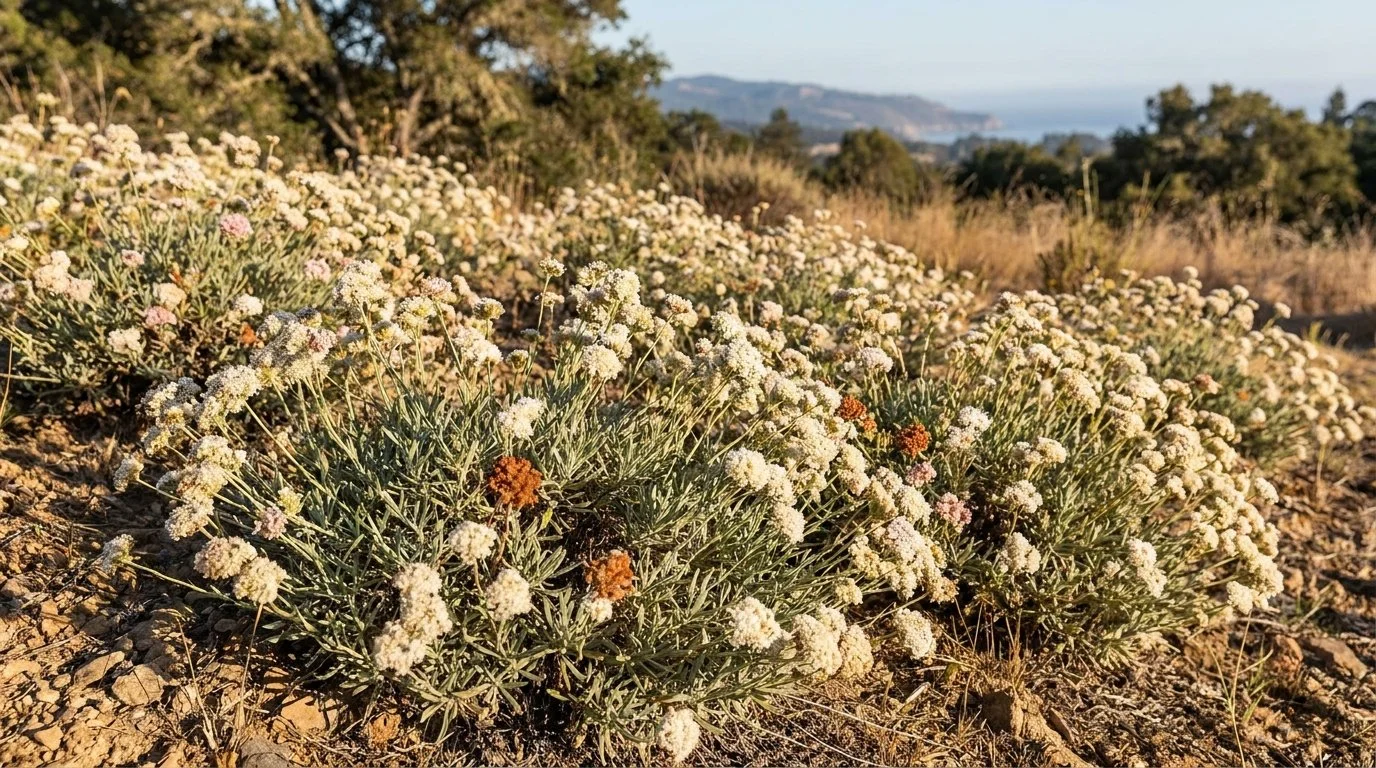
According to Calscape, the California Native Plant Society's plant guide, it is a rounded, mounding shrub ranging from about one foot to seven feet tall and wide depending on the form. Its narrow, dark green leaves stay on the plant year-round. From spring through fall it carries dense, flat-topped clusters of tiny pink and white flowers, and as those flowers age they turn a warm rust-red that holds for months. That rust-red show is the look most people fall for.
Why Should I Grow California Buckwheat in Santa Cruz County?
Start with its status here. California buckwheat is genuinely native to Santa Cruz County, but it is uncommon in the wild locally. Calscape records only around seven county occurrences, and the species is far more abundant in Southern California and our drier inland chaparral than along our cool, foggy coast. That does not make it a poor garden choice. It simply means you are planting a native that is more at home in heat and lean soil than in damp shade, which is worth knowing going in.
The reasons to grow it are easy to list. First is the bloom: few shrubs flower as long, and the slow shift from pink-white to rust-red gives you changing color over many months with zero effort. Second is wildlife value, which is genuinely exceptional and which we cover in detail below. Third is toughness, since this full-sun, very-low-water, evergreen shrub asks for almost nothing once established. Fourth is its deep, anchoring roots, which make it one of the better natives for holding a slope and reducing erosion, something many Santa Cruz County hillside and San Lorenzo Valley properties can put to good use.
Where Does It Grow Best?
Our county is really several gardens stacked together, and California buckwheat has clear preferences among them. The inland valley and warmer foothills suit it best. Gardens in the Pajaro Valley, the sunnier benches of the San Lorenzo Valley, and the warm, open slopes around Scotts Valley give it the heat, sun, and long dry summer it evolved for. Mountain and chaparral sites with good drainage are also a natural fit, since this is a classic chaparral plant.
The coastal fog belt takes more thought. California buckwheat tolerates the coast, but in cool, damp, still air it is happiest in the brightest, most open, best-draining spot you can give it. Choose a sunny slope or raised bed, keep the soil lean and gritty rather than rich and moist, and give it room for air to move. A sunny banana-belt pocket that escapes the heaviest fog makes it easier still.
One sidebar on a related plant. If your garden sits right on a windy coastal bluff, you may be better served by seacliff buckwheat (Eriogonum parvifolium), a closely related native adapted to our sandy bluffs and dunes. Per Calscape, it is a low, sprawling buckwheat built for sand, salt spray, and ocean wind, which makes it the better choice in true coastal-bluff conditions. It is also a host plant for the federally endangered Smith's blue butterfly, with an important caveat we explain in the pollinator section below.
The rule of thumb across our microclimates is simple. The cooler and foggier your site, the more sun and sharp drainage California buckwheat needs, and the less you should water it.
How Do You Plant California Buckwheat?
Fall is the ideal planting time in California. Putting plants in from October through early winter lets the roots establish during the rainy season so they are ready for their first dry summer. Spring planting works too, but you will water more attentively through that first summer.
Follow these steps for a strong start:
Pick full sun. Aim for at least six hours of direct sun. California buckwheat grows open and blooms poorly in shade.
Prioritize drainage. This is the single most important factor. The plant wants fast-draining, lean soil. In heavy clay, plant on a mound or berm raised six to twelve inches, or improve a wide area with coarse sand or fine gravel rather than rich compost.
Do not over-amend. Skip the heavy compost and fertilizer. Lean native soil produces a tougher, longer-lived plant; rich soil encourages soft, floppy growth.
Dig wide, not deep. Set the plant so the top of the root ball sits slightly above the surrounding soil to keep the crown dry, then backfill with native soil and firm it gently.
Give it room. Forms vary from compact mounds to shrubs several feet across, so check the size of the form you bought and keep plants off walkways where they will get sheared.
Water in, then ease off. Soak the root ball at planting, then water deeply but infrequently through the first dry season while the roots extend.
How Do You Care for It?
The good news is that an established California buckwheat barely needs you. The most common way to kill one is kindness in the form of too much water. Once settled in, this is a very-low-water plant: a deep soak every few weeks during the hottest stretch is plenty for the first year or two, and after that many gardens rely on winter rain alone, especially inland. Water at the base rather than overhead, and let the soil dry between waterings. If you are unsure, water less. A slightly dry buckwheat recovers; a waterlogged one in poor soil can rot.
Skip the fertilizer entirely. Like most of our dry-country natives, it is adapted to poor soils, and feeding it does more harm than good. UC Master Gardeners note that the appeal of California natives is that, once established in the right spot, they thrive on local rainfall with minimal care (UC Master Gardeners). A light gravel mulch helps keep the crown dry without trapping moisture against the stems the way bark mulch can.
For pruning, keep it light. After the rust-red flower heads fade, shear the spent blooms back lightly to tidy the plant, always cutting above healthy green growth. Many gardeners leave the dried heads standing into winter for the seed-eating birds, then cut back in late winter before new growth begins. Avoid cutting hard into old, bare wood, which the plant is slow to resprout from.
One of the quiet pleasures of this shrub is how little trouble it brings. It is not toxic, not weedy or invasive, and it has no serious pest or disease problems in a well-drained, sunny spot. The main thing to get right is not the care, but the name, so you start with the actual native shrub rather than the cover crop.
What Pollinators Does California Buckwheat Support?
This is where California buckwheat truly earns its place, and it is no exaggeration to call it a pollinator powerhouse. Calscape documents that this single species supports an extraordinary range of butterflies and moths, listing 105 native butterfly species and 40 native moth species that visit it, plus 63 butterfly and moth species that use it as a larval host, among them the Mormon metalmark, Behr's metalmark, and the great purple hairstreak. That means it feeds caterpillars as well as adults, exactly the full-life-cycle support native insects need.
The long bloom does double duty. Those flat clusters of tiny flowers are easy for short-tongued insects to work, so honeybees and a wide range of native bees forage on them from spring into fall, when many other plants have finished. Later, the dried seed heads feed small seed-eating birds. Plant a buckwheat near a path or patio and you will have a front-row seat all season.
Now the caveat about that endangered butterfly. The seacliff buckwheat mentioned earlier is a documented host plant for the Smith's blue butterfly, a federally endangered species, and it is tempting to plant buckwheat here "for the Smith's blue." But you should know the real picture. According to the Xerces Society and the U.S. Fish and Wildlife Service and the U.S. Fish and Wildlife Service, the Smith's blue's core range is centered on Monterey County, including the Fort Ord and Monterey Bay dunes, and the butterfly is marginal at best in Santa Cruz County. Plant buckwheat for the dozens of bees, birds, and common butterflies it reliably supports here. If a Smith's blue ever turns up, that is a wonderful bonus, not something to count on.
Where Can You Buy It in Santa Cruz County?
California buckwheat and seacliff buckwheat are both sold at California native plant nurseries, and locally grown plants establish best. Check independent garden centers and native specialty growers around Santa Cruz, Watsonville, and the San Lorenzo Valley, and watch for the seasonal native plant sales hosted by the local chapter of the California Native Plant Society, usually in fall, which is also the best time to plant. Buying from a local CNPS sale is the surest way to get the right species, grown from local stock, from people who can tell you which buckwheat fits your site.
If you would rather start from seed, or cannot find plants locally, you can find California buckwheat (Eriogonum fasciculatum) seed by mail order. Double-check the botanical name on the listing so you end up with the native shrub Eriogonum fasciculatum and not cover-crop buckwheat, Fagopyrum esculentum, which is often sold under the same one-word common name.
One more naming note. You may see a plant labeled "Santa Cruz Island buckwheat" (Eriogonum arborescens). Despite the name, it is not a mainland Santa Cruz County native. It is an endemic of the Channel Islands off Southern California, and the "Santa Cruz" refers to Santa Cruz Island, not our county. It is a fine garden plant, but do not buy it expecting a local native.
Frequently Asked Questions About California Buckwheat
Is California buckwheat the same as the buckwheat used for cover crops or pancakes?
No. California buckwheat (Eriogonum fasciculatum) is a woody, evergreen native shrub grown for its flowers and wildlife value. The cover crop and grain buckwheat is Fagopyrum esculentum, an unrelated annual you sow each year and till in or harvest. They share only a common name. If you want to build soil with a quick summer cover crop, you want Fagopyrum, not this shrub.
Is California buckwheat really native to Santa Cruz County?
Yes, but it is uncommon here in the wild. Calscape records only around seven county occurrences, and the species is far more abundant in Southern California and inland chaparral. It still grows well in local gardens, especially in sunny inland and foothill sites, as long as you give it full sun and sharp drainage. It tolerates the coast best in the brightest, most open, best-draining spots.
Will planting buckwheat help the endangered Smith's blue butterfly?
Possibly, but do not count on it. Seacliff buckwheat (Eriogonum parvifolium) is a host plant for the Smith's blue, but per U.S. Fish and Wildlife Service species documentation, the butterfly's core habitat is the Monterey Bay dunes, including Fort Ord, and the Big Sur coastal cliffs, and the Santa Cruz County colonies have been classified as intergrades rather than true Smith's blue. Plant buckwheat for the many bees, birds, and common butterflies it reliably supports here, and treat a Smith's blue as a bonus.
How big does California buckwheat get, and is it hard to grow?
It is a mounding shrub that ranges from about one to seven feet tall and wide depending on the form and conditions, so check the size of the form you buy. It is easy in the right spot: full sun, lean fast-draining soil, very little water once established, and only light pruning. It is not toxic and not weedy, and its deep roots make it excellent for slopes and erosion control.
