

Does Drip Irrigation Waste Water?
This guide contains an affiliate link. Purchases through it may earn Ambitious Harvest a commission at no extra cost to you. As an Amazon Associate, we earn from qualifying purchases. Read our full disclosure.
The sprinklers have finished, but the drip line is still ticking away beside the tomatoes. Does that longer run mean more water is disappearing? Runtime alone can't tell you. Drip applies water at a lower flow rate, so a longer session may deliver less water. It can also waste water if it leaks, runs too long or wets the wrong part of the bed.
Count gallons, not just minutes
A minute on the controller is a measure of time, not volume. To estimate an emitter's delivery, multiply its flow rate in gallons per hour by the fraction of an hour it runs. For example, an emitter actually delivering one gallon per hour supplies half a gallon in 30 minutes. Ten of those emitters supply five gallons together. This is an arithmetic example, not a watering prescription.
That distinction explains why copying a sprinkler's runtime onto a drip zone can leave plants short of water. Extending it without checking the soil can create the opposite problem.
What the evidence supports
UC Master Gardener guidance from Placer County describes drip as an efficient way to deliver controlled water flow close to plants. That potential depends on layout and maintenance, rather than appearing automatically when you buy tubing.
A study summarized by CDFA reported lower water use with drip on Imperial Valley sweet corn compared with furrow irrigation. It supports drip's potential in that setting; it doesn't establish a percentage saving against sprinklers for a Santa Cruz raised bed. The starting system, crop, soil and irrigation management all affect the comparison.
Applying water close to the soil can reduce overspray and wind losses. It doesn't eliminate evaporation or guarantee that every drop stays within reach of roots. UC’s drip guide also emphasizes checking output and keeping emitters from clogging. A quiet system still needs attention.
Make the system fit the bed
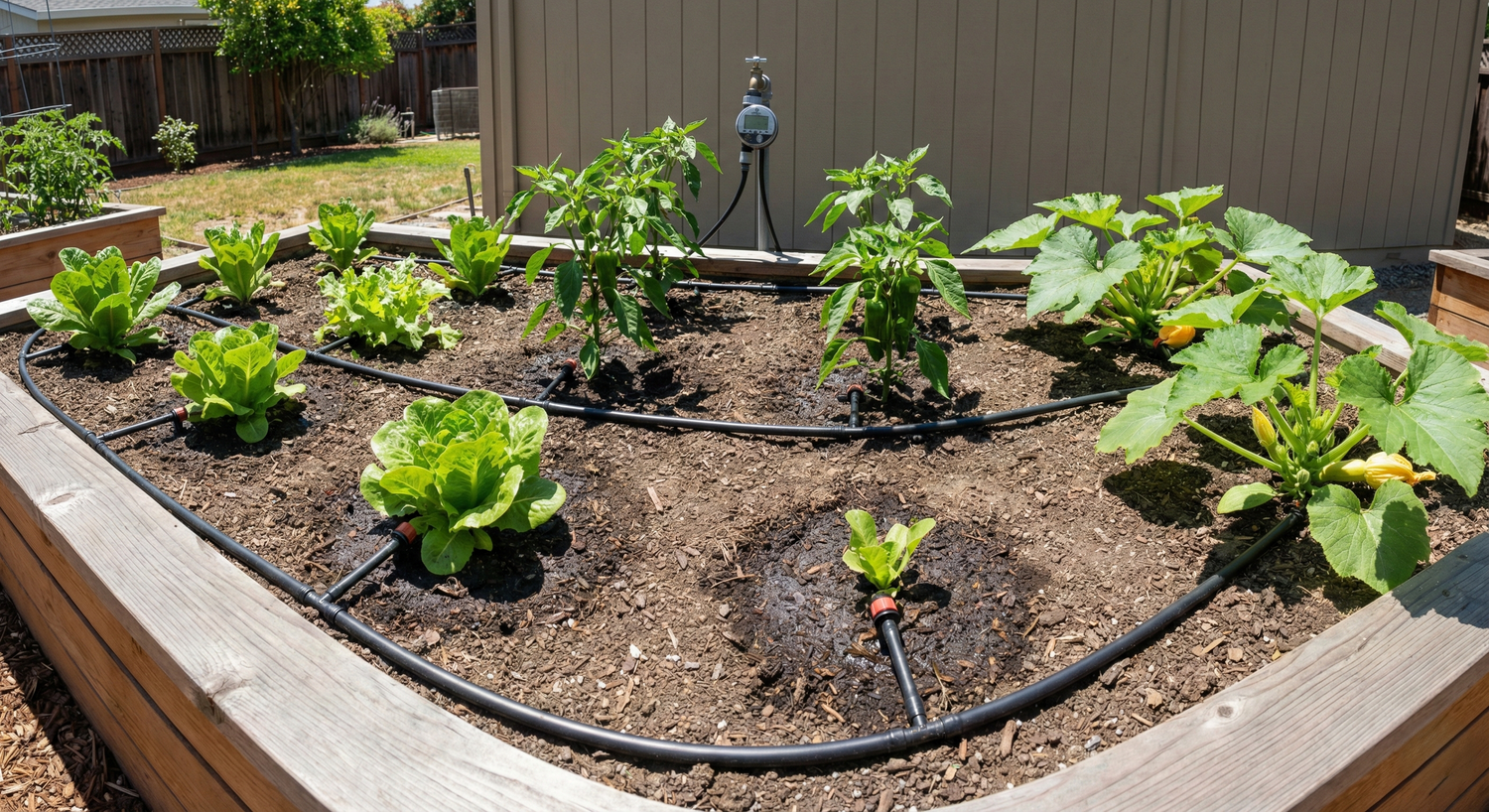
Start with one manageable area and draw where the plants and lines will go. The drip kit linked here is a DIG raised-bed kit. Check its coverage, fittings and water-supply requirements against your plan instead of assuming a kit contains everything your garden needs. Prices and installation time depend on the setup.
Group plants that need similar watering on the same zone. A vegetable bed and an established dry-garden shrub may need different treatment even when they sit beside each other. Keep conventional sprinklers and drip on separate controls so you can schedule each appropriately.
Then watch a watering cycle:
- Look for leaking connections, disconnected tubing and blocked emitters.
- Check that water reaches the intended root area, including plants between outlets.
- After water has soaked in, check below the surface at several locations. A small damp patch on top doesn't tell you the whole story.
- If water pools or runs away, adjust the application and investigate the layout and soil rather than simply adding more minutes.
A timer makes a tested schedule easier to repeat. Revisit it as plants grow and conditions change. A sunny, exposed bed and a sheltered coastal bed can dry at different rates; neither needs a schedule borrowed from an entire town.
This week: Run one zone while you're there to observe it. Fix a leak or dry spot, then record the runtime and what the soil feels like afterward. Those notes give you a useful starting point for the next adjustment.
Find free gardening resources at Your Garden Toolkit.
Frequently asked questions
Does drip irrigation waste water because it runs so long?
Not necessarily. Flow rate and runtime together determine delivery. Check total output and where the water goes before deciding whether the session is too long.
How efficient is drip compared with sprinklers?
UC Master Gardener Program of Sonoma County describes drip's high delivery efficiency. Treat that as a reason to design and maintain it well, rather than a guaranteed reduction in your bill. Leaks, poor placement and overwatering can erase the benefit.
How long and how often should I run drip in summer?
Use the plants' needs, soil moisture and actual emitter output to set the schedule. Check whether the root area is being wetted adequately and whether it needs water again before the next run. There is no single summer runtime for every bed.
How much does a basic drip setup cost?
Measure the bed and price the complete parts list, including any needed filter, pressure regulator, backflow protection, timer and connectors. Check compatibility and local water-supplier requirements before installation. A kit's shelf price may not be the finished system cost.
