

Growing Malabar Spinach in Santa Cruz County: Summer Greens When Spinach Bolts
A few of the product links in this guide are affiliate links. If you buy through one, Ambitious Harvest may earn a small commission at no extra cost to you, which helps keep these guides free. We only point to gear we would use in our own Santa Cruz garden. As an Amazon Associate, we earn from qualifying purchases. Read our full disclosure.
Regular spinach gives up when summer arrives. The lengthening days and warming temperatures trigger bolting, and suddenly your spinach patch is all flowers and bitter leaves. This is where Malabar spinach earns its place.
Malabar spinach (Basella alba and Basella rubra) isn't related to true spinach at all. It's a tropical vine from South Asia that just happens to produce thick, mild leaves useful in similar ways. While regular spinach struggles once temperatures rise, Malabar spinach thrives, producing abundant greens through the hottest months.
For Santa Cruz County gardeners, Malabar spinach offers a solution to the summer greens gap. It's more vigorous in warm inland areas than on the foggy coast, but with the right placement, it can provide leafy harvests from June through October when true spinach is off the menu.
What Is Malabar Spinach?
Not Actually Spinach
Malabar spinach belongs to the Basellaceae family, completely unrelated to true spinach (Spinacia oleracea). The "spinach" name comes from similar culinary uses, not botanical kinship.
What you're actually growing is a vigorous climbing vine native to tropical Asia and Africa. In its native habitat, it's a perennial that can grow year-round. In Santa Cruz County, we grow it as a warm-season annual, planting after frost danger passes and harvesting until cool fall weather slows growth.
Two Varieties
Green Malabar (Basella alba): Glossy green leaves and stems. Generally considered slightly milder in flavor.
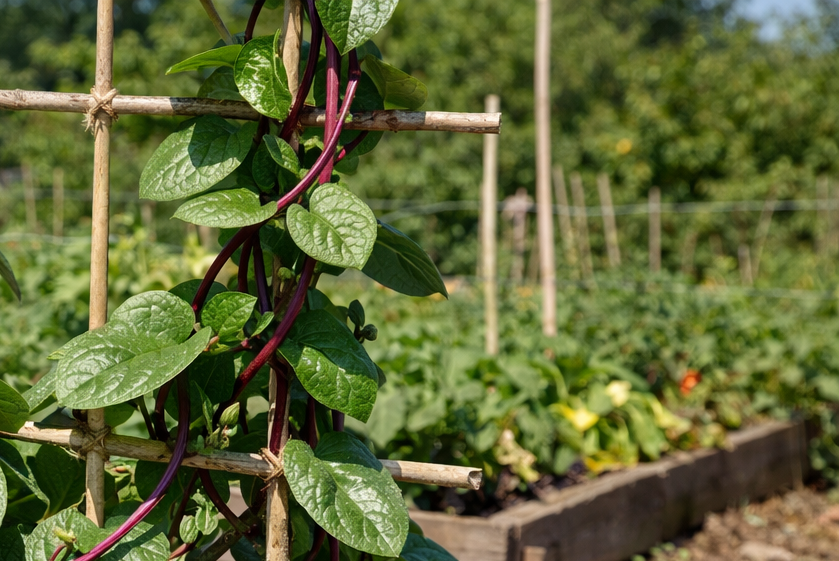
Red Malabar (Basella rubra): Striking reddish-purple stems and veins with green leaves. Same flavor and uses as green, but adds ornamental appeal. The color fades when cooked.
Both varieties are equally productive and useful. Choose based on aesthetic preference or grow both.
The Leaves
Malabar spinach leaves are thick, fleshy, and somewhat succulent. They're larger than spinach leaves (typically 3 to 6 inches) with a glossy surface. The texture is meatier than true spinach.
The flavor is mild and slightly earthy, similar to spinach but with a subtle citrus undertone. Raw leaves have a slight mucilaginous (slippery) quality that becomes more pronounced when cooked. This texture is familiar in Asian and African cuisines where Malabar spinach is traditional, but may be unfamiliar to some Western palates.
The Plant
Malabar spinach is a vigorous vine that can grow 6 to 10 feet or more in a single season. The vines climb by twining around supports, much like pole beans.
The plant is quite ornamental, especially the red-stemmed variety. Attractive enough for front-yard vegetable gardens or mixed ornamental borders.
In late summer, plants produce small white or pink flowers followed by dark purple berries. The berries are edible but not particularly tasty; their main use is for saving seeds or as a natural dye (the juice stains intensely).
Can You Grow Malabar Spinach in Santa Cruz County?
Climate Considerations
Malabar spinach is tropical and heat-loving. This creates a nuanced situation in Santa Cruz County:
Heat requirement: Malabar spinach grows fastest when temperatures exceed 80 degrees Fahrenheit and struggles below 60 degrees. It won't grow at all in cold weather and is killed by frost.
Our reality: Coastal Santa Cruz County rarely sees 80-degree temperatures, and summer fog keeps things cooler still. Inland areas are warmer and better suited to this heat-lover.
This doesn't mean coastal gardeners can't grow Malabar spinach, but expectations should be realistic. Growth will be slower and total harvest smaller than in genuinely hot climates.
Microclimate Guidance
Inland areas (Scotts Valley, Watsonville, sunny mountain exposures):
Good conditions for Malabar spinach. Warmer summer temperatures support vigorous growth. Plant in full sun and provide sturdy support for vigorous vines.
Coastal areas (Aptos, Capitola, Live Oak, Santa Cruz):
Malabar spinach will grow but more slowly. Choose your warmest microclimate: south-facing, against a heat-absorbing wall, protected from fog and ocean breezes. Consider black plastic mulch to warm soil. Growth may be modest compared to descriptions in gardening books written for warmer climates.
Under redwoods:
Not recommended. Malabar spinach needs full sun and warmth. The cool, shaded conditions under redwoods won't support good growth.
Alternative Heat-Tolerant Greens
If Malabar spinach struggles in your coastal microclimate, consider these alternatives for summer greens:
New Zealand spinach: Another not-actually-spinach that tolerates heat and spreads as a groundcover. Even more heat-tolerant than Malabar and may perform better in our cooler coastal areas.
Swiss chard: Handles summer heat better than true spinach and grows reliably throughout Santa Cruz County.
Perpetual spinach: A chard variety with spinach-like flavor that doesn't bolt.
How Do You Start Malabar Spinach?
From Seed
Malabar spinach seeds have hard coats that benefit from pre-treatment.
Scarification: Soak seeds in warm water for 24 hours before planting. This softens the seed coat and improves germination.
When to start: Start seeds indoors 6 to 8 weeks before your planned transplant date, or direct sow after soil has thoroughly warmed (65+ degrees Fahrenheit).
Germination requirements:
Temperature: 70 to 85 degrees Fahrenheit. Use a seedling heat mat.
Depth: 1/4 to 1/2 inch deep.
Time: 10 to 21 days. Germination can be slow and irregular.
Seedling care: Grow in warm conditions with bright light. Seedlings grow slowly at first, then accelerate as temperatures warm.
From Cuttings
Malabar spinach roots readily from stem cuttings, making propagation easy once you have established plants.
Take 4 to 6 inch cuttings from growing tips. Remove lower leaves and place in water or directly in moist potting mix. Roots develop in 1 to 2 weeks. Cuttings establish quickly and can begin producing harvestable leaves within a month.
This is useful for expanding your planting mid-season or sharing with other gardeners.
Finding Seeds or Starts
Baker Creek Heirloom Seeds carries both green and red Malabar spinach.
Kitazawa Seed Company specializes in Asian vegetables including Malabar spinach.
Territorial Seed Company stocks Malabar spinach seasonally.
For starts, check Asian groceries (sometimes sold as potted herbs) or specialty vendors at farmers markets.
How Should You Plant and Grow Malabar Spinach?
When to Plant
Wait until soil has warmed and nighttime temperatures are consistently above 50 degrees Fahrenheit. In most of Santa Cruz County, this means late May or early June.
Don't rush. Malabar spinach planted in cold soil sits dormant and may rot. A later planting in warm soil quickly catches up to and surpasses early plantings in cold conditions.
Support Systems
Malabar spinach is a climbing vine that needs something to climb. Plan your support before planting.
Options:
Trellis: A simple wooden or bamboo trellis 6 to 8 feet tall works well. Space vertical supports 12 to 18 inches apart.
Fence: An existing fence provides ready-made support. Just plant at the base.
Teepee: Bamboo poles tied at the top, teepee-style, similar to bean supports.
Netting: Sturdy garden netting or string attached to a frame.
Arbor: Malabar spinach makes an attractive, edible covering for arbors and pergolas.
The support needs to be sturdy. A healthy Malabar spinach vine in warm conditions becomes heavy with foliage.
Planting
Space plants 12 to 18 inches apart at the base of your support structure. If growing multiple rows, space rows 3 to 4 feet apart to allow access for harvesting.
Amend planting holes with compost. Malabar spinach grows more vigorously in fertile soil.
Water thoroughly after planting and apply mulch to retain moisture and moderate soil temperature.
Watering
Malabar spinach is more drought-tolerant than true spinach once established, but produces better with consistent moisture.
Water when the top inch of soil is dry. Deep watering 2 to 3 times per week is typical during warm weather.
The thick, succulent leaves store water, so plants don't wilt as quickly as thin-leaved greens. But don't mistake drought tolerance for drought preference; consistent water produces more and better-quality leaves.
Fertilizing
As a leafy green, Malabar spinach benefits from nitrogen.
Side-dress with compost or apply balanced organic fertilizer every 3 to 4 weeks during the growing season. Fish emulsion or kelp applied every 2 weeks provides steady nutrition.
Well-fed plants produce larger, more tender leaves and more vigorous growth.
Managing Growth
Malabar spinach can become rampant in ideal conditions. You may need to:
Train vines: Guide vines onto support structures. Left alone, they may sprawl along the ground or climb into unintended areas.
Pinch growing tips: Pinching the growing tips encourages branching and more leaf production. This also keeps plants from becoming excessively tall.
Harvest regularly: Frequent harvesting controls size while encouraging continued production.
When and How Should You Harvest Malabar Spinach?
When to Start
Begin harvesting when plants are well-established with vigorous growth, typically 55 to 70 days after planting. Don't harvest heavily from young plants; let them develop good root systems first.
What to Harvest
Young leaves: The most tender with the mildest flavor. Harvest leaves up to 6 inches long.
Growing tips: The tender tips (top 4 to 6 inches of vine) are excellent and harvesting them encourages branching.
Older leaves: Usable but tougher and with more pronounced mucilaginous quality. Better for cooking than raw use.
How to Harvest
Cut or pinch leaves and stem tips. Harvest regularly (every few days to weekly) to encourage continued production.
Like other cut-and-come-again greens, the more you harvest, the more the plant produces. A few well-maintained plants can provide greens all summer.
Yield Expectations
In warm conditions, a single Malabar spinach plant can produce pounds of leaves over the season. In Santa Cruz County's cooler conditions, expect more modest but still worthwhile yields.
How Do You Cook with Malabar Spinach?
The Mucilaginous Factor
Let's address this directly: Malabar spinach has a mucilaginous texture, similar to okra. When cut or cooked, the leaves release a somewhat slippery, gel-like substance.
This texture is prized in many cuisines. It's what makes Malabar spinach excellent for thickening soups and stews. But it can be off-putting if unexpected.
To minimize mucilaginous texture:
Use leaves raw in salads (less pronounced than when cooked)
Cook quickly at high heat (stir-frying)
Avoid long simmering (which releases more mucilage)
Combine with acidic ingredients (tomatoes, lemon juice)
To embrace it:
Add to soups and stews for natural thickening
Use in curries where the texture is traditional
Combine with other greens to moderate the effect
Raw Uses
Young, tender leaves work in salads. The flavor is mild and the mucilaginous quality is minimal when raw. The thick leaves add substance that lettuce lacks.
Use as wraps for fillings, similar to lettuce cups.
Cooked Uses
Stir-fry: Quick cooking at high heat with garlic, ginger, and soy sauce. Add the leaves last and cook just until wilted.
Soups and stews: Add to soups in the last 10 to 15 minutes of cooking. The leaves contribute body and natural thickening.
Curries: Traditional in South Asian cuisines. The texture works well in coconut milk-based dishes.
Sautéed: Quick sauté with olive oil, garlic, and lemon. Cook just until wilted.
Substitute for spinach: Use anywhere spinach is called for in cooked dishes, keeping the texture difference in mind.
Nutritional Value
Malabar spinach is nutritionally dense: high in vitamins A and C, rich in iron and calcium, and a good source of protein for a leafy green. The thick leaves contain more substance than delicate greens.
What Are the Most Common Problems?
Slow Growth
The most likely issue in Santa Cruz County. Cool temperatures, fog, and insufficient heat slow Malabar spinach growth.
Solutions: Choose the warmest microclimate. Use black plastic mulch to warm soil. Plant against south-facing walls. Accept that growth will be slower than in tropical climates.
No Climbing
Young plants sometimes need guidance to find their support.
Solution: Gently wrap young vines around the support structure. Once they start climbing, they continue on their own.
Pests
Malabar spinach is relatively pest-free. Occasional issues include:
Aphids: Check undersides of leaves, especially on new growth. Spray off with water or use insecticidal soap.
Slugs and snails: Can damage young plants. Use standard slug controls (traps, barriers, hand-picking).
Spider mites: More common in hot, dry conditions. Increase humidity around plants; spray undersides of leaves with water.
Flowering and Seeding
In late summer, plants may begin flowering and setting seed, which can reduce leaf production.
Options: Pinch off flowers to extend leaf harvest, or allow some plants to set seed for saving. The berries that form after flowering are deeply pigmented and will stain hands and clothing.
How Do You Save Malabar Spinach Seeds?
Malabar spinach seeds are easy to save.
Allow berries to ripen fully on the vine (they turn dark purple/black). Collect ripe berries, squish to extract seeds, and wash off the pulp. Dry seeds thoroughly before storage.
Seeds remain viable for 2 to 3 years with proper storage.
Local Resources
Seeds
Baker Creek Heirloom Seeds , Both varieties
Kitazawa Seed Company , Asian vegetable specialist
Territorial Seed Company , Seasonal availability
Information
UC Master Gardeners of Monterey Bay , Can answer questions about growing unusual vegetables locally
If Malabar spinach is too heat-dependent for your microclimate, consider growing traditional spinach during the cool season instead. Understanding your local microclimate will help you decide which approach works best.
Frequently Asked Questions About Growing Malabar Spinach
Is Malabar spinach actually spinach?
No. Malabar spinach (Basella alba/rubra) is completely unrelated to true spinach (Spinacia oleracea). The name comes from similar culinary uses: mild-flavored leaves used in similar ways. Malabar spinach is a tropical vine in a different plant family, but it fills the same role in the kitchen as true spinach, especially in summer when true spinach has bolted.
Will Malabar spinach grow well in foggy coastal Santa Cruz?
It will grow, but more slowly than in warmer areas. Malabar spinach is heat-loving and grows fastest when temperatures exceed 80 degrees. Coastal fog and cool temperatures limit growth. Choose your warmest microclimate and have realistic expectations. Inland areas of Santa Cruz County are better suited to this tropical vine.
What is the slimy texture and can I avoid it?
Malabar spinach contains mucilage, a gel-like substance similar to what's in okra. This texture is traditional and valued in many cuisines for thickening soups and stews. To minimize it, use leaves raw, cook quickly at high heat, or combine with acidic ingredients. To embrace it, add to soups and curries where natural thickening is welcome.
How do I get Malabar spinach to climb?
Provide a support structure (trellis, fence, netting, or poles) at planting time. Young vines may need initial guidance: gently wrap them around the support. Once climbing begins, they continue on their own. Without support, vines sprawl along the ground, which is workable but less space-efficient.
Can I grow Malabar spinach in a container?
Yes, with a large container (at least 5 gallons) and a support structure. Use a trellis inserted into the pot or position the container where vines can climb a nearby fence or wall. Container plants need more frequent watering than in-ground plants. Yields will be lower than in-ground growing.
When should I plant Malabar spinach in Santa Cruz County?
Wait until soil has warmed and nighttime temperatures are consistently above 50 degrees, typically late May or early June. Don't rush; Malabar spinach won't grow in cold conditions and may rot in cold, wet soil. Later planting in warm soil produces faster growth than early planting in cool soil.
How do I preserve Malabar spinach for winter use?
Blanch leaves briefly (30 seconds to 1 minute), plunge into ice water, squeeze dry, and freeze in portions. The texture changes somewhat but remains suitable for cooked dishes. Fresh storage is limited: leaves keep only a few days refrigerated before wilting.
Is the red variety different from the green?
The red variety (Basella rubra) has attractive purple-red stems and veins but otherwise similar flavor and growth habit. The color is ornamental and adds visual interest to gardens and plates. However, the red color fades when cooked. Both varieties are equally productive and nutritious.
Free Gardening Resources
Getting Started
Beginner Garden Setup Checklist , Complete setup guide to start your garden right.
Know Your Microclimate Worksheet , Understand your local conditions before planting.
Planning & Timing
Seasonal Planting Calendar , Avoid timing mistakes with month-by-month guidance.
Vegetables by Season Chart , Quick reference for what to plant and when in Santa Cruz County.
Seasonal Garden Tasks Checklist , Stay on track with monthly garden maintenance tasks.
Growing Guides
Companion Planting Guide , Learn which plants grow better together and which to keep apart.
Tomato Variety Selector , Find the best tomato varieties for your Santa Cruz microclimate.
Problem Solving
Garden Troubleshooting Guide , Diagnose common problems before they become disasters.
Gopher Control Guide , Humane and effective strategies for managing gophers in your garden.
Santa Cruz-Specific Guides
Water-Wise Gardening Guide , Conserve water while keeping your garden thriving through dry seasons.
Can Malabar Spinach Solve Your Summer Greens Gap?
When true spinach bolts in early summer, Malabar spinach takes over. It won't produce as vigorously in Santa Cruz County as it would in tropical climates, but it fills a gap no other green quite fills: nutritious, productive leafy greens through the warmest months.
Try it in your warmest spot this summer. Learn to work with its unique texture. You may find it becomes a regular part of your warm-season garden, providing fresh greens long after spinach has given up.
