

Hugelkultur in Santa Cruz County: Building Mound Beds with Buried Wood
A few of the product links in this guide are affiliate links. If you buy through one, Ambitious Harvest may earn a small commission at no extra cost to you, which helps keep these guides free. We only point to gear we would use in our own Santa Cruz garden. As an Amazon Associate, we earn from qualifying purchases. Read our full disclosure.
Hugelkultur (pronounced HOO-gul-culture) is a German word meaning "hill culture" or "mound culture." The technique is simple: bury wood under soil to create a raised bed that holds water, builds fertility, and improves over many years.
The concept has gained popularity among permaculture gardeners, but it's not new. Farmers in Eastern Europe have used variations of this method for centuries, and the basic principle of burying organic matter to improve soil is ancient.
For Santa Cruz County gardeners, hugelkultur offers a practical solution to several common challenges: what to do with storm debris and pruning waste, how to improve drainage in clay soil or water retention in sandy soil, and how to reduce irrigation needs during our long dry season. Our water-wise gardening guide covers additional strategies for conserving water in California gardens.
But hugelkultur isn't magic, and the enthusiastic claims you'll find online don't always match reality. Understanding what hugelkultur actually does (and doesn't do) helps you decide if it's right for your garden and set realistic expectations for the first few years.
UC Master Gardeners have explored hugelkultur as a soil-building technique in several California demonstration gardens. According to the UC Master Gardeners of El Dorado County, hugelkultur recreates a forest floor environment that generates healthy, nutrient-rich soil where none exists. The UC Master Gardeners of San Mateo and San Francisco Counties describe it as a practical way to turn woody debris into long-term garden fertility.
What Does Hugelkultur Actually Do?
Water Retention (Eventually)
The primary benefit of hugelkultur is water retention. Decomposing wood acts like a sponge, absorbing water during rain or irrigation and releasing it slowly to plant roots during dry periods.
However, this benefit takes time to develop. Fresh wood actually repels water initially. As fungi begin breaking down the wood over the first one to three years, the wood becomes increasingly absorbent. A mature hugelkultur bed (3 to 5+ years old) can hold remarkable amounts of water, significantly reducing irrigation needs.
The UC Master Gardeners note that organic amendments mixed into soil improve structure and increase water-holding capacity, reducing the overall need to irrigate. This aligns with the long-term benefits of wood decomposition in hugelkultur beds.
Realistic expectation: Don't expect dramatic water savings in year one. Plan to water normally the first season or two while the wood begins decomposing.
Soil Building Over Time
As the buried wood decomposes, it creates humus (stable organic matter), improves soil structure, and releases nutrients. For more on building healthy garden soil, see our California garden soil amendments guide. This process takes years to complete, with most of the benefit coming after the first 2 to 3 years.
The decomposition also creates air pockets and channels in the soil that improve drainage and root penetration. Over time, earthworms and beneficial soil organisms colonize the bed, further improving soil quality.
Nitrogen Considerations in Early Years
Here's the catch that enthusiastic hugelkultur advocates often downplay: decomposing wood temporarily ties up nitrogen.
UC research in Assessing Compost Quality for Agriculture (ANR Publication 8514) explains that soil microbes use carbon for energy while immobilizing nitrogen for their own needs, so material with a high carbon-to-nitrogen ratio, like wood, ties nitrogen up temporarily until those microbes die and release it. UC ANR Garden Notes puts the working balance at roughly 30 parts carbon to 1 part nitrogen, and recommends adding nitrogen when you dig high-carbon material into soil at planting time.
Wood-decomposing fungi need nitrogen to break down carbon-rich material. In the first year or two, they'll take nitrogen from the surrounding soil, potentially causing nitrogen deficiency in your plants (yellowing leaves, stunted growth).
Solutions for the nitrogen issue:
Add extra nitrogen when building your bed. Incorporate grass clippings, coffee grounds, or well-rotted manure into the layers above the wood. Our guide to innovative composting techniques covers more ways to create nitrogen-rich amendments.
Plant nitrogen-fixing crops the first year. Beans, peas, and fava beans add nitrogen to the soil while the bed matures.
Expect to supplement with nitrogen fertilizer (fish emulsion, blood meal) during the first growing season or two.
Use well-rotted wood rather than fresh wood. Wood that's already partially decomposed causes less nitrogen drawdown.
Heat Generation
Decomposing organic matter generates heat, which can warm soil in early spring and extend the growing season. This benefit is most noticeable in the first year or two when decomposition is most active, and in larger beds with substantial organic matter.
In Santa Cruz County's mild climate, this heat generation is a modest benefit rather than a dramatic one. It won't turn your coastal garden into a tropical zone, but it may help warm-season crops get established a few weeks earlier.
When Does Hugelkultur Make Sense in Santa Cruz County?
Good Candidates for Hugelkultur
You have wood to dispose of: After storm damage, tree removal, or major pruning, hugelkultur lets you use that material productively instead of hauling it away or burning it.
Your soil needs help: Clay soil that drains poorly or sandy soil that drains too fast both benefit from the organic matter and improved structure that hugelkultur creates over time.
You're building permanent beds: Hugelkultur is a long-term investment. The beds improve for 10 to 20 years as the wood fully decomposes. This makes sense for permanent garden beds, not areas you might reconfigure.
You want to reduce irrigation eventually: Once mature, hugelkultur beds need significantly less watering. This is valuable during Santa Cruz County's dry summers, especially in areas without reliable irrigation.
You have space for larger beds: Hugelkultur works best at scale. A 4-foot-wide, 2-foot-tall mound has enough mass to retain meaningful moisture. Smaller beds may not justify the effort.
When to Consider Alternatives
You need immediate productivity: If you want a productive vegetable bed this season, a standard raised bed with quality soil will outperform a new hugelkultur bed. Consider hugelkultur for long-term plantings while using conventional beds for annual vegetables.
You have limited space: In small gardens, the space taken by hugelkultur mounds (which slope outward from the center) may not be worthwhile. Traditional raised beds use space more efficiently.
Fire safety is a concern: In high fire risk areas, stockpiling wood and building exposed mounds requires careful consideration. More on this below.
You're renting or may move soon: Hugelkultur is a 10+ year investment. If you won't be around to see the long-term benefits, focus on faster-return improvements.
How Should You Choose Wood for Hugelkultur in Santa Cruz County?
The type of wood you use significantly affects how well your hugelkultur bed performs.
Best Wood Choices
Alders, willows, and poplars: Soft woods that decompose quickly, getting the system productive faster.
Fruit tree prunings: Apple, pear, plum, and other deciduous fruit wood breaks down at a moderate rate and doesn't contain problematic compounds.
Oaks: Abundant in Santa Cruz County. Oak decomposes slowly but creates excellent long-term structure. Mix with faster-decomposing wood for balance.
Untreated lumber scraps: If you have untreated dimensional lumber, it can go in the pile.
Wood to Use with Caution
Redwood and cedar: Decompose very slowly due to natural preservatives. They'll work eventually but may take 10+ years to break down significantly. Use only if you're building for the very long term and have nothing else.
Black walnut: Contains juglone, a compound toxic to many plants including tomatoes, peppers, and potatoes. Avoid entirely or limit to the very bottom of deep beds where roots won't reach for years.
Eucalyptus: Contains oils that can inhibit plant growth. If you have eucalyptus to dispose of, bury it deeply and add extra soil layers above. Or compost it separately for 1 to 2 years before using.
Wood to Avoid
Pressure-treated lumber: Contains chemicals that can leach into soil and plants. Never use in food gardens.
Painted or stained wood: May contain lead or other toxic compounds.
Plywood and particle board: Contains glues and chemicals.
Diseased wood: If the tree died from a disease, composting that wood in your vegetable garden may spread the problem.
Wood Size and Condition
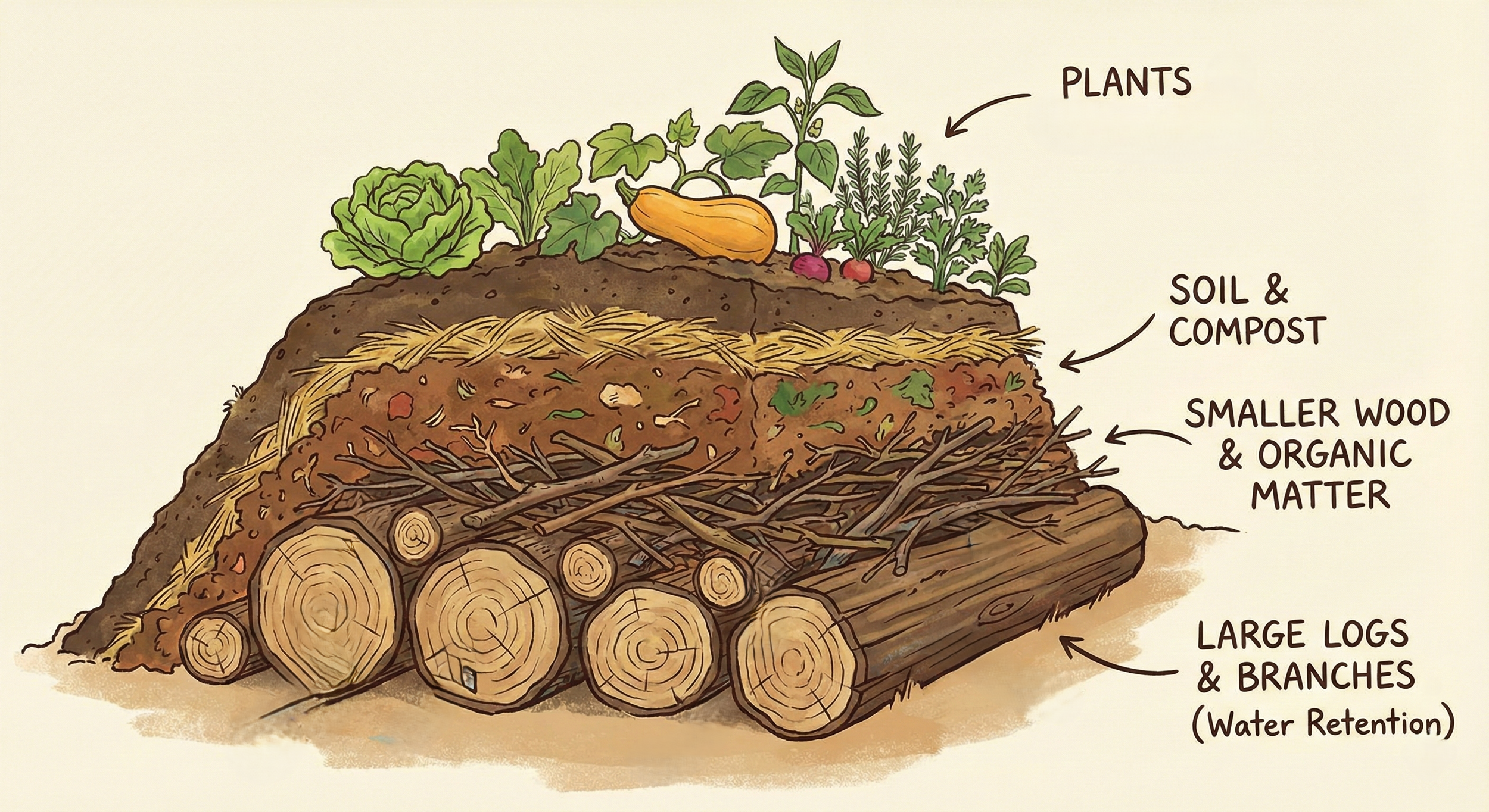
Mix sizes: Large logs (6+ inches diameter) at the bottom decompose slowly and create long-term structure. Branches and twigs in upper layers decompose faster and provide quicker benefits.
Rotten wood is good: Partially decomposed wood is actually ideal. It's already colonized by decomposing fungi, absorbs water better, and causes less nitrogen drawdown than fresh wood.
Avoid very fresh wood: Wood cut within the past few months is the most problematic for nitrogen drawdown. If using fresh wood, compensate with extra nitrogen-rich materials.
How Do You Build a Hugelkultur Bed?
Choose Your Location
Sun: Full sun for vegetables (6+ hours). Partial shade works for leafy greens and some herbs.
Drainage: Avoid low spots where water pools. Hugelkultur beds need good underlying drainage, even though the bed itself retains moisture.
Access: You'll need to reach all sides for planting and harvesting. Leave 2 to 3 foot paths around the bed.
Orientation: Running beds north-south provides more even sun exposure. East-west orientation creates a warmer south-facing slope and cooler north-facing slope, which can be useful for planting different crops on each side.
Gather Materials
For a 4-foot-wide by 8-foot-long bed, you'll need approximately:
Large logs and branches: 15 to 20 cubic feet (a pickup truck load or two of prunings)
Smaller branches and twigs: 5 to 10 cubic feet
Nitrogen-rich material: 3 to 4 cubic feet of grass clippings, coffee grounds, or well-rotted manure
Leaves or straw: 2 to 3 cubic feet
Compost: 5 to 6 cubic feet
Topsoil: 10 to 15 cubic feet
Building Steps
Step 1: Prepare the site
Remove grass or weeds from the bed area. You can leave them in place (they'll decompose), but removing them gives a cleaner start.
Optionally, dig a shallow trench (6 to 12 inches deep) to sink the first layer of logs. This creates a more stable base and positions the bed lower, which may be preferable for aesthetics. However, trenching isn't required.
Step 2: Lay the log base
Arrange the largest logs in your bed area. Pack them fairly tightly, filling major gaps with smaller pieces. This layer forms the long-term water reservoir and structure.
If using very large logs (12+ inches diameter), consider splitting them. Split wood has more surface area exposed and decomposes faster than round logs.
Step 3: Add branches and fill gaps
Pile branches, smaller logs, and woody debris on top of the log layer. Fill spaces between logs with twigs and smaller material. The goal is creating a mound roughly 18 to 24 inches tall at this stage.
Step 4: Add nitrogen-rich materials
Layer grass clippings, coffee grounds, or well-rotted manure over and between the woody materials. This is critical for reducing nitrogen drawdown. Be generous.
Step 5: Add leaves, straw, or other browns
A layer of leaves, straw, or other dry organic matter helps fill remaining gaps and provides carbon for the decomposition process.
Step 6: Water thoroughly
Soak the entire mound. The wood needs to absorb water to begin decomposing. Use a sprinkler and let it run for an hour or more. The mound should be thoroughly wet, not just damp on the surface.
Step 7: Add compost layer
Cover the mound with 2 to 3 inches of compost. This provides an immediate growing medium and introduces beneficial microorganisms.
Step 8: Add topsoil layer
Finish with 4 to 6 inches of quality topsoil or garden soil. This is your planting medium for the first few years.
The finished mound should be 2 to 3 feet tall at the center, sloping down to ground level at the edges.
What to Expect
Settling: The mound will settle significantly as materials decompose. Expect to lose 30 to 50 percent of the height over the first 2 to 3 years. You can add more compost and soil annually to maintain height.
Surface shape: The mound creates slopes. Plant accordingly: put moisture-loving plants lower on the slopes, drought-tolerant plants at the top.
When and How Should You Plant Your Hugelkultur Bed?
First Year Strategies
Plant nitrogen-fixers: Beans, peas, and fava beans add nitrogen while the bed is most nitrogen-hungry. They'll perform well even if other crops struggle.
Expect some challenges: Leafy greens and other nitrogen-demanding crops may show deficiency symptoms (yellowing, slow growth) in year one. Supplement with fish emulsion or other nitrogen sources as needed.
Plant densely: Dense plantings shade soil, reduce evaporation, and help the bed mature faster.
Choose deep-rooted crops with caution: Until the bed has settled (year two or three), deep-rooted crops like tomatoes may encounter unstable planting conditions.
Best Crops for Year One
Beans (bush and pole), peas, fava beans: Ideal. They add nitrogen and perform well.
Squash and pumpkins: Their vigorous root systems tolerate the variable conditions. They benefit from the warmth of decomposing matter.
Potatoes: Work well planted directly into the sides of the mound.
Herbs: Mediterranean herbs (rosemary, sage, thyme) tolerate the drier mound top.
Years Two and Beyond
As the bed matures, you can grow anything you'd grow in a regular garden bed. The improved moisture retention and soil structure will particularly benefit water-hungry crops like tomatoes, peppers, and cucumbers.
What Are the Fire Safety Considerations?
In Santa Cruz County's fire-prone areas, anything involving wood and dry organic matter requires careful thought.
Building phase: If you're stockpiling wood for a hugelkultur project, store it away from structures (30+ feet recommended). Complete the build promptly rather than leaving exposed wood piles through fire season.
Finished beds: Once covered with soil, hugelkultur beds aren't significantly more flammable than regular garden beds. The buried wood is protected from ignition by the soil covering.
Location: In Zone 0 or Zone 1 (within 30 feet of structures), ensure the soil covering is complete and maintained. Don't leave exposed wood or dry organic matter on the surface during fire season.
Maintenance: Keep the soil layer intact. If settling exposes wood or dry material, add more soil before fire season.
How Does Hugelkultur Perform in Santa Cruz County Microclimates?
Coastal Areas (Aptos, Capitola, Live Oak)
The moderate moisture from fog reduces irrigation needs (learn more about Santa Cruz microclimates and how they shape your garden) even before the hugelkultur benefits mature. However, cool temperatures slow decomposition, so beds take longer to reach full productivity. The heat generated by decomposition is particularly valuable here for warming soil in early spring.
Sunny Mountain Areas (Boulder Creek, Ben Lomond)
These conditions closely match traditional hugelkultur climates: warm, with distinct wet and dry seasons. Beds mature faster due to warmer temperatures accelerating decomposition. The water retention benefits are especially valuable during hot, dry summers.
Under Redwoods
The abundant material from redwood forests is tempting, but redwood decomposes very slowly. If building hugelkultur under redwoods, use deciduous wood for the main structure if possible. The shaded, moist conditions slow decomposition but also reduce irrigation needs.
Watsonville and Pajaro Valley
Warm conditions and agricultural soil create good hugelkultur environments. The flat terrain works well for standard mound construction.
How Should You Maintain Hugelkultur Beds?
Annual Tasks
Add compost: Top-dress with 1 to 2 inches of compost each fall or spring. This feeds the decomposition process and replenishes the planting layer as the bed settles.
Add soil as needed: If settling exposes wood or creates uneven surfaces, add topsoil to maintain a consistent planting depth.
Refresh nitrogen sources: Continue adding nitrogen-rich materials (grass clippings, coffee grounds) for the first 3 to 4 years.
Long-Term Care
After 3 to 5 years, hugelkultur beds become largely self-maintaining. The wood is partially decomposed, nitrogen drawdown is no longer an issue, and the bed functions like a very rich raised bed.
Continue adding compost annually to maintain fertility. Over 10 to 20 years, the wood fully decomposes, leaving behind exceptionally rich, well-structured soil.
Frequently Asked Questions About Hugelkultur
How long until my hugelkultur bed is fully productive?
Year one is typically a transition year with modest productivity and some nitrogen-related challenges. Years two and three show significant improvement as the wood begins absorbing water and nitrogen levels stabilize. By years four and five, most hugelkultur beds are outperforming conventional raised beds. The beds continue improving for 10 to 20 years as wood fully decomposes into rich humus.
Can I build hugelkultur beds with just branches and twigs (no large logs)?
Yes, this creates what's sometimes called "twig hugelkultur" and works well on a smaller scale. Without large logs, the bed decomposes faster (3 to 5 years instead of 10 to 20), provides quicker benefits, but doesn't last as long. This is a good option if you don't have access to large wood or want faster results.
Do I need to dig a trench first?
No, though it's an option. Building directly on the ground (called "lasagna hugelkultur") works fine. Trenching creates a lower profile bed and may improve stability, but it's more work. Choose based on your preference and how visible you want the mound to be.
What about gophers tunneling into the wood?
Gophers generally don't tunnel into solid wood, but they may burrow through the soil layers on top. If gophers are a problem, you can line the bottom of your trench (if digging one) with hardware cloth before adding wood. However, many hugelkultur gardeners find gophers aren't significantly worse than in regular beds.
Can I use wood chips instead of logs and branches?
Wood chips work but behave differently. They decompose faster (1 to 3 years), cause more severe nitrogen drawdown initially, and don't provide the same long-term water reservoir as larger wood. If using chips, mix them with larger pieces and add extra nitrogen-rich material.
How much will the bed settle?
Expect 30 to 50 percent settling in the first 2 to 3 years, then slower settling as decomposition slows. A 3-foot-tall mound may be 18 to 24 inches tall after three years. Plan to add soil and compost periodically to maintain usable height.
Is hugelkultur worth the effort compared to regular raised beds?
It depends on your situation. If you have wood to dispose of, poor native soil, and a long-term perspective, hugelkultur offers significant benefits. If you need immediate productivity, have limited space, or prefer predictable conditions, conventional raised beds may be simpler. Many gardeners do both: hugelkultur for permanent plantings and perennials, raised beds for annual vegetables.
Can I grow perennials and fruit trees on hugelkultur beds?
Yes, and this may be hugelkultur's ideal use. Perennial plantings benefit from the long-term moisture retention and soil improvement without the year-one challenges of nitrogen competition with annual vegetables. Berry bushes, fruit trees, and perennial herbs all do well on mature hugelkultur beds.
Free Gardening Resources
Beginner Garden Setup Checklist: Compare hugelkultur with other garden bed options for your situation.
Water-Wise Gardening Guide: More strategies for reducing irrigation needs in Santa Cruz County.
Seasonal Tasks Checklist: Year-round maintenance including when to top-dress beds with compost.
Know Your Microclimate Worksheet: Understand your local conditions to predict how hugelkultur will perform.
What Is the Long Game?
Hugelkultur isn't a quick fix. It's a long-term investment in soil building that pays dividends over years and decades.
If you have wood to dispose of, patience for a multi-year project, and a spot where permanent beds make sense, hugelkultur rewards that commitment. A ten-year-old hugelkultur bed is a remarkable thing: rich, moist soil teeming with life, requiring minimal inputs, producing abundant harvests.
Start small. Try one bed. Give it three years before judging the results. You may find that this ancient technique transforms how you think about building soil and designing gardens.
