

Cedar vs. Redwood Raised Beds: Which Lasts Longer?
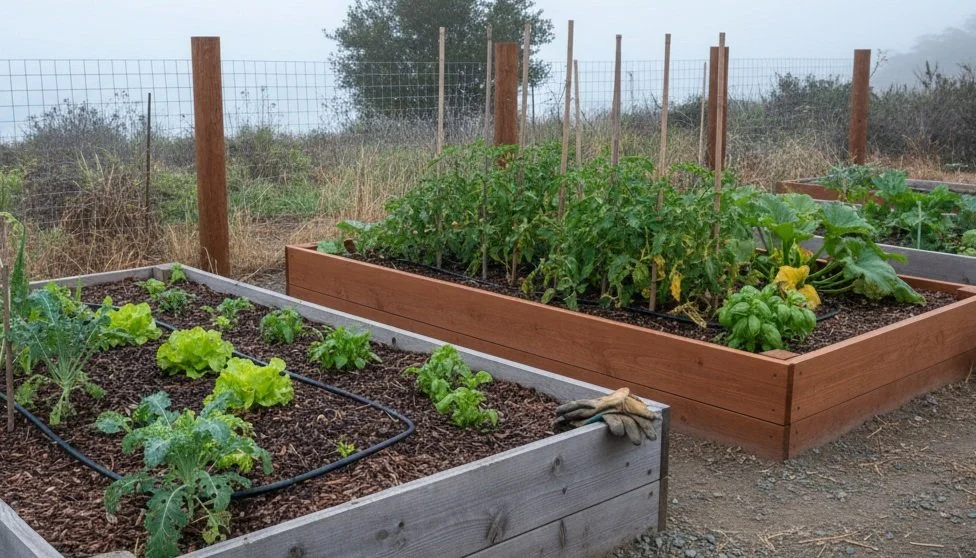
Redwood lasts longer than cedar for raised beds in most conditions. The heartwood of old-growth redwood is naturally resistant to decay and insects and can last 15-20 years in ground contact, compared to 10-15 years for western red cedar. According to the Forest Products Laboratory (a USDA research facility), redwood and cedar are both rated "resistant" to "very resistant" for decay, but redwood's denser heartwood gives it an edge in wet soil conditions. For Santa Cruz gardeners, where raised beds stay moist through winter rains, that difference matters.
When to Choose Cedar
Cedar is the better choice when budget matters and you want a lighter wood that is still naturally rot-resistant. Western red cedar is widely available at Home Depot, Lowes, and local lumber yards, and it is typically $10-20 less per board than redwood. If you are building multiple beds on a tight budget, that savings adds up quickly.
Cedar also has a slight advantage if you need to move or reconfigure beds in the future. It is about 25% lighter than redwood, which makes a difference when you are wrestling 8-foot boards into position. The lighter color of cedar (golden to honey tones) weathers to a pleasant silver gray within a year or two, which some gardeners prefer. Just be sure to buy heartwood, not sapwood. Cedar sapwood (the lighter, outer portion of the board) has almost no rot resistance and will break down in 3-5 years.
When to Choose Redwood
Redwood is the premium choice for raised beds you plan to keep for 15 years or more. Living in Santa Cruz County gives you an advantage here: redwood is a local wood, sourced from mills in the Santa Cruz Mountains and nearby counties. Buying from a local lumber yard like Scarborough Lumber or San Lorenzo Lumber often means better prices and better quality than big-box stores.
The key is to buy redwood heartwood (the dark reddish-brown interior wood), not the lighter sapwood that is sometimes labeled "construction heart" or "con heart." True heartwood redwood in 2x12 dimensions is the gold standard for raised beds on the Central Coast. It handles the wet-dry cycle of our Mediterranean climate exceptionally well, and it does not need any stain, sealant, or liner. The wood does the work on its own.
The Bottom Line for Santa Cruz Gardeners
If you are building raised beds in Santa Cruz County, redwood is the local, long-lasting choice. It is readily available from area lumber yards, it outlasts cedar by 5 or more years in our wet-winter climate, and it supports local forestry. Expect to pay a bit more per board, but the longer lifespan makes the per-year cost comparable to cedar. Buy 2x12 heartwood boards, use stainless steel or coated deck screws, and skip any liner or treatment. Your beds will last well over a decade.
This week: Call your nearest local lumber yard and ask for redwood heartwood in 2x12x8 dimensions. Compare the price to cedar at the big-box store. The difference is often smaller than you expect, especially when you factor in the longer lifespan.
For more on building and filling raised beds, check out our free Raised Bed Guide at Your Garden Toolkit.
Keep Reading
- Metal Raised Beds vs. Wood Raised Beds: Which Is Worth the Money?
- Bagged Soil vs. Bulk Soil: Which Is the Better Deal for Raised Beds?
- Square Foot Gardening vs. Row Gardening: Which Uses Space Better?
- Worm Castings vs. Finished Compost: Which Is the Better Soil Amendment?
Frequently Asked Questions
Does cedar or redwood last longer for a raised bed?
Redwood generally lasts longer thanks to its denser heartwood, roughly 15 to 20 years in ground contact compared with about 10 to 15 years for cedar. Both are rated resistant to very resistant to decay.
Should I buy heartwood or is sapwood fine?
Always choose heartwood for either species. Sapwood breaks down quickly, in as little as three to five years, which undoes the durability advantage you are paying for.
Which wood makes the most sense for a Santa Cruz garden?
Redwood is a strong choice locally because it is regionally sourced, handles our wet-winter Mediterranean climate well, and supports local forestry. Cedar is a good option when budget is the main concern, and neither needs a sealant or liner when you use heartwood.
