

Western Redbud: Spring Color for SC County Gardens
A few of the product links in this guide are affiliate links. If you buy through one, Ambitious Harvest may earn a small commission at no extra cost to you, which helps keep these guides free. Read our full disclosure.
Why Should I Grow Western Redbud in Santa Cruz County?
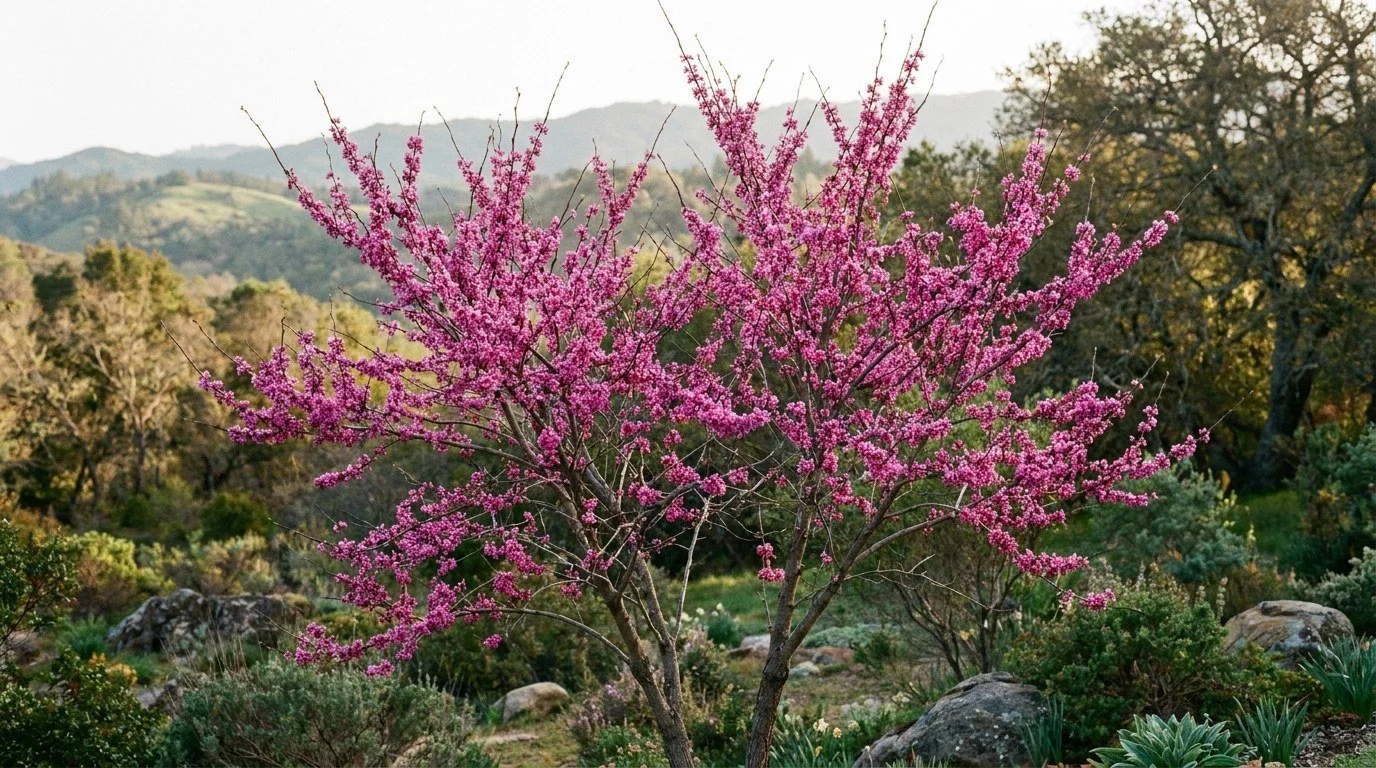
The first reason is the spring show. Before most of the garden has woken up, redbud lights up with clusters of small, pea-shaped magenta flowers along every branch and even on the older trunks. According to the UC Master Gardeners of Placer County, those blossoms appear in early spring before the leaves, which is exactly why the color reads so strongly against bare wood.
The second reason is wildlife. Because it blooms early, redbud is a valuable nectar and pollen source for native bees when little else is flowering. The Calscape profile notes it supports native bees such as leafcutter bees, along with honeybees and early butterflies. Later in the year the seed pods and structure add interest for birds and the winter garden.
The third reason is scale. A lot of native trees get large. Redbud stays small, usually 10 to 18 feet tall and 10 to 15 feet wide, with a naturally multi-trunk, rounded form. That makes it one of the few native trees that actually fits a typical Santa Cruz County backyard, a side garden, or a spot near a patio where you want spring color without a future shading problem.
Where Does Western Redbud Grow Best in Santa Cruz County?
Western redbud is a foothill and mountain native. Calflora lists it growing on canyon slopes in foothill woodland and chaparral across California, which tells you what it likes: sun, drainage, and a real winter.
That habitat note matters here because Santa Cruz County is not one climate, it is several. Here is how it does in our microclimates:
Inland and the warmer valleys (Pajaro Valley, the inland edges, sunny ridgelines): This is where redbud is happiest. More sun, warmer summers, and cooler winter nights give it the chill it wants and reward you with the heaviest bloom.
San Lorenzo Valley and other inland canyon pockets: Often a strong choice. These spots can collect cold air on winter nights, which redbud appreciates, as long as the planting site itself gets good sun and drains well.
The coastal fog belt and the mild "banana belt" near the water: This is the catch. Redbud needs a genuinely cool winter to set a good flower display. In the mildest, foggiest, frost-free pockets close to the coast you can expect a weaker, patchier bloom, even though the plant itself will usually grow fine.
If you garden in the fog belt and want to try it anyway, give it the sunniest, most open spot you have, and treat a lighter bloom as the likely trade-off rather than a surprise.
How Do You Plant Western Redbud?
When to Plant
Fall through early winter is the best window, the same as for most California natives. Planting in the cool, rainy season lets the roots establish before the first dry summer, so the tree heads into its first hot stretch already settled. You can plant in late winter or spring too, but be ready to water more attentively through that first summer.
Choosing a Location
Pick a spot with full sun to part shade and, above all, good drainage. Redbud tolerates a wide range of soils, including clay, and Calscape notes it adapts to fast, medium, or slow drainage. What it does not tolerate is sitting in soggy ground. A slope, a raised area, or simply soil that drains after rain is ideal. Give it room for its eventual 10-to-15-foot spread so you are not fighting its natural shape later.
Planting Steps
Dig a hole as deep as the root ball and about twice as wide, loosening the sides.
Set the plant so the top of the root ball sits slightly above the surrounding soil, never buried deeper than it grew in the pot.
Backfill with the native soil. Skip rich amendments and fertilizer; natives prefer lean ground.
Water deeply to settle the soil, then add a couple of inches of mulch, kept back from the trunk.
Through the first fall and winter, let the rain do the work, and water only if there is a long dry gap.
How Do You Care for and Prune Western Redbud?
Once established, redbud is genuinely low-maintenance, which is much of its appeal. The two things to get right are water and shape.
Water: This is the most common way people harm a redbud. After the first year or two, it needs very little summer irrigation. Calscape rates its established water needs as very low to moderate, with no more than about one deep soak a week in summer at the absolute most, and many gardeners give far less. Frequent shallow watering, or a sprinkler zone that keeps the root zone wet, is a recipe for problems.
Pruning and shaping: Redbud naturally wants to be a multi-trunk small tree or large shrub. You can lean into that and let it form a graceful clump, or you can prune to a few main trunks for a more open, tree-like look. Do any structural pruning in late winter while it is dormant and bare, before bud break, so you can see the framework and so you are not cutting off the spring show. Remove dead or crossing wood, then step back. It does not need much.
What Plants Grow Well With Western Redbud?
Redbud pairs beautifully with other sun-loving, low-water California natives that share its preference for good drainage and a dry summer. The California Native Plant Society highlights redbud among small native trees well suited to home landscapes, and it sits comfortably in a native, water-wise bed.
Manzanita and ceanothus (California lilac) for evergreen structure and a blue-flowering counterpoint to the magenta.
California poppy, yarrow, and sages (Salvia) at its feet for color and more pollinator support.
Deergrass and other native bunchgrasses for texture and movement.
Toyon nearby as a taller evergreen native, so the bed has interest after the redbud drops its leaves.
You can find native redbuds and companions through specialty growers, and many gardeners also start with nursery-grown western redbud trees when a local source is sold out.
What Are the Most Common Problems With Western Redbud?
Redbud has few serious pests in our area, but a handful of issues come up often enough to name:
Overwatering. By far the most frequent mistake. Too much summer water, or poor drainage, stresses the roots and invites rot. If a redbud is struggling in an irrigated lawn or bed, water is usually the culprit.
Poor or sparse bloom. In the mildest coastal and fog-belt spots, a lack of winter chill leads to a thin flower display. The plant is healthy; the climate is just too mild to trigger a heavy bloom. Too much shade reduces flowering as well.
Occasional branch dieback. Redbuds can shed an individual branch or trunk now and then, sometimes from canker or stress. Prune the affected wood back to healthy growth during the dormant season and keep the plant lean and unirrigated.
Leaf nibbling. Leafcutter bees take neat half-circles out of the leaves. This is harmless and is actually a sign you are supporting native pollinators, so leave it be.
Where Can You Buy Western Redbud in Santa Cruz County?
Western redbud is a popular native, so it shows up at California native plant nurseries and well-stocked local garden centers, especially in the fall planting season. Because it is deciduous, the best buying window is fall through winter, when nurseries carry it and the planting timing is ideal.
For a current, location-based list of growers that stock it, the Calscape nursery finder from the California Native Plant Society is the most reliable tool, since stock changes season to season. Local CNPS chapter plant sales are another excellent source for healthy, regionally appropriate plants. If you cannot find one locally, container-grown native redbud trees can be shipped, though buying locally and planting in fall gives you the best establishment.
Frequently Asked Questions About Western Redbud
How big does Western redbud get?
In most home gardens it grows 10 to 18 feet tall and 10 to 15 feet wide, as a multi-trunk small tree or large shrub. Some sources list it reaching up to about 20 feet in ideal conditions, but it stays small enough for a typical backyard.
Will Western redbud bloom well on the Santa Cruz coast?
Often not as well as inland. Redbud needs a genuinely cool winter to set a heavy flower display. In the mild, foggy coastal pockets it usually grows fine but blooms more sparsely. It performs best in the warmer, sunnier inland valleys and canyon spots that get real winter chill.
How much water does it need?
Very little once established. After the first year or two it gets by on rainfall in many spots, with at most an occasional deep summer soak. Overwatering is the most common cause of a sick redbud, so err on the dry side.
Is Western redbud deer resistant?
It is generally considered low on the deer-preference list, though no plant is truly deer-proof in a hungry year. Young plants are the most vulnerable, so protect them while they establish if deer pressure is high on your property.
Is Western redbud native and is it invasive?
It is native to California's foothills and mountains and is not invasive. Calflora lists it as a California native of foothill woodland and chaparral, so planting it supports local ecology rather than disrupting it.
Why are there half-circles cut out of the leaves?
That is the work of native leafcutter bees, which use the leaf pieces to line their nests. It does not hurt the tree, and it means your redbud is doing exactly the pollinator-supporting job you planted it for.
A Small Tree Worth the Wait
Western redbud is patient, low-water, and quietly generous: a small native tree that fits real yards, feeds early bees, and puts on a spring show that few plants can match. Give it sun, good drainage, a cool-winter spot, and very little summer water, and it will reward you for decades.
