

Deergrass: A Tough California Native Bunchgrass
A few of the product links in this guide are affiliate links. If you buy through one, Ambitious Harvest may earn a small commission at no extra cost to you, which helps keep these guides free. Read our full disclosure.
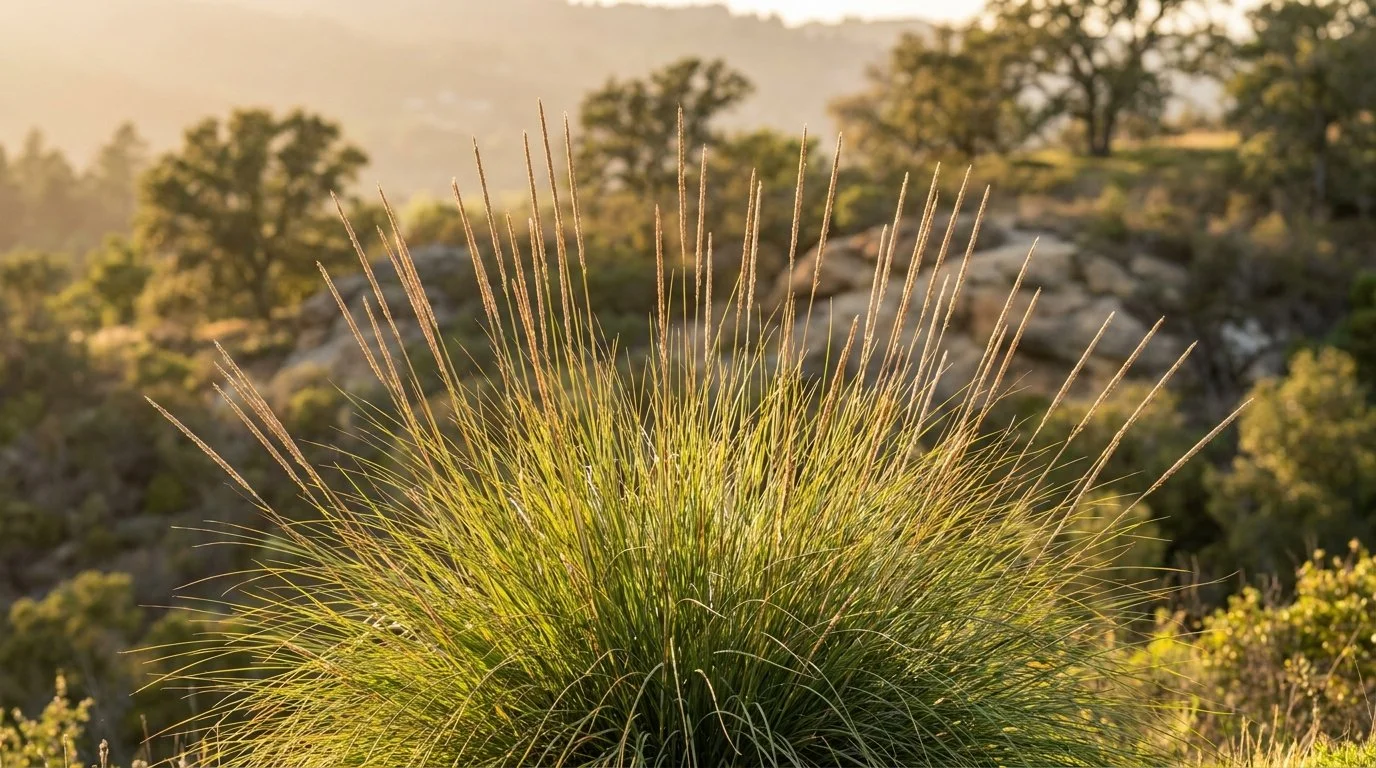
If you want the soft movement and graceful plumes of an ornamental grass without planting something that will take over your neighborhood, deergrass is the answer. Muhlenbergia rigens is a large, fountain-shaped native bunchgrass that sends slender tawny flower stalks three to four feet above its clump, catching the light and swaying in the smallest breeze. It is evergreen, deeply drought-tolerant, and remarkably tidy, and it asks for almost nothing once it settles in.
Deergrass is native to the Central Coast Ranges and the dry foothills of our region, more a creature of sunny inland slopes and open woodland than of the cool, damp coast. That makes it a natural fit for many Santa Cruz County gardens, especially the warmer, drier ones.
Just as importantly, deergrass is the well-behaved native answer to invasive pampas grass. It delivers the same bold, sculptural form and feathery plumes, but it does not reseed aggressively or escape into wild land. If you have ever admired a fountain of grass but worried about what it might spread into, this is the plant to reach for.
Why Should I Grow Deergrass in Santa Cruz County?
The first reason is its form. According to Calscape, the California Native Plant Society's plant guide, deergrass grows as a dense, rounded clump with a graceful fountain shape, sending up airy flowering spikes well above the foliage from summer into fall. The plumes start green and age to a warm straw or tawny gold, and backlit by morning or evening sun they practically glow. It is a plant that earns its place on looks alone.
The second reason is toughness. Deergrass is built for our long dry summers. Once established it needs very little water, tolerates lean and rocky soils, and shrugs off heat, making it one of the lowest-input plants you can put in a California garden.
The third reason is its manners. Where pampas grass and many ornamental fountain grasses self-sow into a weedy nuisance, deergrass stays put. Native specialists recommend it specifically as a tidy, non-invasive substitute that gives you the drama without the spread. The fourth reason is versatility. Whether you need a single bold accent, a soft mass to replace a thirsty lawn, or a deep root system to hold a slope, deergrass does the job.
Where Does Deergrass Grow Best?
Our county is really several gardens stacked together, and deergrass has clear preferences among them.
The inland valley and warmer sites suit it best. Gardens in the Pajaro Valley, the sunny benches and banana-belt pockets, and the warmer neighborhoods around Scotts Valley give deergrass the heat and long dry summer it evolved for, and as a foothill-slope plant it is right at home on sunnier, better-drained inland ground.
The San Lorenzo Valley and mountain sites work well wherever you have an open, sunny exposure. Deergrass is excellent on slopes, where its deep, fibrous roots help hold soil and slow erosion, so a bright hillside can be an ideal spot. The main thing to avoid is deep shade under a dense redwood canopy, where it grows thin and floppy.
The coastal fog belt is workable as long as you give deergrass full sun. It is naturally more an inland and foothill plant than a fog-belt one, so close to the ocean choose your brightest, most open site and avoid low, soggy corners. In a sunny coastal yard with decent drainage, it will still perform.
The rule of thumb across all our microclimates is simple. The more sun and drainage you can give deergrass, the better it looks and the less it asks of you.
How Do You Plant Deergrass?
Fall is the ideal planting time in California. Putting plants in the ground from October through early winter lets the roots establish during the rainy season so they are ready for their first dry summer. Spring planting works too, but you will need to water more attentively through that first summer.
Follow these steps for a strong start:
Pick full sun. Aim for at least six hours of direct sun. In too much shade deergrass grows loose, leans open, and flowers poorly.
Give it real room. This is the most common mistake. A mature plant reaches three to five feet tall and four to six feet wide, so space plants four to six feet apart and keep them off paths and out of small beds.
Do not over-amend. Skip heavy compost and fertilizer. Deergrass is adapted to lean soil, and rich ground only encourages soft, floppy growth.
Mind the drainage. It tolerates a range of soils, including some clay, but on heavy, wet ground plant on a slight mound and avoid spots where winter water pools.
Set the depth and water in. Plant so the crown sits at or just above the soil surface, soak the root ball, then water deeply but infrequently through the first dry season while the roots extend.
How Do You Care for Deergrass?
The good news is that an established deergrass barely needs you. It is one of those plant-it-and-forget-it natives that rewards a light touch.
For watering, give it a deep soak every couple of weeks through its first dry summer while it roots in. After that, deergrass is very low water. Established plants can get by on a deep soak once a month during the hottest stretch, and many gardens, especially inland, rely largely on winter rain. It looks a little greener with occasional summer water and more tawny without, and both are fine.
Skip the fertilizer. Like most California natives adapted to poor soils, deergrass does best on a lean diet, and feeding only encourages floppy, oversized growth.
The one yearly task worth doing is a late-winter cleanup. Many gardeners cut deergrass back hard, to several inches above the crown, in late winter or early spring before new growth starts, which removes the previous season's tired old growth and lets fresh blades come in clean. It is optional, and some gardeners simply comb out the dead material by hand instead. As a grass, deergrass resprouts readily from the base, so you never have to worry about cutting into dead wood the way you would with a shrub.
What Wildlife Does Deergrass Support?
It is worth being clear about how deergrass helps wildlife, because it works differently from a flowering nectar plant. Deergrass is wind-pollinated, which means it does not produce showy nectar flowers and is not a pollinator magnet in the way a sage or a buckwheat is. If you are after bees and hummingbirds at the bloom, that is not deergrass's job.
What deergrass offers instead is habitat. As a native bunchgrass it serves as a larval host plant, including for the green cutworm moth, and muhly grasses in general support skipper butterfly caterpillars, so it quietly feeds the next generation of native moths and butterflies. Its seeds feed sparrows, finches, and other small seed-eating birds in late summer and fall, and the dense, evergreen clump gives cover and nesting material for birds and shelter for beneficial insects.
In a habitat garden, deergrass plays the supporting role of structure and shelter while flowering natives like Cleveland sage and California buckwheat handle the nectar. Plant them together and you cover both jobs at once.
Common Problems with Deergrass
Deergrass is genuinely trouble-free, and it has no serious pests or diseases. The handful of issues that do come up are almost always about placement rather than the plant itself.
Not enough room. The most common regret is planting deergrass too close to a path, a doorway, or its neighbors. At four to six feet wide it needs space, and crowding it leads to constant cutting back that ruins its natural fountain shape. Plan for the mature size from the start.
Too much shade. In low light, deergrass grows loose and leggy, leans open in the middle, and produces few of the upright plumes that make it worth growing. The fix is simple: give it full sun.
Soggy soil. Deergrass tolerates more moisture than many dry-country natives, but it still does not want to sit in waterlogged ground all winter. On heavy clay in a low spot, plant on a slight mound to keep the crown from staying wet.
Deergrass is non-toxic and safe to plant around children and pets. Its main real limitation is simply its footprint. This is a large plant, and the most important thing you can do is give it the space it needs.
Where Can You Buy Deergrass in Santa Cruz County?
Deergrass is widely sold at California native plant nurseries, and locally grown plants tend to establish best. Check independent garden centers and native specialty growers around Santa Cruz, Watsonville, and the San Lorenzo Valley, and watch for the seasonal native plant sales hosted by the local chapter of the California Native Plant Society, usually in fall, which is also the best time to plant.
If you cannot find one locally, mail-order native and water-wise nurseries are a reliable backup. You can often find deergrass plants and other drought-tolerant native grasses shipped to your door. When you order, plan for the mature size and choose a spot with full sun and room to spread before your new plant arrives.
Frequently Asked Questions About Deergrass
Is deergrass a good substitute for pampas grass?
Yes, and it is one of the best reasons to grow it. Deergrass gives you the same bold fountain shape and feathery plumes as pampas grass, but it is a well-behaved California native that does not reseed aggressively or escape into wild land. If you love the look of an ornamental fountain grass but want something that will not become invasive, deergrass is the responsible choice.
How big does deergrass get?
Plan for a large plant. The clump itself grows roughly three to five feet tall and four to six feet wide, and the flowering plumes rise three to four feet above that in summer. Space plants four to six feet apart and keep them away from paths and small beds so you do not have to keep cutting them back.
Does deergrass attract pollinators?
Not in the usual sense. Deergrass is wind-pollinated, so it does not offer nectar and is not a bee or hummingbird magnet. It supports wildlife as a habitat plant instead: it hosts native moth and skipper caterpillars, its seeds feed small birds, and its dense clump provides cover and nesting material. Pair it with flowering natives like Cleveland sage for nectar in the same bed.
When should I cut back deergrass?
Late winter or early spring, before new growth begins. Many gardeners cut the whole clump back to several inches above the crown every year or two to remove old growth and let fresh blades come in clean. As a grass it resprouts readily from the base, so a hard cutback does not harm it. If you prefer, comb out the dead material by hand instead.
A Native Worth Growing
Deergrass is the rare plant that is both beautiful and nearly foolproof. Give it sun, room, and a dry summer, cut it back once a year, and it returns the favor with sculptural form, glowing tawny plumes, erosion-holding roots, and quiet habitat value, all on almost no water. In a county where water is precious and invasive grasses are a real problem, a tidy, well-behaved native like deergrass is an easy choice. Plant one this fall in your sunniest spot, give it the space it deserves, and let it anchor your water-wise garden for years.
