

Elderberry Growth Stages: Life Cycle and Harvest
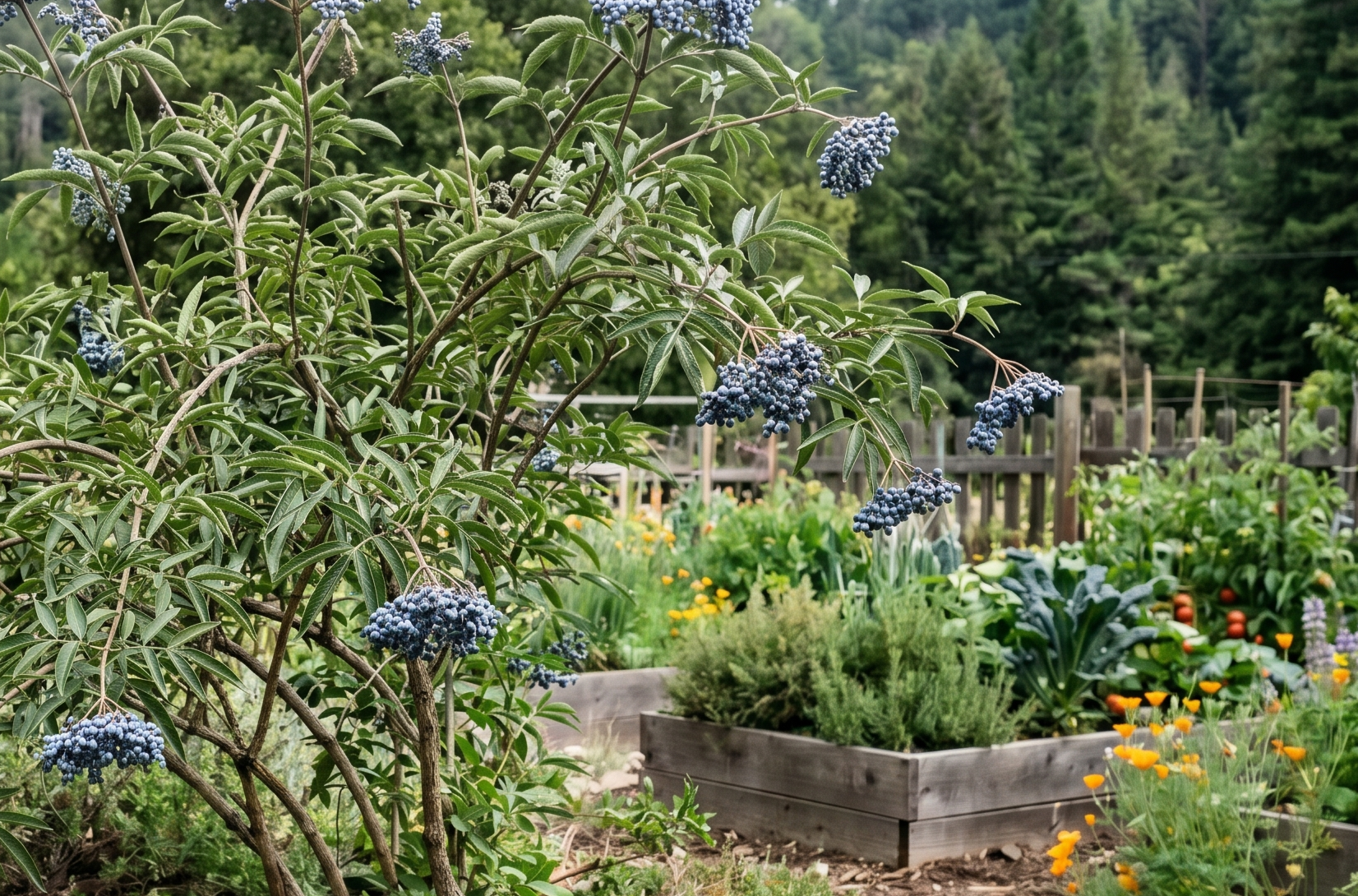
Elderberry plants move through a predictable elderberry life cycle each year: winter dormancy, leaf-out and rapid spring growth, flowering in flat or rounded clusters in late spring to early summer, green berry development, and ripening from midsummer into early fall. Layered on top of that annual rhythm is a multi-year maturity arc, where a young plant spends its first season building roots and reaches full production somewhere around years three to five. Once you understand both cycles, the elderberry growth stages start to feel intuitive, and your pruning and harvest decisions get a lot easier.
This guide walks through each stage in order, gives you a stage-by-stage timeline, and covers the care each phase needs. Before we get into it, one safety point matters more than any other with this plant, so we will return to it more than once: raw elderberries and the green parts of the plant are not safe to eat. We will explain exactly why, and how to enjoy the fruit safely.
Are Elderberries Safe to Eat? Read This First
Elderberries are a wonderful backyard crop, but they come with a real safety caveat that you need to understand before planting. The leaves, stems, bark, roots, and unripe (green) berries of elderberry contain cyanogenic glycosides, naturally occurring compounds that can release cyanide when eaten. These are the same class of compounds found in apple seeds and raw cassava. Eating raw berries, or any green part of the plant, can cause nausea, vomiting, abdominal cramps, and weakness, and there are documented cases of people being hospitalized after drinking juice pressed from raw berries, leaves, and stems.
Blue and black elderberries are edible only when cooked. Heat breaks down the problematic compounds, which is why traditional uses are always cooked or processed: syrups, jams, pie fillings, and cordials. You should never eat the berries raw, and you should always strain out the stems. The flowers are the one part many people use with minimal processing, but the fruit always gets cooked.
Here in California, the species most gardeners grow is our native blue elderberry (Sambucus nigra ssp. cerulea), a widely adapted shrub or small tree found across most of the state. Its ripe berries are bluish-black with a pale, dusty bloom, and they are edible once cooked. Do not confuse this plant with red elderberry (Sambucus racemosa), which grows in moister coastal and mountain areas and produces bright red fruit in a cone-shaped cluster. Red elderberry is considerably higher in those toxic compounds and is generally treated as not safe to eat. If your elderberry has red berries in an upright cone, leave it for the birds. The rest of this article is about growing blue or black elderberry for the table.
How Long Until an Elderberry Plant Produces Fruit?
Elderberries are fast growers, but a young plant still needs time to establish before it carries a real crop. Here is the timeline.
In the first year, the plant is focused on putting down roots and building its framework of canes. You may see a few flowers and even a handful of berries, but the smart move is to prioritize establishment over fruit. Many growers remove the flower heads in year one so the plant pours its energy into roots and structure instead of seed.
By the second year, you will get a meaningful harvest. Second-year canes that have developed lateral branches are the most fruitful wood on the plant, so this is when production really begins. From there, expect full production to arrive around years three to five, once the plant has built a mature crown of productive canes. So while you can taste your first cooked elderberry jam in year two, plan on year three and beyond for the harvests that make a row of elderberries worth the space.
What Happens to an Elderberry During Winter Dormancy?
Elderberry is deciduous, so it drops its leaves and goes dormant in winter. Above ground the plant looks like a cluster of bare canes, and almost nothing visible is happening. Below ground, the shallow root system is resting and holding the plant's reserves for the coming spring push.
Dormancy is not a dead period for you, though. This is the window for your main pruning and cleanup, because the plant is not actively growing and you can clearly see the cane structure. In California's mild zones, dormancy is shorter and less deep than it is in cold-winter regions, but the plant still slows down noticeably through the coldest, shortest days. Cold winter chill helps set the plant up for an even spring break, and our coastal and valley winters generally provide enough.
Dormant-season care: Remove dead, broken, or weak canes, and take out the oldest canes (those more than about three years old) to keep the plant vigorous. Elderberry fruits best on younger wood, so clearing out aging canes during dormancy is one of the highest-value things you can do all year.
What Does Spring Leaf-Out and Growth Look Like?
As soil warms and days lengthen, elderberry breaks dormancy and leafs out, and it does so with real speed. New shoots, called primocanes, push up from the base and from buds along existing canes. This is the most visually dramatic stage of the elderberry growth stages, because the plant can put on a surprising amount of length in a matter of weeks. Compound leaves with their characteristic serrated leaflets fill in fast, and the whole shrub goes from bare sticks to a full leafy mound.
This rapid spring growth is the plant building the framework that will flower and fruit. Because elderberry has a shallow, fibrous root system, this is also the stage where consistent moisture matters most. A plant short on water during this push will be smaller and carry less fruit.
Spring care: Keep the soil evenly moist as growth accelerates, especially for plants in their first year that are still establishing. A spring feeding once growth is underway supports the surge. Mulch helps hold moisture over those shallow roots and keeps weeds down.
When Do Elderberries Flower, and What Do the Clusters Look Like?
Flowering typically begins in late spring to early summer, often around May into June or July depending on your microclimate and the season. Elderberry flowers are tiny, creamy white, and carried in large, showy clusters. On blue and black elderberry these clusters are broad and flat-topped to slightly rounded, sometimes called cymes, and they can be several inches across. A plant in full bloom is covered in these clusters, and they are a magnet for bees and other pollinators.
An important detail for understanding fruit production: elderberry flowers form on current-season growth, especially at the tips of canes and on the lateral branches that second-year canes develop. That is why second-year wood is so productive, and why keeping a supply of vigorous younger canes coming along matters for steady harvests.
Flowering-stage care: Avoid heavy nitrogen feeding right at bloom, since you want the plant moving toward fruit rather than pushing only leaves. If you grow more than one elderberry, having a second plant nearby generally improves pollination and fruit set, so the clusters fill out more completely. The flowers themselves can be harvested for cordials and other uses, but if you want berries, leave the clusters on the plant.
How Do Elderberries Develop From Flower to Green Fruit?
Once the flowers are pollinated, the clusters transition from bloom to fruit. Petals drop, and tiny green berries begin to swell where the flowers were. At this stage the cluster is heavy with small, hard, green berries, and this is exactly the fruit you must not eat. Green, unripe elderberries are among the parts of the plant highest in those cyanogenic compounds, so this is a look-but-do-not-taste phase.
Berry development is when the weight of the crop starts to show. Full clusters of developing berries can pull canes downward, and a heavy-bearing plant may need some support so loaded canes do not break. This stage also draws in birds, who will happily start sampling well before you consider the fruit ready, so plan for some sharing or netting if you want the bulk of the crop.
Fruit-development care: Keep water steady through this stage, because uneven moisture stresses the shallow roots right when the plant is filling fruit. Continue to hold off on heavy feeding. If birds are heavy in your area, this is the moment to plan protection, since the window between green and gone can be short.
When Are Elderberries Ripe and Ready to Harvest?
Ripening generally runs from midsummer into early fall, with most plants ripening fruit somewhere in the July-through-September range. As berries ripen, the green clusters turn deep purple to bluish-black on blue and black elderberry, and the whole cluster tends to droop under the weight of ripe fruit. Ripe blue elderberries also carry that telltale pale, waxy bloom over a dark berry.
A cluster is ready when nearly all of its berries have colored up fully and the fruit is soft and juicy rather than hard. Because berries within a cluster ripen fairly close together, the usual method is to harvest whole clusters by snipping the stem, then strip the berries off the stems at home. Remember to discard those stems, since they are part of the plant you do not consume.
Harvest and post-harvest care: Pick promptly once clusters ripen, both to beat the birds and to catch the fruit at peak quality. Process or preserve soon after picking. And the rule that bears repeating: cook the berries before eating, and strain out every bit of stem. Cooked into syrup, jam, or pie filling, your harvest is both safe and delicious. Eaten raw, it can make you ill.
How Does an Elderberry Mature Year by Year?
Beyond the single-season cycle, an elderberry planting matures over several years, and knowing that arc helps you set fair expectations.
Year 1: Establishment. The plant builds roots and a starter framework of canes. Remove flowers to direct energy into the plant rather than fruit. Water faithfully, since first-year plants are the most vulnerable to drying out.
Year 2: First real harvest. Canes from the previous season develop lateral branches and become the most productive wood on the plant. You get a genuine crop, though not yet a full one.
Years 3 to 5: Full production. The plant reaches a mature, productive size with a balanced mix of younger fruiting canes. This is the payoff window the earlier years were building toward.
Mature years and beyond: A well-managed elderberry keeps producing for many years as long as you renew it. The key is ongoing pruning: each dormant season you remove the oldest, least productive canes so the plant keeps cycling in fresh, vigorous wood. Left unpruned, an elderberry gets crowded and woody, and production wanes on aging canes. A common renewal approach with elderberry is to cut older stems back hard, and some growers periodically cut the whole plant to the ground during dormancy to force a flush of new productive canes.
What Is the Stage-by-Stage Elderberry Timeline?
Here is the full elderberry life cycle laid out in order, blending the annual cycle with the multi-year arc.
Winter (dormancy): Bare canes, no active growth. Your main pruning window. Remove dead, weak, and oldest canes.
Early to mid spring (leaf-out and growth): Rapid shoot growth and leaf-out. Keep moisture steady; feed as growth starts; mulch.
Late spring to early summer (flowering): Large creamy clusters of flowers open on current-season growth. Pollinators arrive; a second plant aids fruit set.
Early to midsummer (berry development): Pollinated flowers set hard green berries. Do not eat green fruit. Support heavy canes; keep water steady.
Midsummer to early fall (ripening and harvest): Clusters turn deep purple-black and droop. Harvest whole clusters, strip and discard stems, then cook before eating.
Fall to winter (senescence and return to dormancy): Leaves drop, the plant winds down, and the cycle resets for next year's pruning and growth.
Across years, layer in the maturity arc: establishment in year one, first real crop in year two, and full production from years three to five onward, sustained by annual renewal pruning.
Why Isn't My Elderberry Growing or Fruiting as Expected?
If your elderberry is underperforming, the cause is usually one of a few common issues, and most are fixable.
It is simply too young. The most frequent reason for a light or absent crop is impatience. A first-year plant is supposed to put on growth without much fruit, and even a second-year plant is not at full production yet. Give it through year three before judging its yield.
Not enough water. Elderberry's shallow roots dry out fast, and a thirsty plant grows poorly and sets little fruit. In California's dry summers this is the single most common cause of weak performance. Consistent moisture through spring growth and fruit development makes a real difference.
Too much shade. Elderberry flowers and fruits best in full sun. A plant tucked into shade will grow but bloom sparsely, which means few berries. More sun usually means more fruit.
No pruning, or wrong pruning. Because fruit comes on younger wood, a plant full of old, crowded canes will fade in production. Skipping the dormant-season removal of the oldest canes is a slow path to a tired, low-yielding shrub. On the flip side, pruning at the wrong time can remove the wood that would have flowered.
Poor pollination. If clusters bloom but set few berries, weak pollination may be the issue. Planting a second elderberry nearby generally improves fruit set, and protecting pollinators by avoiding sprays during bloom helps too.
Keep growing: see Blueberry growth stages and Fig growth stages.
Frequently Asked Questions
Can you eat elderberries straight off the bush?
No. Raw elderberries contain cyanogenic glycosides that can cause nausea, vomiting, and cramping, and raw juice has sent people to the hospital. Blue and black elderberries are safe only after cooking, which breaks down those compounds. Always cook the berries and strain out the stems before eating them in syrups, jams, or pies. Never eat the leaves, stems, bark, roots, or green unripe berries.
How do I tell California's edible blue elderberry from toxic red elderberry?
Look at the ripe fruit and the cluster shape. Edible blue elderberry (Sambucus nigra ssp. cerulea) carries bluish-black berries with a pale waxy bloom in broad, flat-topped clusters, and it grows across most of California. Red elderberry (Sambucus racemosa) produces bright red berries in an upright, cone-shaped cluster and favors moister coastal and mountain spots. Red elderberry is much higher in toxic compounds and is treated as not safe to eat, so if the berries are red and clustered in a cone, do not harvest them.
How many years until an elderberry bush is fully productive?
Plan on full production arriving around years three to five. The plant spends its first year establishing roots, gives a meaningful first harvest in year two on second-year canes, and reaches its mature, full-yield stride by years three to five. After that, annual dormant-season pruning to remove the oldest canes keeps production strong for many years.
When should I prune my elderberry?
Prune during winter dormancy, when the plant has dropped its leaves and you can see the cane structure clearly. Remove dead, broken, and weak canes, and take out the oldest canes (those more than about three years old) so the plant keeps cycling in younger, more productive wood. Because elderberry fruits on younger wood, this renewal pruning is the key to steady harvests year after year.
